
Interview Day Missteps That Competitive Program Directors Never Forgive
It’s 7:45 a.m. on interview day. You’re sitting in a plastic chair outside the conference room at a big-name program—think MGH Anesthesia, UCSF Dermatology, or HSS Ortho. Your suit is fine. Your scores are competitive. You’ve done the “Tell me about yourself” practice.
By 11:30 a.m., your file will be in one of two piles:
- “Rank this person.”
- “Absolutely not.”
And here’s the part too many applicants refuse to believe: it’s usually not about your Step score. It’s about the avoidable nonsense you do (or don’t do) on interview day that instantly tells competitive program directors you’re a risk.
I’m going to walk through the mistakes smart people keep making—the ones PDs talk about at lunch and never completely forget. If you’re aiming at derm, ortho, ENT, plastics, neurosurgery, integrated IR, urology, rad onc, EM at a top place—whatever your poison—do not make these errors.
1. Acting Like Your Scores Already Got You In
Competitive applicants with strong numbers commit this one constantly: they think the interview is a formality. Program directors can smell it in the first five minutes.
The “I’m a commodity” vibe
You know the type:
- Talks like they’re shopping for a program, not interviewing for a job.
- Subtle flexes: “At the other top program I interviewed at…” every third sentence.
- Asks questions that sound more like evaluation checklists than genuine curiosity.
PD translation: “This person thinks they’re doing us a favor by being here. Hard pass.”
If you’re applying to:
- Dermatology with a 260+
- Ortho with a big-name away rotation
- Neurosurgery with serious research
You absolutely cannot coast on paper stats. The higher your numbers, the less forgiving they are of arrogance or entitlement.
Don’t do this:
- “I’m mainly interested in high-volume centers and strong fellowships, so how do you compare to [prestigious program]?”
- “I have a lot of other interviews, so I’m trying to get a sense quickly of how competitive your graduates are.”
Do instead:
- Ask grounded, resident-focused questions: workflow, teaching culture, case ownership, mentorship.
- Show that you understand you’d be lucky to be here, even if you’re also competitive elsewhere.
Program directors want confidence. Not someone who walks in like they’re already halfway out the door.
](https://cdn.residencyadvisor.com/images/articles_svg/chart-top-reasons-applicants-drop-on-rank-lists-after-in-1076.svg "Top Reasons Applicants Drop on Rank Lists After Interview")
| Category | Value |
|---|---|
| Arrogance | 35 |
| Poor fit | 25 |
| Unprofessional | 20 |
| Lack of interest | 15 |
| [Bad references](https://residencyadvisor.com/resources/most-competitive-specialties/letters-of-recommendation-mistakes-that-hurt-you-in-competitive-residencies) | 5 |
2. Disrespecting Anyone in the Building (Especially Staff and Residents)
If you remember nothing else, remember this: people talk. The coordinator, the residents, the person at the front desk, the med student at the pre-interview dinner—they all report back, formally or informally.
The silent program killer: how you treat “non-important” people
I’ve seen this more than once:
- Applicant is charming with the PD.
- Applicant is dismissive with the coordinator (“Can you hurry this up? I have a flight.”).
- Applicant barely acknowledges residents or only engages when an attending sits down.
Guess whose opinion the PD actually trusts? The coordinator who’s worked there for 15 years and the chiefs who have to work with you at 3 a.m.
PD red-flag phrases you never hear but should assume:
- “The applicant was…polite with faculty, but kind of cold with the staff.”
- “Felt like they were interviewing us more than anything.”
- “They were glued to their phone when residents were talking to them.”
If someone in that building says “I get a bad vibe from this person,” you’re probably done. Top programs care a lot about culture because they can fill every spot. They don’t need your Step score if you’re going to be poison on the team.
Avoid these subtle disrespect moves:
- Checking your phone while a resident or staff member is talking.
- Only turning on the charm for people with “MD” or “Program Director” in their title.
- Treating the pre-interview dinner like optional social fluff instead of part of the evaluation.
You cannot fake being a decent human for just the “important” conversations. That act always cracks.

3. Being a Black Box About Your Application Red Flags
Competitive specialties are paranoid for a reason: one problem resident can destroy a lot—patient safety, morale, schedules, even accreditation if things get ugly.
So when something doesn’t add up in your file, and you pretend it does? That’s unforgivable.
Classic red flag mishandling
You’ve got:
- A leave of absence
- A failed Step or significant score drop
- A professionalism incident
- A sudden specialty switch with no real explanation
And when they ask, “Tell me about…” you either:
- Get defensive.
- Give a vague, 30,000-foot answer with no specifics.
- Minimize it to the point of dishonesty.
They don’t need perfection. They need honesty and insight. If they feel you’re hiding, they stop trusting you. Once trust is gone, you’re off the list.
Bad response example:
- “It was just a misunderstanding and it all got resolved.” (No details, no reflection.)
- “I had some personal issues but they’re not really relevant now.” (Translation: absolutely still relevant.)
Better approach:
- Briefly describe what happened.
- Own your role in it, even if others were involved.
- Explain concrete steps you’ve taken since.
- Connect it to how you function better now.
If your story is, “Nothing to see here,” when there clearly is something, they assume this: “When things go wrong as a resident, this person will hide, deflect, and lie.” That is not fixable with a 270.
4. Talking Like the Specialty Is a Status Symbol, Not a Job
You’re interviewing for:
- Dermatology because you “like lifestyle.”
- Ortho because you “like working with your hands.”
- Plastics because you “like doing cool cases.”
- Neurosurgery because you “want something challenging.”
Every PD on earth has heard those lines. None of them sound good if that’s all you’ve got.
The “brand chaser” mistake
Common signals that you like the idea of the field more than the work:
- You only talk about prestige, research, or fellowship placement.
- You light up discussing program reputation but get vague when asked about patient care.
- Your explanations of “Why this specialty?” are generic and could have been lifted from Reddit.
For competitive specialties especially, PDs are sick of status tourists. You know the type: decided on derm as an MS1 because it was “the best,” and then backfilled the story.
If they suspect you’re chasing:
- Money
- Lifestyle
- Brand name
- Or escaping a different specialty you actually didn’t like
They’re not going to rank you high. Because you’re a flight risk. A burnout risk. A “I hate this but now I’m stuck” risk.
Avoid these landmines:
- Over-emphasis on lifestyle in derm, rad onc, anesthesia.
- Over-emphasis on prestige and complex cases in neurosurgery, ortho, plastics.
- Zero mention of bread-and-butter, mundane, and unglamorous parts of the job.
You don’t need a perfect story. You need one that clearly shows you know what the day-to-day reality actually looks like—and still want it.
| Topic | Red-Flag Statement |
|---|---|
| Motivation | "I really want a good lifestyle specialty." |
| Program Comparison | "How do you rank compared to top 5 programs?" |
| Research | "I just did research because I had to for derm." |
| Future Plans | "I only want big-name fellowships or I won't do it." |
| Team Culture | "I mostly like to do my own thing and be efficient." |
5. Fumbling Basic Professionalism (You’d Think This Is Obvious…)
You’d think that in 2026, people applying to ultra-competitive specialties would at least nail the basics. Nope. Every cycle, PDs see the same clown-show repeats.
Time, appearance, and attitude errors
You don’t recover from these easily:
- Showing up late without a legitimate, clearly explained reason.
- Looking disheveled, wrinkled, or sloppy.
- Joining a virtual interview from a chaotic or inappropriate environment.
- Eating, slurping, or checking your phone on camera.
I’ve literally watched an applicant log into a derm interview from a car with poor reception, wearing AirPods and a hoodie, then send a “so grateful for the opportunity” thank-you afterward. That person isn’t going to derm. Not anywhere serious.
For in-person interviews:
- You show up early. Period.
- You look like you care. Suit, clean shoes, nothing distracting.
- You don’t complain about parking, traffic, or the schedule.
For virtual interviews:
- Neutral background. Good lighting. Stable internet.
- Proper attire top to bottom. Yes, you will eventually stand up at some point. And yes, they will see.
- No multitasking. They can tell.
If they start the interview thinking, “This person doesn’t understand this is a job interview,” that impression never fully fades.
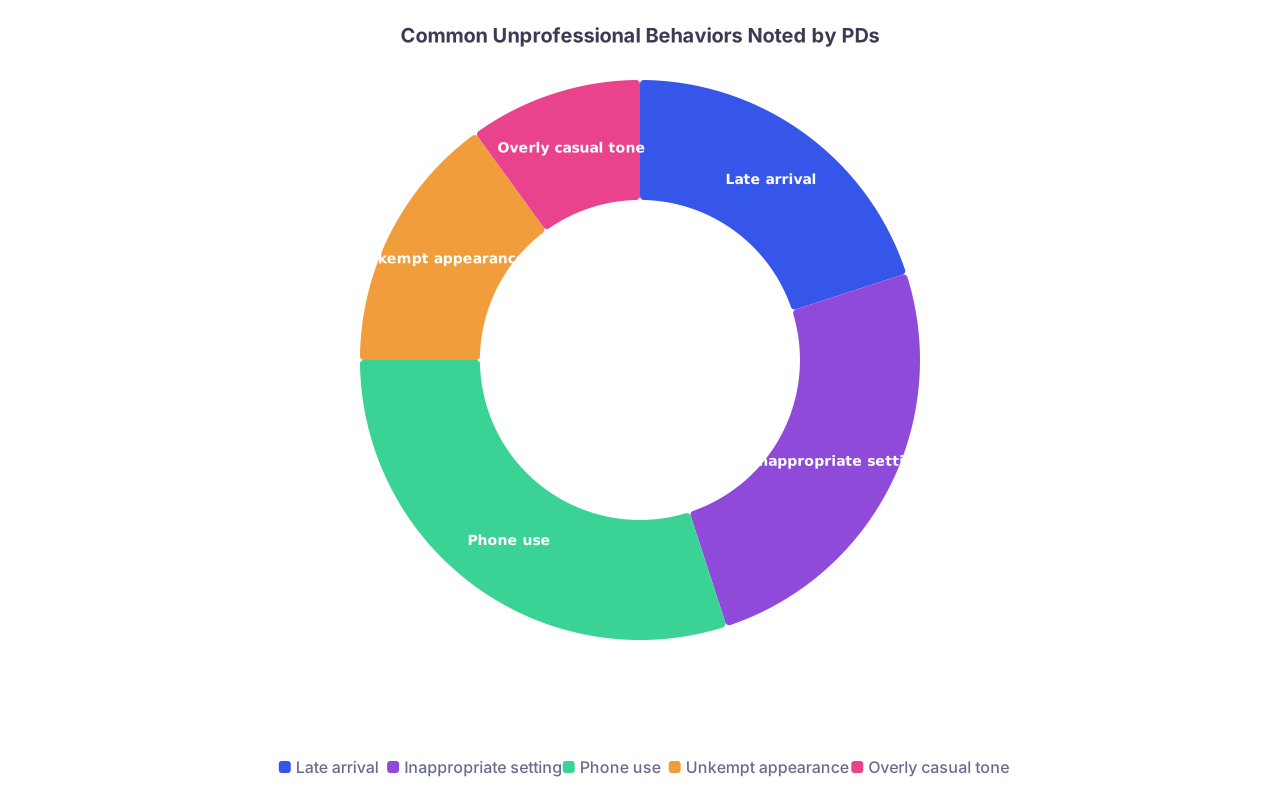
| Category | Value |
|---|---|
| Late arrival | 20 |
| Inappropriate setting | 25 |
| Phone use | 30 |
| Unkempt appearance | 15 |
| Overly casual tone | 10 |
6. Being Weirdly Vague or Dishonest About Your Rank Intentions
Program directors know you’re interviewing at multiple places. They also know people lie. What they don’t forgive is clearly manipulative, inconsistent, or sloppy messaging.
The “you’re my top choice” disaster
Mistakes that burn bridges fast:
- Telling multiple programs they’re your “#1” in writing.
- Being overly effusive in-person (“I will rank you number one”) and then sending generic, copy-paste emails afterward.
- Having residents or faculty at their institution hear you say very different things to different people.
PDs talk. Residents talk even more. Especially in competitive, small fields like neurosurgery or ENT where everybody knows everybody.
If they catch even a whiff that you’re playing games, they mark you down as untrustworthy. Not just “meh.” Actively negative.
Better approach:
- If you genuinely have a #1, and you’re permitted to say so ethically, say it once, clearly, and mean it.
- If you don’t, you can still express strong interest without lying: “I’d be very excited to train here. This program is one of my top choices.”
- Don’t over-promise. Don’t send fluffy prose that says nothing specific about their program.
You’re not required to share your rank list. But you are required not to be a manipulative idiot about it.

| Step | Description |
|---|---|
| Step 1 | Start Interview Day |
| Step 2 | Immediate Red Flag |
| Step 3 | Middle or Low Rank |
| Step 4 | High Rank |
| Step 5 | Professional? |
| Step 6 | Respectful to staff and residents? |
| Step 7 | Honest about red flags? |
| Step 8 | Good fit for specialty? |
| Step 9 | Genuine interest in program? |
7. Overcompensating With Over-Rehearsed, Robotic Answers
Interview prep is necessary. Sounding like ChatGPT on benzos is not.
Program directors in competitive specialties deal with highly polished applicants all day. When you give the same buzzword salad about “lifelong learning, teamwork, and passion for research” that twelve people before you gave, you disappear.
The “perfect but fake” persona
Things that make you look untrustworthy even if you’re not:
- Every answer sounds memorized.
- No pauses. No thinking. Just smooth, pre-packaged lines.
- You dodge anything remotely vulnerable or personal.
In high-stress, high-acuity fields (EM, anesthesia, neurosurgery, ortho), they need to know how you think under uncertainty. If you can’t even handle a slightly unexpected interview question without reaching for your internal script, they worry.
Red-flag behaviors:
- Never saying “I’m not sure, but here’s how I’d think about it…”
- Turning every question into a chance to flex your CV.
- Giving long, perfect-sounding monologues that don’t actually answer the question.
You’re allowed to be human. In fact, they prefer it.
Better: short, honest, specific answers that show actual thought. They don’t want your personal brand. They want to know whether they can trust you with patients at 3 a.m.
8. Mishandling the Social Events (Pre-Interview Dinners, Resident Zooms)
A lot of applicants still don’t get this: the “casual” dinner or Zoom with residents is not casual. It is part of the interview. It absolutely influences rank lists.
Two ways to blow it fast
Treating it like free food / free time
- Showing up late or leaving early without explanation.
- Sitting quietly in a corner, barely engaging.
- Spending the whole time on your phone or whispering with one other applicant.
Forgetting you’re being evaluated
- Drinking too much.
- Complaining about other programs, your med school, the Match, Step exams.
- Oversharing personal drama or controversial opinions.
I’ve watched residents go back to the PD and say: “That person was great with faculty but super awkward / arrogant / negative with us.” Guess what matters more? The resident report.
You don’t have to be the life of the party. You do have to show you can hold a normal conversation, ask decent questions, and not be a social liability.

9. Revealing You’re a Bad Teammate Without Realizing It
Competitive programs are drowning in applicants with 250+ and publications. What they actually fear is matching someone who:
- Won’t help colleagues.
- Blames others.
- Melts down when feedback is given.
- Thinks they’re above scut or routine tasks.
Applicants expose themselves constantly—without noticing.
Subtle tells that you’re a problem in the making
Listen to how you talk about:
- Other students: “I basically carried the team on that rotation.”
- Residents: “The residents didn’t really teach that much, so I kind of had to do things myself.”
- Nurses and staff: “They were sort of in the way when we were trying to get things done.”
- Feedback: “That attending was just really harsh and unfair.”
To a PD, this all screams:
- Blame-shifter.
- Poor insight.
- Not coachable.
They want to hear stories where you:
- Owned your mistakes.
- Helped someone else look good.
- Took criticism and actually changed something.
If every story has you as the hero and someone else as the problem, you’ve told them exactly why they shouldn’t rank you.
10. Thank-You Notes: Not Required, But Very Good at Exposing You
No, a thank-you email won’t magically overcome a bad interview. But a bad thank-you email can confirm doubts.
Mistakes that hurt more than they help
- Sending obviously copy-pasted, generic emails (“I really enjoyed learning about your insert specialty program” to four different places).
- Misspelling the program name, institution, or interviewer’s name.
- Mixing up details (“I loved hearing about your strong global health opportunities” at a program that does zero global work).
- Overly aggressive language about rank intentions.
For competitive specialties, PDs assume: if you’re sloppy on a small thing with no time pressure, you’ll be sloppy with orders, notes, and follow-through when it matters.
If you send thank-you notes:
- Keep them short, specific, and accurate.
- Mention 1–2 specific things you discussed.
- Do not overpromise about ranking.
Think of it this way: thank-you notes won’t move you from “no” to “yes.” But they can move you from “maybe” to “definitely no” if you screw them up.
FAQ (3 Questions)
1. Do I have to be “perfect” on interview day to match a competitive specialty?
No. You have to avoid fatal mistakes. People match with awkwardness, nerves, and imperfect answers all the time. What they don’t match with is arrogance, dishonesty, disrespect, or obvious poor fit. Focus on not setting off alarm bells rather than delivering a flawless performance.
2. How do I know if I came off as arrogant or entitled?
Ask someone brutally honest who’s not invested in your ego—an attending who likes you but doesn’t depend on you, or a resident who will tell the truth. Practice answers out loud. If you hear a lot of “me, me, me” and almost nothing about patients, teams, or learning, you’re probably leaning arrogant whether you mean to or not.
3. If I realize I made a mistake during interview day, should I address it afterward?
If it’s minor (slightly awkward answer, nerves), let it go. If it’s significant—like you mishandled a question about a red flag or misspoke about something important—you can briefly clarify in a follow-up email to the PD or interviewer. One sentence of correction, one sentence of insight. Then stop. Over-explaining usually makes you look worse.
Key things to remember:
- Competitive program directors forgive nerves. They do not forgive arrogance, dishonesty, or being a bad teammate.
- Every interaction—from the coordinator to the pre-interview dinner—is part of your evaluation, not background noise.
- Your goal is simple: show them you’re safe, coachable, and sane to work with at 3 a.m. Do that, and your scores and CV can actually work for you instead of being wasted.