
You are here
It is June 28th.
You are holding a 245 Step 2 score, decent research, and a burning desire to match ortho / derm / ENT / plastics / neurosurgery / urology / ophtho. ERAS opens in a few days. SF Match and AUA dates are a blur in your inbox. Your classmates keep saying, “I think applications are sometime in September?”
That vague hand-wavy attitude is how strong applicants quietly sabotage competitive specialty dreams.
Let me walk you month-by-month through what actually needs to happen and when—for ERAS specialties (ortho, ENT, neurosurg, plastics, IR, rad onc, derm at some places), SF Match (ophtho, some plastics), NRMP/AUA (urology), and early-signaling madness.
Big-Picture Calendar: Competitive Specialties At-a-Glance
| Specialty Group | Main Platform | Apps Submitted Around | Match Day (Approx.) |
|---|---|---|---|
| Ophthalmology | SF Match | Early Sept–Oct | Early Feb |
| Urology | AUA + NRMP | Early Oct | Mid Jan |
| Derm / Ortho / ENT / etc. | ERAS + NRMP | Mid–Late Sept | Mid Mar |
| Plastics (independent) | SF Match | Early fall | Early spring |
| Neurosurgery | ERAS + NRMP | Mid–Late Sept | Mid Mar |
January–March: Foundation and Positioning
You are an M3 in the winter, eyeing a competitive field. At this point you should focus on positioning, not panicking.
January
At this point you should:
- Lock in your target specialty (or narrow to 1–2).
- Map out required away rotations and their windows.
- Decide when you will take/completed Step 2 CK.
Key moves:
Reality-check your metrics
- Look at recent matched data for your specialty:
- Derm: heavy research, strong home letter, often AOA.
- Ortho / ENT / Neurosurg: high Step 2, strong letters from name faculty.
- Compare your CV honestly. You do not need to be perfect, but you cannot be delusional.
- Look at recent matched data for your specialty:
Create your rotation plan
- Identify:
- Home specialty rotation dates.
- Away rotation months (usually June–Oct of M4).
- Talk to:
- Your dean’s office about VSLO timelines.
- Specialty residents about which months “matter most” for letters. (Usually June–August.)
- Identify:
Start relationship-building
- Join:
- Specialty interest group.
- Ask:
- “Which faculty actually write strong letters for applicants?” Not all attendings are equal here.
- Join:
February
At this point you should:
- Start VSLO (Visiting Student Learning Opportunities) prep.
- Lock down your research presentation goals.
Tasks:
- Update your CV to a clean, ERAS-ready format.
- Collect documents needed for away applications:
- Immunizations, background check, BLS, transcripts.
- Talk with your specialty advisor and get:
- A target number of away rotations (often 2–3 for ortho, ENT, etc.).
- A tentative geographic strategy.
March
At this point you should:
- Submit early VSLO apps as soon as they open for your target programs.
- Choose your Step 2 CK test date (if not already done).
Key items:
- VSLO:
- Many competitive programs fill June–August rotation slots by early spring.
- Late applicants get stuck with October aways—still helpful, but not prime letter material.
- Step 2:
- If Step 1 was weak, you want Step 2 taken and strong by June/July for program review.
- If Step 1 was solid, you still should aim to have Step 2 in by September at the latest.
April–May: Aways, Letters, and Pre-ERAS Setup
April
At this point you should:
- Finalize away rotation schedules.
- Identify letter writers by name.
Work list:
- Confirm:
- Which month you will do home specialty rotation. That LOR is usually gold.
- Which away rotations are confirmed and which are pending.
- Research programs:
- Build a spreadsheet of:
- Program name
- Location
- Residents per year
- Board requirements
- “Personality” notes from residents you talk to
- Build a spreadsheet of:
This spreadsheet becomes your ERAS and interview bible.
May
At this point you should:
- Prep for your first away/home rotation like it is an extended interview.
- Outline your personal statement.
Specific moves:
Rotation prep
- Review:
- Common consults, bread-and-butter cases, basic anatomy for your field.
- Goal:
- Show up competent on day 1. Residents notice quickly who did basic homework.
- Review:
Personal statement groundwork
- Do not write the full thing yet. Do this:
- Bullet core themes (3–4 stories max).
- Identify one central thread: a patient, a research problem, a defining experience.
- You want these in your head before busy rotations start.
- Do not write the full thing yet. Do this:
Check specialty-specific deadlines
- Ophthalmology:
- SF Match registration typically opens in late spring / early summer.
- Urology:
- AUA/ERAS details updated around this time.
- Put those dates in a calendar today.
- Ophthalmology:
June–July: Core Rotations and Letter Production
This is when everything starts to count in a visible way.
June
At this point you should:
- Start your home rotation or first away.
- Think “audition month,” not “just another clerkship.”
Daily/weekly priorities:
- Be present, early, and prepared. Always know your patients cold.
- Identify potential letter writers within the first week:
- The attending you round with daily.
- The program director who supervises your clinic.
- Mid-rotation, schedule a brief feedback meeting:
- Ask explicitly: “Do you feel you could write a strong letter for my residency application?”
If they hesitate, do not use them. I have watched applicants tank their cycle with lukewarm letters.
July
At this point you should:
- Lock down at least 1–2 strong letters from your home program.
- Stay on top of early-match requirements (ophtho, urology).
Action steps:
- Letters:
- Give letter writers:
- Your CV
- Draft personal statement (even if rough)
- List of programs if they ask
- Set a target deadline: early September for all letters.
- Give letter writers:
- Exams / scores:
- If Step 2 CK taken in June, confirm score release date.
- If your score is suboptimal, discuss with an advisor whether to adjust specialty or application strategy.
Early matches:
- Ophthalmology (SF Match):
- By late July, you should:
- Be fully registered on SF Match.
- Know your letter requirements.
- Have your program list at least 70% built.
- By late July, you should:
- Urology:
- Keep an eye on AUA announcements.
- ERAS still handles documents, but timelines differ from main NRMP.
August: Application Build and Final Aways
Now the window is tight. Every week matters.
Early August (Weeks 1–2)
At this point you should:
- Have:
- Final personal statement draft close to done.
- Updated CV in ERAS format.
- Be:
- On or just finishing an away rotation that will yield a strong letter.
To-do list:
- Personal statement:
- Finish a disciplined, 1-page statement.
- Get it reviewed by:
- Specialty mentor
- One person who writes well but is outside your field (for clarity).
- Program list:
- Build tiered list:
- “Reach” programs
- “Realistic” core group
- “Safety” but still reasonable options
- Build tiered list:
- Aways:
- Ask directly for letters in the final week:
- “I have really enjoyed working with you. Would you feel comfortable writing a strong letter of recommendation for my [specialty] residency application?”
- Ask directly for letters in the final week:
Late August (Weeks 3–4)
At this point you should:
- Enter everything into ERAS / SF Match portals.
- Triple-check your documents and photo.
Concrete steps:
- Upload:
- Professional photo (clinic attire, neutral background).
- Finalized personal statement.
- Activities with specific impact (not fluffy “I learned to work in teams” nonsense).
- Confirm:
- USMLE/COMLEX scores ordered for release.
- Letters assigned correctly by specialty and program.
This is also when you need to face signaling.
Signaling, Tokens, and Priority Systems
Many competitive specialties now use preference signaling. How you handle this can make or break exposure at top programs.
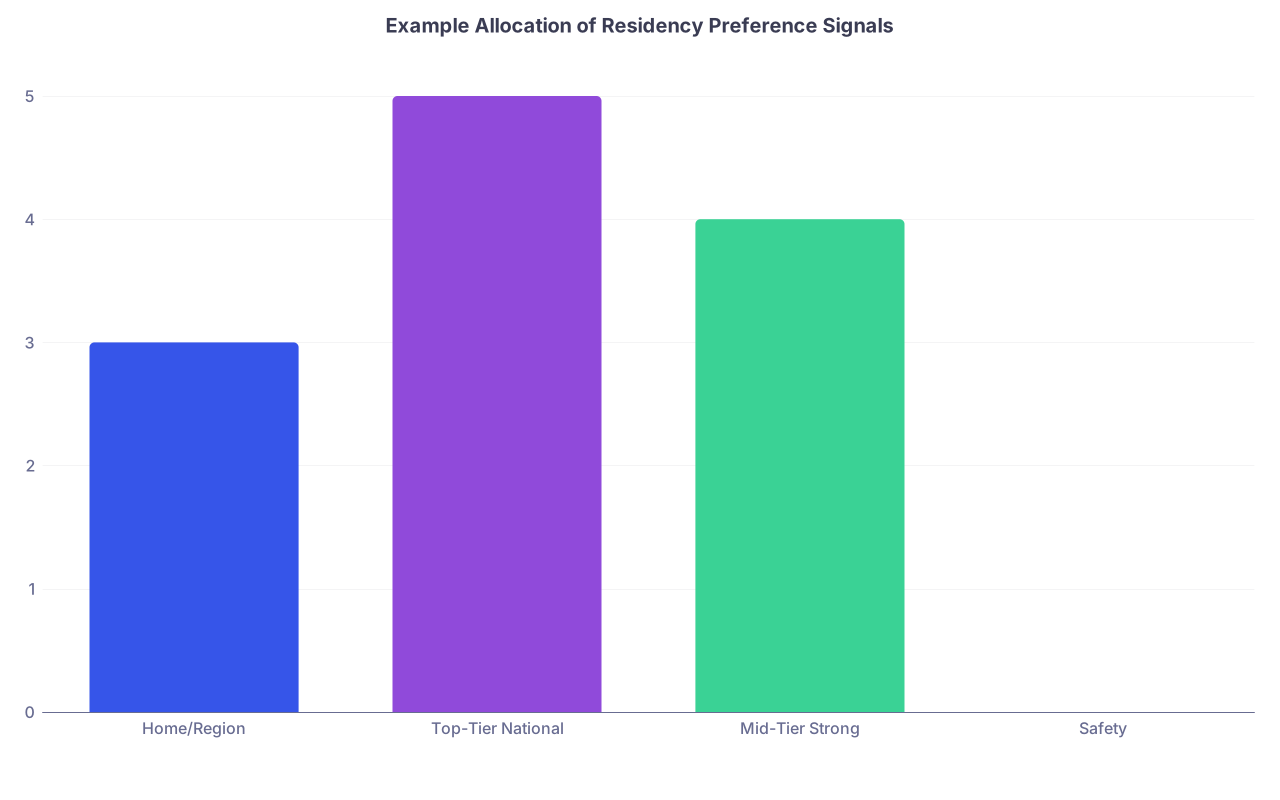
| Category | Value |
|---|---|
| Home/Region | 3 |
| Top-Tier National | 5 |
| Mid-Tier Strong | 4 |
| Safety | 0 |
Principles:
- Signals are not for “safety” places.
- You use them where:
- You are competitive and
- You genuinely want to go and
- They are flooded with applicants.
At this point (late August / early September), you should:
- Read your specialty’s current-year signaling guidelines.
- Allocate signals before you lock program lists.
- Coordinate with your advisor; they often know which programs weight signals heavily.
September: Submission Month (Core ERAS + Early Ophtho)
This is where many people hesitate and lose ground.
Early September (Weeks 1–2)
At this point you should:
- Be ready to hit “submit” as soon as the application opens for submissions.
- Especially for:
- Ophthalmology (SF Match often early September deadline).
- Highly competitive ERAS specialties.
Tasks:
- Final review:
- Check every activity entry for:
- Quantified impact
- Clear role
- Verify:
- No typos in personal statement.
- All letters correctly assigned.
- Check every activity entry for:
- SF Match (ophtho):
- By this point, most ophthalmology applications should be submitted or within days of submission.
Mid–Late September (Weeks 3–4)
For ERAS-based competitive specialties, at this point you should:
- Submit by the first ERAS transmission date or very close to it.
- Programs often download a wave of applications on day 1 and start screening immediately.
- Avoid:
- Waiting “to add one more abstract” or “perfecting one more sentence.” That delay costs you more than it helps.
After submission:
- Shift your focus to:
- Interview prep.
- Staying clinically solid on rotations.
- Updating programs only for major changes (new first-author paper, award).
October: Urology, Interview Wave 1, and Communication Discipline
Early October
At this point you should:
- Have:
- Urology applications submitted (if applicable—AUA deadlines tend to cluster here).
- All competitive ERAS specialty apps in.
You should not be:
- Rewriting your personal statement from scratch.
- Adding programs in a panic daily. Targeted additions are fine; flailing is not.
Mid–Late October
This is when interview invites begin.
At this point you should:
- Monitor your email and ERAS messages multiple times per day.
- Have a clear ranking system:
- Top-priority invites: Accept immediately.
- Mid-tier: Weigh against geography, cost, and number of spots.
- Low-priority: You may need them later, but do not overbook early.
I have watched students lose dream interviews because they waited 6 hours to respond. The spot was gone. Do not assume invites will sit.
November–December: Interview Blocks and Strategic Updates
November
At this point you should:
- Be in peak interview season for ophtho, urology, and many early ERAS programs.
- Protect your bandwidth.
Weekly routine:
- Before each week starts:
- Confirm travel or virtual links.
- Review program notes from your spreadsheet.
- After each interview:
- Jot:
- 3–5 specific details about that program.
- People you met.
- This will save you from sending generic, cringe follow-up messages.
- Jot:
Communication:
- You may send short, sincere thank-you emails if your specialty still values them. Keep them specific: 3–4 sentences max.
- Avoid:
- Embellishing or implying a rank order you have not decided yet.
December
At this point you should:
- Continue interviews, especially for ERAS specialties.
- Begin mentally sketching your rank list.
You may also:
- Send one meaningful “continued interest” note to your top 1–3 programs if your specialty culture allows it.
- Content:
- One or two reasons their program fits you.
- Brief update if there is a significant new item (accepted manuscript, major award).
- Content:
No mass emails. No “you are my top choice” to five places. Faculty talk.
January–February: Rank Lists and Early Matches
January
At this point you should:
- Complete interviews for most competitive specialties.
- Prepare rank lists for early matches.
Key dates:
- Urology Match:
- Usually in January. Rank list deadlines precede this by 1–2 weeks.
- Some SF Match results (ophtho):
- Usually early February, but check the current cycle.
Your job:
- Build your rank list based on:
- Fit and training quality.
- Resident happiness.
- Personal life factors that actually matter to you long-term.
- Do not:
- Rank based on prestige alone while ignoring 6-year misery red flags.
February
At this point you should:
- Have your ophtho / early specialty results.
- Shift focus, if unmatched in early cycles, to:
- Backup plans within ERAS/NRMP.
- Re-strategizing with your dean’s office and specialty advisors.
For ERAS specialties:
- Continue monitoring for:
- Late interviews.
- Second-look opportunities (only if explicitly encouraged by programs).
March: NRMP Match and Aftermath
Early March
At this point you should:
- Lock in your NRMP rank list for ERAS specialties (derm, ortho, ENT, neurosurg, plastics, etc.).
- Review:
- Program notes.
- Your own priorities. Not your classmates’. Yours.
NRMP deadlines are hard. Do not cut it close.
Match Week (Mid March)
At this point you should:
- Prepare emotionally for:
- The email on Monday: “You have matched” or “You did not match.”
- If matched:
- Celebrate, of course.
- Then immediately pivot to:
- Housing planning
- Required credentialing
- If not matched:
- Scramble/SOAP with your dean’s office.
- This is brutal, but having a pre-thought Plan B as a competitive applicant is smart, not pessimistic.
Month-by-Month Snapshot Timeline
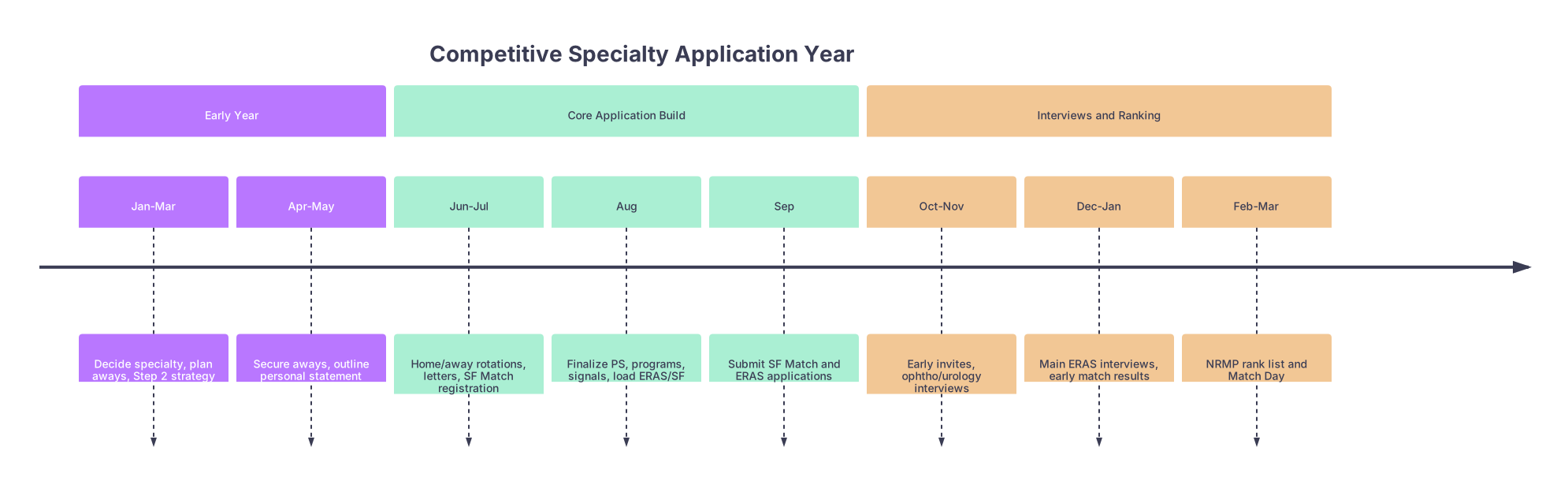
| Period | Event |
|---|---|
| Early Year - Jan-Mar | Decide specialty, plan aways, Step 2 strategy |
| Early Year - Apr-May | Secure aways, outline personal statement |
| Core Application Build - Jun-Jul | Home/away rotations, letters, SF Match registration |
| Core Application Build - Aug | Finalize PS, programs, signals, load ERAS/SF |
| Core Application Build - Sep | Submit SF Match and ERAS applications |
| Interviews and Ranking - Oct-Nov | Early invites, ophtho/urology interviews |
| Interviews and Ranking - Dec-Jan | Main ERAS interviews, early match results |
| Interviews and Ranking - Feb-Mar | NRMP rank list and Match Day |
What You Should Do Today
You are somewhere on this timeline. The next step is not vague “prep.” It is concrete.
Do this right now:
- Open your calendar for the coming year.
- Create three all-day events:
- “Application submission target date” (ERAS or SF Match, whatever is earliest for your field).
- “Letters must be requested by” date (2 months before that).
- “First away rotation starts” date.
Then work backward 4–6 weeks from each and add one action item at each point. Example: “Personal statement full draft done,” “Program spreadsheet finished,” “Confirm all scores uploaded.”
If those dates are not on a calendar you actually look at, you are already behind.