The biggest mistake students make with competitive away rotations is thinking the work starts when you show up. It doesn’t. You’re being evaluated from the moment you hit “submit” on VSLO and from the first email you send the coordinator.
You’ve got 12 weeks. Here is exactly what to do, week by week, so that when you walk into that ortho/derm/neurosurg/ENT/plastics/IR away, you look like someone they can trust with a spot.
12–10 Weeks Out: Foundation and Paperwork Blitz
At this point you should be locking down the boring stuff that can quietly kill your application if you procrastinate.
Week 12: Confirm Strategy and Targets
- Clarify your goal for this away:
- Are you trying to impress a single dream program?
- Casting a net in a region?
- Needing a “home program replacement” if your school doesn’t have your specialty?
- Meet with:
- Specialty advisor (departmental)
- Dean/advising office
- Decide on:
- 2–4 realistic away sites (with at least one “reach,” one “target,” one “safety”)
- Optimal month for the away (earlier is usually better for competitive fields)
At this point you should also clean up your CV. Program directors do actually read it for aways in competitive specialties.
- Update:
- Publications (with PMID if available)
- Posters, oral presentations
- Leadership roles
- Step 2 score if you have it
- Convert to a clean 1–2 page PDF. No weird fonts. No 0.5-inch margins.
| Specialty | Typical Away Timing | # of Aways Common |
|---|---|---|
| Orthopedic Surgery | Summer–Early Fall | 2–3 |
| Dermatology | Late 3rd–Early 4th | 1–2 |
| Neurosurgery | Summer–Fall | 2–3 |
| ENT (Otolaryngology) | Summer–Early Fall | 2–3 |
| Plastic Surgery | Summer–Fall | 2–3 |
Week 11: Compliance and Health Requirements
This is the week you get all the “HR nonsense” handled before it delays your start.
At this point you should:
- Check each target program’s visiting student / GME page for:
- Required vaccines: Hep B series + titer, MMR, Varicella, Tdap
- TB testing: PPD or Quantiferon within 6–12 months
- Flu/COVID requirements by season
- Background check and drug screen specs
- Fit testing requirements (some still want documentation)
Book everything now. The titer you “definitely had last year” will mysteriously not be in your chart. I’ve watched people lose aways over a missing Hep B titer that took 2 weeks to redraw and process.
Checklist to knock out this week:
- Email student health: request full immunization/serology record
- Schedule:
- TB test or Quantiferon
- Any boosters needed
- Drug screen if not provided through school
- Ask your school:
- Who completes visiting student forms?
- How long they usually take (build that delay into your calendar)
10–8 Weeks Out: VSLO, Documents, and Letters
Now you’re on the clock for actual applications.
Week 10: VSLO Profile and Program Recon
At this point you should be turning your VSLO application into a “mini-ERAS” for that specialty.
- Clean up VSLO profile:
- Consistent professional photo (no graduation cap, no car selfies)
- Confirm your legal name matches your school records and ID
- Double-check contact email and phone
Research each program like you’re already applying there:
- Look up:
- Current residents and where they came from
- Recent publications from the department
- Structure of the away rotation (subspecialty vs general service; call expectations)
- Make a 1-page summary per program with:
- Key faculty (PD, chair, education chief)
- Any residents from your med school
- Special “angles” (unique research focus, early OR time, derm continuity clinic, etc.)
Week 9: Personal Statement Lite + Letters
Competitive aways often ask for a short statement or even a full personal statement. Do not recycle your generic MS3 surgery blurb.
At this point you should draft a targeted 300–500 word statement that answers:
- Why this specialty (in a specific, not generic, way)
- Why this program/region
- What you bring that’s useful on day one (work ethic is assumed; give specifics)
Example fragments that actually sound like a human:
- “I grew up in a rural area where we had no local ENT, and I watched my sister drive 4 hours for basic care.”
- “My best days on surgery clerkship were the ones where I was the last person leaving the OR, closing skin with the resident.”
Letters:
- Identify 2–3 letter writers:
- At least one from your specialty or closest surgical/medicine proxy
- Someone who’s actually seen you work hard (not the famous name who barely knows you)
- Ask them specifically:
- “Would you be comfortable writing a strong letter for my away rotation applications in [specialty]?”
- Confirm:
- Timeline: “I’ll need this uploaded within the next 2–3 weeks.”
- Mechanism: VSLO upload, school portal, or email to coordinator
8–6 Weeks Out: Logistics and Skills Tune-Up
This is where you separate yourself from the “I’ll just wing it” crowd.
Week 8: Housing, Travel, and Budget
At this point you should assume housing will be expensive, inconvenient, or both. Plan early.
- Check:
- Program’s housing options: student housing, arranged apartments
- Resident suggestions: message a resident on email or social, politely ask for neighborhoods + commute tips
- Book:
- Refundable housing if dates aren’t 100% locked yet
- Travel if flights are significantly cheaper this far out
Money reality check:
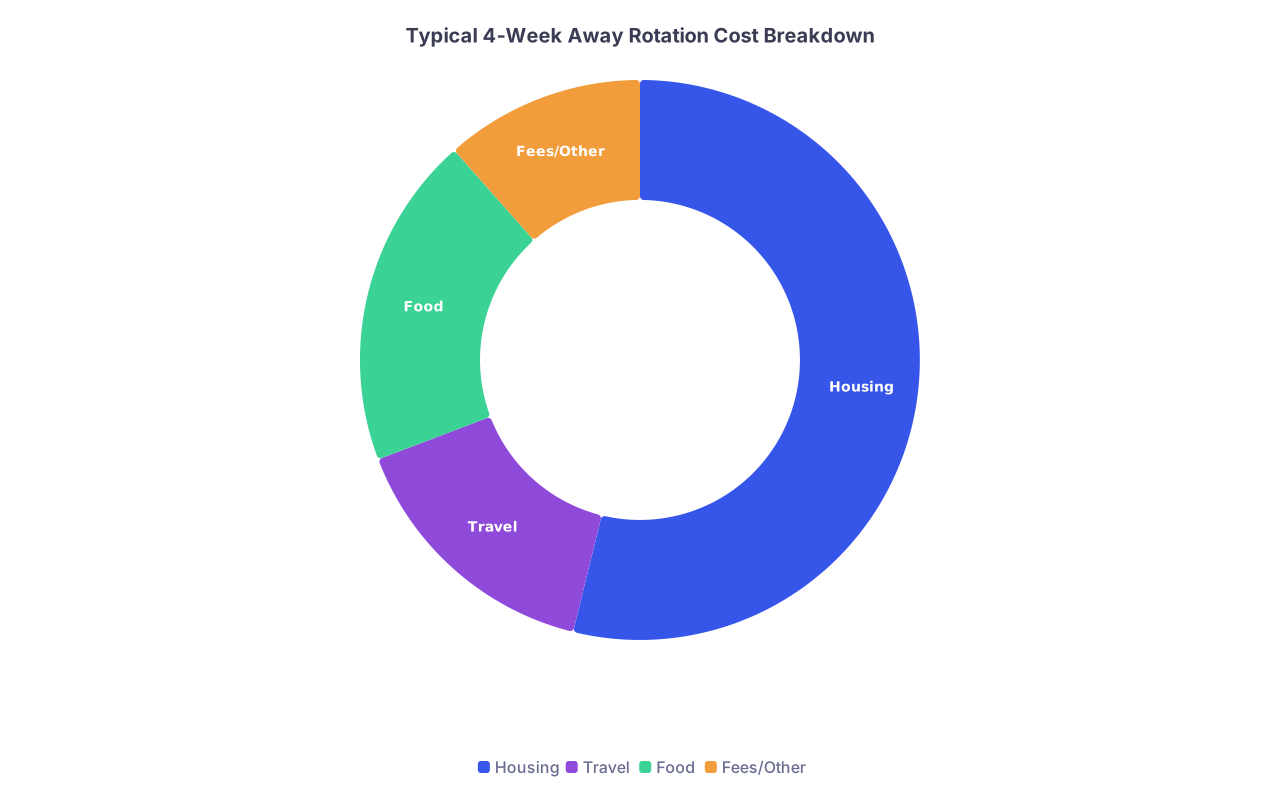
| Category | Value |
|---|---|
| Housing | 1400 |
| Travel | 400 |
| Food | 500 |
| Fees/Other | 300 |
If that number made you swallow hard, you’re not alone. At this point you should:
- Apply for:
- VSLO/VSAS scholarships (many departments hide these in small print)
- Specialty-specific scholarships (e.g., Nth Dimensions, SNMA, LMSA, WPS)
- Ask:
- “Is there funded student housing?”
- “Do you have diversity or visiting student grants?”
Week 7: Specialty-Specific Skills Refresh
This is where you quietly get competent so you’re not fumbling on day one.
Ortho / Neurosurg / Plastics / ENT:
- Practice:
- Knot tying (instrument + two-handed) daily for 10–15 minutes
- Basic suturing: simple interrupted, running, vertical/horizontal mattress
- Watch:
- 2–3 high-yield procedures per week on good platforms:
- E.g., AO Surgery Reference (ortho), ENT/Plastics OR videos, OSH/YouTube channels used by residents
- 2–3 high-yield procedures per week on good platforms:
Derm:
- Review:
- Basic morphology: papule, plaque, vesicle, bulla, etc.
- Common derm diagnoses by pattern
- Practice:
- Describing rashes out loud, concisely
- Writing short derm notes with clear assessment/plan
IR:
- Refresh:
- Vascular anatomy
- Indications/contraindications for common procedures (paracentesis, thoracentesis, ports, angiography)
Pick 3–5 core topics per week. Do not try to read an entire textbook “before the away.” You won’t.
6–4 Weeks Out: Rotation Rules, Expectations, and Early Contact
Now you’re tightening the details and letting the program know you exist.
Week 6: Confirm Acceptance and Requirements
By this point, you should have at least one away confirmed or be close.
- Once accepted:
- Read every email from the coordinator slowly. Twice.
- Create a single document with:
- Start/end dates
- Report time and location for day 1
- Dress code (scrubs vs white coat)
- EMR training requirements
- Upload:
- All remaining records: titers, BLS/ACLS, malpractice coverage letter, transcripts
If anything is unclear, ask one concise email:
“Hi [Name], I’m confirmed for the [Service] rotation from [dates]. Just to confirm, is there anything else you need from me before I arrive (EMR training, ID photo, or additional forms)?”
Do this now, not 5 days before you start.
Week 5: Understand the Rotation Structure
At this point you should know exactly what you’re walking into.
- Ask the coordinator (or check the website) for:
- Sample daily schedule
- Call expectations (nights? weekends?)
- Which service(s) students usually rotate on
Better move: reach out to a current or recent away student if you can get their contact. Ask pointed questions:
- “What did successful students do that made them stand out?”
- “What did people get in trouble for?”
- “What’s the vibe on pre-rounding and notes? Expected or optional?”
This is the kind of intel that saves you from being the only student who didn’t show up for Saturday trauma cases.
4–2 Weeks Out: Cognitive Load and Clinical Polish
Now the focus shifts from paperwork to performance.
Week 4: Build Your Study and Prep Plan
At this point you should be deliberately planning what you’ll review during the rotation, not just “reading when I can.”
Create a 4-week rotation study scaffold:
- Week 1: Common consults and emergencies
- Ortho: hip fracture, ankle fracture, septic joint
- Derm: drug eruptions, psoriasis flares, acne
- ENT: epistaxis, airway issues, neck masses
- Week 2: Core procedures and anatomy
- Week 3: Subspecialty topics (e.g., hand, spine, pediatric derm)
- Week 4: Interview-style and board-style questions
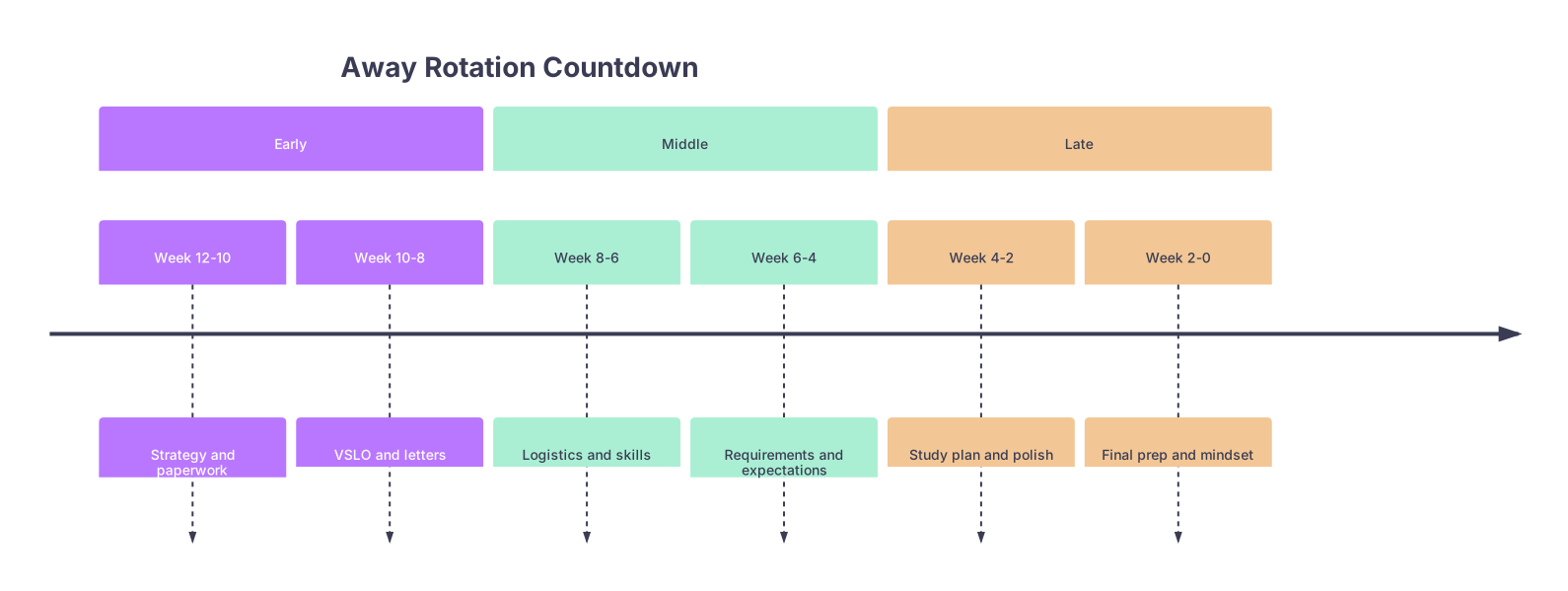
| Period | Event |
|---|---|
| Early - Week 12-10 | Strategy and paperwork |
| Early - Week 10-8 | VSLO and letters |
| Middle - Week 8-6 | Logistics and skills |
| Middle - Week 6-4 | Requirements and expectations |
| Late - Week 4-2 | Study plan and polish |
| Late - Week 2-0 | Final prep and mindset |
Create one small daily habit now that you’ll continue on the away:
- 10–15 board-style questions in that specialty
- 1 brief article or UpToDate topic relevant to the day’s cases
Week 3: Polishing Presentations and Team Skills
Competitive specialties care a lot about how you function on a team. You don’t get a pass because you’re “just an away.”
At this point you should:
- Practice:
- 2-minute new patient presentations
- 30-second “OR update” summaries
- Focus on:
- Leading with the headline:
“This is a 65-year-old with a displaced femoral neck fracture after a fall yesterday; we’re planning operative fixation today.” - Concise, organized structure
- Leading with the headline:
If you’re at your home institution now, ask a resident you trust:
“Can I run a quick presentation by you like I would on an away and get ruthless feedback?”
You’ll learn more from that 5-minute interaction than from any Reddit thread on “how to be a good sub-I.”
Final 2 Weeks: Details, First Impressions, and Mindset
Now you’re in the red zone. Details matter.
Week 2: Logistics Double-Check and Gear
At this point you should remove as many unknowns as possible.
- Confirm:
- Housing address, parking instructions, and commute time at the actual time you’ll be traveling
- Hospital entry points (badge vs guest pass first day)
- Pack:
- 2–3 sets of appropriate scrubs (check color if required)
- Short white coat, ironed
- Comfortable, professional shoes (you’ll regret the cute but painful ones by noon)
- Small notebook or index cards
- Pen that actually works, plus backup
Digital prep:
- Download:
- Key PDFs or ebooks (boards review, specialty handbooks)
- Offline copies of your CV and personal statement
- Create:
- A note on your phone with:
- Names of PD, chair, key faculty
- Service pager numbers, if available
- Basic templates for notes and consults
- A note on your phone with:

Week 1: Mindset, Expectations, and Professionalism
This is where a lot of strong students blow it—not on knowledge, but on attitude and social awareness.
At this point you should decide:
- You will be early. Not “on time.” Early.
- OR specialty? 4:45–5:00 a.m. is not insane in many places.
- You will be low maintenance.
- No complaints about hours.
- No drama about assignments.
- You will be coachable.
- If someone corrects you, you change your behavior. Immediately.
Common ways students quietly tank their away:
- Looking disinterested in the OR or clinic
- Pulling out their phone constantly
- Disappearing when there’s scut to be done
- Acting like a resident but without the responsibility or accountability
You’re there to learn and to help. In that order. If you do both, people notice.
Day 0–1: Arrival, First Impressions, and Early Wins
You’re there. Now the countdown switches from weeks to hours.
Day Before Start (Day 0)
At this point you should:
- Walk into the hospital and find:
- Where you’ll report on day one
- The OR board / clinic area
- Time:
- Your commute at rush hour
- Lay out:
- Clothes, badge, notebook, pens, snacks, water bottle
Send a short, polite confirmation email if you haven’t had recent contact:
“Hi [Coordinator/Resident], I’m looking forward to starting the [specialty] rotation on [date]. I’ll plan to arrive at [time] at [location] as instructed. Please let me know if there’s anything else I should review or bring before day one.”
Day 1: Do This, Not That
Morning:
- Arrive 15–20 minutes early
- Introduce yourself to:
- Residents
- Nurses
- OR staff / clinic MAs
- Ask one key question:
- “How do you like students to help on this service?”
During the day:
- Write down:
- Everyone’s names and roles
- Pager numbers
- How they like presentations and notes organized
- Volunteer:
- To see consults (with supervision)
- To help with dressing changes, notes, discharge summaries
End of the day:
- Ask:
- “Is there anything I can do better tomorrow?”
- “What time do you want me here in the morning, and what should I pre-round on?”

Week 1 On-Rotation: Daily Micro-Checklist
The first week sets your reputation for the entire rotation.
Daily checklist:
- Show up:
- Early, prepared with patient list updated
- Pre-round:
- Know vitals, labs, imaging for your patients
- In OR or clinic:
- Phone away, eyes engaged
- Anticipate next steps (suture scissors, dressing supplies, next note)
- End of day:
- Make sure all your tasks are closed
- Clarify expectations for tomorrow
Weekly self-audit:
- Ask yourself on Friday:
- “Do the residents trust me with small tasks yet?”
- “Am I more useful this Friday than last Monday?”
If the answer is no, you’re not doomed—but you need to actively seek feedback and adjust.
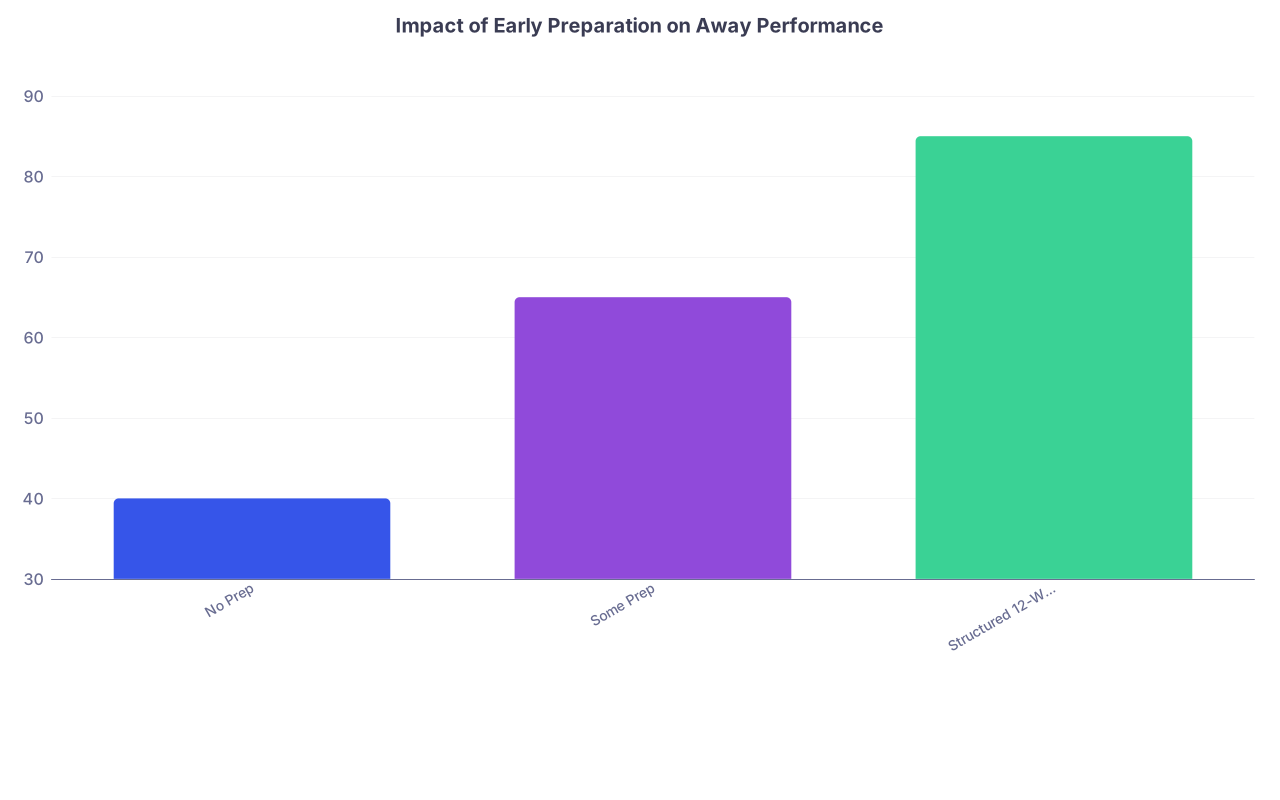
| Category | Value |
|---|---|
| No Prep | 40 |
| Some Prep | 65 |
| Structured 12-Week Prep | 85 |
Put It Into Motion Today
Do not just nod along and close this tab. Open your calendar, count 12 weeks back from your first away rotation start date, and block off each week with a single focus (paperwork, letters, skills, logistics, polish). Then, pick one task from Week 12—updating your CV, emailing student health, or meeting your specialty advisor—and do it before you go to bed.