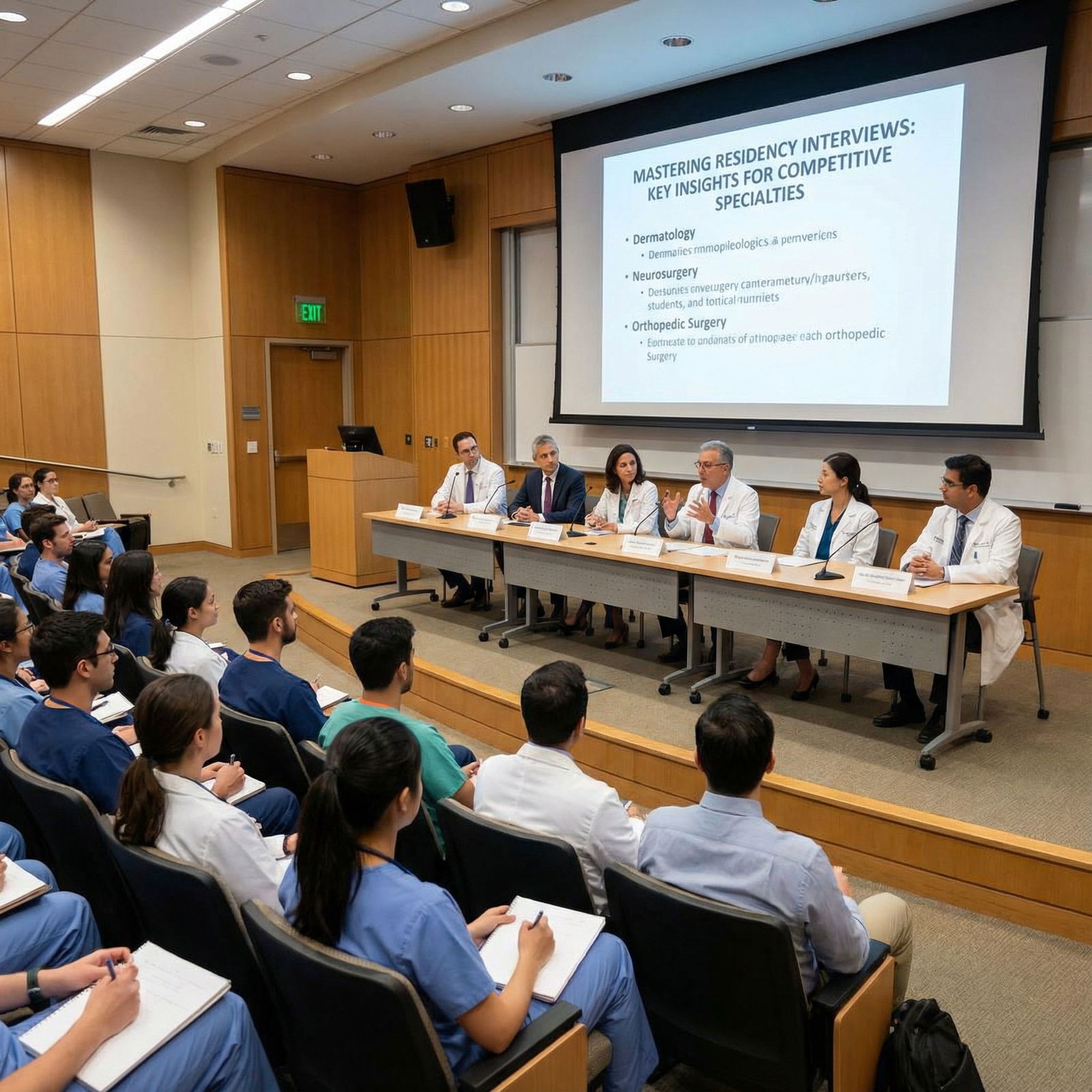
The loudest “rules” about IMG and DO chances in competitive specialties are mostly wrong. Not a little wrong. Completely upside down.
You’ve heard the script: “Derm, ortho, plastics, ENT, neurosurgery — forget it if you’re an IMG or DO.” Attendings say it. Residents repeat it. Reddit amplifies it. And then everyone starts treating those myths as laws of physics instead of what they actually are: rough trends with huge exceptions and a lot of lazy thinking.
Let me be blunt: being an IMG or DO absolutely makes some doors harder to open. But it does not work the way most people think. Your passport and degree letters are not some magical force field blocking “top” specialties. What usually kills applicants is something more boring and fixable: weak metrics, bad targeting, and complete misunderstanding of where the real bottlenecks are.
Let’s dismantle this properly.
Myth #1: “IMGs and DOs basically never match competitive fields”
This is the big one. The fatalistic one. It sounds plausible because the percentages are low. But “rare” is not the same thing as “never,” and the difference matters if you're deciding whether to even try.
Look at the data, not the hallway gossip.
NRMP publishes Match results every single year, broken down by specialty and applicant type. Are IMGs and DOs underrepresented in derm, ortho, plastics, ENT, neurosurgery, urology, radiation oncology? Absolutely. But “underrepresented” is not “zeroed out.”
What actually happens?
– A small group of IMGs and DOs match these fields every year.
– They are not unicorns with perfect 280 scores and Nobel-level research.
– But they are methodical, strategic, and realistic about geography and program type.
You’ll see patterns:
– DOs match ortho and ENT at osteopathic-heavy or DO-friendly academic centers.
– IMGs match neurosurgery and plastics at mid-tier academic programs or institutions with strong IMG traditions.
– Derm is brutal for everyone; the IMG/DO who matches usually has multi-year research and a Step 2 score in the stratosphere.
The myth survives because people look at match rates and ignore the denominator. If 5% of IMGs who apply plastics match, everyone screams “IMPOSSIBLE.” But that 5% is often pulled from a pool where a lot of applicants had no business applying in the first place: no US clinical experience, no publications, no letters, weak scores. Of course the rate is low.
The relevant question isn’t “What’s the overall rate?” It’s: “What’s the rate for someone like me — with X scores, Y clinical background, Z research — who applies smartly to the right programs?”
The data: very few people actually do that analysis before declaring a specialty “impossible.”
Myth #2: “Your degree type is what kills you”
The more accurate version: your degree type labels you as high-risk until proven otherwise.
Program directors are not sitting there thinking, “I hate DOs” or “I dislike IMGs” in some cartoon-villain way. What they are actually thinking is closer to this:
– “I don’t know how to interpret this school’s grading.”
– “I have no idea what their exams are like.”
– “We’ve had bad experiences with some off-shore grads who were underprepared.”
– “We simply have too many top-tier US MD applicants; I don’t need to take a risk.”
That is not flattering, but it is reality.
Your degree label (IMG/DO) acts like a default handicap because it adds uncertainty. PDs hate uncertainty. So what do they use to override that discomfort?
– USMLE/COMLEX performance (ideally USMLE if available)
– US clinical experience at their or similar institutions
– Strong letters from people they know or trust
– Serious research productivity in their field
– Evidence you function well on a US team (sub-I, acting internship, away rotation)
The myth says: “I did okay but I’m a DO/IMG, so I’m screwed.”
The reality is often: “I did average in every domain and brought nothing so strong that a PD would override their default bias toward US MDs.”
Your degree is not the final verdict; it’s the starting burden of proof.
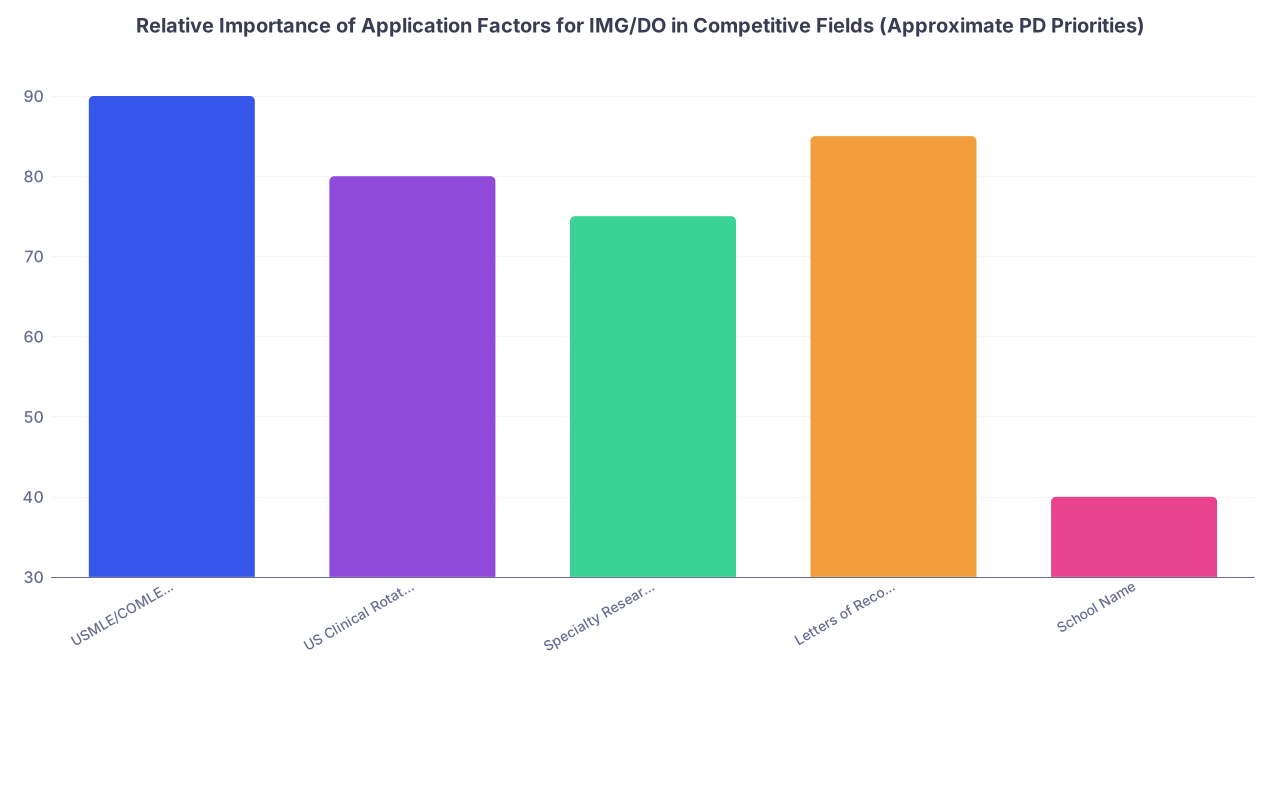
| Category | Value |
|---|---|
| USMLE/COMLEX Scores | 90 |
| US Clinical Rotations | 80 |
| Specialty Research | 75 |
| Letters of Recommendation | 85 |
| School Name | 40 |
Notice what’s at the bottom of that list. School name matters, but not the way premed forums think. A DO or IMG with better scores, US experience, and research is more attractive than a weak US MD coasting on a fancy school name. I’ve seen that play out directly in ortho and neurosurgery rank meetings.
Myth #3: “Without Step 1 scores, DOs and IMGs are finished”
Step 1 moving to pass/fail triggered panic, especially among DOs and IMGs who saw it as their way to “prove” they were equal or better than US MDs.
Yes, that change hurt IMG/DO signaling. No, it did not erase your ability to stand out.
Programs didn’t stop ranking people. They just shifted what they hyper-focus on.
Now the spotlight has moved to:
– Step 2 CK (for everyone)
– COMLEX Level 2 (for DOs, though many still want USMLE)
– Objective performance during away rotations
– Research productivity (especially in derm, rad onc, neurosurgery, plastics)
– Who is personally vouching for you
I sat in a derm meeting where one faculty member literally said, “We’ll treat Step 2 as the new Step 1. Anyone under 250 is basically out unless they rotated here and blew us away.” That’s not fair. It’s also how people are actually thinking.
So you cannot hide behind the idea that “Step 1 was my chance and now it’s gone.” You still have a numerical battlefield. It just moved.
If you’re a DO and you refuse to take USMLE because “COMLEX should be enough,” understand how that reads from the other side of the table:
– “This person voluntarily chose to make comparison harder.”
– “We have 400 applicants with USMLE; why decode COMLEX?”
Not every program thinks this way — some truly are COMLEX-friendly — but enough do that you’re handicapping yourself in competitive specialties by not taking USMLE, unless you are deliberately only targeting a narrow set of DO-friendly programs.
Myth #4: “Research is optional unless you’re aiming for ivory-tower academic programs”
This one stubbornly refuses to die.
In community IM or FM, you can often match with minimal or no research. In derm, rad onc, neurosurgery, plastics, ENT? Research is not “nice to have.” It’s part of the currency. Doubly so if you’re an IMG or DO.
Here’s what the real world looks like:
– The top half of applicants in these fields often have double-digit publications, abstracts, or presentations.
– A lot of that is fluff — case reports, poster abstracts, follow-up analyses. But it still signals: “This person can start and finish projects.”
– Many successful IMG/DO applicants in competitive specialties did 1–3 years of research (sometimes paid, often not very well paid) at US institutions before applying.
The myth is: “If I do well on exams, I can skip research.”
The reality: as a non-US MD, research is how you “convert suspicion into trust” and build relationships that lead to meaningful letters.
I’ve seen the pattern over and over:
– IMG A: 260+ on Step 2, no dedicated research year, a couple of posters, generic letters. Applies neurosurgery. Gets a handful of interviews, doesn’t match.
– IMG B: 245–250, but two full years in a neurosurgery lab at a mid-tier academic center, co-author on multiple papers, chair knows them personally, strong letters. Matches neurosurgery at that same center.
Which one looks “stronger” on paper if you only stare at scores? A.
Which one PDs actually trust and rank higher? B, usually.
DOs and IMGs keep underestimating how much that institutional familiarity and productivity matters in competitive fields. You are not just selling yourself; you are selling the judgment of the faculty who back you.

Myth #5: “Programs just blacklist IMGs/DOs — nothing you do matters”
Some programs absolutely block IMGs and/or DOs. They will not say it on their website. They sometimes barely admit it internally. But you can see it in their historical match lists and NRMP Charting Outcomes.
The lazy conclusion is: “Well, if I am an IMG/DO, I am powerless; everyone is like that.” No. Programs fall into rough buckets.
| Program Type | Attitude Toward IMG/DO Applicants |
|---|---|
| Elite top-10 academic | Very restrictive / token spots |
| Mid-tier academic with IMG history | Limited but real opportunities |
| DO-heavy academic / regional center | DO-friendly, sometimes IMG-open |
| Community with niche program | Case-by-case, connections matter |
| Historically no IMG/DOs matched | Effectively closed |
If the last 5–10 years of a program’s fellows/residents have zero IMGs or DOs, that is not a coincidence. It is a choice. Applying there is basically donating money. That’s on you.
On the flip side, if a mid-tier academic ENT or ortho program has a steady trickle of DOs or IMGs every few years, you do not shrug that off. That is a bright neon sign saying, “We will take a chance if you give us a good reason.”
You do have leverage:
– You can aggressively prune “never” programs from your list.
– You can concentrate applications and effort on places with a proven history of IMG/DO acceptance.
– You can target your away rotations to these “probable yes” institutions.
The real mistake is spraying 80 applications randomly “just in case,” then whining that “nobody interviews DOs/IMGs.” No — those programs did not interview you. The ones who do, look different.
Myth #6: “One away rotation will fix everything”
Away rotations (audition rotations, sub-Is) are extremely high yield in competitive specialties. They are also dramatically over-romanticized.
The fantasy: “If I rotate there and work hard, they’ll overlook everything else and rank me high.”
Reality: they might overlook some weaknesses, but they will not ignore everything.
An IMG with a 230 and no research is not getting saved by a single away at a top-10 derm or ortho program. You might get a courtesy interview. You are not suddenly first on their rank list.
What away rotations can do for an IMG/DO in competitive fields:
– Turn “probably no” into “interview, and maybe mid-list rank.”
– Turn “borderline metrics but solid research” into “top-half of rank list.”
– Provide glowing, personalized letters from faculty known to PDs.
– Prove you can function on a US team with complex patients, documentation, and workflow.
But here’s the dirty secret: away rotations often separate people into three buckets very quickly.
– “Absolutely yes — we want them.”
– “Safe, fine, but not special.”
– “Never again.”
If you go in unprepared — weak knowledge, poor documentation, passive on the team — being an IMG or DO will be the second problem. Your performance will be the first.
You use away rotations to confirm your application strength, not to patch a fundamentally weak one.

| Step | Description |
|---|---|
| Step 1 | Decide on competitive specialty |
| Step 2 | Plan research and away rotations |
| Step 3 | Reassess specialty or add gap year |
| Step 4 | Target IMG/DO friendly programs |
| Step 5 | Dedicated research year |
| Step 6 | Strengthen metrics |
| Step 7 | Away rotations at realistic programs |
| Step 8 | Interviews and match |
| Step 9 | Scores 245+ Step 2? |
| Step 10 | Research in field? |
This is roughly how actual successful IMG/DOs in derm/ortho/ENT/neurosurgery succeed. It is not magic. It is structured suffering.
Myth #7: “If I do not match first try, it’s over”
This one wastes a lot of potential.
In hyper-competitive specialties, a first-attempt non-match — especially for DOs and IMGs — is common. What matters is how you respond.
The self-defeating path looks like this:
– Apply too broadly and ambitiously the first time with mediocre metrics.
– Get 0–2 interviews.
– Panic-match into a prelim medicine or surgery year with no plan.
– Drift through intern year, exhausted, with no added research or clear mentor support.
– Reapply with basically the same application plus “I did a prelim year.”
That does almost nothing for you.
The productive version:
– After a failed match, you deliberately choose a position or gap year that builds your value in the target specialty.
– Transitional year at a place with strong research in your field.
– Dedicated research fellowship under a known name in that specialty.
– Extra time to crush Step 2 / Level 2 if you haven’t already.
I’ve watched IMGs go from zero interviews in ortho to several interviews and matching on the second attempt, solely because they spent a year doing 3–4 ortho publications with a respected PI and got letters saying, “We worked with this person every day for a year; they are excellent.”
The myth is “failed once = permanently tainted.”
The reality is “failed once with no visible improvement = doomed; failed once followed by one or two years of obvious growth = salvageable.”
So what actually limits IMGs and DOs in competitive fields?
Let’s strip it down.
The real constraints, based on what I’ve seen and what the data shows:
– Insufficient numerical strength on Step 2/Level 2 versus your competition.
– Lack of targeted, specialty-specific research with US-based mentors.
– Poor or generic letters instead of detailed, advocacy-style letters from known faculty.
– Applying to programs that have never taken IMGs/DOs and calling it “bad luck.”
– No US clinical experience in the field at all, or only random observerships.
– Refusing to adapt after a failed cycle (no research year, no improvement, no strategic change).
What does not absolutely limit you, by itself:
– Being a DO instead of MD, if you’re willing to take USMLE and go hard on research and targeting.
– Being an IMG, if you’re willing to put in 1–3 extra years of research/US experience and be extremely selective about where you apply.
– Not being at a “top” med school. Big-name schools help but they are not everything.
– Coming from a non-traditional path, older age, or previous careers. PDs care more about performance and reliability than your origin story.
The blunt bottom line
You do not get to rewrite the hierarchy. Competitive specialties are biased toward US MDs from strong schools with high scores and heavy research. That is not “fair.” It is simply the current ecosystem.
But being an IMG or DO is not a hard stop. It is a handicap that can be overcome — sometimes — with enough:
– Score strength
– Research signal
– Real US clinical performance
– Strategic program selection
– Time
If you’re not willing to pay that price, then yes, for you, those fields are effectively closed. Not because you are an IMG or DO, but because you are unwilling to stack enough advantages to counteract the initial bias.
If you are willing? Then the myths stop being prophecies and start being what they should have been all along: background noise.
Key takeaways:
- Degree type and IMG status are handicaps, not death sentences; metrics, research, and targeting matter more than students want to admit.
- Competitive fields are still open to IMGs and DOs, but usually only for those who are willing to invest extra years in research, US experience, and strategic applications.
- Stop asking, “Is it possible for IMGs/DOs?” and start asking, “Given my current numbers and timeline, what specific plan makes me one of the few who realistically can break in?”