
You are on a post‑call Sunday, sitting in the call room with someone’s “informal wisdom” spreadsheet open. You are trying to decide how many derm, plastics, or ortho programs to apply to. One co‑resident is saying, “Shoot your shot, you never know.” Another is warning, “Do not waste money on places that will never interview you.” You have a half‑finished personal statement, a Step score you keep side‑eyeing, and an uneasy feeling that you are either about to overreach and crash, or undershoot and trap yourself.
This is exactly where smart people make stupid application decisions.
Let me be direct: in highly competitive fields, applying “wrong” does more damage than being slightly weaker on paper. A mediocre application with a smart list can still match. A strong application with a delusional or timid list can absolutely fail.
You cannot afford that mistake.
The Core Problem: You Are Probably Miscalibrated
Most applicants in competitive specialties fall into one of two traps:
Overreaching:
- 70–90% “dream” programs
- Ultra‑prestige emphasis
- Ignoring cold numbers and historical cutoffs
- Magical thinking: “They might love my story”
Undershooting:
- Overreacting to one weak point (a single failed exam, a leave of absence, late switch)
- Avoiding solid mid‑tier programs out of fear of “wasting” an application
- Self‑selecting out of your true target field before programs ever see you
Both feel rational in the moment. Both are usually wrong.
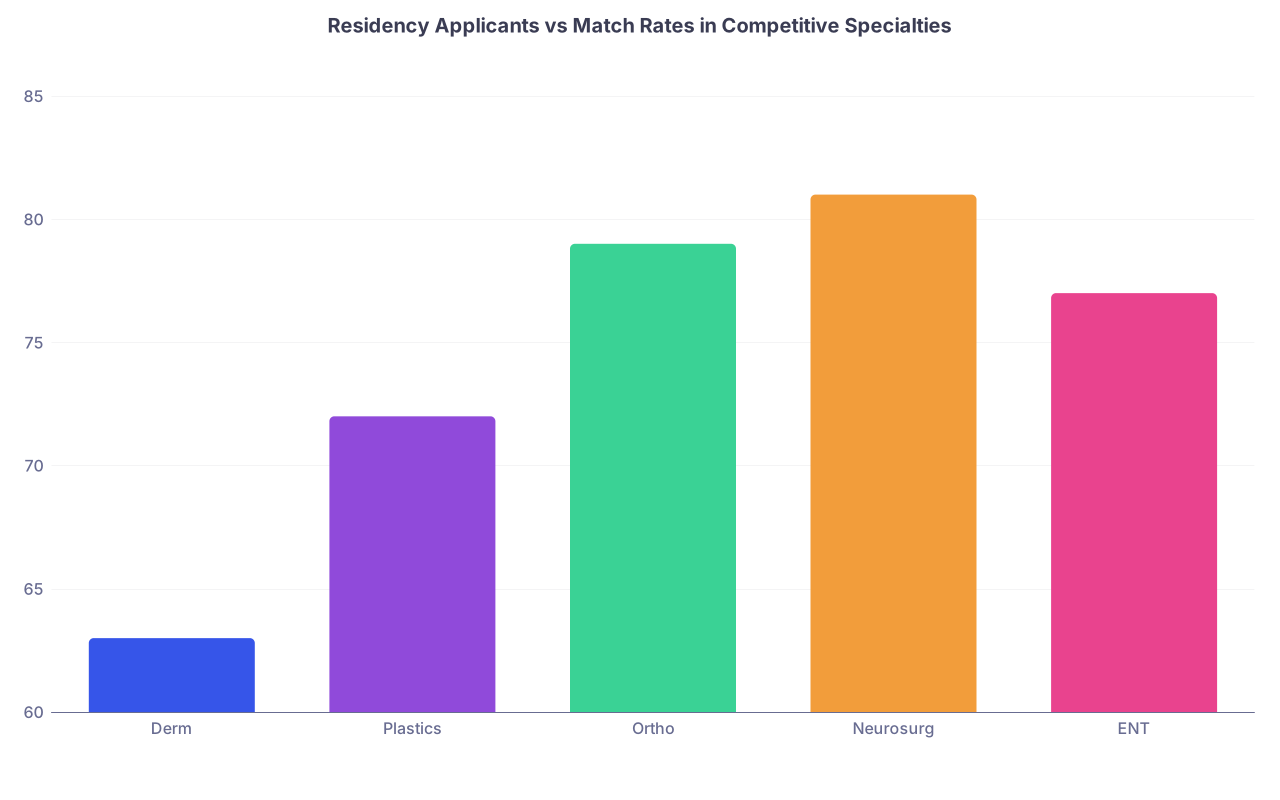
Here is what actually happens in competitive specialties like dermatology, plastic surgery, orthopedic surgery, neurosurgery, ENT, and integrated vascular:
| Category | Value |
|---|---|
| Derm | 63 |
| Plastics | 72 |
| Ortho | 79 |
| Neurosurg | 81 |
| ENT | 77 |
Those “match rates” hide something ugly: the bottom half of applicants in these fields are often not even truly in the game. They applied badly, aimed wrong, or ignored obvious red flags.
Do not be one of them.
Where Overreaching Destroys You
Overreaching is not “having a few reach programs.” That is healthy.
Overreaching is building your list as if you are a top‑decile applicant when you are not, then being shocked when interview season is dead.
You see this a lot in:
- US MDs with mid or low Step 2 scores (below the typical interviewed range)
- US DOs or IMGs applying to derm, plastics, or neurosurgery without realistic anchors
- Late switchers with limited specialty‑specific letters and research
Here are the common overreach mistakes that I keep seeing.
Mistake #1: Confusing “I Meet The Minimum” With “I Am Competitive”
If the program says “no Step 2 cutoff” and your score is 225 for derm or 230 for plastics, you are not suddenly competitive because they did not put a number on the website.
Programs screen in tiers. They just do not publish them.
| Tier | Typical Step 2 Range | Interview Priority |
|---|---|---|
| Automatic screen-in | 255+ | Very high |
| Discretionary review | 245–254 | Moderate |
| Rare exceptions | <245 | Low |
People screw this up by telling themselves:
- “They said they consider the whole application.”
- “My narrative will stand out.”
- “My away rotation there went well.”
Reality: you might be an exception, but you cannot build a whole list assuming exception status.
How to avoid this mistake:
- Get actual data. From:
- Recent grads from your school who matched that specialty
- Specialty‑specific application advisors (not generic Student Affairs only)
- NRMP Charting Outcomes (look at applicants who matched, not just overall scores)
- Put yourself in a realistic score + research + letters bucket. Then plan from that bucket, not from your fantasy self.
Mistake #2: Overloading On Top‑10 Name Programs
If 60–70% of your list is “brands your family has heard of,” you are probably overreaching.
Common offenders:
Derm: UCSF, Stanford, Penn, MGH, NYU, Northwestern
Plastics: Duke, Michigan, Pittsburgh, UT Southwestern
Ortho: HSS, Rush, Mayo, Rothman‑related programs
You can and should apply to some of these. The problem is believing volume compensates for reality:
- “If I apply to 60 derm programs, something will hit.”
- “If I apply to every top plastics program, one will give me a chance.”
No. If you are not in their usual interview band, 60 × 0 is still 0.
Avoid this:
Cap your true “reach” programs at roughly 20–30% of your list. If you are a borderline applicant, that percentage should be lower, not higher.
Mistake #3: Ignoring Program Fit Signals Because You Want the Name
I have seen students apply to:
- Research‑heavy academic derm programs with no publications
- Global surgery‑focused programs having done zero global or health equity work
- Places that strongly advertise “no DOs or IMGs historically” as their dream destination
Then they are surprised when crickets.
If a program has:
- No history of interviewing your applicant type
- A clearly different profile than your record (you have pure clinical, they only take research‑year people)
…then it belongs in the lottery bucket, not the core bucket. Lottery tickets are fine. You just do not want most of your money in them.

| Step | Description |
|---|---|
| Step 1 | Start List |
| Step 2 | Talk to specialty advisor |
| Step 3 | Build tiers |
| Step 4 | Limit dream to 20-30% |
| Step 5 | Standard distribution |
| Step 6 | Add realistic and safety |
| Step 7 | Finalize list |
| Step 8 | Know your percentile? |
| Step 9 | Competitive specialty? |
Where Undershooting Quietly Ruins Your Chances
Undershooting is less flashy but just as lethal. It is what happens when fear, shame, or one bad data point push you into playing way too small.
Patterns I see:
- A derm‑interested student with a 245 Step 2 convinced they are “too weak” and defaulting to IM without even exploring prelim + research options
- A DO student with strong ortho letters who only applies to small community programs because “the academic places will never look at me”
- Someone with a single Step 1 fail who decides they “cannot” apply ENT, even with later strong performance and solid faculty support
Here are the specific ways people undershoot.
Mistake #4: Letting One Weakness Define Your Entire Strategy
Failed Step 1, below‑average Step 2, leave of absence, remediation. None of these are ideal in a hyper‑competitive specialty. But they are not uniform death sentences either.
The wrong move: “Because I have X, I will not be considered anywhere strong, so I should only apply to low‑tier backups in a different specialty.”
The right move:
- Accept that you are not a first‑round pick for the very top programs
- Double down on:
- Strong Step 2 or CK if still relevant
- Excellent specialty letters
- Real, focused research or meaningful clinical exposure
- Apply broadly across the middle tier, where programs actually look at context and growth
Mistake #5: Over‑focusing On Geography Or Lifestyle Too Early
I have watched people tank their match because they decided:
- “I only want to be in California or New York derm.”
- “I will not move away from my partner, so I am restricting to these 3 states for ortho.”
- “I cannot live in the Midwest, so I will just apply coastal programs.”
You are trying to enter one of the hardest training pipelines in medicine. This is not the moment to play location princess or prince.
If you are competitive for the field but not an obvious superstar, brutal truth:
- You may need to do 5–7 years somewhere you did not plan to live
- The alternative may not be “same specialty in a slightly worse city”
- The alternative may be “never doing that specialty at all”
You can adjust your geography after you are board‑certified.
Mistake #6: Failing To Include Enough True Target Programs
Applicants love extremes:
- 30–40 “reach” programs
- 10 safety programs in a totally unrelated specialty
- 3–5 actual realistic target programs
Then they wonder why the outcome looks binary: no interviews in the dream field, then stuck ranking only their backup specialty.
For competitive fields, you want something closer to:
| Applicant Type | Reach | Target | Safety (same or related field) |
|---|---|---|---|
| Strong US MD | 25% | 50% | 25% |
| Borderline US MD / Strong DO | 15–20% | 55–60% | 20–25% |
| IMG with research year | 10–15% | 55–65% | 25–30% |
Undershooting often means that middle column is empty. You jumped from dream to panic. That gap is where a lot of matchable programs actually live.
The Field‑Specific Traps People Walk Into
Let me call out a few specialties where mis‑targeting is especially common.
Dermatology
Common overreach:
- 240–245 Step 2, no derm research, zero away rotations at powerhouse programs… but applying mostly to UCSF, Penn, MGH, Stanford and their friends
- Assuming “I did a derm elective at my home program so I am fine” at a non‑derm‑heavy school
Common undershoot:
- Solid 250s, 1–2 derm publications, good letters, but limiting to 20–30 programs in 1–2 states because “I do not want to move”
- Not adding prelim medicine spots strategically
Plastic Surgery (Integrated)
Common overreach:
- Applying plastics with:
- No plastics research
- Only generic surgery letters
- Late exposure in M4
- Believing “strong personality” or being “good in the OR” will compensate fully
Common undershoot:
- Competitive Step 2 and solid research, but applying only to smaller community gen surg instead of a mix of:
- A realistic number of integrated plastics programs
- Plus strong gen surg programs where an independent plastics route is still viable
Orthopedic Surgery
Common overreach:
- DO or IMG applicants with minimal away rotations and no strong ortho letters applying only to historically DO‑unfriendly or IMG‑unfriendly academic powerhouses
Common undershoot:
- Students with mid‑range scores and good away evaluations restricting themselves to “easy” community programs and skipping midsize academic centers that actually like workhorse residents
I have seen a DO applicant with strong SLOEs match at a very reputable academic ortho program while MDs who limited themselves geographically did not match. The DO applied widely and realistically. The MDs did not.
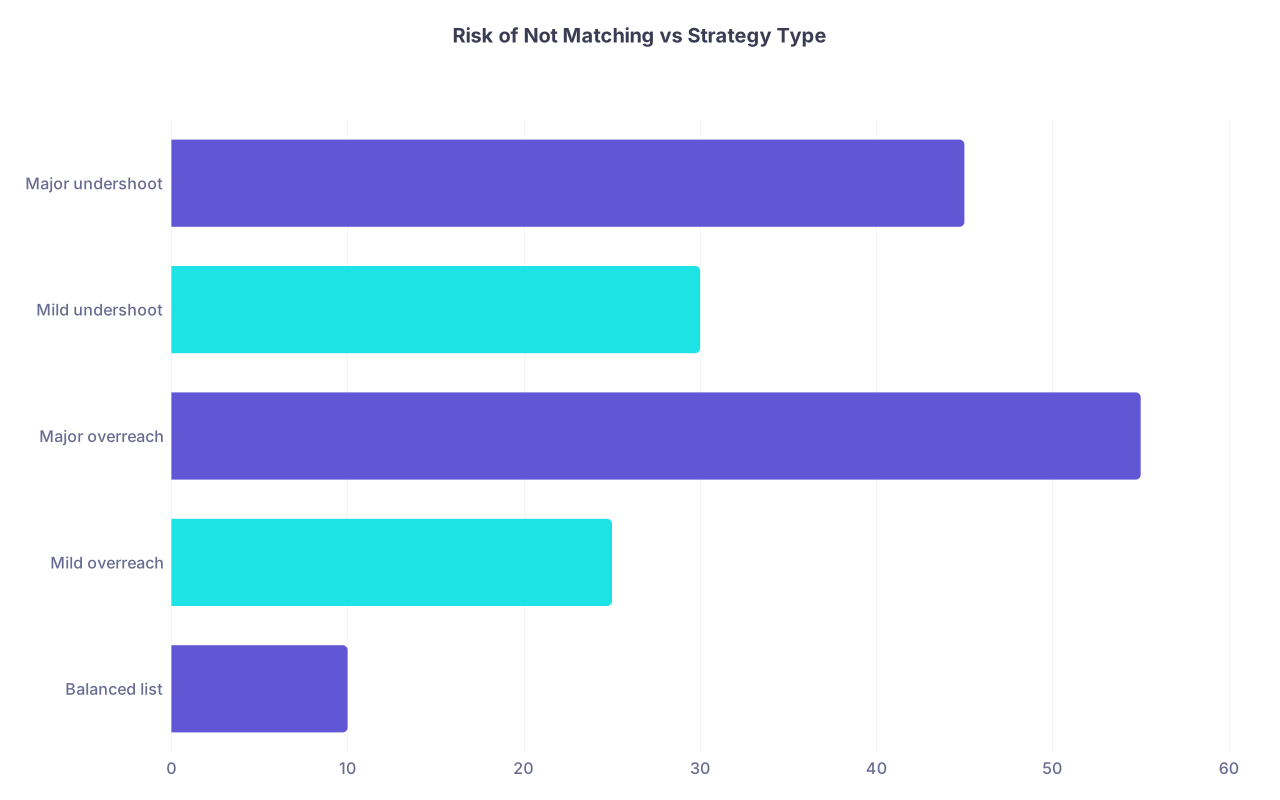
| Category | Value |
|---|---|
| Balanced list | 10 |
| Mild overreach | 25 |
| Major overreach | 55 |
| Mild undershoot | 30 |
| Major undershoot | 45 |
Building a Smart List: Guardrails So You Do Not Sabotage Yourself
Here is how you avoid both cliffs.
Step 1: Get a Ruthlessly Honest Baseline
You need real feedback, not vibes.
Talk to:
- A specialty‑specific advisor (not just the generic Dean’s Office)
- At least one faculty member who writes a lot of letters in that field
- A recent graduate from your school who matched your target specialty in the last 2–3 years
Ask them explicitly:
- “If you had to guess, what percentile applicant am I in this field from our school?”
- “If I apply smartly, what is my realistic match probability?”
- “Where did people at my level match in the last 3–5 years?”
If they hesitate, push. “I need you to be blunt rather than nice. I would rather have hurt feelings now than unmatched later.”
Step 2: Tier Your Programs Before Emotion Gets Involved
Do this on a spreadsheet. Three simple columns:
- Reach – programs where your metrics and profile are clearly below their usual interviewed group
- Target – programs where your profile is roughly similar to recent matched residents
- Safety – programs where you are on the stronger end for that specialty or in a closely related specialty you would actually consider
Then force ratios:
- No more than ~20–25% reach for most borderline applicants
- At least 40–60% target programs
- Remaining in realistic safeties (same field if possible, or a field you genuinely like)
Step 3: Anchor To Actual Interview Numbers
For highly competitive specialties, interview count matters.
If your target field usually demands ≥10–12 interviews to feel safe, you cannot build a strategy where you are only competitive for 5–7 programs and then “hope” your reaches will make up the rest.
Brutal but true: if you are not likely to generate enough interviews via realistic targets + a few reaches…
You need to:
- Consider a research year
- Or add a parallel plan now, not in January when rejections have piled up
Key Red Flags You Are Overreaching Or Undershooting
If you recognize yourself in any of these, you need to adjust.
You are probably overreaching if:
- More than one honest advisor raised an eyebrow at your list and said “This is aggressive”
50% of your programs are ones your school has rarely matched to in that field
- You are relying heavily on “my story is unique” while being substantially below average on scores and research
- You are applying to almost no programs that have previously interviewed or matched students with your profile (MD vs DO vs IMG, school type, score range)
You are probably undershooting if:
- Your main reason for avoiding strong programs is geography, not fit
- You are ashamed of one part of your record and using it as an excuse to lower all your expectations
- People who know your file keep saying “You should apply more broadly” and you are ignoring them
- Your list leans heavily toward a backup specialty that you are actually less excited about, simply because it feels safer
What To Do If You Realize You Already Screwed This Up
If you are early in the season: good. You can still change course.
If applications are already submitted but interviews are sparse, you need to respond like an adult, not a victim.
Concrete options:
- Scramble to add realistic programs if ERAS is still open for new submissions
- Directly email programs in your realistic band with a short, focused message if that is acceptable in your specialty
- Ask your mentors to reach out for you selectively where appropriate
- Plan seriously for the next cycle:
- Research year in that specialty
- Additional audition rotations
- Or a frank decision to commit to a less competitive specialty you actually like
Do not do the classic denial move: changing nothing and then being “shocked” in March.
FAQs
1. How do I know if I am strong enough to apply to a highly competitive specialty at all?
Look at three things together:
- Your Step 2 (or CK) score compared with matched applicants in that field
- Your specialty‑specific exposure (rotations, aways, letters)
- Your research or unique value add that aligns with that field
If you are below the 25th percentile on all three, you are in dangerous overreach territory. If you are weak on one but solid on the others, you still have a shot with a smart, realistic list and possibly a research year.
2. How many programs should I apply to in a competitive specialty?
The right number depends on your profile, but for most borderline applicants in derm, plastics, ortho, ENT, neurosurg:
- Very strong US MD: often 40–60
- Middle‑of‑the‑pack US MD or strong DO: 60–80
- IMG or DO with weaker metrics: often 80+ plus a back‑up plan
But the distribution (reach vs target vs safety) matters more than the raw number. Eighty applications that are 70% reaches is not strategy. It is wishful spending.
3. Should I always have a parallel backup specialty?
Not always, but if you are below average for a very competitive field, you should at least plan one. Signs you probably need a parallel:
- Your mentors keep using words like “risky,” “aggressive,” or “long shot” about your primary plan
- You would be genuinely content in a related field (for example, IM if you miss derm; gen surg if you miss plastics)
- You are not able or willing to do a research year if you do not match
Your backup should not be a random afterthought. It should be a real path you can live with.
4. How much should I care about program reputation vs just matching?
In the ultra‑competitive fields, the first battle is getting into the field at all. Program reputation matters, but not more than actually becoming board‑certified. Once you are in residency, your work, fellowships, and networking will matter more than whether your program was #5 or #25 in some ranking.
Do not sacrifice entry into your chosen specialty just to chase prestige.
5. What is one concrete way to sanity‑check my list before I submit?
Today, send your current program list to three people:
- A specialty advisor
- A faculty letter writer in that field
- A recent grad from your school who matched there
Ask all three the same question:
“Looking at my actual record, does this list look balanced, overreaching, or undershooting?”
If 2 out of 3 say “overreaching” or “undershooting,” you change the list. Not in a week. Now.
Your next step is simple: open your program spreadsheet, add three columns labeled “Reach,” “Target,” and “Safety,” and force yourself to classify every single program you plan to apply to. If you cannot justify why each one is in its column based on data, not feelings, you are not ready to hit submit.