
You’re sitting in the library, probably post-rotation, with three tabs open: NRMP Charting Outcomes, Reddit, and your Step 2 score report. You like derm. You also kind of like anesthesia. Your advisor said, “Apply with your heart, not your fears.” Reddit said, “If you do not have 10 pubs and a 260, forget it.”
You just want a straight answer: is this specialty too competitive for you? Not in the abstract. For you, with your actual numbers and your actual CV.
Here’s that answer, and a framework so you can stop doomscrolling and make a rational call.
Step 1: Define What “Competitive” Really Means
First, get out of the vibes-based thinking.
“Competitive” is not “I heard it’s impossible” or “someone at my school didn’t match.” Competitive has three concrete components:
- How many spots exist vs how many serious applicants
- How strong the matched applicants are (scores, research, AOA, etc.)
- How punishing it is if you do not match (reapplying vs. pivoting)
Let’s put some names on it. Rough, but real-world categories:
| Tier | Examples | General Feel |
|---|---|---|
| Ultra-Competitive | Dermatology, Plastic Surgery, Neurosurgery, Ortho, ENT | High bar, minimal forgiveness |
| Competitive | Anesthesiology, EM (varies by year), Radiology, Ophthalmology, Urology | Still selective, but more room |
| Moderately Competitive | IM categorical, Gen Surg categorical, OB/GYN, Peds | Most solid applicants match somewhere |
| Less Competitive | FM, Psych (though rising), PM&R, Pathology | High match rates with reasonable stats |
This shifts year to year, but the overall pattern holds. Your question isn’t “is derm competitive?” You already know that. Your question is “where do I sit relative to the typical successful applicant for derm (or whatever specialty)?”
Step 2: Take Inventory of Your Actual Application
Stop hand-waving. Put it all on one page.
Write down, literally:
- School: US MD, US DO, international
- Exams: Step 1 (P/F but still matters via context), Step 2 CK
- Class rank: quartile, AOA, Gold Humanism, etc.
- Research: number of pubs/posters/abstracts; are any in the specialty?
- Letters: how strong and from whom (home vs away, big names, specialty-specific)
- Clinical: honors in core clerkships, especially in the specialty of interest
- Red flags: failed attempts, leaves of absence, professionalism issues
Now you’re going to compare yourself to the typical matched applicant in that field, not to your gunner classmate with a 275.
If you don’t have NRMP data handy, here’s the mental model I use with students:
| Tier | Step 2 CK Ballpark for Comfortable Apps* |
|---|---|
| Ultra-Competitive | 250+ (or a truly elite CV if lower) |
| Competitive | 240–250+ |
| Moderately Competitive | 225–240+ |
| Less Competitive | 215–230+ |
*Not hard cutoffs. Just where life starts getting easier.
If your school or specialty advisor says, “Our matched derm applicants are usually 255+ with 10+ pubs,” and you’re at 235 with one poster, that’s not automatically a death sentence. But it tells you something important: this field is high-risk for you unless you compensate in other ways.
Step 3: Use the “3-Bucket” Framework
This is the cleanest way I’ve found to make this decision with people:
You’re going to classify yourself into one of three buckets for each specialty you’re considering.
Bucket 1: Green Zone – “I’m A Typical Matched Applicant or Better”
Signs you’re in the Green Zone for that specialty:
- Your Step 2 CK is at or above the average for matched applicants in that field.
- You don’t have major red flags.
- Your CV has at least some alignment with the specialty (electives, at least one good letter, a little research or at least some engagement).
- Your home program faculty don’t flinch when you say, “I want to match here.”
If you’re Green Zone for a specialty, you can safely apply primarily to that specialty, with a normal to moderately broad list (think 30–60+ programs depending on field and your risk tolerance).
Bucket 2: Yellow Zone – “I’m Within Striking Distance, But Below Average”
Yellow Zone looks like:
- Your Step 2 is 5–15 points below the typical matched range in that field.
- Your research is light or not in the specialty.
- You’re coming from a weaker home school for that specialty (no department, no home program, low history of matching there).
- You have a mild red flag: repeat shelf, pass-only clerkships, no AOA, etc.
Here, matching is very possible, but not safely assumed. This is where “How competitive is too competitive for me?” is actually a real question.
With Yellow Zone specialties, you have three rational options:
- Full-send but strategic: apply broadly in that field, max aways, lots of programs.
- Dual-apply: that field plus a safer back-up that you’d actually be okay doing.
- Pivot the primary and treat this as a long-shot add-on (not common, but possible for some).
We’ll get into how to pick among those in a minute.
Bucket 3: Red Zone – “I Am Far Below the Typical Matched Applicant”
Red Zone is blunt:
- Your Step 2 is 15–20+ points below typical matched in that field.
- Or you have multiple fails, serious professionalism issues, or major unexplained gaps.
- Or you’re an IMG without an absolutely stellar record applying to ultra-competitive fields.
- Or every advisor you talk to raises an eyebrow and gently suggests something else.
For Red Zone specialties, treating them as your only plan is reckless. This is how people end up unmatched with no realistic pivot. I’ve seen it. It’s brutal.
You can still chase Red Zone specialties, but only if:
- You fully assume you might not match and
- You have a clear, concrete Plan B that you actively apply to in the same cycle.
Step 4: Decide: Solo-Apply vs Dual-Apply vs Pivot
Now you’ve got your buckets. Here’s the framework I actually walk people through in my office.
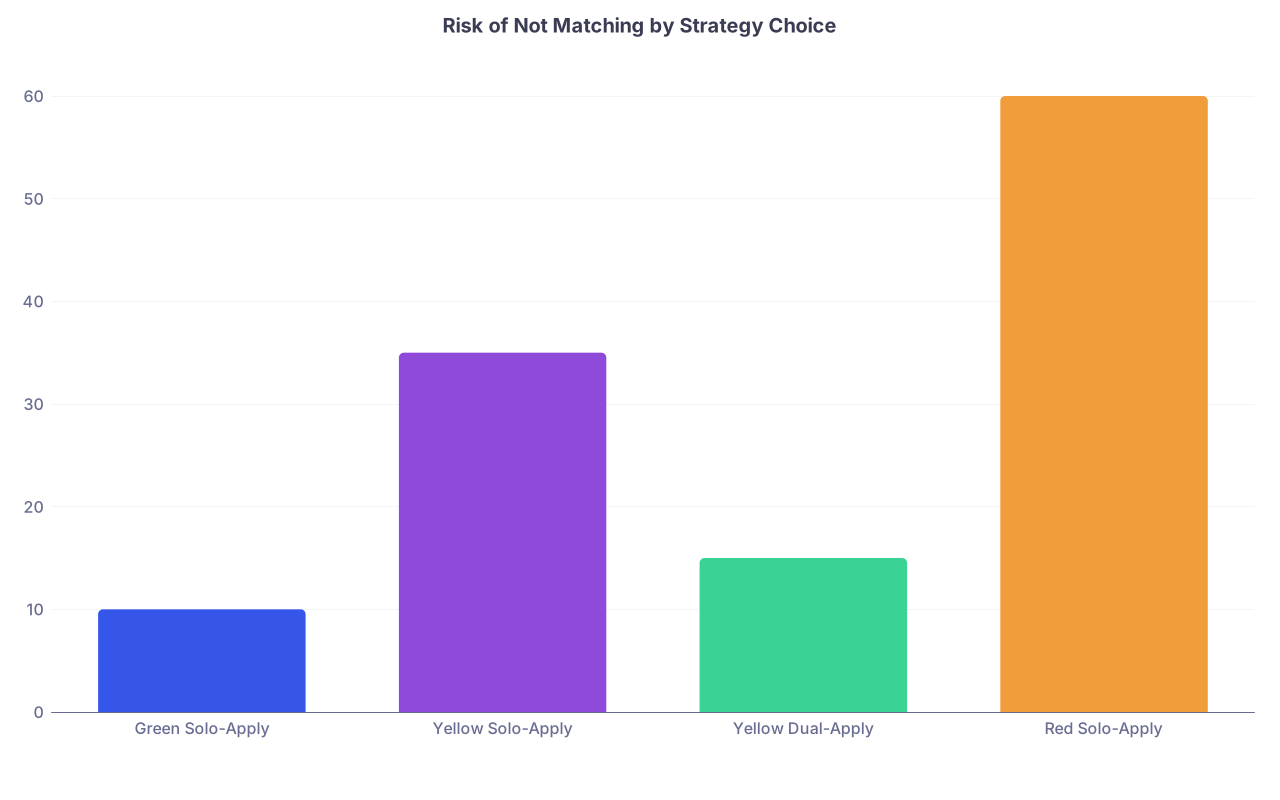
| Category | Value |
|---|---|
| Green Solo-Apply | 10 |
| Yellow Solo-Apply | 35 |
| Yellow Dual-Apply | 15 |
| Red Solo-Apply | 60 |
These numbers are illustrative, not literal NRMP stats. But the pattern is real.
If You’re Green Zone
Default: Solo-apply to that specialty.
You still need a rational list:
- Ultra-competitive (derm, plastics, etc.): often 60+ programs unless you’re truly top 5–10% of applicants and have geographic constraints.
- Competitive (rads, gas, ophtho, urology): 40–60 programs for most.
- Moderate (IM, gen surg, OB, peds): 25–50 depending on your exact profile and flexibility.
You do not need a second specialty unless:
- You have a major red flag that may be read differently across specialties.
- You’re absolutely geographically rigid (one city, spouse constraints, etc.).
- Your advisor, who actually knows your file, is nervous.
If You’re Yellow Zone
This is where most people reading this actually fall. Here’s the decision tree I’d use:

| Step | Description |
|---|---|
| Step 1 | Identify Specialty Interest |
| Step 2 | Apply primarily to this specialty |
| Step 3 | Make this a reach, choose safer primary |
| Step 4 | Dual-apply |
| Step 5 | Solo-apply but very broad |
| Step 6 | Bucket for this specialty |
| Step 7 | Risk tolerance and back up acceptable? |
Yellow Zone, high-risk specialty (derm, plastics, neurosurg, etc.):
- I strongly prefer dual-apply unless you’d genuinely rather reapply than ever do a different field.
- That means: derm + IM; plastics + gen surg; ENT + gen surg; neurosurg + neurology/IM, etc.
Yellow Zone, moderate specialty (anesthesia, rads, EM in a sane year):
- Reasonable to solo-apply if:
- You are geographically flexible.
- You apply broadly.
- You are okay with possibly SOAPing into something else.
- Smarter to dual-apply if:
- You’re location-constrained.
- You’re at a weaker school.
- Your Step 2 is meaningfully below average for that field.
If You’re Red Zone
I’ll be blunt: for ultra-competitive specialties where you are solidly Red Zone, that field should be your reach, not your plan.
Example:
- US MD, Step 2 225, no research, wants derm.
- Realistic move: primary in IM (or FM/psych if that fits better), apply to a handful of derm programs if you accept that derm is essentially a lottery ticket for you this cycle.
Could you still someday end up in derm? Possibly, via research year, reapplication, or fellowship paths. But treating it as your only ERAS specialty today is how you court disaster.
Step 5: Factor in Your Personal Risk Tolerance and Backup Acceptability
Here’s the piece almost no one talks about: two people with the same stats should not necessarily make the same choice.
You need to be brutally honest about two things:
- How devastated would you be not matching this cycle?
- How okay would you be doing your backup specialty long term?
If:
- You’re okay taking a gap year or research year to reapply
- You absolutely cannot see yourself in a “safer” field
- You can tolerate serious uncertainty
…then you can afford to be more aggressive. Yellow pushing toward Red is acceptable.
If:
- You have family or financial pressures to match now
- You’d genuinely be content in 2–3 different specialties
- You hate risk
…then you should bias toward safer choices and dual-applications.
Step 6: Sanity-Check With People Who Actually Know Your File
Not Reddit. Not me. People who can see your full MSPE, letters, and school history.
You want:
- Your specialty advisor (for your desired field)
- Your dean or core advisor
- At least one faculty member who has placed multiple students into that field
Ask them directly:
- “Would you consider me a strong, average, or below-average applicant for this specialty from our school?”
- “If I only apply to this specialty, how worried would you be?”
- “If this were your kid, what would you tell them to do?”
If three out of three people are nervous about you solo-applying to an ultra-competitive field, that’s your answer.
Step 7: Build an Actual Application Strategy (Not Just a Vibe)
Once you’ve picked your lane (solo, dual, or pivot), you need an execution plan. Otherwise you’re just rearranging anxiety.
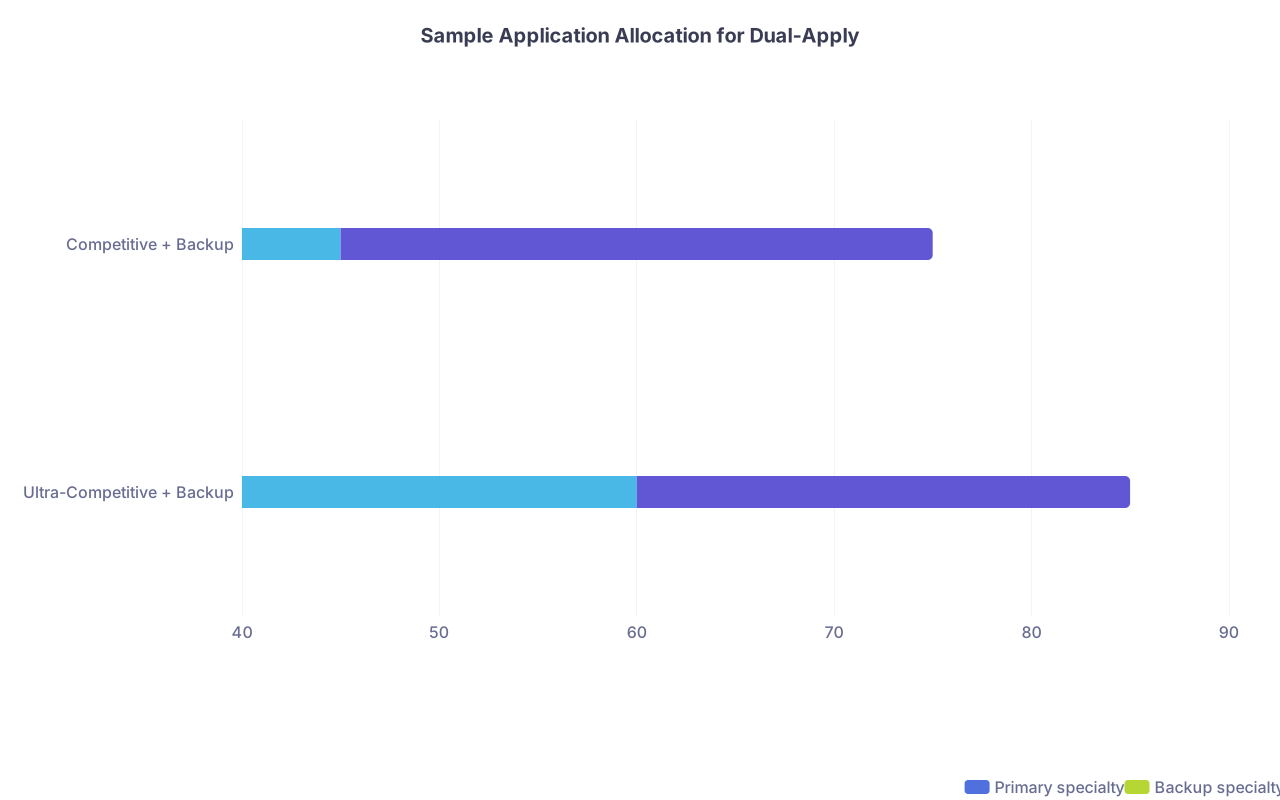
| Category | Primary specialty | Backup specialty |
|---|---|---|
| Ultra-Competitive + Backup | 60 | 25 |
| Competitive + Backup | 45 | 30 |
If you’re dual-applying:
- Aim for something like 60–70% of your applications to your dream specialty, 30–40% to backup.
- Make sure your personal statement and letters are specialty-specific and not generic nonsense that fits neither.
- Schedule interviews in a way that doesn’t sabotage one specialty for the other.
If you’re solo-applying to a competitive field:
- Go broad. More than you think. People regret not applying to enough programs far more than they regret spending a bit more money.
- Maximize away rotations where they actually help (surgical subspecialties, EM, etc.).
- Front-load Step 2 if it’s strong; if it’s weak, clean up everything else: letters, performance, research.
Quick Examples to Ground This
US MD, Step 2 256, 3 derm pubs, one derm away, strong letters
- Green Zone for derm at most mid-tier programs.
- Strategy: derm primary, apply ~60+ programs, consider no backup if geography flexible.
US DO, Step 2 238, no home radiology, 1 radiology poster, decent letters
- Yellow Zone for diagnostic radiology.
- If risk-tolerant: rads-only, apply very broadly.
- If risk-averse: dual-apply rads + IM.
IMG, Step 2 245, strong home-country CV, limited US experience, wants neurosurg
- Realistically Red Zone for US neurosurg.
- Strategy: primary in a more accessible field (IM or neuro), a very small neurosurg reach list if you understand odds are tiny.
A Simple Rule of Thumb
If you remember nothing else:
- If you’re at or above typical matched stats for that specialty and your advisors are comfortable, it’s not “too competitive for you.” Apply.
- If you’re close but clearly below, that specialty is borderline for you. Either dual-apply or accept real risk.
- If you’re far below what typical matched applicants look like, that specialty is a reach. Treat it like one. Build your real plan somewhere else.
You’re not trying to win a purity contest about passion. You’re trying to build a career. There are many ways to a happy, interesting, respected life in medicine that do not require playing Russian roulette with an ultra-competitive match.
Key Takeaways
- Stop asking “is this specialty competitive?” and start asking “where do I fall compared to people who match here?” Use the Green/Yellow/Red buckets.
- Yellow and Red Zone specialties aren’t forbidden, but they demand strategy: dual-applying, broader lists, and honest conversations about risk.
- The right answer isn’t just about stats; it’s about your risk tolerance and how acceptable your backup options really are to you. Match your strategy to both your numbers and your personality.