
What number of interview invites lets you actually sleep the night before rank lists are due?
Let me be blunt: there’s a number where anxiety drops sharply. Below it, people scramble, add prelims, email programs. Above it, the stress shifts from “Will I match?” to “Where will I match?” That’s a very different problem.
This is about that number.
The Short Answer: General “Safe” Ranges by Competitiveness
You’re not looking for philosophy; you want concrete numbers. Here’s the direct framework I use when advising applicants.
- Less competitive specialties (FM, IM categorical at many places, peds, psych at non-elite programs)
- Moderately competitive (OB/GYN, EM, anesthesia, general surgery, some IM subspecial focus)
- Highly competitive (derm, ortho, ENT, urology, ophtho, plastics, neurosurgery, rad onc, IR, some top-tier anesthesia/EM/surgery tracks)
For competitive specialties, most applicants fall in that middle and high tiers.
Here’s the reality:
| Specialty Tier | Very Worried | Reasonable Chance | Safer Zone |
|---|---|---|---|
| Less Competitive | 3–6 | 7–9 | ≥10 |
| Moderately Competitive | 5–8 | 9–11 | 12–14 |
| Highly Competitive | 7–10 | 11–13 | 14–18 |
Key point: “Safe” is a probability game, not a guarantee. But if you want a mental target:
- Most moderately competitive specialties: aim for 12+ categorical interviews
- Most highly competitive specialties: aim for 14–18 interviews to feel reasonably safe
- If you’re in the “super-cutthroat” category (derm, PRS, neurosurg, urology, ophtho): survival math often starts looking better around 15+ interviews
And no, not all interviews are equal. I’ll get to that.
Why the Magic Numbers Aren’t Actually Magic
The NRMP and specialty matches don’t care about your feelings. They care about math.
In short:
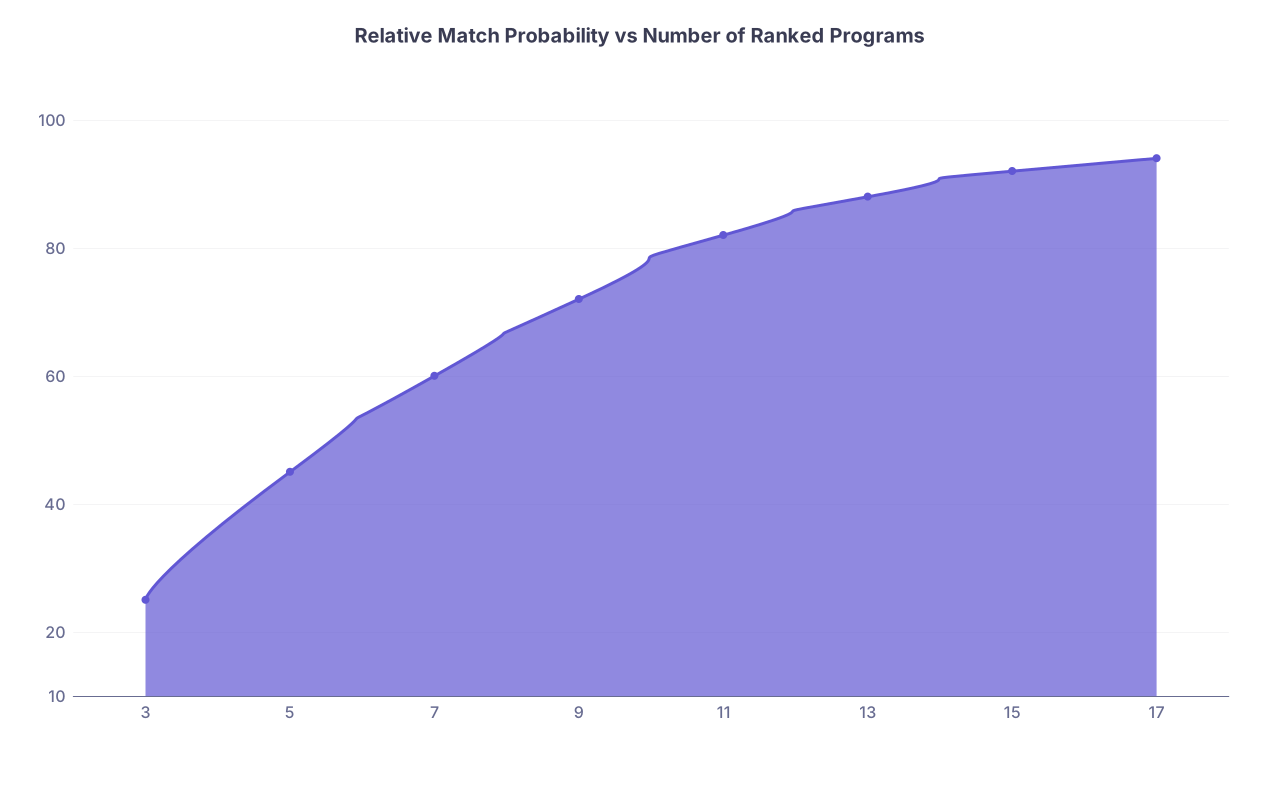
As you move from ~5 to ~15 ranked programs, your chance of matching doesn’t just creep up. It jumps.
Here’s the basic pattern I’ve seen across multiple NRMP Charting Outcomes and specialty match data:
- Going from 3 to 5 interviews helps, but lots of people still go unmatched.
- 6–8 interviews: you’re in “coin flip to slightly better” territory for many competitive fields.
- 10–12: the odds start looking decent for applicants who are not way below average.
- ≥14: the curve flattens. Each extra interview still helps, but less dramatically.
| Category | Value |
|---|---|
| 3 | 25 |
| 5 | 45 |
| 7 | 60 |
| 9 | 72 |
| 11 | 82 |
| 13 | 88 |
| 15 | 92 |
| 17 | 94 |
Are these exact numbers identical for every specialty? No. But the shape of that curve is very similar.
If you’re asking “When do most reasonably competitive applicants start to feel okay?”, it’s usually around:
- 10–12 interviews for moderate competitiveness
- 14–18 for truly brutal specialties
Below that, most people are still very aware they might not match.
Specialty-Specific Ranges: What’s “Enough” Per Field?
Let’s break out what most people actually want to know: “For my specialty, what’s enough?”
I’m grouping by competitiveness. These are generic guidance ranges for a typical US MD/DO applicant. If you’re an IMG, red flags, or underpowered application, you need to be above these.
| Group | Example Specialties | “Feel Safer” Target |
|---|---|---|
| High-High Competitive | Derm, Ortho, PRS, ENT, Neurosurg | 15–20 |
| High Competitive | Ophtho, Urology, IR, Rad Onc | 14–18 |
| Moderately Competitive | EM, Anesthesia, Categorical Surgery | 12–14 |
| Mid | OB/GYN, IM at stronger places | 10–12 |
Now in plain English.
Dermatology
- Below ~8: very nervous
- 8–12: possible, but I’ve seen people not match here
- 13–15: more reasonable
- 16–20: where most strong applicants start to breathe
If you’re US MD with solid apps and 14+ real derm interviews, you’re usually in decent shape. But “decent shape” is not “guaranteed.”
Orthopedic Surgery
Similar to derm in vibe:
- 6–8: danger zone
- 9–12: acceptable but not at all comfy
- 13–16: much safer
16: where strong applicants tend to land
If you have <10 ortho interviews, most people I’ve worked with also have a backup (prelim, different specialty).
Plastic Surgery (Integrated)
Brutal. Very small numbers, very high expectations.
- <8: I’d be worried
- 8–12: possible
- 13–16: where many ultimately matched applicants sit
16: strong position
Most PRS folks feel “kind of safe” in the mid-teens.
Neurosurgery
Similar story.
- 6–8: serious risk
- 9–12: could match, but not a lock
- 13–16: decent safety
16: strong
Most neurosurgery applicants I’ve seen happy by rank list time had 13+ interviews.
ENT (Otolaryngology)
- 6–8: uneasy
- 9–12: possible
- 13–16: better
16: solid range
Ophthalmology (SF Match)
Smaller match system, but same logic:
- <8: anxious
- 8–11: borderline
- 12–14: fair
- 15+: better
Urology (AUA Match)
- <7: uncomfortable
- 8–11: moderate risk
- 12–14: better
- 15+: more secure
Interventional Radiology (Integrated)
IR is sneaky-competitive and numbers are still maturing.
- 6–8: nervous
- 9–12: moderate
- 13–16: better
16: good
Almost everyone I’ve seen with 13+ IR interviews matched somewhere unless there were major red flags.
Rad Onc
Historically ultra-competitive, now in flux. But if you’re applying in an era where it’s tightened again:
- 7–9: borderline
- 10–13: decent shot
- 14+: safer zone
General Surgery (Categorical)
Surgery is competitive at good programs, but not derm-level nationally.
- 6–8: worry, especially if you care about program tier
- 9–11: okay-ish
- 12–14: where most categorical surgery applicants feel reasonably safe
- 15+: strong
Anesthesiology
Varies by cycle, but generally:
- 6–8: borderline
- 9–11: decent
- 12–14: usually feel okay
- 15+: strong
EM, OB/GYN, Strong IM
EM has been chaos some years, but historically:
- 6–8: uneasy
- 9–11: decent chance
- 12–14: solid
For OB/GYN and IM at more competitive programs (university, academic tracks), similar pattern.
Not All Interviews Are Equal: Quality vs. Quantity
This is where people mess up. They obsess over raw count.
Twelve interviews at:
- 8 low-tier community programs
- 3 prelim-only offers
- 1 advanced without a guaranteed prelim
…is not the same as:
- 12 true categorical interviews at a mix of academic and solid community programs.
Ask yourself:
- Is it categorical in my specialty, or prelim/transition year only?
- Are they real interviews (not “we’ll call you if we have space” phone chats)?
- Are they mostly in one geographic region that’s super saturated?
- Am I actually ranking all of these, or are some “I would never go” places?
If half your invites are for prelim years with no linked advanced spot, you are not as safe as the number suggests.
A decent rule:
- Count only categorical / advanced + guaranteed prelim interviews as true “safety” interviews for your specialty.
- Prelims are insurance against being completely unmatched, not against missing your field.
How to Adjust for Your Specific Risk Factors
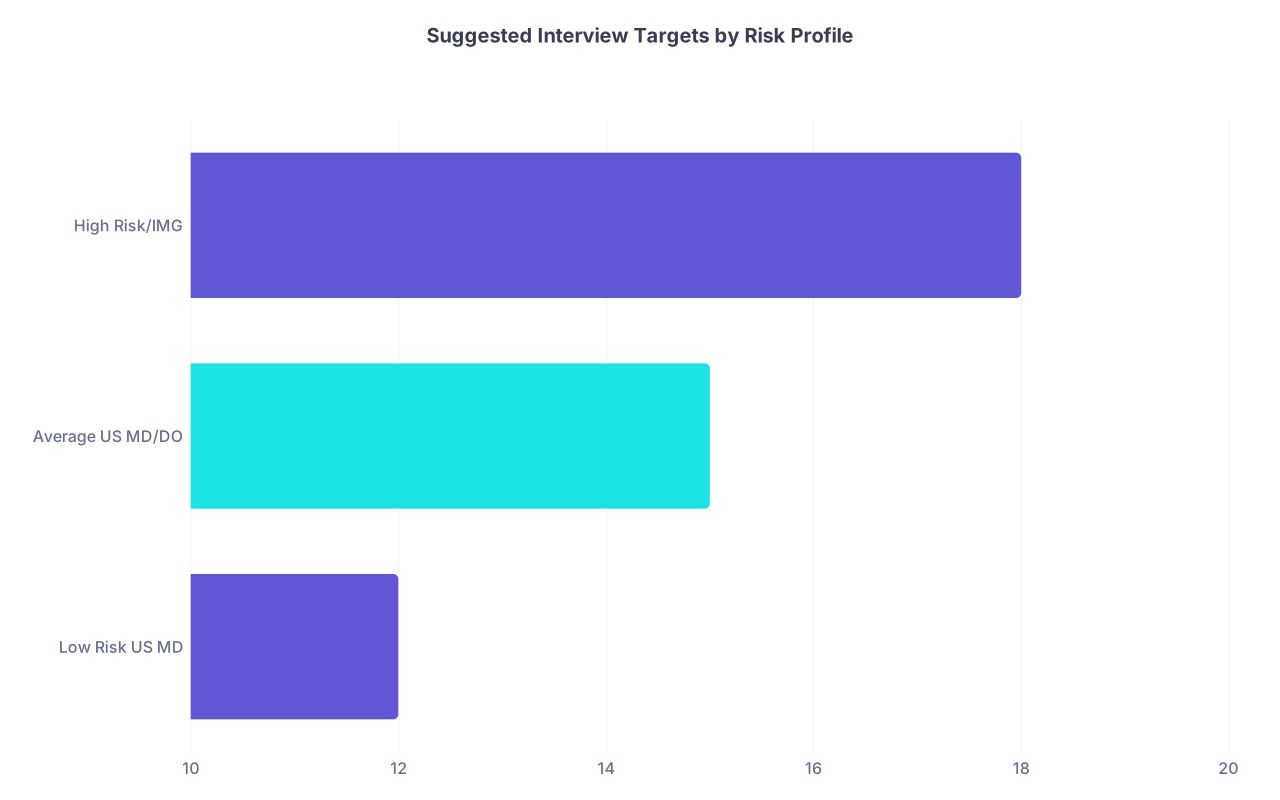
This is where you personalize the numbers. You should move your target up if you:
- Are an IMG (even strong ones often need significantly more interviews)
- Have a significant red flag (Step failure, probation, gap with weak explanation)
- Are switching specialties late without deep specialty-specific backup
- Have below-average scores/research for that field
- Are couples matching, especially if your partner is also competitive or geographically constrained
For example:
- A US MD derm applicant with strong stats: might feel okay at 13–15 derm interviews
- An IMG derm applicant: I’d want 20+ derm interviews before relaxing even a little
Same for ortho, PRS, etc.
| Category | Value |
|---|---|
| Low Risk US MD | 12 |
| Average US MD/DO | 15 |
| High Risk/IMG | 18 |
If you’re in a high-risk category and sitting at 8–10 interviews in a very competitive specialty, you should be:
- Aggressively holding onto prelims or backup specialties
- Talking honestly with mentors
- Expanding geography and program tier expectations if you still can
When You Should Start to Worry (And What to Do)
Here’s the gut-check timeline I’ve seen over and over.
Mid-season, you’re at:
- 0–4 interviews in a highly competitive specialty: you’re in trouble for that field unless you have late-wave expectations from specific programs.
- 5–7: you are absolutely not safe; you should be in backup/plan B mode.
- 8–10: you’re in “can match, but cannot relax” territory.
- 11–13: borderline-comfortable if you’re a reasonably strong applicant with no major flags.
- 14–18+: now you’re mostly choosing where you’d be okay living.
If you’re under about 10 in a high-competitive field by the time invites clearly slow (you’ll feel it; people stop posting new invites in your group chats), you should:
- Talk to someone real. A PD you know, trusted faculty, not random Reddit.
- Clarify your real risk level. Scores? Letters? Red flags?
- Secure a backup. Prelim surgery, TY, IM prelim, or a second specialty that’s realistic for your numbers.
- Keep every reasonable interview. This is not the time to get picky about “prestige” over “anywhere vs nowhere.”
How Many Is “Too Many”? The Overkill Question
Yes, you can overdo it.
At some point, each extra interview:
- Costs time and money
- Adds fatigue
- Doesn’t meaningfully change your probability of matching
If you already have:
- 15–18 decent interviews in a highly competitive specialty
- Or 12–15 in a moderately competitive one
…you’re almost always better off canceling the lowest-fit ones once you’re sure you’re safely above your personal target band.
Don’t flex by going on 25 interviews unless you have money, time, and zero burnout risk. I’ve watched people drag themselves through January interviews so exhausted they barely remember programs. It’s not impressive. It’s just sloppy.

Practical Decision Framework: Are You Safe Enough?
If you want a quick check, run through this:
What group is your specialty in?
- High-high, high, moderate?
How many categorical/real interviews do you have?
Where do you sit relative to this rough guidance?
- High-high competitive: under 10 = worried, 10–13 = maybe, 14–18 = better
- High competitive: under 9 = worried, 9–12 = maybe, 13–16 = better
- Moderate: under 8 = worried, 8–10 = maybe, 11–14 = better
Any major risk factors (IMG, red flags, low stats, couples match)?
- If yes, mentally subtract 2–4 from your comfort level.
If after that you’re:
- Still under ~10 in a high/high-high field → not safe.
- Around 11–13 with decent stats → cautious optimism, keep everything.
- 14+ and average or better applicant → you can start canceling the weakest fits if burned out.

| Step | Description |
|---|---|
| Step 1 | Count true categorical interviews |
| Step 2 | Target 15 to 20 |
| Step 3 | Target 14 to 18 |
| Step 4 | Target 12 to 14 |
| Step 5 | Activate backup plan |
| Step 6 | Keep all remaining interviews |
| Step 7 | Consider canceling lowest fit |
| Step 8 | Finish season as planned |
| Step 9 | Specialty competitiveness |
| Step 10 | Below target by 4+? |
| Step 11 | Above target by 3+? |
Common Mistakes I See Every Year
Let me call out the big ones:
- Counting prelim only interviews as if they’re categorical safety. They’re not.
- Pretending that 7 derm/ortho/PRS interviews is “actually pretty good.” It’s not good. It’s survivable with luck.
- Canceling “less desirable” programs early when you’re at like 9 total interviews “to be kind to others.” Kindness is good; self-sabotage isn’t.
- Using one friend’s experience (“my buddy matched ortho with 6 interviews”) as your benchmark. Survivorship bias at its finest.
- Ignoring red flags and assuming the generic NRMP numbers apply to you 1:1. They don’t.

FAQ: Competitive Specialty Interview Numbers
1. I have 8 interviews in a very competitive specialty. Should I be panicking?
Not full panic, but you should be concerned. Eight is squarely in “could match, could easily not” territory for derm, ortho, PRS, neurosurg, ENT, ophtho, urology, IR. You need a backup plan: prelims, a second specialty, or at least brutally honest talks with mentors.
2. Do virtual interviews change how many I need to feel safe?
No, not meaningfully. Virtual made it easier to attend more interviews, which pushed some people into silly-high counts, but the match math didn’t change: more ranked programs still increase your odds in roughly the same curve. Don’t assume 8 virtual interviews = 12 in-person. They don’t.
3. I’m couples matching into two competitive specialties. How many is “enough”?
You both need more. Couples matching effectively narrows your actual options because both partners’ rank lists need overlap. I’d add at least 3–5 interviews to your “feel safe” target for each of you, and I’d strongly consider including some less competitive or broader-geo options on both lists.
4. Should I ever cancel interviews before I hit those “safe” ranges?
Only if you truly would not rank that program at all. If you’d rather go unmatched than go there, sure, cancel. Otherwise, keep it. Interview fatigue is real, but being unmatched is worse. Start canceling aggressively only once you’re clearly above your personalized “safe enough” range.
5. I have 15+ interviews but several are low-tier or in places I don’t love. Am I overshooting?
If you’re already above your target and burning out, yes, you can safely cut the lowest-fit few. But don’t get cocky: I’d still keep a mix of “anywhere I can be trained” programs, even if they’re not sexy on paper. Prestige looks great on Instagram; a job in your field looks better in real life.
Bottom line:
Aim higher than your anxiety wants to admit. For competitive specialties, most people start to genuinely relax somewhere between 12 and 18 real, categorical interviews, depending on the field and their risk profile. Count only meaningful interviews, adjust for your personal risk, and don’t let one lucky friend’s story become your strategy.