
You’re staring at your Step scores and class rank with three tabs open: dermatology, orthopedic surgery, ENT. Every forum you read says something different. One spreadsheet tells you you’re fine. A resident on Reddit says you have “no shot.” Your dean shrugs and says, “Apply broadly.”
You want something better than vibes. You want to know: based on my numbers, where do I actually stand for derm, ortho, or ENT?
Here’s the answer you’re looking for: a blunt, specialty-specific way to interpret your profile and decide if you should push, pivot, or protect yourself with a backup.
Step 1: Know What Actually Matters (Numbers Only)
For derm, ortho, and ENT, programs still care about objective metrics, even with Step 1 pass/fail. The big numerical levers:
- Step 2 CK score
- Class rank / AOA / MSPE language
- Research output (especially derm)
- Home program / audition rotation performance (especially ortho and ENT)
Before we dive into each specialty, lock in your baseline:
- Step 2 CK: below 230, 230–239, 240–249, 250–259, 260+
- Class rank: top 10–25%, middle, or bottom third
- School type: top 20 research, mid-tier, new/less-known, DO, or IMG
You’re going to use those categories repeatedly.
Step 2: Current Competitiveness Snapshot
Let me give you a quick mental scoreboard. This is approximate, but it tracks with what applicants actually see on the interview trail.
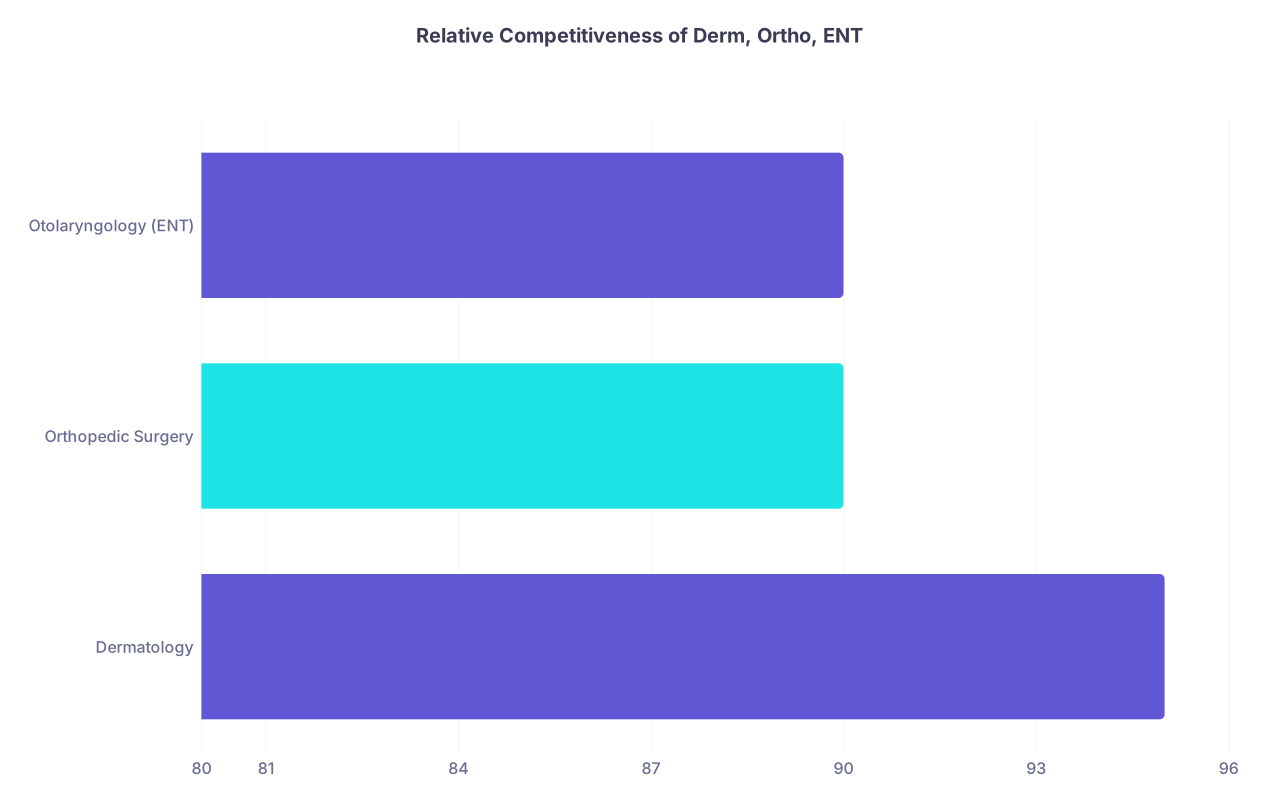
| Category | Value |
|---|---|
| Dermatology | 95 |
| Orthopedic Surgery | 90 |
| Otolaryngology (ENT) | 90 |
Think of it this way:
- Dermatology: absurdly competitive. Heavy research culture. Small field.
- Ortho: numbers + “known quantity” from rotations. Alpha culture, but predictable.
- ENT: also intense, slightly smaller applicant pool, strong emphasis on letters and rotations.
None of these are forgiving if your numbers are weak. But “weak” is different across specialties. So let’s break it down.
Step 3: Dermatology – Do You Have the Numbers?
Derm is ruthless on paper. Programs are drowning in applicants with high Step 2 scores and a stack of pubs. They cut hard on the front end.
Here’s the basic score reality for derm:
| Step 2 CK Range | Rough Competitiveness for Derm |
|---|---|
| 260+ | Strong at many programs |
| 250–259 | Competitive, but need support |
| 240–249 | Possible, but uphill |
| 230–239 | Very limited, niche paths |
| <230 | Almost always fatal |
Now layer in everything else.
If you’re 260+
You’re in the zone where derm is realistic.
You’re in good shape for derm if most of this is true:
- Step 2 CK 260+
- Top 25% of class, ideally AOA or “outstanding” MSPE language
- 1+ derm-focused research projects, ideally at least one actual publication or accepted abstract
- You have a home derm program OR did a derm research year OR have a strong connection to a derm department
This profile gets you serious looks at many university derm programs. You’re not guaranteed anything—this is derm—but you’re playing the right sport.
You’re more borderline (but still viable) if:
- 260+ but mid-class rank and minimal derm research
- No home derm program, but decent generic research
Translation: you can still match derm, but you should:
- Apply very broadly (70+ programs isn’t crazy here)
- Consider prelim medicine backup
- Strategically add a second specialty that fits your story if your dean points that way
If you’re 250–259
You’re not out. But you’re not a slam dunk either.
You’re still a reasonable derm candidate if:
- 250–259 AND
- Strong derm research (multiple abstracts/posters, at least one publication or serious involvement)
- Strong letters from derm faculty who know you
- Good narrative fit—something in your application that screams “future academic dermatologist,” not “person who suddenly decided derm is chill.”
If you’re 250–259 without derm research, your chances drop fast. You can still try derm, but you’d better:
- Be willing to do a dedicated derm research year, or
- Accept that derm might fail and have a realistic backup (usually IM, prelim + another advanced field, or a less competitive specialty that you genuinely like)
If you’re 240–249
Now we’re in “you need an angle” territory.
Derm is not impossible, but this is what it usually takes in this range:
- Serious derm research: 1–2 years, multiple papers/abstracts, possibly at a big-name institution
- Strong relationships with derm faculty who will call programs for you
- A home program (or place you spent a research year) that is actively willing to advocate for you
Without that, you’re mostly burning money. The match stories in this range almost always come from applicants who did a research year and became essentially part of a derm department for 12–24 months.
If you’re <240
Be blunt with yourself: traditional derm is very unlikely unless you have:
- Multiple derm research years
- Significant publications
- A well-connected mentor actively pushing your application
Even then, the odds are not kind. If you’re here, ask a derm PD or research mentor for their honest read. Often the saner path is:
- Internal medicine → dermatology fellowship path (cutting edge, but not mainstream yet)
- Pivot to another specialty you actually enjoy that uses similar skills (allergy/immunology later, rheum, etc.)
Step 4: Orthopedic Surgery – Do You Have the Numbers?
Ortho loves two things: numbers and “known quantities.” They care about Step 2, but they also care deeply about:
- How you perform on audition/sub-I rotations
- What the attendings say about you behind closed doors
Let’s frame the Step 2 ranges for ortho:
| Step 2 CK Range | Rough Competitiveness for Ortho |
|---|---|
| 255+ | Strong at many programs |
| 245–254 | Competitive, depends on extras |
| 235–244 | Possible, needs strong rotations |
| 225–234 | Steep uphill, niche match cases |
| <225 | Very low odds |
If you’re 255+
You’re in very good numerical shape.
You look strong for ortho if:
- 255+ Step 2
- Solid clinical evaluations, especially surgery core
- You have a home ortho program or did away rotations at 2–3 reputable programs
- You’re not socially awkward on rounds (yes, this matters more here than in some other fields)
Programs will still screen hard on fit, letters, and performance on audition rotations, but your application will get through the initial cuts.
If you’re 245–254
Still very realistic for ortho.
In this range, your fate is more tied to your rotations and letters:
- Do you have at least one ortho away rotation where you were clearly in the top tier of students?
- Do you have letters saying things like “top 5% of students I’ve worked with in 10 years”?
- Do residents like working with you, or do you come off entitled / disinterested?
With strong rotations and that score range, you’re a legitimate candidate. Without strong rotations, even a 250 can stall.
If you’re 235–244
This is where away rotations become life-or-death.
You can still match ortho here if:
- You absolutely crush your home and away ortho rotations
- You get very strong letters from ortho faculty (ideally from programs where you’d be happy to match)
- You apply broadly, target mid-tier and community programs, and listen to your advisors on where to spend aways
I’ve seen multiple applicants in this band match at solid programs because attendings advocated for them after seeing them work. I’ve also seen people with these scores ignore advice, only apply to top-tier academic places, and go unmatched.
If you’re 225–234
You’re in long-shot land for categorical ortho, without a compelling angle.
Someone in this range can still match if:
- You’re a DO or MD with a strong home ortho program that knows and loves you
- Your letters are exceptional and personal
- You’re geographically flexible and cast a very wide net
Still, you need a safety plan: either a backup specialty or a realistic openness to a surgical prelim year with a plan B.
If you’re <225
For most people, categorical ortho is not realistic at this score. You can still:
- Talk to your home ortho faculty and PDs
- Think seriously about other surgical fields where your personality and skills still fit (general surgery, PM&R with a sports angle, etc.)
The worst move here is denial—burning a year and thousands of dollars on a 1–5% shot without a clear backup.
Step 5: ENT (Otolaryngology) – Do You Have the Numbers?
ENT behaves a bit like ortho plus derm: high numbers matter, but your face and performance on away rotations matter just as much.
Rough Step 2 ranges for ENT:
| Step 2 CK Range | Rough Competitiveness for ENT |
|---|---|
| 255+ | Very competitive |
| 245–254 | Solid, depends on package |
| 235–244 | Possible, needs strong fit |
| 225–234 | Rare, special cases |
| <225 | Very unlikely |
If you’re 255+
Numerically excellent for ENT.
You’re in a strong position if:
- 255+ Step 2
- Strong surgery and ENT rotations
- You have a home ENT program or did multiple ENT aways
- ENT research is a plus but not as non-negotiable as derm research is for derm
Programs will care a lot about:
- How you worked on their service (if you rotated there)
- How residents and nurses perceived you
- If your letters say “future ENT leader” or just “solid student”
If you’re 245–254
Still in the main competitive band.
You match ENT from this range with:
- 1–2 strong ENT away rotations where you built relationships
- Good letters from ENT faculty (ideally with national or regional recognition)
- A believable narrative: why ENT, why now, why you
If you have no ENT exposure or research and you show up at the start of fourth year saying “I think ENT is cool,” programs will read that as a red flag, even with a good score.
If you’re 235–244
Matchable, but you need to be smart and deliberate.
You should:
- Prioritize strong away rotations at programs that actually take outside rotators seriously as applicants
- Avoid overloading your list with only the top 20 prestige programs
- Let ENT faculty help you build a sane list
I’ve seen plenty of applicants in this band match at solid university or hybrid programs because they were outstanding on service, kind to everyone, and had genuine ENT interest.
If you’re 225–234
Now ENT becomes a narrow path.
A few situations where match is still plausible:
- You’re at a strong home ENT program that is willing to rank you highly
- You have unique, long-term ENT research or a story that makes PDs remember you
- You accept geographical constraints and apply accordingly
Still, most people here should have a genuine backup specialty that they would be okay living in.
Step 6: MD vs DO vs IMG – How Harsh Is the Reality?
Harsh truth: derm, ortho, and ENT are harder for DO and IMG applicants. Not impossible. Just harder.
Here’s the broad reality:
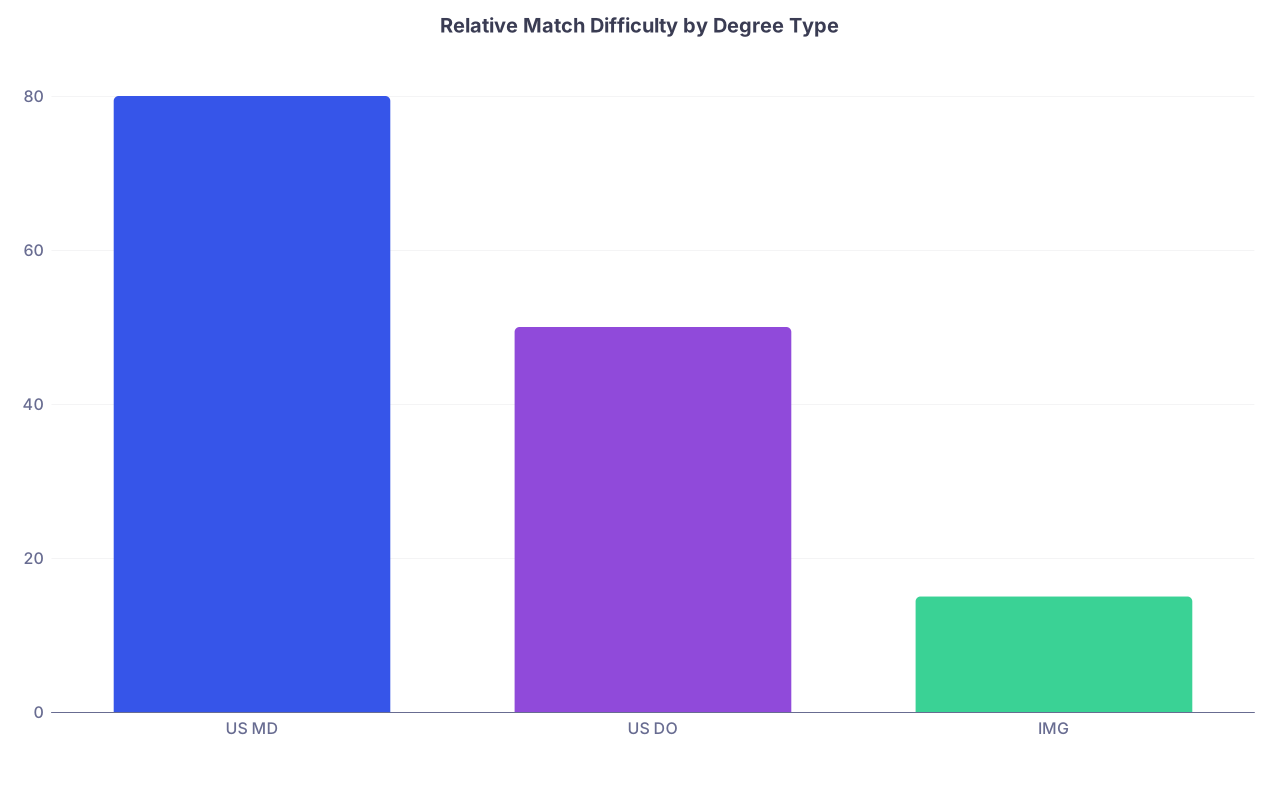
| Category | Value |
|---|---|
| US MD | 80 |
| US DO | 50 |
| IMG | 15 |
Those numbers aren’t exact match rates; they just reflect relative ease.
To be taken seriously as a DO or IMG in these fields, you generally need:
- Scores at the high end of the ranges we’ve been talking about
- US-based research (especially for derm)
- Strong letters from MD faculty at known programs
- Often, a research year at a major academic center
If you’re a DO or IMG with mid-range scores for these specialties and no significant research or connections, the match odds are very low. You can still try, but you absolutely must have a more attainable backup.
Step 7: A Simple Decision Framework
You want a quick way to decide: push, hedge, or pivot?
Use this:

| Step | Description |
|---|---|
| Step 1 | Check Step 2 CK score |
| Step 2 | Strong derm research and mentor? |
| Step 3 | Apply derm, broad list, consider backup |
| Step 4 | Do derm research year or pivot |
| Step 5 | Very low odds for derm ortho ENT |
| Step 6 | Focus on strong aways and letters |
| Step 7 | Apply broadly, include mid tier |
| Step 8 | 250 or higher? |
| Step 9 | Derm interest? |
| Step 10 | 240 or higher? |
| Step 11 | Ortho or ENT interest? |
Translated:
- If you’re ≥260 and interested in any of these: you’re numerically fine. Focus on research (for derm) and rotations/letters (for ortho/ENT).
- If you’re 245–259: still very realistic, but everything else matters more (research for derm, aways for ortho/ENT).
- If you’re 235–244: narrow it down to one of these, build a very targeted strategy, and almost certainly have a backup.
- If you’re <235: derm/ortho/ENT becomes niche-case territory. You need very strong offsets (research year, home program advocacy) or a serious conversation about other fields.
Final Thoughts: What To Actually Do Next
Three things you should walk away with:
Your Step 2 number sets your lane.
Above ~250, derm/ortho/ENT are realistically on the table. 240s? Selective, strategic, and supported. Below that, you’re in “special-case” territory and should be brutally honest about your odds.For derm, research is oxygen.
You don’t get far without visible derm involvement, especially under 260. For ortho and ENT, performance on away rotations and letters can save or sink you, even with high scores.Do not guess alone.
Take your score bands and this framework to a specialty advisor or PD who knows the current match for your school. If their read and this article disagree, ask why. Then build a plan that’s aggressive but not delusional.
You cannot control how competitive these specialties are. You can control how clearly you assess your profile and how intelligently you respond to it.