The blunt truth: delaying graduation one year is sometimes absolutely worth it—and sometimes absolutely dumb. The difference comes down to your numbers, your specialty, and what you can actually accomplish in that extra year.
Let me walk you through how people really use a “gap year” before graduation for competitive specialties, when it pays off, and when it’s just expensive procrastination dressed up as strategy.
1. Start With the Only Question That Matters
Forget the feel-good narratives for a second.
The real question is this:
If you apply this cycle, are you realistically competitive for the programs and specialty you actually want?
Not “could I maybe scrape a match somewhere if I shotgun 80 programs.”
I mean: for your target tier, in your specialty, with your geography limits.
If the honest answer is “probably not,” a deliberate one-year delay can be a smart, calculated move. Especially in:
- Dermatology
- Plastic surgery (integrated)
- Orthopedic surgery
- Neurosurgery
- Otolaryngology (ENT)
- Radiation oncology (variable but often research-heavy)
- Some road specialties at top-tier academic programs (radiology, anesthesia, EM at elite places)
In those fields, an extra year:
- To publish solid research with a known name
- To fix a weak Step 2 or class rank story (as much as possible)
- To get stronger letters from big names
…can literally be the difference between matching vs reapplying after a failed cycle.
But delaying only makes sense if:
- You have a clear, specific plan for what you’ll do in that year, and
- What you’ll do is aligned with what program directors in that specialty actually care about.
If you cannot answer those two points clearly, you’re not ready to delay.
2. What a “High-Value” Delay Year Looks Like (vs a Useless One)
I’ve watched this play out dozens of times. There are good delay years and bad delay years. Programs can tell which you had within 30 seconds of opening your application.
High-value delay year usually looks like one (or a blend) of these:
Dedicated research year in your specialty
- Full-time research in derm, ortho, ENT, neurosurgery, etc.
- You’re on-site, integrated with the team, going to conferences, presenting at grand rounds.
- Outcome: abstracts, posters, ideally 1–3 solid publications where your name isn’t buried as #17.
Formal research fellowship
- E.g., one-year research position in orthopedics, neurosurgery, cardiology, etc.
- Sometimes paid. Often structured. PDs know these programs and value them.
- Outcome: brand-name recommendations plus research output.
Extra degree or structured program that fits your specialty
- MPH, MHS, or MS with heavy research if you’re aiming academic IM, EM, or competitive fellowships later.
- Only makes sense if you are actually building a research portfolio, not just collecting a line on the CV.
Targeted clinical year that strengthens story + letters
- Substantial work as a research fellow with clinical exposure, or a non-ACGME clinical year in related specialty.
- You earn strong, specific letters from faculty in that exact field.
“Low-value” delay year looks like:
- Random online MPH with almost no research.
- Working part-time in urgent care while “figuring things out.”
- Vague “research” where you’re not embedded in a specialty team, and you end the year with nothing submitted.
- Shadowing but no concrete output, responsibility, or leadership.
Programs can smell fluff. A “gap year” that doesn’t clearly move the needle is more red flag than asset.
3. How Much Does a Year Actually Help in Competitive Specialties?
Let’s put some rough numbers and expectations on this.
| Specialty | When a Delay Helps Most | Typical Benefit |
|---|---|---|
| Dermatology | Low research, mid scores, no derm letters | Big – can move you into the pool |
| Plastics (Int) | Weak research, limited exposure, generic letters | Big – boosts connections & output |
| Ortho | Average app, limited ortho research | Moderate–big |
| ENT | Few ENT letters, no ENT research | Big – field is small & networked |
| Neurosurgery | Minimal research, generic letters | Often essential |
| Radiology | For top academic places with research focus | Moderate |
And here’s the important nuance:
For ultra-competitive specialties, not fixing obvious deficits usually leads to either:
- No match, or
- Matching at a program/region completely misaligned with your goals.
So the calculation is often:
Option A: Apply now, risk not matching, burn a cycle, and then be forced into another year anyway as a re-applicant.
Option B: Take a deliberate year before applying, build a much stronger application, and apply once from a better position.
In many cases, B is actually more efficient and less demoralizing.
4. The Money, Time, and Burnout Equation
Let’s not romanticize this. A delay year is expensive.
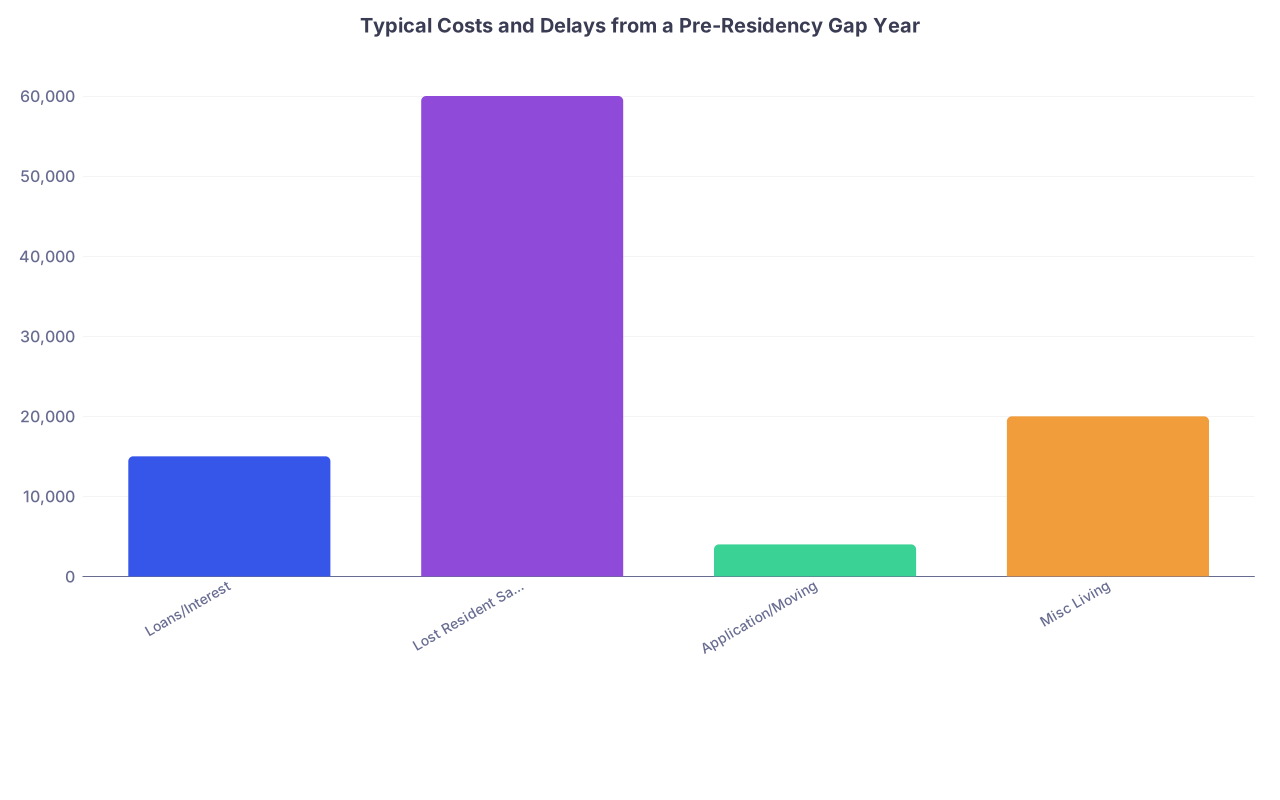
Here’s a rough breakdown of what you’re trading:
| Category | Value |
|---|---|
| Loans/Interest | 15000 |
| Lost Resident Salary | 60000 |
| Application/Moving | 4000 |
| Misc Living | 20000 |
You’re looking at:
- Extra year of living expenses (often $20–30k minimum)
- Another year of loan interest accruing
- Loss of PGY-1 salary and benefits (easily $55–70k depending on region)
- Emotional cost: watching your class graduate and move on while you stay behind
This is why I’m harsh about “fuzzy” gap years. If you’re spending that kind of money and delay, you better walk away with:
- Multiple strong, field-specific letters
- Tangible output: at least submitted manuscripts and completed projects
- A tight narrative: “I spent this year doing X, Y, Z in [specialty] which prepared me to be an effective [specialty] resident.”
If you cannot get that where you are, consider moving—literally—to a place that will give you that (research fellowship, big academic program, etc.).
5. A Simple Decision Framework: Should You Delay?
If you want a straightforward way to think about this, use a quick triage model.

| Step | Description |
|---|---|
| Step 1 | Want Competitive Specialty |
| Step 2 | Apply Now |
| Step 3 | Consider Less Competitive Specialty |
| Step 4 | Do Not Delay Yet - Find Plan |
| Step 5 | Delay 1 Year with Clear Goals |
| Step 6 | Currently Competitive? |
| Step 7 | Can Fix in 1 Year? |
| Step 8 | High Value Plan Available? |
Ask yourself:
Am I clearly competitive right now?
Compare honestly to successful applicants at your home program. If your Step 2, research, and letters are clearly weaker, that’s a red flag.Can the major weaknesses be fixed in a focused year?
- Low research? Yes, usually fixable.
- No specialty exposure? Yes, fixable.
- Weak letters? Yes, fixable with real time in that department.
- Historically low test scores/failed Step? Harder—one year helps the narrative but doesn’t erase this.
Do I have access to a real high-yield opportunity?
- A known research group with track record of getting people into that specialty.
- A dedicated fellow position (even unofficial) with real responsibilities.
- Faculty explicitly telling you, “If you work with us for a year, we can strongly support your application.”
If you only have vague ideas like “I’ll find something in dermatology research somewhere,” you’re not ready to commit.
6. Specialty-Specific Realities
Let’s hit a few high-yield examples.
Dermatology
- Hyper-competitive, research-heavy, small field.
- A derm research year at a strong program with known faculty can be a game changer.
- PDs actually expect and respect gap/research years in many derm applicants.
- Weak “random basic science” with no derm angle is less useful than 1–2 solid derm clinical projects with strong letters.
Orthopedic Surgery
- One-year ortho research fellowships are very common.
- They often function as a “trial run” for the program to see if they want you.
- If your Step 2 or rank is borderline, this can be the difference between matching vs not, especially at academic programs.
Neurosurgery
- Many applicants do research years.
- The bar is high: you’re expected to care enough about the field to commit time to it.
- A strong year with neurosurgery faculty, resulting in papers + letters, is often not optional—it’s expected if your baseline metrics aren’t stellar.
ENT (Otolaryngology)
- Very network-driven.
- A year working directly with ENT faculty, especially at a place with fellowship programs, can dramatically improve your odds.
- Letters from known ENT names matter a lot.
Radiology / Anesthesia / EM (at top-tier academic places)
- For mid-tier or community programs, a delay year is often unnecessary if your scores and evaluations are good.
- For Harvard/MGH, UCSF, Hopkins-type programs, a research-heavy year with publications absolutely helps if you aim for a pure academic trajectory.
7. When You Probably Should Not Delay
There are situations where a delay is more self-sabotage than strategy:
- You’re switching into a much less competitive specialty (e.g., neurosurgery → family medicine). You usually don’t need a year to make that work.
- You’re already well above average for your chosen field with solid letters and no glaring gaps.
- Your main motivation is fear, not strategy: “I’m scared to apply” rather than “My application clearly has fixable weaknesses.”
- You don’t have a structured plan for the year and are hoping “something will come up.”
One more harsh reality: if you’ve got a failed Step exam or multiple major failures, a single year usually doesn’t erase that. It can help you craft a narrative, but it doesn’t magically turn you into a competitive derm/plastics candidate. Sometimes the wiser move is to recalibrate your specialty choice rather than stretch out training chasing something that’s statistically very unlikely.
8. How to Make a Delay Year Actually Work for You
If you decide to delay, treat the year like a job with performance metrics.
You should be able to define, before you start:
- Target number of projects you’ll join (and your role in each)
- Which conferences you’re aiming to present at
- Who you want letters from—and what they’ll see you doing day to day
- How your CV will look different 12 months from now
And yes, you track your own progress.
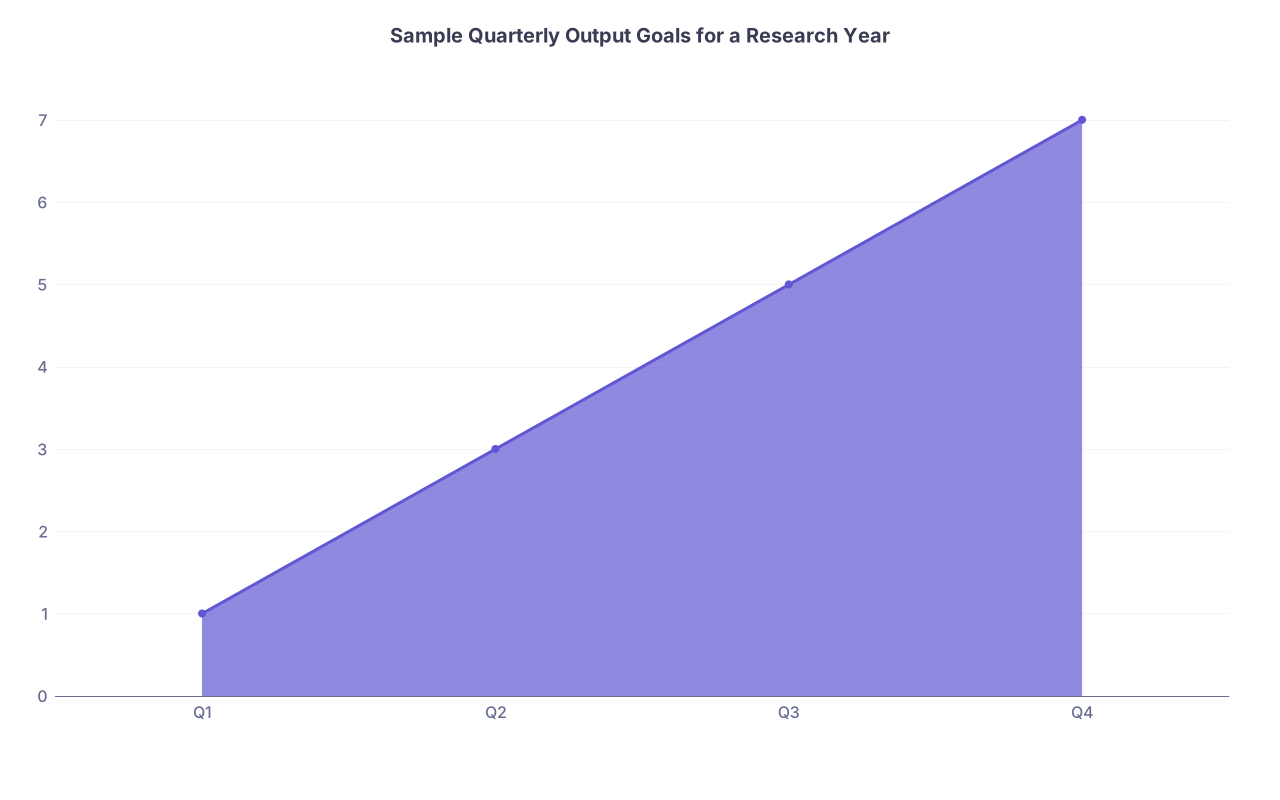
| Category | Value |
|---|---|
| Q1 | 1 |
| Q2 | 3 |
| Q3 | 5 |
| Q4 | 7 |
Example (reasonable) goals for a derm or ortho research year:
- Q1: Join 2–3 active projects, submit 1 abstract.
- Q2: Present 1 poster, draft 1 manuscript as first or second author.
- Q3: Submit 1–2 manuscripts, pick up 1 new project.
- Q4: Have at least 2 submissions, multiple abstracts, and letters from 2 major faculty.
If your environment cannot offer that type of opportunity, you’re in the wrong place for a delay year.
FAQ: Delaying Graduation One Year for a Competitive Application
1. Is it better to delay a year or risk not matching and then reapply?
Usually it’s better to delay before your first application if your deficits are obvious and fixable. A failed application cycle marks you as a re-applicant, which is a real disadvantage in many competitive specialties. A well-planned gap year before your first try is cleaner and often more effective than trying to “repair” after a failed match.
2. Will programs judge me for taking an extra year?
They’ll judge what you did with that year, not the mere fact that it exists. A clearly productive research or enrichment year in your specialty is often seen as maturity and commitment. A vague unstructured year—especially with weak explanation—is a red flag. You control how it looks by how you use the time.
3. Can a research year compensate for low Step 2 CK or mediocre grades?
It can partially offset them, especially in research-heavy fields. But it doesn’t erase them. Strong research, great letters, and proven work ethic can move you from “automatic no” to “worth an interview” even with mid-range scores. If your scores are far below typical for the specialty, a research year helps your best-case odds but doesn’t guarantee match.
4. Do I need to delay if I’m applying to a competitive specialty from a lower-ranked med school?
Not automatically. If your Step 2, class rank, and letters are strong—and you’ve done away rotations and solid specialty-specific work—you might not need a year. But if you’re from a less-known school and lack research or home specialty support (e.g., no derm department), a dedicated year at a bigger program can help level the playing field.
5. How do I find a good research or gap-year position?
You do not sit and wait. You email faculty directly, ask chiefs/program directors, talk to recent grads, and search for formal fellowships or research positions on department websites. Subject line like “Prospective research fellow – interested in [specialty]” with a tight CV attached works better than long essays. Aim for departments with a documented track record of helping students match into that field.
6. Bottom line: When is delaying graduation worth it?
It’s worth it when:
- You’re targeting a genuinely competitive specialty.
- Your current application is clearly below where it needs to be.
- You have access to a high-yield, structured opportunity in that specialty.
- You’re willing to treat the year like a serious professional investment, not a pause.
If those are all true, one well-used year can change your entire trajectory. If they’re not, you’re often better off applying now—or rethinking the specialty.
Key takeaways:
- A delay year is powerful only if it directly addresses clear, fixable weaknesses with structured, specialty-specific work.
- For derm, ortho, neurosurgery, ENT, and plastics, a strong research year can be the difference between matching and not.
- If you cannot clearly state what your extra year will produce, you are not ready to justify delaying graduation.