
The dangerous truth: most people over-rank “dream” programs and under-rank safer backups—then act surprised on Match Day.
You’re asking the right question: Should you rank a less competitive backup above a low-tier dream program?
Here’s the answer:
If the “dream” program is significantly more competitive than your realistic profile and the backup is somewhere you’d genuinely be okay training, then yes—you probably should rank the safer program higher. The algorithm favors YOUR preferences, but it cannot fix fantasy.
Let me walk you through how to decide without guessing.
1. First, stop misunderstanding the Match algorithm
The NRMP algorithm is applicant-favoring, but people routinely twist that into “I can shoot for the moon with no downside.”
Wrong.
Here’s what the algorithm actually does in plain English:
- It goes down your list, one rank at a time, trying to place you at your highest-ranked program that also ranked you high enough to fit you in.
- If a higher-ranked applicant comes later who that program likes more, you can be kicked out and tried at your next choice.
- You don’t get penalized for ranking competitive places high.
But you do get penalized if your list isn’t honest about your actual preferences given your real odds.
The key nuance:
The algorithm can’t turn a 1% shot into a 50% shot. Ranking a program #1 that’s a long shot doesn’t magically make it likely. If your realistic chance is near zero, ranking it above a “solid 70%” program only reduces your chances of matching somewhere acceptable.
Your rank list should reflect your true preference order weighted by reality, not your ego.
2. The core decision: dream vs backup – what are you actually choosing?
Strip away the labels. Instead of thinking:
“Low-tier dream vs safer backup”
Think:
“Much lower probability at a place I love vs much higher probability at a place I like/accept”
Here’s the real tradeoff:
- Option A: Maximize the chance of landing at the dream (but with serious risk of falling all the way down to programs you barely want—or not matching at all in competitive fields).
- Option B: Maximize the chance of landing at a solid, realistic program you’re okay with, even if it means giving up a small chance at the dream.
That’s not a math problem first. It’s a values problem.
So start with two blunt questions:
Would I rather be in my “backup” program than:
- Reapplying
- Switching specialty
- Scrambling into a prelim or unrelated field
If I land at the backup, will I feel mostly relieved or mostly resentful?
If you’d be relieved, that backup should not be buried under a 5% dream.
If you’d be furious with yourself for not shooting your shot, then the dream deserves to be above most backups.
3. Competitiveness reality check: are we talking 5% vs 70%, or 30% vs 60%?
The phrase “low-tier dream” is doing a lot of work here. In competitive specialties, “low-tier dream” often still means:
- Strong case volume
- Strong fellowship pipeline
- Great city or personal ties
- Big name in a niche area
But if it’s in a hyper-competitive specialty (derm, plastics, ortho, ENT, neurosurg, integrated IR, some ophtho, competitive gas/anesthesiology spots, certain rads programs), being “low-tier” doesn’t suddenly make it easy.
You need to answer:
How much of a long shot is this actually?
Rough guideline if you’re applying to a competitive specialty:
| Scenario | Dream Odds | Backup Odds | What I Usually Advise |
|---|---|---|---|
| Total long shot | ≤10% | ≥70% | Rank backup higher |
| Reach but plausible | 10–30% | 60–80% | Case-by-case; lean toward dream if backup is only 'fine' |
| Both realistic | 30–60% | 50–80% | Rank by genuine preference |
| Backup weak | Low | 40–60% | Consider more backup programs, do not rely on 1–2 |
If your “dream” feels like a lottery ticket—flew in for one interview, no strong connections, average to slightly below-average app for that program’s usual profile—then ranking it above a backup you’d be very content at is more emotional than rational.
4. A clean framework to decide your order
Here’s the decision framework I use with students when we’re staring at a rank list with this exact dilemma.
Step 1: Define three categories honestly
Make three columns, but don’t anchor on prestige—anchor on reality + happiness.
- Category 1: “I’d be thrilled”
Places you’d wake up happy to train, city/program fit is great, and odds are at least plausible. - Category 2: “I’d be content”
Maybe not exciting, but solid training, acceptable lifestyle/location, you can see yourself there. - Category 3: “I’d be disappointed but still go”
Programs you’d accept to avoid reapplying, but you’d feel a gut sink on Match Day.
Now, where do the “low-tier dream” and “less competitive backup” actually land?
If your “backup” is clearly in Category 2 and the dream is borderline Category 1–2 with low odds, that backup belongs much higher than most people are willing to admit.
Step 2: Add a risk penalty in competitive specialties
In fields with real non-match rates (derm, plastics, ortho, neurosurg, ENT, ophtho, some rads/anesthesia), being aggressive is far more dangerous.
Ask this blunt question:
If I do not match in this specialty, what is my plan and how devastated will I be?
If the honest answer is:
- “I will be crushed; reapplying or switching will be brutal”
→ Give more priority to realistic backups. - “I can live with doing IM/peds/FM or a research year and trying again”
→ You can prioritize the dream more.
Step 3: Use the “Would I trade?” test
For two programs A and B (A = dream, B = backup), answer:
If I woke up matched at Program B, and someone offered to magically switch me to Program A right now with no risk of going unmatched, would I take it?
- If yes → A should probably be ranked above B.
- If no → B should absolutely be ranked above A.
Do this honestly, away from classmates, without talking about prestige.
5. Common bad logic that will screw you
I’ve heard all of these. All are flawed.
“I should put the dream higher because it’s the one I want most, regardless of odds.”
That’s only true if you:- Have enough other realistic programs above your danger zone.
- Won’t regret falling way down your list or not matching if the dream doesn’t work out.
“Ranking it higher doesn’t hurt me, because the algorithm is applicant-friendly.”
It doesn’t hurt you mathematically if your list is already long and realistic.
But it hurts you if emotional wishful thinking pushes you to rank dream programs above backups you’d actually prefer to not risk losing.“I’ll feel like I sold out if I rank a backup higher.”
No, you’ll feel like you used your brain. You’re not choosing your worth; you’re choosing where you’ll train, sleep, and work 80 hours a week for years.“But this is my only interview in [prestigious city/low-tier academic/etc].”
Scarcity makes people irrational. One shiny outlier interview can distort your whole list. Judge it like any other: would day-to-day life and training actually be better than the backup?
6. Example scenarios: what I’d actually say
Let’s make it concrete.
Example 1: Dermatology applicant
- Applicant: Mid-tier derm candidate, 240s pre-pass Step 1 equivalent, solid research, average LORs.
- Program A (dream): Low-tier academic derm, coastal city, historically matches 250+ and has few IMGs, you felt okay but not amazing.
- Program B (backup): Community derm, midwest, strong clinical volume, not glamorous but solid, PD liked you, you vibed with residents.
Reality:
Your odds at A might be 5–10%. At B, maybe 60–75%.
If you’d be totally fine living in the Midwest for 3 years and you really want to do derm and avoid reapplying, I’d tell you straight:
Rank B over A. Then fill in the rest.
Example 2: Orthopedics applicant
- Applicant: Borderline ortho candidate, minimal research, 240s, decent letters.
- Program A: Low-tier university ortho in a great city, very competitive historically.
- Program B: Community ortho, less glamorous city, more realistic.
If you’ve already got 10–12 reasonably realistic ortho programs ranked above both A and B, and you’re okay reapplying or doing a prelim year if you miss—fine, put A above B. You’ve bought yourself some safety already.
If those are your only two interviews?
I’d rank B above A 100% of the time. Walking away unmatched to preserve a tiny chance at the “dream” would be irrational.
7. A quick visual: when to favor the backup
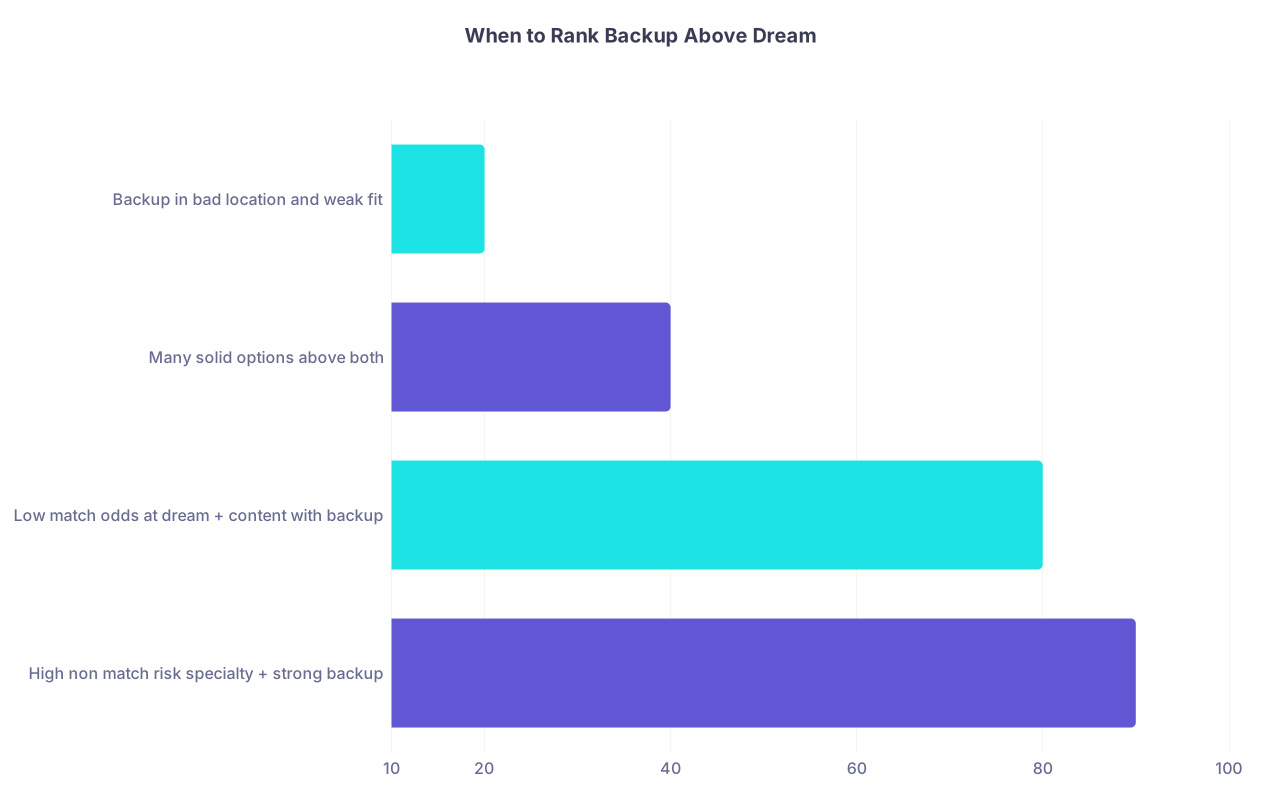
| Category | Value |
|---|---|
| High non match risk specialty + strong backup | 90 |
| Low match odds at dream + content with backup | 80 |
| Many solid options above both | 40 |
| Backup in bad location and weak fit | 20 |
Interpretation (rough, but useful):
- First two scenarios: Strong reasons to favor the backup.
- Third: Mixed—depends on how many “safe enough” programs are already above.
- Fourth: If the backup is truly miserable for you, then yes, the dream can go higher.
8. Practical steps: how to finish your list without spiraling
Here’s how I’d tell you to finish this up without losing your mind.
Write your “gut” list first.
No thinking about odds. Just pure “where would I be happiest if I 100% knew I’d match there?”Mark each program as: High, medium, or low chance.
Be honest. Talk to mentors if needed. Use your interview count, specialty competitiveness data, past match lists from your school.Look at places where “gut rank” and “reality” are in conflict.
That’s where your question lives: dream vs backup.For each conflict pair, answer:
- Would I rather be at the “safer” program than risk dropping far below both?
- If I match at the safer program, will I feel mostly relief or mostly regret?
Fix the obvious errors:
- A program you’d genuinely hate should drop, even if “it’s university.”
- A program you’d clearly prefer to reapplying should move up, even if it’s not sexy.
Stop tinkering.
People destroy good lists by endlessly micro-editing. Do one serious pass with honesty and data, maybe a second with a trusted mentor, then lock it.
FAQs
1. Does ranking a super competitive program high hurt my chances at backup programs?
No. The algorithm tries to put you in your highest-ranked program that will take you. Ranking a competitive place above a safer program doesn’t mathematically reduce your odds at the safer program—unless your fantasy ranking causes you to push realistic programs way down the list in a way that doesn’t reflect your genuine preferences.
2. Is it ever wrong to rank a “dream” #1 even if it’s a long shot?
It’s wrong if:
- Matching in the specialty at all is more important to you than that specific dream, and
- You have a clearly more realistic program you’d be very happy with.
If your entire career and mental health would be better served by securing “a good program” rather than gambling on one “perfect” name, then yes, putting the dream over that backup is a bad move.
3. How many “reach” programs is too many in a competitive specialty?
As many as you want—as long as:
- You’ve ranked a sufficient number of realistic programs above your “danger zone,” and
- You aren’t letting vanity keep great but less famous programs lower than they deserve.
If you only have a handful of interviews, you should be very conservative; every spot on that list matters.
4. Should I rank a low-tier academic dream above a strong community backup?
If your top priority is pure training/prestige and you’re comfortable with the risk of non-match or ending up at worse options, you can justify that. But if you know you’d be quite happy at the community program, the smart, risk-aware choice in competitive fields is often to rank the strong community higher.
5. What if my mentor says “just rank where you’d be happiest” and ignore competitiveness?
That advice works fine for highly matchable applicants in less competitive fields. It’s lazy in truly competitive specialties, especially when your application is borderline. You have to factor in both happiness and realistic odds. Your mentor doesn’t live with the consequences—you do.
Bottom line:
- Rank based on your true preferences, but weighted by realistic odds and your risk tolerance.
- In competitive specialties, a strong backup you’d be content with often deserves to sit above a low-probability “dream.”
- If you’d feel relief, not regret, landing at the backup—don’t bury it beneath a fantasy.