Last fall, a third-year at a mid-tier state school sat across from me, eyes wide. She wanted derm. Her school had exactly zero dermatology residents, no home program, and the closest derm department was two hours away. “Everyone says find residents in your field,” she said. “I literally don’t have any.”
If that’s you—chasing ortho, derm, plastics, ENT, neurosurg, optho, urology, radiation oncology, whatever—and your school has no residents in that specialty, you’re not just “behind.” You’re playing a different game. So you need a different playbook. Here it is.
Step 1: Stop Wishing For A “Normal” Path
You can waste a year being bitter that your school doesn’t have your specialty. Or you can accept the terrain and move.
You do not have:
- Built-in residents to tell you which away rotations matter
- A home program chair to “make calls” for you
- Automatic letters from people everyone on selection committees already knows
Fine. Then your strategy becomes:
- Borrowing other people’s ladders (external mentors, visiting students, virtual networks)
- Making your application impossible to ignore (scores, grades, research, narrative)
- Showing programs you can function without hand-holding
You’re not “less than.” You’re just not pre-packaged. If you execute well, some PDs will actually respect that.
Step 2: Build a Proxy Mentorship Structure Fast
You need guidance from somewhere in the field. Waiting for it to magically appear is how you end up unmatched.
A. Build an outside network in the specialty
Here’s the move set:
Identify 5–10 target programs in your specialty
- Mix: 1–2 highly competitive, 3–4 mid, 2–3 “safeties” (community or newer programs)
- Use FREIDA, program websites, and match lists from schools similar to yours.
Stalk (politely) for potential mentors
- Look for:
- Assistant/associate program directors
- Recent grads (within 5 years)
- Faculty with a “medical student education” title
- Check their publications—who works with students, who publishes education stuff, who has “mentorship” language in their bios.
- Look for:
Cold email like a professional, not a spam bot
Template that actually works:
Subject: MS3 from [School] seeking honest guidance for [Specialty]
Dear Dr. [Name],
I’m a [MS2/MS3] at [School], very interested in [Specialty]. Our institution doesn’t have a [Specialty] residency or home department, so I don’t have residents in this field to turn to.
I’m currently [USMLE Step 1 pass/failed, Step 2 planned for X, class rank if good]. I would be grateful for 15–20 minutes of your advice on:
- Whether my current trajectory is realistic for [Specialty], and
- How students from non-home-program schools can best position themselves (research, aways, timing).
I’m happy to email a brief CV if helpful and completely understand if your schedule doesn’t allow.
Sincerely,
[Name]
[School, MS3]
[Phone]
Key: you’re not asking for a letter. You’re asking for clarity. People respond better.
If they say yes, you’re not just getting advice—you’re auditioning as someone worth investing in. Show up prepared with 3–5 pointed questions and a one-page CV ready to send.
Step 3: Use Other Specialties At Your School As Launch Pads
No residents in your field doesn’t mean no residents at all. You need to borrow structure.
Who at your school is still useful?
- Internal medicine / surgery residents: They know how this hospital works. How research gets done. How letters work. Use them for process advice.
- Any specialty with a strong research culture: You can learn how to get projects off the ground, then transfer that skill to your target field at other institutions.
- Advising deans who’ve seen weird matches: The one who helped a student match ENT from your school ten years ago? Find them.
Your questions for them:
- “Which faculty here actually get things done for students?”
- “Who will answer emails, get IRB done, and put my name on papers if I do the work?”
- “Which attendings write strong, detailed letters?”
Even if they’re not in your field, a heavy-hitting letter from someone credible still carries weight.
Step 4: Anchor Yourself With Hard Metrics Early
With no home program, you don’t get the benefit of the doubt. Programs will lean more on your numbers and objective performance.
You need to treat these like non-negotiable pillars:
| Component | Target Range |
|---|---|
| Step 2 CK | ≥ 245–250+ |
| Core Clerkships | Honors in ≥ 3 major cores |
| Research Output | ≥ 1–2 specialty-related items |
| Letters | ≥ 1 letter from specialty or near-adjacent |
Are these rigid cutoffs? No. But if you aim below this in a competitive field without a home program, you’re playing on hard mode.
Your sequence:
Crush core clerkships
- Especially medicine, surgery, and any rotation even adjacent to your target (for ENT, crush surgery; for derm, crush IM/peds).
- You need honors language in MSPE as a stand-in for “I was vetted by a home program.”
Plan Step 2 CK timing strategically
- Take it early enough that a good score is in your application, but not so early you sabotage yourself.
- If your Step 1 is weak or just “pass,” Step 2 becomes your lifeline. Treat it that way.
Step 5: Get Specialty-Specific Exposure Without A Home Program
You still need face time and credibility in your field. That means creative workarounds.
A. Regional shadowing/observerships
If there’s any practicing specialist within driving distance, that’s now your “mini-home program.”
Plan:
- Email them directly (or their clinic manager) for a longitudinal shadowing setup:
“Can I join you 1 day a week for 6–8 weeks?” - Show up on time, ask intelligent questions, and don’t annoy staff.
- After 3–4 visits, ask for:
- Case-based teaching
- Help identifying small, feasible projects (case reports, QI, chart review)
Eventually, this can turn into a letter, and that one letter from an actual specialist matters more when you have no residents.
B. National organizations and student groups
Most competitive fields now have:
- Student-specific tracks at national meetings
- Formal mentorship match programs
- Virtual lecture series
Examples:
- Derm: Medical Dermatology Society, Women’s Dermatologic Society student programs
- Ortho: RJOS/AAOS student mentorship
- ENT: AAO-HNS student membership, virtual mentor networks
- Neurosurg: AANS Medical Student Chapter
Join. Show up to the virtual stuff. Speak up once in a while. Follow up with people who seem responsive.
Step 6: Research When You Have No Lab And No Residents
This is where students at “have-everything” schools lap you—if you let them. Don’t.
A. Target low-friction, high-yield projects
Forget the fantasy of bench research in a field you can’t even access. Go for:
- Case reports / case series
- Retrospective chart reviews
- Review articles with a busy attending
- Education projects (curriculum, online modules, specialty exposure initiatives)
Your ask to an outside mentor:
“I know I’m limited by not having a home [Specialty] department, but I’m hungry and reliable. Is there a small project—case report, chart review, or review paper—where I can take the grunt work and move something forward?”
You send them a one-page CV and a couple of paper examples showing you can read and write.
B. Multi-institutional and student-led work
Some fields have built-in pathways:
- Ortho: medical student research collaboratives driven by residents/faculty
- EM and surgery: multi-institutional QI or education studies that will happily add a motivated student
If your field doesn’t have this formally, look at what nearby schools are doing in the literature. Contact first or second authors who are residents: they often need manpower.
Step 7: Away Rotations: Your Substitute “Home Program”
For you, aways are not optional window-shopping. They’re core strategy.
You need to treat each away as:
- Proof that real specialists have seen you and would work with you
- Opportunity for a specialty letter
- Real-time audition for an interview
How many and where?
In a competitive field from a no-home-program school, typical pattern:
- 2 aways in your specialty (one reach, one realistic)
- 1 away in a geographically realistic or slightly “safer” program
- Home core rotations first where possible to show you’re not incompetent around patients
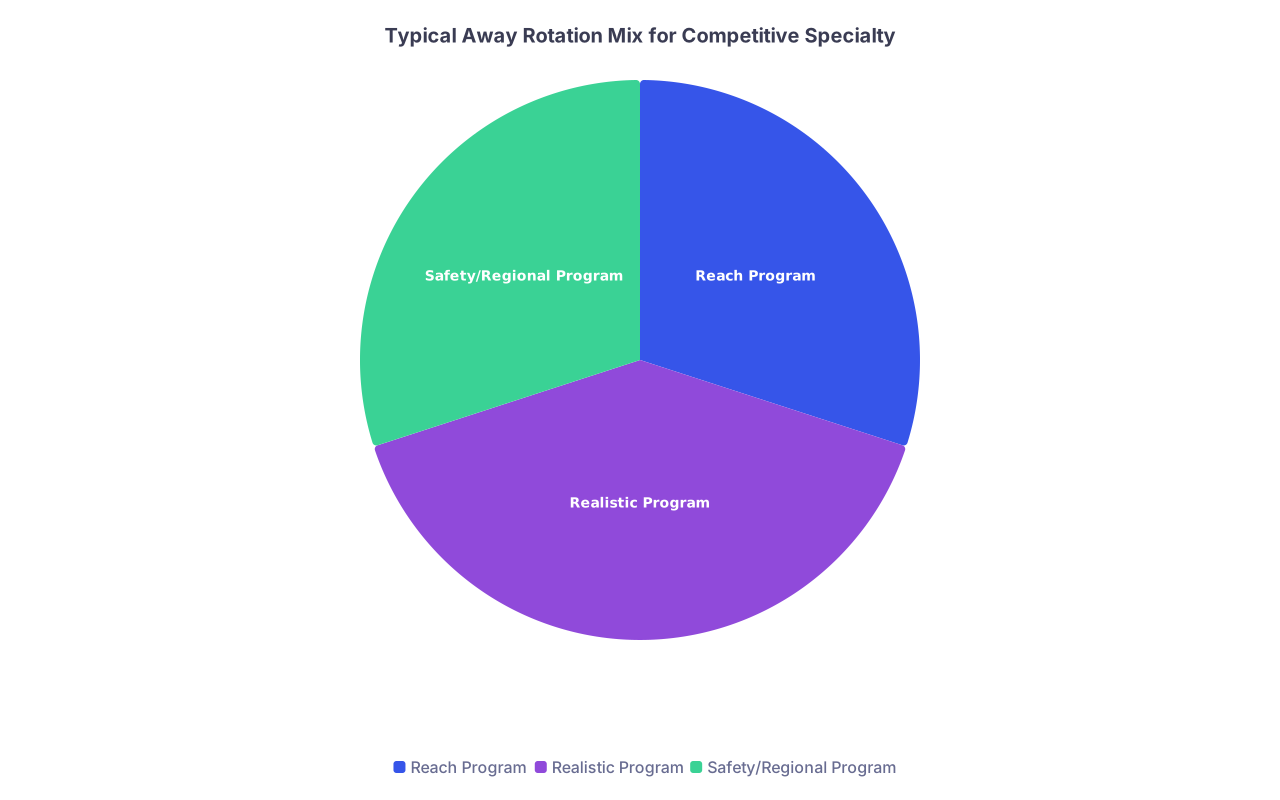
| Category | Value |
|---|---|
| Reach Program | 30 |
| Realistic Program | 40 |
| Safety/Regional Program | 30 |
What to do on an away
You do not need to be the smartest person there. You do need to be:
- Reliable
- Prepared
- Not annoying
Daily checklist:
- Know your patients—vitals, labs, overnight events—without being asked twice.
- Read about every case you scrub into or clinic pathology you see.
- Offer small, specific help: “I prepped consent forms for X and Y. Anything else before we head to OR?”
- Ask 1–2 thoughtful questions per day. Not 17.
At the end of 2–3 weeks, if it’s going well:
“Dr. X, this rotation has really confirmed that [Specialty] is what I want. Since my school doesn’t have a home program or residents in this field, your perspective would carry a lot of weight. Would you feel comfortable writing a letter for my application?”
If they hesitate even a little, thank them and back off. You want strong letters, not vague ones.
Step 8: Use Your “No Residents” Reality To Your Advantage In Story
You’re going to get asked:
- “Why [Specialty]?”
- “How did you explore this without a home program?”
- “What challenges have you faced in pursuing this field?”
If you answer with fluff, you’ve wasted your own story.
You need a clean narrative:
- Acknowledgment: “My school has no [Specialty] residents or home department.”
- Action: “So I did X, Y, Z to build that structure elsewhere.”
- Outcome: “That forced me to be deliberate, resourceful, and sure I wanted this.”
Example framing in a personal statement or interview:
“Without [Specialty] residents or a home department, I had two options: pick something easier or build my own path. I started by reaching out to… [brief specifics]. Over the last two years, I’ve driven two hours weekly to shadow, completed two projects with an outside mentor, and structured my aways to be as much about honest feedback as letters. That process has been humbling, but it also convinced me this isn’t a passing interest. It’s the work I’m willing to struggle for.”
That sounds like someone who will survive residency.
Step 9: Get Brutally Honest Risk Assessment Early
You do not want to be the person applying to ortho with a 228 Step 2 and one abstract because no one sat you down and told you the truth.
You need at least one person whose job is not to sugarcoat things to you. Ideally:
- An outside faculty in your target specialty
- A dean or advisor with actual match data
- A senior resident/fellow in that field at another institution
Your script:
“I know you don’t owe me optimism. I need an honest assessment. If you had my stats and background and no home program, would you apply [Specialty] only, [Specialty] plus a backup, or pivot now?”
Then you shut up and listen.
If everyone independent of each other says your chances are extremely low, you owe it to yourself to at least consider a dual-application strategy (e.g., apply rad onc + IM, ENT + prelim surgery, etc.). Does it suck? Yes. Is it better than going unmatched? Also yes.
Step 10: Logistics And Timeline When You’re Off The Standard Track
Your timeline has zero buffer. So map it.
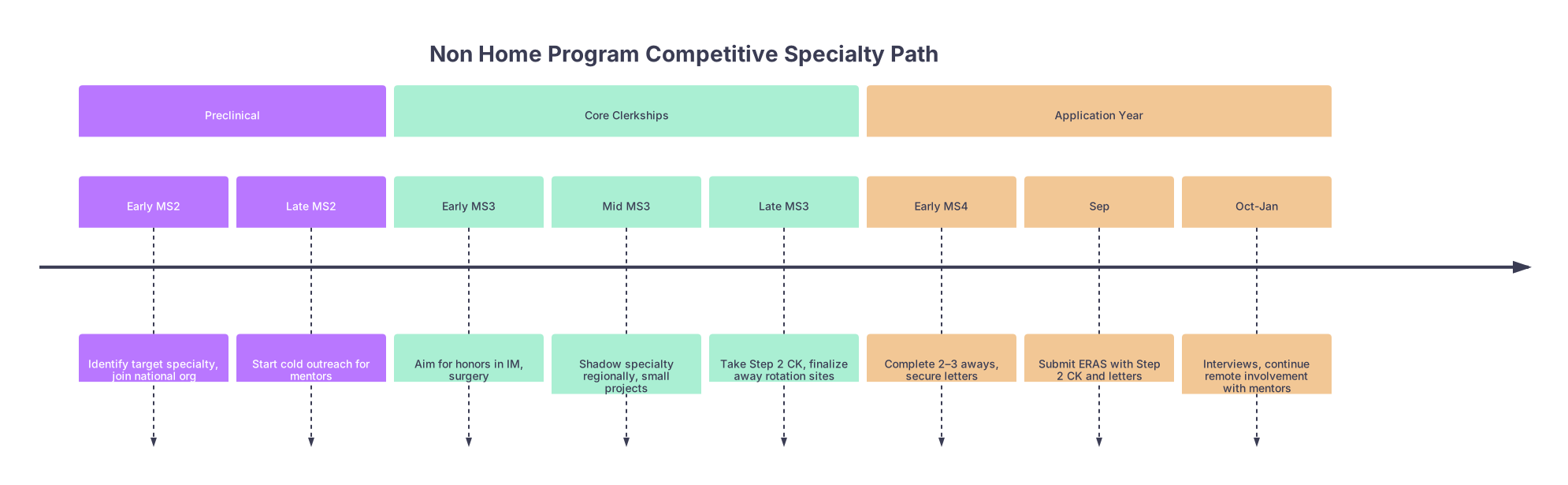
| Period | Event |
|---|---|
| Preclinical - Early MS2 | Identify target specialty, join national org |
| Preclinical - Late MS2 | Start cold outreach for mentors |
| Core Clerkships - Early MS3 | Aim for honors in IM, surgery |
| Core Clerkships - Mid MS3 | Shadow specialty regionally, small projects |
| Core Clerkships - Late MS3 | Take Step 2 CK, finalize away rotation sites |
| Application Year - Early MS4 | Complete 2–3 aways, secure letters |
| Application Year - Sep | Submit ERAS with Step 2 CK and letters |
| Application Year - Oct-Jan | Interviews, continue remote involvement with mentors |
Put that somewhere visible. If you’re behind on any given month, adjust ruthlessly. Fewer side projects, more focus on what moves the needle: metrics, exposure, letters.
Quick Reality Check: What Not To Waste Your Time On
Because your time is already stretched, here’s what I’ve seen students like you burn hours on that did very little:
- Attending every single generic “career panel” at your school that has nothing to do with your field
- Doing “research” that’s really just unpaid data entry with no realistic chance of a paper or abstract
- Spending hours on hyper-aesthetic note decks while your Step 2 prep and clerkship shelf scores suffer
- Trying to become best friends with 10 different distant faculty instead of solid with 2–3
You need depth, not scatter.
FAQ (Exactly 3)
1. Is it even realistic to match a competitive specialty without a home program or residents?
Yes, but only if you treat it like a high-risk, high-effort project. I’ve seen students match derm, ENT, ortho, neurosurg from schools with no home program. Common threads: excellent Step 2 CK, strong clerkship performance, at least one credible letter from the specialty, and visible initiative—aways, national engagement, and real mentoring relationships. If you’re middle-of-the-road on all metrics and passive about outreach, your chances drop fast.
2. What if I can’t get a single letter from someone in my specialty?
Then you need to be hyper-deliberate about who does write for you. Three lukewarm letters from random community physicians will not save you. Better: one or two heavy-hitting letters from well-known faculty in adjacent fields (e.g., surgical oncology for ENT, rheumatology or heme-onc for derm) who can speak specifically to your clinical reasoning, work ethic, and fit for a demanding residency. Pair that with at least some documented exposure to the field—shadowing logs, national organization involvement, maybe a small project—and explicitly address this gap in your materials without sounding defensive.
3. How many programs should I apply to if I have no home program?
More than your classmates with built-in support. For ultra-competitive fields, I usually tell students in your position: don’t be shy about 60–80+ applications if you can afford it, especially if your metrics are good but you lack home advocacy. You’re buying opportunities for someone, somewhere, to take a serious look. That said, spray-and-pray without strategy is dumb—prioritize programs where (1) your mentors know someone, (2) you’ve rotated, or (3) they historically interview applicants from schools like yours.
Bottom line:
- You can’t fix the fact that your school has no residents in your target specialty. You can build an external scaffolding—mentors, aways, research—that serves the same function.
- Your application has to stand on hard evidence: strong Step 2, solid clerkships, one or more credible letters, and a clear story of initiative in the face of a real disadvantage.
Everyone else is playing with a home-field advantage. You’re not. So you outwork them on structure, intention, and execution.