
It’s late January. You just finished your last interview, you’re obsessively re-reading your thank-you emails, and your friends are trading screenshots of “rank list drafts” like it’s fantasy football.
You think programs are still “getting to know” candidates.
They’re not. They’re already sorting you. And they’ve been doing it since before you logged onto Zoom for that first interview.
Let me walk you through what actually happens behind those closed doors when program directors rank residents. The polished NRMP slide decks and “holistic review” statements only tell you a piece of the story. The rest of it lives in the side comments, the quick glances in ranking meetings, the “do not rank” scribbles in the margins.
You need to understand this if you want to choose programs wisely and interpret what’s really happening during your season.
The First Quiet Ranking: Before You Even Interview
Most applicants believe the rank list starts after interview season. That’s the first mistake.
By the time you’re holding an interview invite, you’re already on an internal list. Call it what it is: a pre-interview rank.
Here’s the part nobody publishes on their website.
Programs usually start with a rough numerical score or tiering system. They don’t all admit this, but I’ve seen the spreadsheets. The columns vary, but the structure is the same.
| Factor | Typical Weight (Out of 100) |
|---|---|
| Boards / Exams | 20–30 |
| Clinical Grades | 15–25 |
| Letters of Recommendation | 15–25 |
| Research / Productivity | 10–20 |
| School / Context | 5–15 |
| “Fit” Signals (home, rotator, connections) | 10–20 |
Nobody will admit they put exact numbers like this on your file, but many do. Others use tiers: A/B/C applicant, or “strong/solid/risky”.
The first quiet ranking happens when:
- They screen your Step/COMLEX and filter out the automatic-no pile
- They tag you as “interview must”, “if open spots”, or “unlikely to interview”
- They give early advantage to home students and rotators
If you did an away rotation there, your “score” is already mostly determined before ERAS even opens. The PD has a mental ranking just from how you functioned as a sub-I.
Here’s what actually happens on some PD calls in September:
“We already know we’re ranking [home student] in our top 10. Same for [rotator]. Let’s use the rest of the interview spots to see who surprises us.”
That’s polite code for: there’s already a mental top tier before the first interview day.
How the Rank List Is Really Built: The Meeting You Never See
Everyone imagines some formal, objective ranking committee, thoughtfully re-reading applications. Reality is messier. It usually involves:
- A PD
- One or more associate PDs
- A couple of core faculty
- Sometimes a chief resident or senior resident voice
- A program coordinator quietly running the whole machine
There’s coffee. There are Excel sheets. There are also personal biases and politics, whether they admit it or not.
Here’s the general pattern I’ve watched play out at several programs.
Step 1: The “Board” Is Set
By late January or early February, most programs have a master spreadsheet with:
- Every interviewed applicant
- A numeric score from each interviewer (often 1–5 or 1–10)
- Comments from interviews and socials
- Flags: “red flag,” “culture concern,” “strong interest,” “geographically limited,” etc.
Some programs literally color-code you. Green, yellow, red. I’ve watched PDs scroll through 150 rows of colored cells while the committee thumbs through a printed rank-list packet.
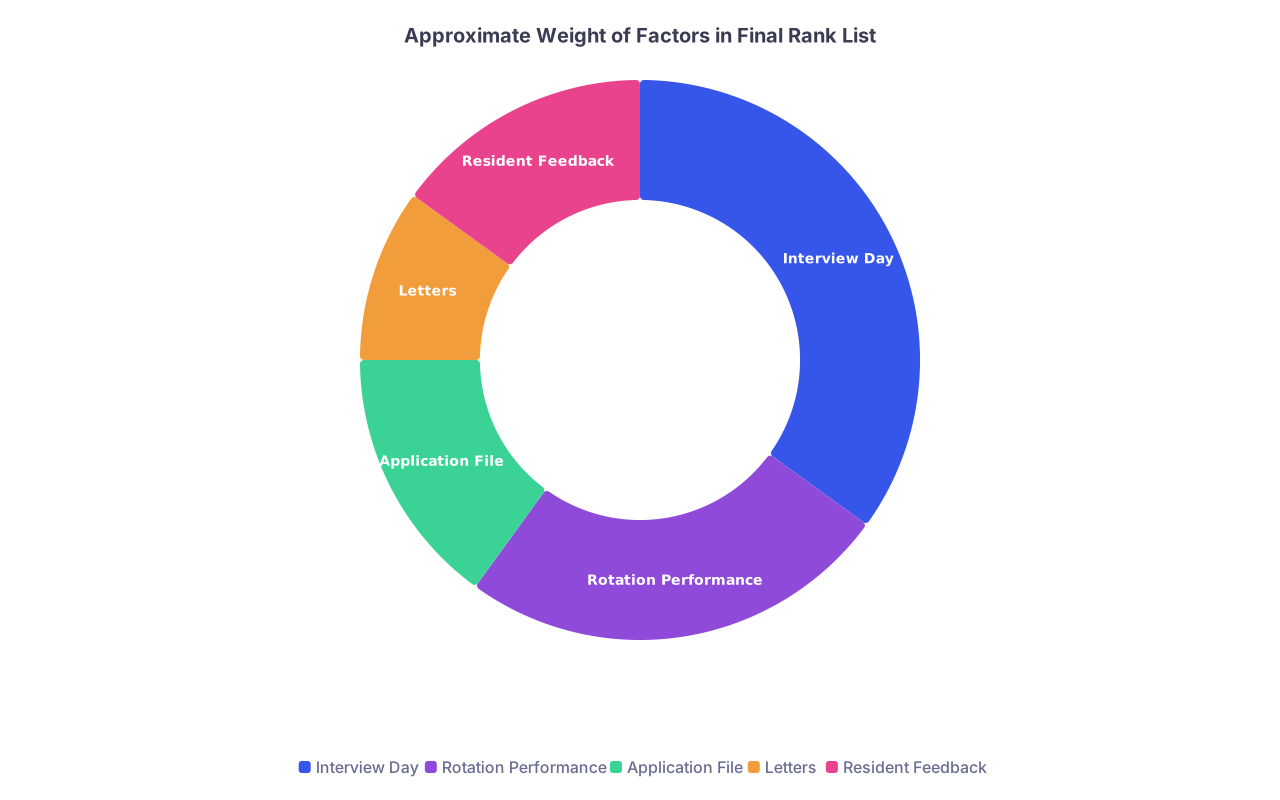
| Category | Value |
|---|---|
| Interview Day | 35 |
| Rotation Performance | 25 |
| Application File | 15 |
| Letters | 10 |
| Resident Feedback | 15 |
The public line is always “we use holistic review.” Behind the scenes, the actual decision power leans heavily on:
- Interview performance and “vibe”
- Direct observation on rotation
- Resident feedback (especially negative feedback)
Your beautifully formatted CV matters, but not as much as what you did in front of them.
Step 2: Tiering Before Fine Ranking
Programs almost never start by saying “who’s #1 vs #2 vs #3.” They start by buckets.
Typical tiers:
- Tier 1 – “Must get” / “Ideal fit” / “Would be devastated to lose”
- Tier 2 – “Strong candidates”
- Tier 3 – “Solid, safe, would be fine here”
- Tier 4 – “Rank low” / “Only if needed”
- DNR – “Do not rank” (and yes, that’s a real column in many sheets)
They’ll talk about you in short, loaded phrases:
- “Strong academically, but a little flat socially.”
- “Residents loved working with her on nights.”
- “Not sure about professionalism — remember that late arrival?”
- “Probably going derm if they don’t match here.”
The first pass is often: assign each applicant to a tier. Only then do they sort inside each tier for order.
If you’re trying to choose programs, this is the part you need to understand:
Within a given tier, tiny things flip people up or down. Across tiers, it’s hard to jump. If you left a mediocre or weird impression during interview season, no personal email in February is going to rescue you into Tier 1.
The True Heavyweights: Factors That Quietly Decide Your Spot
Let’s stop pretending everything is equal. Here’s what PDs actually weight when they’re honest in a closed room.
1. How You Treated Residents and Staff
You think your most important conversation was with the PD. It wasn’t.
The most brutal torpedoes to an application rarely come from the PD. They come from:
- Residents who worked with you on rotation
- The chief who watched you on consults
- The program coordinator who checked you in and got your emails
A single line from a respected chief like:
“Technically fine, but complained constantly and disappeared when notes were due.”
will sink you three tiers. Quietly. Nobody will ever tell you.
Residents pay attention to:
- Did you help with scut when things got hectic?
- Did you talk down to nurses or support staff?
- Did you show up early or exactly on time and then vanish?
- Did you actually seem to like the specialty or just tolerate it?
Most PDs trust their core residents more than any letter writer who barely knew you. That’s the truth.
2. Your Risk Profile
Programs don’t just think “good vs bad applicant.” They think in terms of risk.
Low risk: shows up, passes boards, does the work, no drama, decent team player.
High risk: anything that hints at future headache.
What counts as high risk?
- Marginal Step 2 score with just-passing Step 1 and sketchy test history
- History of professionalism issues, even vaguely described
- Emotional volatility detected on rotation or social events
- Weird email behavior (overly intense, entitled, or boundary-pushing)
- Chronic lateness or disorganization observed on away rotation
One PD I know literally has an internal column labeled “Headache Potential 1–5”. Nobody outside that conference room will ever see it, but it influences rank order. I’ve watched applicants with stronger CVs slide below “less impressive but rock solid” candidates because of a single “this might be drama” comment.
3. Perceived Commitment to the Program
You’ve heard programs care about “fit.” Translate that: they care if you’re likely to stay, work hard, and not bail or be miserable.
So they try to sniff out:
Are you actually likely to come here and be happy about it?
Signals they actually use:
- Did you do a home or away rotation here?
- Did you consistently mention reasons specific to this program, location, and culture, or just generic fluff?
- Did your thank-you email sound like you copy-pasted it to 20 programs?
- Did you engage with residents in a way that suggested you could see yourself there?
PDs will often have a column like “commitment/interest level” — even if they never tell you they track that.
A brutally honest PD once said in a meeting:
“They’re a great candidate, but this is clearly a backup for them. Let’s not waste a top-10 spot.”
That’s what you’re up against.
The Red Flag File: How You Quietly Become “Do Not Rank”
You want the real dark part? The “do not rank” decisions often get made very quickly and very quietly. There’s no appeal. You’ll never know.
Here’s what earns you that label more often than PDs will admit publicly.
Actual Professionalism Problems
- Showing up late to interview or rotation without a solid reason
- Trash-talking other programs, other applicants, or your own med school
- Being disrespectful to nurses, MAs, coordinators, or junior residents
- Inappropriate comments at social events (this kills people every year)
If a PD hears “I don’t trust this person around patients or staff,” they don’t argue. They just move you to DNR.
Integrity / Honesty Concerns
You’d be surprised how often this happens:
- Inconsistencies between your application and what you say on interview
- Exaggerated roles on research projects that faculty happen to know more about
- Taking credit for group work in a way that rubs people wrong
Once someone in the room says “I’m not sure I fully trust them,” you’re done. No one wants to rank a potential ethics problem. The risk isn’t worth it.
Weird Interpersonal Energy
This is more subjective, but it absolutely matters.
- Inappropriately intense emails to the PD or residents
- Crossing social boundaries during a pre-interview dinner
- Coming off as arrogant, hostile, or dismissive
Programs use vague language: “Just not a good fit” or “Didn’t gel with the group.” Don’t underestimate how powerful that vague negative is in the final meeting.
The Horse-Trading Phase: Final Rank List Politics
Once tiers are set, the real behind-the-scenes maneuvering starts.
This is the part where you’re not just an applicant. You’re a bargaining chip in internal politics.
Faculty Favorites
That one subspecialty faculty who loved you on rotation? They’ll push hard.
“I worked with them for two weeks. They were phenomenal. I want them in our program.”
A good word from a high-status attending can pull you up 5–10 spots, especially in smaller programs.
The reverse happens too. If a powerful faculty member had a bad experience with you, they might not say “do not rank” — they just keep gently nudging you down the list. “Maybe a little lower; I’m just not fully sold.”
Resident Vetoes
In a lot of places, residents don’t control the rank list. But they absolutely can tank people.
I’ve watched this happen:
- Applicant crushed the PD interview
- Looked great on paper
- Then a core set of residents said: “We do not want to work with this person.”
The PD won’t ignore that. They might say, “We need to trust our residents’ instincts.” That’s your quiet demotion from Tier 1 to Tier 3.
On the flip side: if the residents fall in love with you — especially at a program where morale has been shaky — they’ll push to move you up. PDs listen when residents say, “This person feels like one of us.”
Strategic Positioning
Programs play a game:
- They put candidates who are clearly “reach” for them high enough to potentially match, but not so high they waste all their top spots on people who will never come.
- They bump up realistic candidates who showed strong interest.
- They sometimes nudge down candidates they think will almost certainly rank them low.
This is where those vague “preference signals” and your behavior during the season matter. PDs don’t want to admit they speculate about your rank list, but they do.
I’ve seen this logic used word-for-word:
“They’re interviewing at MGH, UCSF, Penn. Let’s not put them #1. We’ll keep them high but we need to protect against going too far down our list.”
If you interview at a program that isn’t a mega-name, but you act like you’re slumming it, they will assume you’re not ranking them high. And they’ll treat you accordingly.
What You Can Actually Control (And What You Can’t)
You can’t change the fact that some PDs like research-heavy applicants and others want workhorses. You also can’t undo your Step scores or magically re-write your clinical grades.
But if you understand how the ranking actually happens, you can be smart about where you invest energy and how you choose programs.
On Rotations and Sub-Is
This is where the “quiet ranking” starts long before Match Day.
On a rotation at a place you’d seriously consider:
- Be relentlessly reliable. Early, prepared, responsive.
- Help the team without being fake or over-the-top about it.
- Show real curiosity about how that program works day to day.
- Do not complain about hours or cases in front of residents or staff.
Those residents are going to sit in a room without you and say, “I’d be happy to work nights with this person” or “absolutely not.” That’s your ranking.
During Interview Season
Stop thinking the PD’s impression is everything. Spread your focus:
- Give residents at socials your full, respectful attention. Don’t treat them like a formality.
- Be specific about why you like their program — not just the city and the reputation.
- Don’t trash-talk other programs or your classmates. People remember that.
And then: know when to stop. Hyper-aggressive post-interview contact can push you into “odd energy” territory fast.

| Step | Description |
|---|---|
| Step 1 | Rotation Performance |
| Step 2 | Resident Opinion |
| Step 3 | Interview Day |
| Step 4 | Faculty Scores |
| Step 5 | Communication and Behavior |
| Step 6 | PD Perception |
| Step 7 | Applicant Tier |
| Step 8 | Final Rank Position |
Choosing Programs Wisely
Here’s the irony: “How programs rank you” should absolutely influence how you rank them.
A few truths:
- Programs that know you from a rotation tend to rank you more aggressively — if you did well.
- Programs where residents seemed lukewarm about you? Expect a mid-to-low tier placement.
- If your application has obvious risk factors (low Step 2, gap years, professionalism blip), prioritize places that explicitly reassured you they value “non-traditional” or “holistic” applicants — and where you felt genuinely welcomed, not politely tolerated.
Your rank list shouldn’t just be about which hospital is prettiest. It should also be about: where am I most likely to be seen as an asset, not a risk?
The Last Quiet Moves Before Submission
The final 48–72 hours before programs certify their rank lists are surprisingly… anticlimactic.
There’s no dramatic reshuffling. It’s mostly tiny adjustments.
What can still change late?
- A late negative email from a faculty member about you
- A resident remembering a bad interaction and speaking up
- A new piece of information (failed Step 2 CK, unprofessional behavior reported)
- Rarely, a truly standout advocacy email from someone the PD deeply trusts
What doesn’t change late?
- You’re not jumping from #45 to #5 overnight.
- A generic “this program is my top choice” email doesn’t magically vault you up tiers, especially at competitive places.
- The personality and behavior impressions from months ago aren’t getting rewritten by a two-paragraph message.
By the time you’re debating how to phrase your “you’re my #1” email, they’ve already got you slotted. That email may help at the margins — a few spots up, or a tiebreaker — but if you think it’s the main driver, you’re misunderstanding how much of the work happens earlier.
If You Really Want to Play the Long Game
You want to understand how to choose programs? Understand this: not all programs evaluate you the same way. And some are much more rigid than others.
A few patterns I see consistently:

Academic powerhouses:
Still care about fit and personality, but they will protect their board pass rates and fellowship match stats aggressively. Risky test-takers slide down more here, no matter how charming you are.Community-heavy, service-oriented programs:
Value work ethic, grit, and being pleasant to work with more than “first-author in JAMA.” If their residents love you, you’re golden.Mid-tier university programs:
This is where internal politics and faculty favorites can sway rank lists most. You can be bumped hard up or down depending on which faculty championed or disliked you.
Your job isn’t to magically become perfect. It’s to put yourself in ecosystems where your strengths match their priorities — and where the way they quietly rank people lines up with who you actually are.
Strip It Down: What Really Matters
Let me compress the whole behind-the-scenes mess into what actually sticks when programs quietly rank you before Match Day:
- Your behavior around residents and staff often counts more than your board scores once you’re in the interview/rotation sphere. That’s where you’re really being evaluated.
- Programs think in tiers and risk, not perfect linear order. Once they decide what “bucket” you’re in, tiny human factors — like whether residents liked you — determine your exact spot.
- By the time you’re obsessing over post-interview emails, most of your fate at each program is already decided. The ranking happens earlier, in rooms you never see, based on impressions you’ve already left.
Understand that, and you’ll build a rank list based not just on prestige, but on where the people in that room are most likely to look at your name and say, “We want this one.”