Understanding the Big Picture: Why Program Research Matters for IMGs in Neurology
As an international medical graduate (IMG) targeting neurology residency in the United States, your program research strategy can be the difference between a scattered, expensive application season and a focused, competitive neuro match. Neurology is moderately competitive and increasingly popular; for IMGs, that means you cannot just “apply broadly and hope.” You need to be deliberate.
This IMG residency guide focuses specifically on how to research residency programs in neurology so you can:
- Identify programs where you are realistically competitive
- Highlight those that fit your career goals (clinical vs academic vs research-heavy)
- Avoid wasting money and time on programs unlikely to interview IMGs
- Prepare tailored applications and stronger interview conversations
Throughout this article, you’ll find practical frameworks, concrete tools, and examples tailored to neurology and IMGs.
Step 1: Clarify Your Personal and Professional Priorities
Before you open a single program website, you need clarity on what you are actually looking for. Otherwise, you’ll be overwhelmed by data and “prestige noise.”
Think in two categories: non‑negotiables and preferences.
1.1 Define Your Non‑Negotiables
These are factors that, if missing, make a program a poor fit for you regardless of its name or reputation.
Common non‑negotiables for IMGs in neurology:
Visa sponsorship
- Do you require a J‑1 or H‑1B?
- Are you open to only J‑1, or do you strongly prefer H‑1B?
- Some neurology programs sponsor only J‑1; some sponsor both; some sponsor none.
USMLE score thresholds and attempts
- If a program requires a minimum Step 2 score or limits attempts (e.g., “no more than one failure”), and you don’t meet it, your chances are extremely low.
- Decide what level of cutoff is acceptable for your profile.
Geographic/Personal constraints
- Need to live near family or a specific city?
- Climate or cost‑of‑living considerations?
- Will you accept anywhere in the US, or are there regions you must avoid?
Start timing and visa timelines
- If you’re currently outside the US, can you realistically secure your ECFMG certification, visa, and move by July 1?
Document these in writing. For example:
Non‑negotiables: J‑1 visa OK, H‑1B ideal; IMG‑friendly; Step 2 ≥ 235; in East Coast or Midwest; no categorical bans on non‑US graduates.
1.2 Define Your Preferences and Career Goals
Next, outline what would make a program truly good for you, beyond basic eligibility.
For neurology, think about:
Clinical exposure and case mix
- Do you want strong exposure to stroke, epilepsy, neurocritical care, movement disorders, or neuromuscular diseases?
- Are you looking for a tertiary academic center with complex cases or a more community-based setting?
Research opportunities
- Are you aiming for a physician‑scientist career or future fellowship at a top institution?
- Do you want structured research blocks, access to NIH‑funded mentors, or a strong track record of fellows matching into competitive subspecialties?
Subspecialty interest
- If you already lean toward neurocritical care, movement disorders, or epilepsy, look for programs with strong divisions and fellowships in those areas.
Educational culture
- Do residents describe the program as “supportive,” “collegial,” “family-like,” or “high pressure but stimulating”?
- Are there structured didactics, board review sessions, and simulation training?
IMG support and diversity
- Does the program clearly value diversity and have multiple current or recent IMGs?
- Are there formal mentorship programs, wellness resources, and visa support?
Write down your priorities in approximate order, for example:
Preferences: Strong stroke + neurocritical care exposure, good board pass rate, at least some research time, academic center preferred, diverse resident group including IMGs.
This list becomes your reference framework when you start evaluating residency programs.

Step 2: Learn the Key Information Sources (and How to Use Them Efficiently)
A strong program research strategy uses multiple sources in a structured way. Each source gives you pieces of the puzzle; your job is to synthesize them.
2.1 FREIDA (AMA Residency & Fellowship Database)
What it is: A comprehensive directory of accredited residency programs.
How to use FREIDA for neurology and IMGs:
Filter by:
- Specialty: Neurology
- Program type: ACGME‑accredited
- Region, state, or city as desired
Check:
- Program size (number of residents per year)
- Program type (university, community, university‑affiliated)
- Visa sponsorship indication (J‑1, H‑1B, or none)
- Contact details and program website link
Why it matters:
- Helps create your initial long list of all possible neurology residency programs.
- Quickly excludes programs that do not sponsor visas or clearly state they do not consider IMGs.
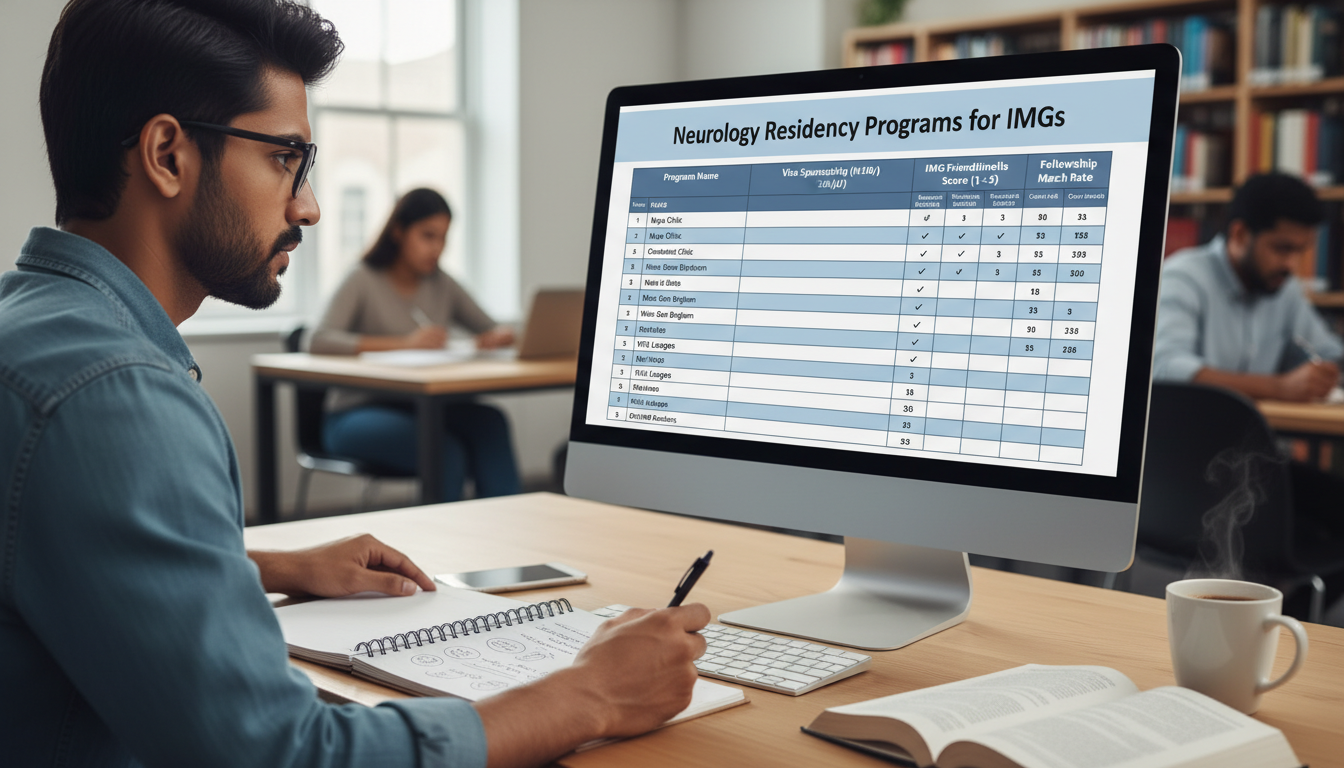
Create a spreadsheet and log basic FREIDA data for each program.
2.2 NRMP and Program Websites
NRMP (National Resident Matching Program) reports:
- Check specialty data reports for neurology:
- Average Step scores
- IMG match rates
- Number of positions
- This helps you benchmark how competitive you are relative to the matched cohort.
Individual program websites:
These are crucial for evaluating residency programs more deeply:
Look for:
- Program overview and mission statement
- Curriculum (inpatient neurology, outpatient continuity clinics, ICU rotations, electives)
- Faculty list and subspecialty representation
- Current residents (pay attention to medical schools and IMG presence)
- Research opportunities and publications
- Call schedules, duty hours, wellness initiatives
- Fellowship placements of recent graduates
- Explicit statements about IMGs and visas (“We welcome applications from international medical graduates…” / “We sponsor J‑1 visas only…”)
2.3 ERAS Program Descriptions
In ERAS (once available), each program will list:
- Required documents
- USMLE score expectations (if specified)
- Cutoffs regarding attempts, graduation year, or clinical experience
- Visa policies
Use this to refine your list before finalizing where to apply, especially if your profile has red flags such as older year of graduation or exam attempts.
2.4 Resident and Applicant Perspectives
For neurology, insider perspectives are extremely valuable:
Program websites – “Meet Our Residents” pages
- Look for diversity, IMGs, and resident backgrounds similar to yours.
Social media (Twitter/X, Instagram, LinkedIn)
- Follow neurology departments and residency accounts.
- Watch resident takeovers, “day in the life” posts, and Q&A sessions.
Online forums and review sites
- Reddit (r/medicalschool, r/neurology, r/ResidencyMatch)
- Student Doctor Network (SDN) threads
- These should be used cautiously (some information may be biased or outdated) but can reveal culture, workload, or hidden strengths/weaknesses.
Virtual open houses and info sessions
- Many neurology programs host these, especially during application season.
- Register early, prepare questions, and note how welcoming they are to IMGs.
Step 3: Build a Structured Program Research Spreadsheet
Without structure, program research becomes chaos. A spreadsheet is your central tool.
3.1 Core Columns to Include
For an IMG neurology applicant, consider columns like:
- Program name & ACGME code
- City, state, region
- Program type: University / University‑affiliated / Community
- Visa sponsorship: J‑1 / H‑1B / Both / None
- IMG‑friendliness indicators:
- Percentage or number of current IMGs
- Any explicit supportive language on website
- USMLE expectations:
- Mentioned thresholds
- Attempts allowed
- Graduation year limits
- Personal competitiveness rating (1–5)
- Educational features:
- Stroke/neurocritical care strength
- Epilepsy/EEG, movement disorders, neuroimmunology presence
- Research opportunities (low/medium/high)
- Culture indicators:
- Collegial/supportive vs. high pressure
- Wellness initiatives, resident support
- Alumni outcomes:
- Recent fellowships (e.g., movement disorders at major centers, epilepsy fellowships, neurocritical care)
- Notes from open houses / contacts
- Decision status: “Apply,” “Maybe,” “Do not apply”
3.2 Rating and Prioritizing Programs
Create a simple scoring system aligned with your priorities. For example:
- Visa support (0–2 points)
- IMG presence (0–2)
- Research opportunities (0–2)
- Subspecialty alignment (e.g., strong stroke program if you’re stroke‑interested) (0–2)
- Geographic preference (0–2)
Total out of 10. Programs scoring 8–10 might be your “high priorities”; those scoring 5–7 are “secondary options.”
This transforms “I heard it’s a good program” into structured decision‑making.
Step 4: Evaluate Programs from an IMG Perspective
Now you have your long list and structure; the next step is interpretation. As an international medical graduate, you must evaluate programs through two lenses:
- Likelihood of receiving an interview (objective)
- Quality of training and fit (subjective but critical)
4.1 Assessing IMG‑Friendliness and Interview Likelihood
Key signals that a neurology program is IMG‑friendly:
Current residents include IMGs
- Look at the resident roster; names and listed medical schools can reveal several foreign medical graduates.
- If 20–50% of residents are IMGs, that’s a strong sign.
Website language explicitly welcomes IMGs
- Phrases like “We strongly welcome applications from international medical graduates” or “We value diversity including IMGs.”
Public data showing prior IMGs
- Some program websites list past graduates and their medical schools; if multiple are from international schools, it’s encouraging.
Visa sponsorship consistency
- Programs that regularly sponsor J‑1/H‑1B for neurology residents are more likely to continue doing so.
Combine this with your objective profile:
- USMLE Step 2 score relative to neurology averages
- Number of attempts
- Graduation year and clinical gap
- US clinical experience (USCE) in neurology or related fields
- Research and publications (especially neurology or neuroscience)
If you have an average or slightly below‑average score but strong USCE and neurology research, aim for programs with a clear history of taking IMGs. If you are a strong applicant (high score, recent graduate, publications), you can add more competitive university programs to your list, but still consider IMG‑friendly patterns.
4.2 Evaluating Educational Quality and Training Environment
Once you know you’re likely to be considered, evaluate how well the program will train you:
Look closely at:
Breadth of clinical exposure
- Do they cover general neurology, stroke, epilepsy, neuromuscular, movement disorders, neuroimmunology, neurocritical care, behavioral neurology?
- Is there a dedicated neuro ICU experience with neurointensivists?
Didactics and exam preparation
- Regular morning report, grand rounds, journal clubs, board review sessions?
- Neurology board exam pass rates (if mentioned)?
Faculty expertise and subspecialty coverage
- Are there fellowship‑trained faculty in your interests (stroke, epilepsy, neurocritical care, etc.)?
- Are faculty well‑published in neurology journals?
Research infrastructure
- Protected research time?
- Access to clinical trials, neuroimaging research, basic neuroscience labs?
- Options for research electives?
Resident workload and duty hours
- Is call frequency reasonable?
- Are there night float systems and good ancillary support (nurses, PAs, NPs)?
Support for IMGs
- Dedicated GME office that handles visas smoothly?
- Mentoring systems and well‑being resources?
Use real examples from program descriptions. For instance, a program with:
“Level 4 epilepsy center, comprehensive stroke center, 24‑bed neurointensive care unit, and robust movement disorder and neuromuscular clinics…”
…may be ideal if your goal is strong clinical foundation and future fellowship.
4.3 Aligning Programs with Long‑Term Goals
Think beyond residency:
Want a fellowship in epilepsy, movement disorders, neurocritical care, or neuromuscular?
- Favor programs with in‑house fellowships and good external fellowship matches.
Consider a physician‑scientist career or academic neurology?
- Prioritize programs with NIH grants, multiple ongoing neurology clinical trials, and faculty who publish frequently.
Prefer a clinical track in a community or regional setting?
- Community and university‑affiliated programs may offer excellent hands‑on experience and autonomy.
Write in your spreadsheet whether each program supports your long‑term vision: “Academic”, “Fellowship‑focused,” or “General clinical neurology.”
Step 5: Strategic Narrowing – From Long List to Target List
By this stage, you may have 80–150 neurology programs in your spreadsheet. Applying to all without strategy is expensive and inefficient. Use a phased narrowing process.
5.1 Phase 1: Automatic Exclusions
Immediately remove programs that:
- Do not sponsor your required visa
- Clearly state “We do not accept IMGs” or strongly imply it
- Have absolute cutoffs you don’t meet (e.g., no failures, specific score thresholds)
- Are in locations you cannot live in for personal reasons
This may remove 20–40% of programs right away.
5.2 Phase 2: Competitiveness and Fit Filtering
Next, evaluate:
- Your competitiveness vs. their typical profiles
- Presence of current IMGs
- Whether their strengths align with your neurology interests
Categorize remaining programs into:
- Reach – Highly competitive or top‑tier academic centers where you meet minimums but are still a stretch (e.g., major university hospitals).
- Target – Programs where your profile is well aligned and IMGs are present.
- Safety – Programs with clearly IMG‑friendly patterns and slightly lower average scores, where you are above the mean.
Aim for a balanced distribution. For most IMG neurology applicants:
- 20–30% Reach
- 40–50% Target
- 20–30% Safety
Adjust based on your profile strength and budget.
5.3 Phase 3: Fine‑Tuning via Direct Engagement
Attend:
- Virtual open houses
- Q&A sessions with program leadership
- Departmental grand rounds open to applicants (often streamed online)
Ask thoughtful questions that also help evaluating residency programs:
- “How does your program support international medical graduates, especially regarding visas and mentorship?”
- “What proportion of residents pursue fellowships, and in which subspecialties?”
- “Can you describe changes made after recent resident feedback?” (This shows responsiveness and culture.)
Update your spreadsheet with impressions after each interaction. Some programs may move from “Apply” to “Do not apply” (or vice versa) based on your experiences.
Step 6: Use Your Research to Strengthen Your Application and Interviews
Thorough research is not only about choosing where to apply; it’s also about how you present yourself as a thoughtful, informed neurology applicant.
6.1 Tailoring Your Personal Statement for Neurology
When you mention programs (if you choose to do so in a targeted personal statement version):
- Highlight specific aspects you value:
- “The program’s strong comprehensive stroke center and neurocritical care experience aligns with my goal of training in acute neurology.”
- “Your department’s active epilepsy and EEG research is particularly appealing given my prior work in seizure semiology.”
You can maintain a core personal statement and adapt a brief section for categories of programs (academic research‑heavy vs clinically focused, etc.).
6.2 Writing Program‑Specific Emails and Communications
When you email program coordinators or attendings (carefully and professionally), your research allows you to:
- Ask focused questions:
- “I noticed your program recently expanded its neurocritical care unit—are there opportunities for residents to participate in related research?”
- Show genuine interest beyond generic lines.
This can subtly improve impressions and occasionally lead to informal mentorship or advice.
6.3 Excelling in Interviews Using Your Research
During interviews, many applicants give generic answers. Use your research to stand out:
When asked, “Why our program?”:
- Refer to specific strengths:
- “I’m drawn to your program’s combination of a busy stroke service and structured didactics—especially the weekly board review sessions and the EEG reading curriculum.”
- Tie these strengths to your goals as an IMG in neurology:
- “As an international medical graduate, I’m looking for a program that not only exposes me to a broad US neurology case mix but also mentors me through the fellowship application process, and I saw that many of your graduates match into stroke and neurocritical care fellowships.”
Show that you did your homework and see yourself fitting into their environment.
Step 7: Common Pitfalls IMGs Should Avoid When Researching Programs
Being systematic helps you avoid mistakes that cost opportunities.
7.1 Over‑Focusing on Prestige
Well‑known names are attractive, but many “mid‑tier” neurology programs:
- Have excellent clinical exposure
- Support IMGs strongly
- Place graduates into competitive fellowships
Do not let prestige overshadow visa support, IMG‑friendliness, and educational quality.
7.2 Ignoring Visa and Policy Details
Some IMGs waste money applying to programs that:
- Do not sponsor visas
- Accept only US medical graduates
- Require US citizenship or permanent residency
Always verify visa sponsorship and IMG policies on the website or via email if unclear.
7.3 Blindly Following Online Opinions
Anonymous reviews or forum posts may be biased. Use them as one data point, not the final decision maker. Always cross‑check with:
- Program websites
- Direct communication and open houses
- Conversations with current or recent residents if possible
7.4 Applying Without Enough “Safety” Programs
Neurology is not as competitive as some surgical subspecialties, but it is progressively more selective. For IMGs, having a strong base of IMG‑friendly programs increases your chance of a successful neuro match.
FAQs: Neurology Program Research for IMGs
1. How many neurology residency programs should an IMG apply to?
It depends on your profile, but many IMGs apply to 40–80 neurology programs. Stronger applicants with high USMLE scores, recent graduation, and neurology research may apply to fewer (e.g., 40–50). Those with older graduation years, attempts, or limited USCE may consider a larger number (e.g., 70–90) with a strong focus on IMG‑friendly programs.
2. How can I quickly identify IMG‑friendly neurology programs?
Use a combination of:
- FREIDA and program websites to confirm visa sponsorship
- Resident rosters to see current IMGs
- Alumni lists showing graduates from international schools
- Phrasing on websites that explicitly welcome IMGs
Over time, your spreadsheet will highlight programs with multiple IMG‑positive signals.
3. Should I email programs to ask if they accept IMGs?
If the program website or FREIDA is unclear about visas or IMG policies, a brief, polite email to the program coordinator is reasonable. Keep it concise:
- Introduce yourself in one line
- Ask a specific question (e.g., “Do you sponsor J‑1/H‑1B visas?” or “Do you consider international medical graduates?”)
- Thank them for their time
Avoid sending mass or generic emails to faculty; these are rarely helpful.
4. Is research essential for matching into neurology as an IMG?
Research is not absolutely required, but it is highly beneficial, especially for academic or fellowship‑oriented programs. Neurology values clinical reasoning, curiosity, and evidence‑based practice. Even small projects, posters, or case reports—particularly in neurology or neuroscience—strengthen your application and can make you more attractive to research‑active programs.
By following a deliberate, structured approach to program research—clarifying priorities, using the right tools, building a detailed spreadsheet, and evaluating both IMG‑friendliness and educational quality—you can transform the neuro match process from overwhelming to strategic. As an international medical graduate, this level of preparation is one of the strongest advantages you can create for yourself in pursuing a neurology residency in the United States.