How do you tell the difference between a program that talks about wellness and one that actually protects its residents?
Let me be blunt: every residency website says they “prioritize wellness.” Half of them are lying. Another quarter mean well but are completely ineffective. You’re trying to find the 25% where wellness is real: your schedule, your culture, and your sanity actually matter.
Here’s how you judge that—concretely, systematically, without falling for the free-food-and-yoga smokescreen.
1. Start with the hard data: structure, not slogans
If wellness is real, it shows up in policies and numbers, not posters with sunsets.
Here’s what to look for and exactly what to ask.
A. Duty hours and actual enforcement
You want to know: Not “Do you follow duty hours?” but “What happens when they’re broken?”
Ask residents directly:
- “How often do your duty hours get violated?”
- “What happens if you log a violation?”
- “Have you ever felt pressured to under-report your hours?”
Red flags:
- Residents laugh or look at each other before answering.
- They say things like, “We technically log 80 hours…” with a tone.
- “We’re told to ‘be realistic’ with our hours” (translation: lie).
Green flags:
- “Violations happen sometimes on hard rotations, but leadership addressed it.”
- “We’re told to log honestly and PDs actually bring up patterns and fix rotations.”
- “We sometimes get pulled from a shift or have backup coverage when caps are hit.”
B. Call schedules and backup systems
Wellness dies when you’re constantly covering for others with no safety net.
Ask:
- “When someone is sick, how is coverage handled?”
- “Do you have a jeopardy/flex resident system?”
- “How often are you called in on your days off?”
If there’s no formal backup system and coverage is always “we just figure it out,” you’re looking at chronic burnout territory.
Programs that care have:
- A real jeopardy system
- Cross-coverage rules
- A culture of “If you’re sick, stay home” actually practiced
C. Time off that really happens
Everyone “offers vacation.” The issue is whether you can use it without guilt or punishment.
Ask:
- “Can you actually take all of your vacation?”
- “How easy is it to schedule days off for major life events—weddings, funerals, Step exams, pregnancy?”
- “Have you ever had vacation denied last-minute?”
Green flag: Residents can give recent, concrete examples of getting time off for real life and no one resents them.
, Honest duty hour reporting, Protected didactics actually protected, Free confidential mental health access, Residents stay past duty hours regularly](https://cdn.residencyadvisor.com/images/articles_svg/chart-quick-wellness-reality-check-program-signals-7050.svg "Quick Wellness Reality Check: Program Signals")
| Category | Value |
|---|---|
| [Strong backup/jeopardy](https://residencyadvisor.com/resources/choosing-residency-program/how-chief-residents-secretly-shape-which-interns-get-the-best-training) | 4 |
| Honest duty hour reporting | 5 |
| Protected didactics actually protected | 4 |
| Free confidential mental health access | 3 |
| Residents stay past duty hours regularly | 1 |
(Think of 4–5 as strong positive signals, 1 as a big negative. You want a program stacking the positives.)
2. Dissect “wellness initiatives”: are they structural or decorative?
Anyone can throw pizza at tired residents and call it wellness. You’re looking for system-level protections, not treats.
Structural wellness (the real thing)
These are the serious indicators:
Embedded mental health support
- Free or low-cost therapy or counseling
- Guaranteed confidentiality, not run directly by your program
- Easy access (not a 3-month wait)
- Ask: “If you wanted to talk to a therapist, how would you do it? How long would it take to get an appointment?”
Built-in wellness time
- Half-days for appointments, personal tasks, or mental health
- Scheduled non-clinical time that is not routinely eaten up by “just one more admit”
- Ask: “Do you have protected admin or wellness time? How often is it truly protected?”
Fair scheduling practices
- Predictable patterns
- Reasonable number of 24-hour calls (or none in some specialties)
- Night float systems that don’t completely destroy people
- Ask: “Which rotations feel unsafe or unsustainable? Have they changed them over time?”
If a PGY-3 says, “My intern year we had brutal X rotation and enough people complained that they actually cut down the hours/volume,” that’s a very good sign.
Decorative wellness (window dressing)
This is what I’ve seen at programs that burn people out while patting themselves on the back:
- A “Wellness Committee” that mostly organizes bagel breakfasts.
- One wellness lecture per year on resilience.
- Yoga once a month that no one attends because everyone’s post-call.
On interview day, ask:
- “Can you give an example of something the wellness committee changed about the schedule or workload?” If no one can answer, that committee is mostly vibes.

3. Read the culture in the room: how people actually talk
Policies matter, but culture will make or break your sanity.
You’re looking for how attendings and leadership talk about residents and how residents talk about leadership when leadership is not around.
A. Listen between the lines
On interview day and socials, pay attention to:
- Do residents openly joke about being “workhorses” or “cheap labor”?
- Do they describe “earning their keep” by suffering?
- Does anyone say “it’s just residency, it’s supposed to be miserable”?
That’s not tough love. That’s normalization of abuse.
Healthier culture sounds like:
- “It’s busy, but I feel supported.”
- “We work hard, but I don’t feel unsafe or abandoned.”
- “I’ve felt comfortable asking for help or saying I’m overwhelmed.”
B. Leadership attitudes
When you ask the PD or APD:
- “How do you think about resident wellness?”
You do NOT want a long answer about resilience training and grit.
Stronger answers mention:
- Reasonable workloads
- Adequate staffing
- Systems for feedback
- Changes they’ve made after resident input
Ask a follow-up:
- “Can you share something the program changed recently because residents were struggling?” If they can’t name a specific rotation, schedule, or policy that improved, they either aren’t listening or nothing changed.
4. Outcomes: what happens to residents over 3+ years?
If a program is truly committed to wellness, you’ll see it in what happens to their people over time.
A. Retention and leaves
Ask residents (away from faculty):
- “Has anyone left the program in the last few years?”
- “Have residents taken time off for parental leave, illness, or personal reasons? How did the program handle it?”
No program is perfect, but look at how they talk about those who stepped away:
- Respectful and understanding? Or framed as “couldn’t cut it”?
B. Burnout and morale
You can feel this in the room. Are senior residents:
- Engaged and willing to answer questions honestly?
- Smiling in a genuine way, or walking zombies?
- Encouraging you to come, or warning you indirectly with phrases like “you learn a lot”?
If multiple PGY-3s/4s look broken, believe them. The wellness page on the website is irrelevant.
| Feature | Structural (Real) | Decorative (Fake) |
|---|---|---|
| Mental health support | Free, confidential, timely therapy | One-time wellness lecture |
| Schedule | Protected caps, backup, flex days | Inspirational wellness quotes |
| Time off | Enforced vacations, easy coverage | One wellness retreat per year |
| Resident voice | Changes made after feedback | Suggestion box never opened |
| Wellness committee | Alters policies/rotations | Organizes donuts occasionally |
5. How to interrogate a program on interview day (without sounding aggressive)
You need targeted, specific questions. Not “Do you value wellness?” because everyone will say yes.
Here’s a practical script.
Ask residents:
- “What are the toughest rotations, and what makes them tough: hours, culture, volume, or all of the above?”
- “Do you feel comfortable calling in sick? How often do people actually do it?”
- “On your worst days, do you feel supported or alone?”
- “Last time someone was really struggling—burnout, family crisis—what did the program do?”
Then shut up and let them talk. Watch their faces.
Ask program leadership:
- “How do you monitor for resident burnout or distress?”
- “What structural changes have you made to support wellness in the last 2–3 years?”
- “How are duty hours audited, and what happens if violations occur repeatedly on a specific rotation?”
You’re not looking for perfection. You’re looking for evidence of iteration: “We saw a problem, we admitted it, we fixed something concrete.”

| Step | Description |
|---|---|
| Step 1 | Hear wellness pitch |
| Step 2 | Decorative wellness only |
| Step 3 | Ask residents specifics |
| Step 4 | Culture problem |
| Step 5 | Review schedules and backup |
| Step 6 | High burnout risk |
| Step 7 | Program likely truly committed |
| Step 8 | Any structural policies? |
| Step 9 | Residents confirm reality? |
| Step 10 | Reasonable and enforced? |
6. Use your gut, but check it against three core tests
After interviews, you’ll have impressions. Before ranking, run each program through three cold, practical filters.
Test 1: The worst-day test
Imagine:
- You’re post-call, emotionally wrecked from a bad outcome.
- You’ve had three heavy weeks in a row.
- Something blows up in your personal life.
At this program, do you:
- Feel like you can say “I need help” without punishment?
- Have peers and chiefs who’d help redistribute work?
- Have leadership who’d at least care, not dismiss?
If you cannot picture that, wellness is mostly cosmetic there.
Test 2: The senior resident test
Ask yourself:
- “Do I want to become like their PGY-3/4s?”
If their seniors look:
- Competent, tired but not destroyed, still human → sustainable.
- Cynical, hollow, checked out, openly counting days to graduation → pay attention.
Test 3: The pattern test
Look at all your notes:
- How many times did you write “busy but supported” vs “brutal, but ‘you learn a lot’”?
- Are there multiple concrete examples of the program bending for resident needs?
Patterns don’t lie. One polished answer from a PD might.
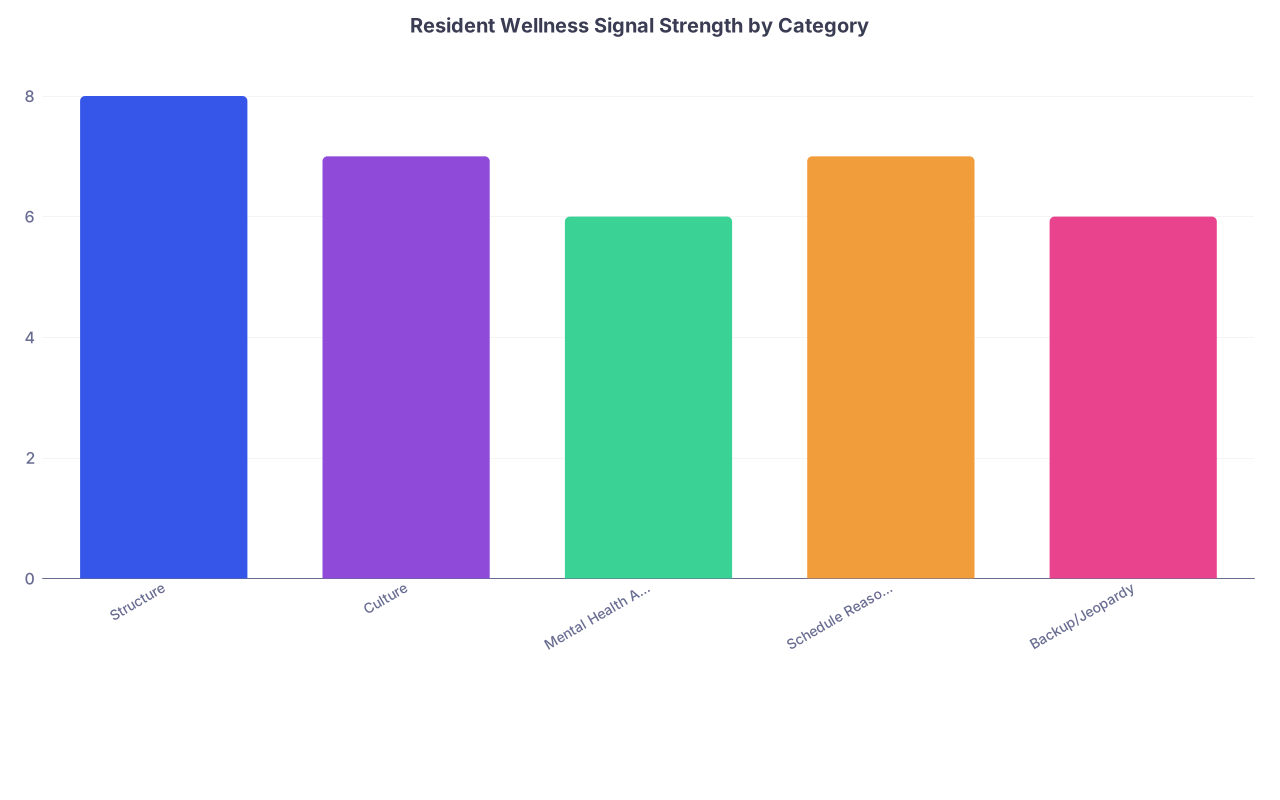
| Category | Value |
|---|---|
| Structure | 8 |
| Culture | 7 |
| Mental Health Access | 6 |
| Schedule Reasonableness | 7 |
| Backup/Jeopardy | 6 |
(When you evaluate, you’re basically rating each program on these buckets. If one is a 2/10, it will contaminate the rest.)
FAQ: Resident Wellness and Choosing Programs
Is it realistic to expect good wellness in a competitive specialty?
Yes, though it will still be hard. Even in surgical subspecialties, some programs protect days off, enforce caps, and do not glorify abuse. You won’t find “easy,” but you can avoid toxic. Look for places where seniors are tired but not bitter.If residents seem miserable but match data is great, should I still rank it high?
I would not. A strong fellowship or board pass rate is not worth three years of mental and physical damage. Good training and humane treatment are not mutually exclusive; several mid-tier “name” programs quietly do both very well.Are anonymous surveys (like Doximity, Reddit, SDN) useful for wellness?
They’re useful as smoke detectors, not final verdicts. If multiple independent sources call out malignant culture or constant duty hour violations, believe there’s at least a problem. Then cross-check with your own impressions and what residents say on interview day.How many wellness features should a program have before I consider it “good”?
Think quality over quantity. I’d prioritize: honest duty hours, real backup for illness, accessible mental health support, and a track record of revising bad rotations. If those four are solid, I don’t care if they never serve pizza.What if residents are split—some love it, some clearly hate it?
That usually means the environment is high-intensity but tolerable for certain personalities and life situations. Ask: “What kind of person thrives here?” If the honest answer does not sound like you (or your life obligations), take that seriously.Can a program fix wellness problems while I’m a resident there?
Sometimes. I’ve seen programs overhaul night float, add APPs, or restructure an ICU rotation over 1–2 years. But do not rank based on future promises. Only count changes that are already in place or clearly underway with timelines and specifics.If two programs are equal on training but differ on wellness, is it reasonable to pick the ‘softer’ one?
It is not just reasonable; it’s smart. You will learn more and function better if you’re not constantly at the edge of collapse. A program that guards your bandwidth lets you read, reflect, and grow. Chronic misery does not make you a better doctor—just a more exhausted one.
Key points to walk away with:
- Ignore the wellness buzzwords; judge programs by structures, culture, and outcomes.
- Ask specific, uncomfortable questions and watch how residents and leadership respond.
- Trust the combination of your gut and your notes—if seniors look broken and coverage is “we just push through,” that is not a wellness-focused program, no matter what the brochure says.