
It’s late January. You just submitted your rank list. Your friends are debating number 3 vs number 4 like it’s life or death. You’re staring at your list thinking, “Do they really discuss me in those rank meetings, or is it all predetermined by scores?”
Let me answer that for you: yes, they talk about you. Sometimes for 10 seconds. Sometimes for 10 minutes. And often, one offhand comment from the right person tilts the room.
I’ve watched applicants leap 20 spots on a rank list because a chief resident said one sentence. I’ve also watched someone with a 260+ Step 2 and glowing letters quietly slide down because a single attending shook their head and muttered, “Not a good fit.”
You never see that part. But you’re living with the consequences.
So let me walk you through what really happens in those rooms — and then I’ll show you how to choose programs knowing how the game is actually played, not how the brochure pretends it is.
What the Rank Meeting Actually Looks Like
Forget the fantasy of an objective algorithm where your score, class rank, and honors crank out a “fair” position.
The rank meeting is human, political, and sometimes downright petty.
Here’s the usual setup.

| Step | Description |
|---|---|
| Step 1 | Collect interview evaluations |
| Step 2 | Preliminary score or tier |
| Step 3 | Rank committee meets |
| Step 4 | Discuss borderline or controversial applicants |
| Step 5 | Adjust ranks based on discussion |
| Step 6 | Finalize rank list |
Most programs follow a loose version of this:
- Everyone submits interview evaluations and numbers.
- The coordinator or APD compiles a “preliminary” rank based on scores, tiers, or buckets.
- The rank committee meets — usually PD, APDs, chief residents, maybe some core faculty.
- They go through the list, focusing on:
- Top few (match “gets”)
- Borderline “are we comfortable training this person?”
- Anyone with red flags or divided opinions
- Legacy cases (home students, rotating students, couples match)
- They adjust people up or down. Sometimes a little. Sometimes a lot.
That’s where comments matter.
I’ve watched someone move up 15–30 spots because a single champion in the room refused to let it go. “Look, I worked with her. She was the only sub-I who stayed late without whining. Put her higher.” And the room shrugged and moved her.
And no, it’s not “always the PD’s call.” At many places, the PD is sensitive to internal politics. If the residents hate someone, the PD won’t die on that hill. Nobody wants to spend 3–5 years dealing with a bad cultural fit just because they had a 99th percentile score.
What They Actually Say About You in the Room
There’s what goes into the written evaluation. Then there’s what people say when the door closes.
The written part is staged: “Pleasant,” “good communicator,” “strong knowledge base.” It’s basically grammar-checked fluff plus a number.
The spoken part is where your fate can really move.
Here’s the kind of language I’ve actually heard in rank meetings:
- “He was smart but exhausting.”
- “She was average clinically, but the nurses loved her on the sub-I.”
- “I don’t trust him with patients at 2 a.m.”
- “If we had 10 of her, this program would run itself.”
- “I cannot spend three years with that level of neediness.”
- “She’s a grown-up. She’ll be fine on day one.”
That kind of sentence is what shifts your rank. Not “strong personal statement” or “published two papers.”
So what drives those comments?
1. Fit — but not the brochure version
Every program says they want “hard-working, team-oriented, compassionate learners.” Empty buzzwords.
In the room, “fit” is code for:
Can we stand working with this person at 3 am for the next 3-7 years?
They’re thinking:
- Will this person cover when things get tough, or will they disappear?
- Are they going to complain about everything?
- Will they poison the culture, or stabilize it?
If you came off as high-maintenance, arrogant, or weirdly rigid, you get crushed on the “fit” axis. And that can outrank your Step score.
2. Resident opinions carry more weight than you think
This part is usually hidden from you. Residents are not just tour guides; they’re informants.
After interview day, there’s often a quick debrief:
- Who stood out?
- Who seemed like trouble?
- Who seemed fake?
- Who did you want as a co-intern?
I’ve seen a PD look at a borderline application and say, “What did the residents think?” and literally decide their fate off that.
One resident saying, “I loved talking with her, she felt like one of us,” can make a big difference. One saying, “He talked over the MS3s and was dismissive,” can lower you an entire tier.
You don’t see those write-ups, but they’re there.
3. Sub-I and away rotation reputations
If you rotated there, your interview is a small part of your file. The bigger part is your month.
What they actually remember:
- Did you disappear right at sign-out every day?
- Did you help without being told?
- Were you teachable, or did you argue for every 3rd-order differential like an UpToDate avatar?
- How did you treat nurses, clerks, and janitorial staff?
I’ve literally seen this:
Prelim list shows you at #45. Chief says, “No way. That’s the student who always came in early, pre-rounded well, and took responsibility when they missed something. We should move them into our top 20.”
And it happens.
Conversely: “That’s the one who thought they were too good to see consults at 5 pm. No.” Down you go.
How the Rank List Is Really Built: What Matters, What Doesn’t
Let’s be blunt. Your Step score and transcript get you the interview. They’re the ticket in the door. After that, they matter less than you think.
Here’s how the relative weight often shifts between file review and rank meeting:
| Factor | Pre-Interview Weight | Rank Meeting Weight |
|---|---|---|
| Step 2 score | High | Low–Medium |
| Clerkship grades | High | Medium |
| Research/publications | Medium | Low |
| Letters of recommendation | High | Medium |
| Interview performance | Medium | High |
| "Fit" / personality | Medium | Very High |
| Sub-I / away reputation | Medium | Very High (if applicable) |
The shift is very real. By the time they’re in the rank room, everyone they’re seriously discussing is “qualified enough.” Now they’re deciding: who do we actually want to deal with?
That’s why one comment can flip you. Because when everyone is clustered in the “acceptable” score band, subjective impressions are the tiebreaker.
What This Means for You When Choosing Programs
You’re trying to build a rank list. You’re supposed to decide where you’ll be for the next several years. But you’re doing it blind to what’s happening on the other side of the curtain.
So here’s how to choose programs with an insider understanding of how they rank you.
1. Favor programs where residents actually have power
If you’re a good human being, you want residents to have a bigger voice. Because residents tend to pick people they can work beside, not statistical monsters with toxic energy.
Pay attention on interview day and socials:
Ask them directly:
- “Do residents have any say in the rank list?”
- “Is there a resident on the rank committee?”
- “Have you ever advocated for or against an applicant and seen it matter?”
If you hear: “We give feedback, but I’m not sure it changes much,” that’s code for residents are decoration. In those places, single attending personalities dominate, and your fate may hang on whether you shared their hobby or appealed to their ego.
Programs where residents can say “no, hard pass” on a clearly bad fit are much healthier to train at.
2. Watch who actually talks about “fit” and how
Terrible programs use “fit” as a dog whistle: they want people who look, talk, and think like the people already there.
Healthy programs talk about fit in terms of:
- Work ethic
- Respect for staff
- Collaborative style
- Ability to function under pressure without melting down or lashing out
Listen to the kind of stories they tell about current residents:
- “She’s insanely smart but doesn’t make you feel dumb.”
- “He’s the one who always stays late when the ED is drowning.”
- “They’re quiet, but super reliable.”
That’s who they value. If that aligns with who you actually are, your odds of getting championed in that rank room go up.
3. Calibrate your risk: prestige vs being supported
A harsh truth: the more “prestigious” the program, the more disposable you become. Not always, but often.
At hyper-competitive places:
- Long lists of top applicants blur together.
- They think they can always fill with another 260+, AOA, research machine.
- One negative comment tanks you because there are 50 people like you behind you.
At strong-but-not-manic programs:
- They’re more deliberate. They care a lot about who will stay, be stable, and not implode.
- They’re more likely to move you up based on good behavior and strong resident buy-in.
If you’re a strong but not god-tier applicant, there’s a decent chance you’ll be ranked significantly higher at a slightly less “famous” program that genuinely liked you, compared to a brand-name one where you were Applicant #87.
Match that with what you want from your career. Chasing name only, without thinking about how they treat their people, is how you end up in a malignant shop smiling through Match Day and regretting it in October.
The One Comment That Helps vs the One That Kills
You need to understand what kind of comment actually moves a room.
The helpful comment usually sounds like this:
- It’s specific.
- It’s grounded in real interaction.
- It reassures the group about risk.
Examples of comments that move you up:
- “She took feedback really well — I gave her a hard patient scenario and she didn’t get defensive, she thought it through.”
- “He was the only one who asked how our interns were doing this year. Felt very grounded.”
- “When I pressed her on a mistake in her application, she owned it and explained how she changed her behavior. That matters to me.”
These comments make people think: safe to train, real adult, good colleague.
The killing comments are often short:
- “I don’t trust his judgment.”
- “She talked over the nurse and med student the entire time.”
- “Very rigid. I worry he’ll be impossible on call when things aren’t textbook.”
- “If we’re already annoyed after 20 minutes, imagine three years.”
I’ve watched the entire room shift posture on comments like that. PD scrolls the list down and says, “Let’s move them lower. Any objections?” Silence. And you never know.
How to Pick Programs Knowing All This
Let’s flip it to something practical: how you should choose and rank programs with these realities in mind.
1. Trust the vibe you got from residents
If residents seemed:
- tired but not bitter,
- honest instead of overselling,
- willing to acknowledge weaknesses without sounding trapped,
that’s a good sign.
Programs where every resident gives the exact same canned line — “We’re a family, we work hard, we play hard, everyone’s so supportive!” — are usually hiding dysfunction. Or they’re terrified to say anything real.
You want a place where residents feel safe enough to tell you, “Our call schedule changed last year and it sucked at first, but leadership actually listened and adjusted it.” That’s a program where your wellbeing might actually matter.
2. Look for how they talk about their low-performers or strugglers
Ask this question in some form:
- “How do you support residents who are struggling clinically or personally?”
- “What happens if someone fails a board exam or has a rough rotation?”
Listen carefully:
- If they dodge, or brag “that never happens here,” they’re lying or delusional.
- If they talk realistically about remediation, mentorship, mental health, and second chances, that’s a program that can absorb human imperfection.
In the rank room, those programs are also more thoughtful. They’ll move you up because they see you as a person, not just a risk.
3. Understand where your one comment is likely to come from
Think back on each interview day and ask:
Who is most likely to be the person speaking about me in that room?
- Was it the PD who interviewed you directly and seemed genuinely engaged?
- Was it a chief who spent 20 minutes with you and said, “I hope you come here” (and meant it)?
- Was it a resident you really clicked with at dinner?
Where you felt seen and understood, you are more likely to have a champion. Rank those programs higher than a shinier name where the interactions felt flat, rushed, or generic.
That thing you keep saying — “I just felt comfortable there” — is exactly what translates into someone saying, “I could see working with them for three years,” and that’s the sentence that moves your line on the spreadsheet.
A Quick Reality Check: Trends and Numbers
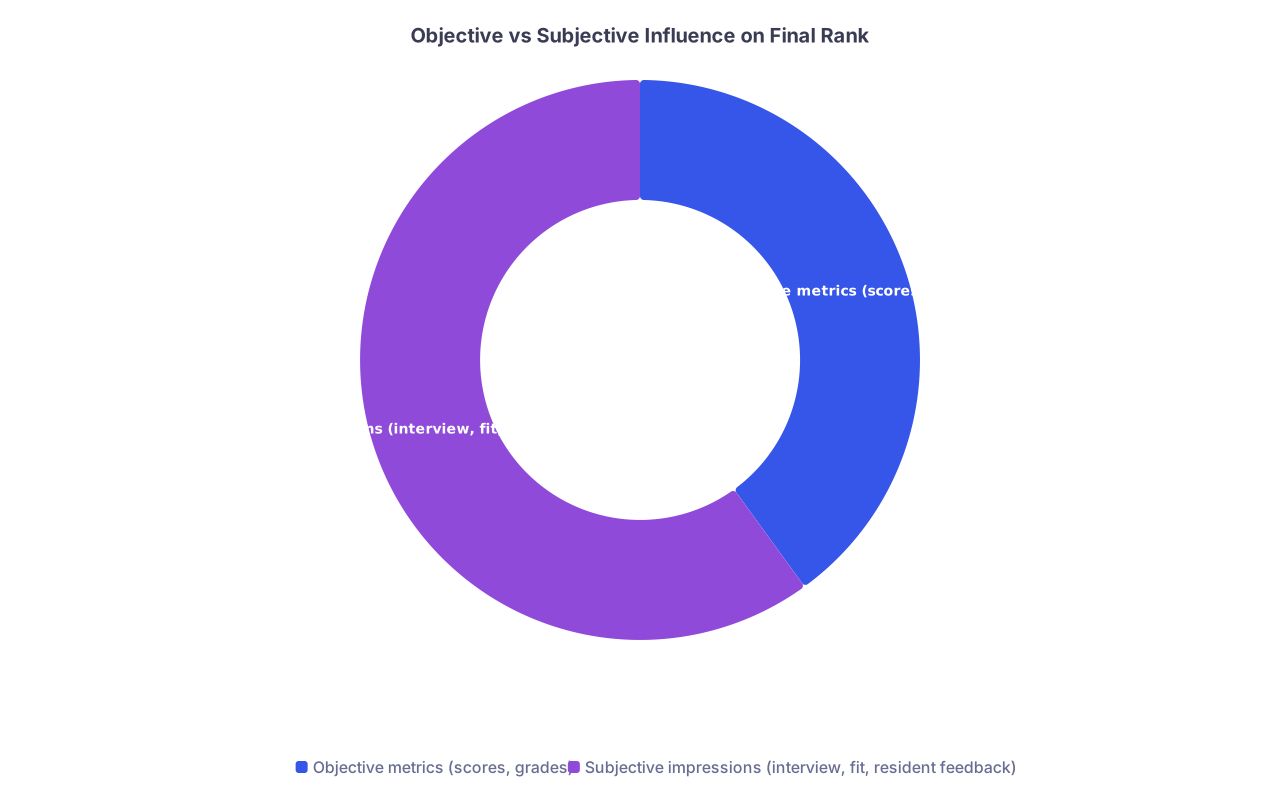
To anchor this in reality, here’s how much of your application’s power shifts away from pure metrics and into “soft” factors by the time you reach the rank room.
| Category | Value |
|---|---|
| Objective metrics (scores, grades) | 40 |
| Subjective impressions (interview, fit, resident feedback) | 60 |
It’s not 10% subjective. It’s often the majority.
That’s why you should stop obsessing over whether they’ll love your third-author paper from a minor journal and start caring more about: Did I pick places where the people I met felt like my people?
Putting It All Together: Strategy For Your Rank List
Here’s the hierarchy I’d actually use, knowing how the rank room plays out.
Put your true #1 first, even if you think it’s a “reach” The algorithm works in your favor. If they’re going to push for you, your only job is to rank them highest. Don’t game it based on guesses of where they put you.
Then prioritize programs where:
- You had a strong, specific connection with at least one influencer (PD, APD, chief, senior resident).
- Residents seemed like people you actually want to be in the trenches with.
- Leadership seemed responsive, not defensive.
Only then sort within that bucket by:
- Location
- Prestige
- Research opportunities
- Niche interests
You’re not just choosing a name on your white coat. You’re choosing the people who will be in the room arguing for or against you for three to seven years — for schedule changes, fellowships, LORs, leadership roles.
You want people who advocate. Not people who shrug and let you slide down some invisible list.