
The obsession with residency rankings is sabotaging good careers.
Not slowing them down. Not mildly misdirecting them. Sabotaging them.
I have watched smart, capable students wreck three to seven years of their life by chasing the highest-ranked name instead of the right fit. They thought they were “maximizing opportunity.” What they actually maximized was burnout risk, misery, and sometimes even fellowship difficulty.
If you are about to build your rank list, you are standing at a very real cliff. The “ranking trap” is how people fall.
Let’s make sure you do not.
The Ranking Trap: What It Actually Looks Like
No one wakes up and says, “I want to be miserable for the next five years but with a shiny logo on my badge.” The trap is more subtle.
It usually sounds like this:
- “It’s a top-10 program. I would be stupid to rank my state program higher.”
- “Everyone says if I can match here I should.”
- “The name will open every door. I can tolerate anything for three years.”
- “I can always be happier later, during fellowship or as an attending.”
This is how it plays out in real life:
The “prestige or nothing” intern who:
- Moves across the country with zero social support.
- Ends up in a malignant culture where asking for help is seen as weakness.
- Spends the second half of intern year looking up transfer options.
The solid, mid-tier matched resident who:
- Gets rich hands-on experience and strong mentorship.
- Matches an elite fellowship because faculty actually know and advocate for them.
- Quietly outperforms peers from “better” residencies.
Here is the uncomfortable truth:
For most careers, beyond a certain baseline, fit beats prestige. Consistently.
The mistake is thinking those glossy rankings on doximity or name recognition at your med school white coat ceremony should drive your list. They are not built for you. They are built to impress each other.
Why Prestige Is a Terrible Primary Decision Tool
Yes, program reputation matters. But not the way students treat it.
Prestige should be a tiebreaker. Not the steering wheel.
Here is where people get burned when they let ranking lead.
1. You overestimate how much the name will matter later
You think:
- “Top-5 program = any fellowship I want.”
- “Program X is ‘better known’ so it must be the correct choice.”
- “Community or mid-tier university = second-class training.”
What actually happens:
- Fellowship directors care far more about:
- Your clinical performance (letters, reputation as a resident).
- Your research productivity where it counts.
- Your reliability, maturity, and how you function on teams.
- Your chief resident, PD, and faculty champions matter more than the logo.
- A mediocre resident at a famous program does not magically beat a strong resident from a mid-tier one.
I have seen applicants from highly ranked programs rejected for fellowship while residents from “no-name” programs got the spot because the latter had:
- Detailed, enthusiastic letters.
- Strong interview presence and clear clinical experience.
- Consistent advocacy from people fellowship PDs trusted.
2. You underestimate how much culture will shape you
Culture sounds fuzzy. It is not. It directly affects:
- Whether you feel safe asking for help at 3 a.m.
- Whether mistakes are debriefed or weaponized.
- Whether faculty know your name or just your pager number.
In a toxic culture, you are more likely to:
- Burn out early.
- Avoid challenging cases because you fear humiliation.
- Develop imposter syndrome that follows you into attending life.
In a supportive culture, you are more likely to:
- Push yourself while feeling protected.
- Learn from complications instead of hiding them.
- Actually like your specialty by PGY-3.
Prestige does not guarantee a healthy culture. I have watched some “top” institutions protect abusive attendings for years because “they bring in grants” or “their name is big.”
3. You confuse selectivity with quality of training
Doximity rank ≠ how much you will learn.
Common blind spots:
Big-name programs often:
- Have huge subspecialty services where fellows do most of the procedures.
- Rely heavily on mid-levels and fellows, thinning resident exposure.
- Push residents into niche research early, with limited time for bread-and-butter clinical growth.
Smaller or mid-tier places may:
- Give residents primary operator status for many procedures.
- Involve residents directly in decision-making instead of observing.
- Produce graduates who hit the ground running as attendings.
You want to avoid the trap of being “observer-in-chief” for three years at a famous place, instead of actually practicing your craft.
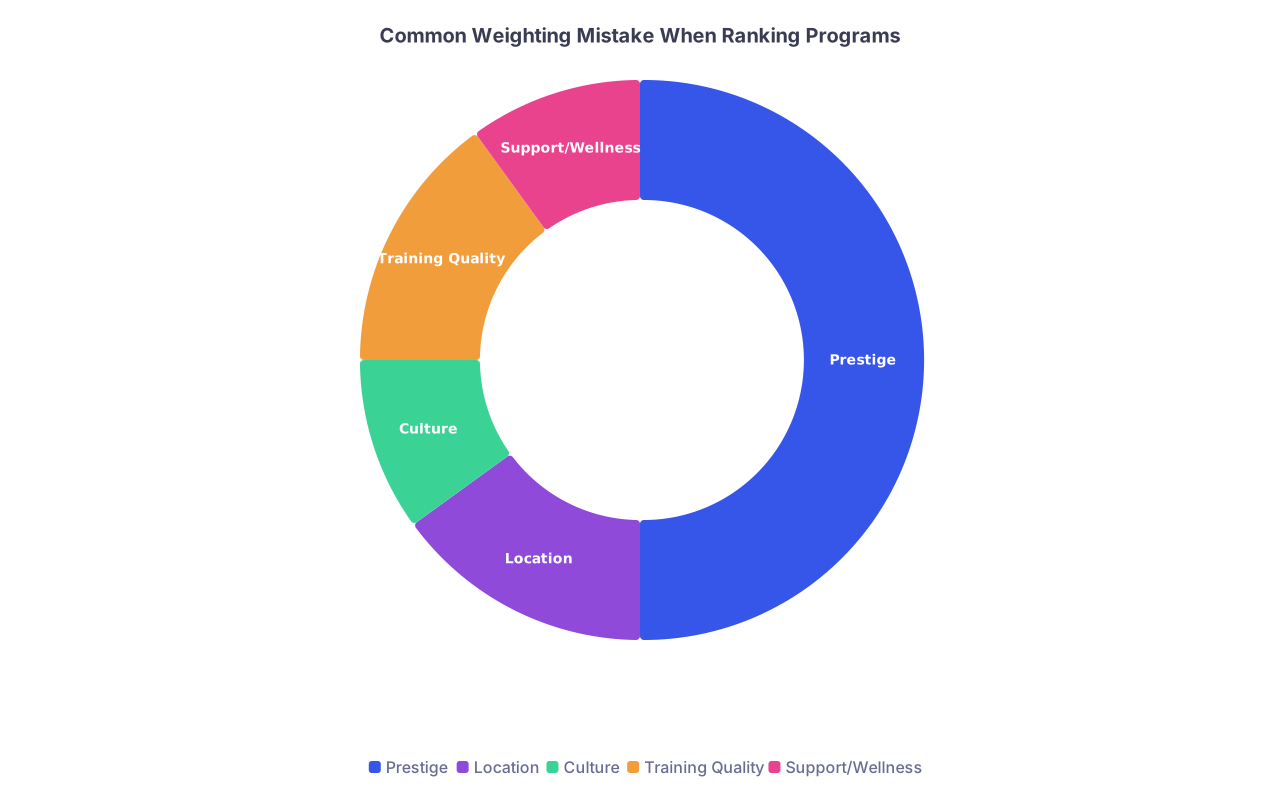
| Category | Value |
|---|---|
| Prestige | 50 |
| Location | 15 |
| Culture | 10 |
| Training Quality | 15 |
| Support/Wellness | 10 |
That chart is how too many students subconsciously weight their decisions: half the value on reputation, everything else fighting over scraps. That is how you get trapped.
Warning Signs You’re About to Fall for Prestige
If you catch yourself doing any of these, stop. You are drifting into bad decision territory.
1. Your rank list does not match your interview feelings
Classic scenario:
- You leave Interview A (top-10 name):
- Pre-interview dinner felt stiff.
- Residents looked exhausted and guarded.
- You heard one too many “we work hard but we’re like family” with dead eyes.
- You leave Interview B (mid-tier, strong clinical program):
- Residents were candid but positive.
- Faculty talked about your goals specifically.
- You could see yourself walking those halls at 5 a.m. without hating it.
Yet when you build your list? You put A above B because: “It’s ranked higher.”
That disconnect is not “being rational.” It is ignoring your own data.
2. Your justifications sound like other people’s voices
Listen very carefully to your internal monologue:
- “My classmates will think I settled if I do not go to the big-name place.”
- “My school faculty keep saying, ‘You’d be crazy not to rank them first.’”
- “My family has heard of Program X. They have not heard of Program Y.”
Those are not reasons. Those are external expectations you are mistaking for your own values.
Your future self, post-call, dragging themselves home after a 28-hour shift, will not care what your M3 classmates thought of your match result.
3. You dismiss real red flags as “just residency”
Red flags you should treat as serious:
- Residents:
- Could not answer direct questions about mentorship without pausing or glancing at each other.
- Warned you off certain rotations or attendings in hushed tones.
- Described “a lot of recent attrition, but it’s fine now” without convincing detail.
- Faculty:
- Talked more about NIH dollars and rankings than about resident education.
- Could not explain how struggling residents are supported.
- Brushed aside wellness questions with jokes.
If you catch yourself thinking, “Every residency is hard, I’m sure it’s fine,” you are minimizing. And setting yourself up.

The Fit Factors Students Consistently Undervalue
You cannot “optimize” residency the way you optimize MCAT prep. You are picking a life ecosystem, not a test center.
Here are the factors students push to the side—then wish they had not.
1. Day-to-day workload and schedule reality
Everyone says, “I can handle anything for three years.” That is pre-residency bravado.
What you should look at:
- Call schedules:
- Q3 vs Q4 vs night float.
- How many months of nights per year.
- Realistic work hours:
- Do residents routinely violate the 80-hour rule “off the books”?
- Are there frequent stay-late expectations after sign-out?
- Service vs education balance:
- Are you a functioning physician or a data-entry machine?
Residents will tell you the truth if you ask specific, not vague, questions.
2. Mentorship and advocacy
You do not just need teachers. You need people who will go to bat for you.
Red flags:
- PD cannot name other residents’ recent fellowships or jobs offhand.
- No structured mentorship program. “We just find mentors organically.”
- Fellows say, “Yeah, I just figured things out myself.”
Positive signs:
- Clear system matching residents with at least one faculty mentor.
- PD and APDs remember residents’ interests and projects without notes.
- Alumni stay connected and help current residents with fellowship/job searches.
3. Autonomy with backup
Too much autonomy and you drown. Too little and you stagnate.
You want:
- Early supervised responsibility that grows over time.
- Attendings who:
- Let you make a plan.
- Then discuss it.
- Then let you implement when safe.
You do not want:
- Attendings who disappear and leave you terrified.
- Attendings who micromanage every detail so you never really practice independent thinking.
4. Location and real life
You cannot “turn off” life for residency. People try. They fail.
Critical questions:
- Can you afford to live within reasonable commuting distance?
- Do you have any social support nearby (partner, friends, family, community)?
- Will you be safe going home post-call in the dark?
- Does this city have anything that refills your tank? Nature, culture, faith community, sports, whatever your version is.
Starving yourself of everything non-medical and calling it “commitment” is a fast path to burnout.
How to Compare Programs Without Getting Seduced by Rank
You need a structured way to compare options that does not default to “which line is highest on Doximity.”
Start by flipping the usual weighting.
| Factor | Typical Student Weight | Recommended Weight |
|---|---|---|
| Prestige/Rank | 40–60% | 10–20% |
| Culture/Support | 10–15% | 25–30% |
| Clinical Training | 10–20% | 25–30% |
| Location/Life | 10–15% | 15–20% |
| Mentorship | 5–10% | 15–20% |
You do not have to use those exact numbers. But if prestige is more than 20% of your internal calculus, you are courting trouble.
A simple exercise that exposes your real priorities
Do this before you lock your list:
- Take your top 6–8 programs.
- For each, score 1–5 on:
- Culture / resident happiness
- Clinical exposure & hands-on experience
- Mentorship & advocacy
- Location & life outside work
- Prestige / reputation
- Write the numbers down, do not just think them.
Then ask:
- “If I ignore the prestige column entirely, what does my list look like?”
- “If I pretend no one else ever finds out where I matched, what would I choose?”
That second question strips away a lot of ego-driven nonsense.
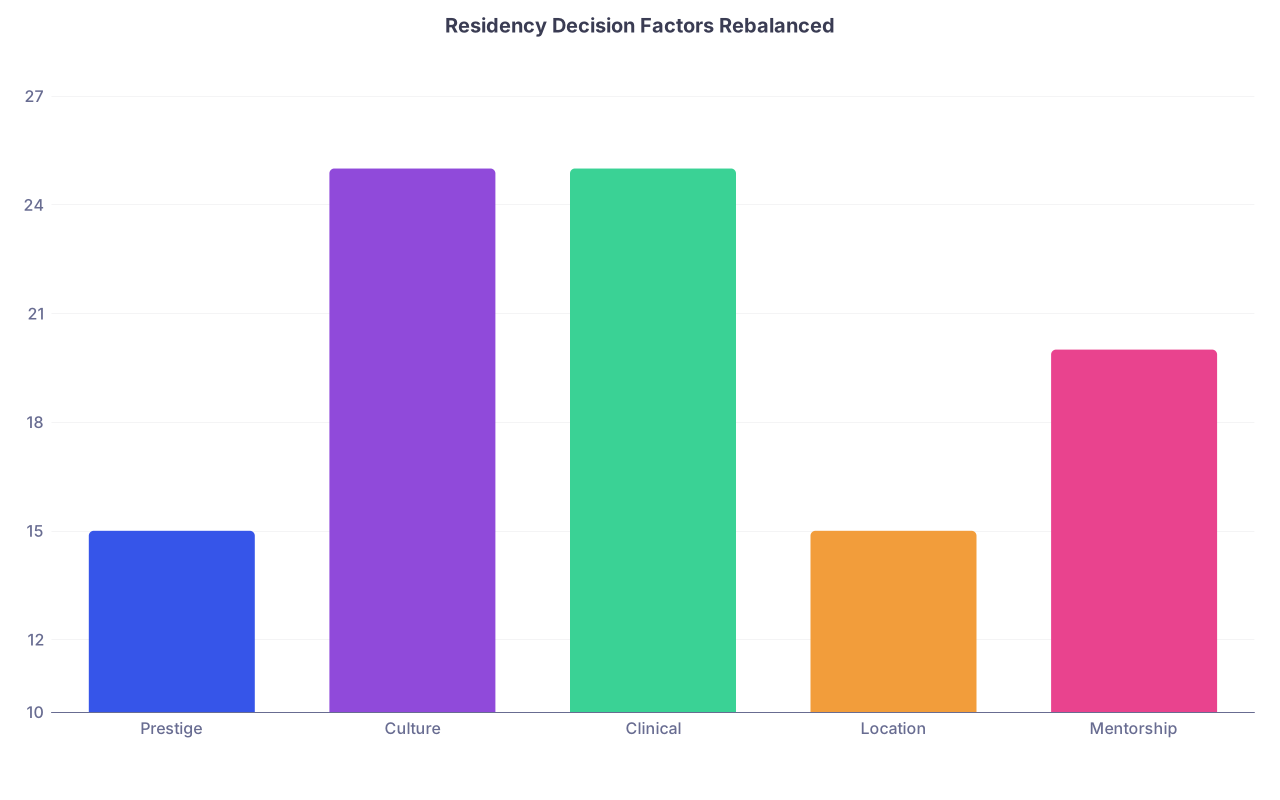
| Category | Value |
|---|---|
| Prestige | 15 |
| Culture | 25 |
| Clinical | 25 |
| Location | 15 |
| Mentorship | 20 |
That is a healthier profile. Notice prestige still exists. It just stopped barking orders.
Special Cases Where Prestige Is Overvalued (And When It Actually Matters)
I am not saying reputation is irrelevant. I am saying most people misapply it.
When prestige matters less than you think
Primary care, hospitalist, general pediatrics, outpatient-focused fields
- Regional reputation and your own performance trump national rank.
- Your eventual employer cares more about:
- Were you well-trained?
- Are you a decent human?
- Can current staff stand working with you?
Geographically bound careers
If you know you want to practice in a specific state/region:- A strong local/regional name + local connections often beats a fancy name from across the country.
- Alumni network in that region is gold.
When program cultures are clearly different
Never choose a malignant culture because the name is bigger. That is lighting your own fuse.
When prestige can matter more
Be honest about where it truly makes a difference:
Ultra-competitive fellowships in academia-heavy fields
Think interventional cardiology, advanced GI, some surgical subspecialties, certain heme/onc or academic neuro spots.- Certain big-name programs have:
- Direct pipelines.
- PDs who call their friends running those fellowships.
- But even here:
- Being middle-of-the-pack at a top place often loses to being stellar at a solid but slightly less known one.
- Certain big-name programs have:
If you are dead set on a research-heavy academic career
- You may benefit from:
- Access to major grants.
- High-impact research groups.
- Established mentors with national names.
- But again, not at the cost of a toxic environment that derails you before you even start writing grants.
- You may benefit from:
Here is the nuance most people miss:
If two programs are equal on culture, clinical training, and mentorship, then yes, pick the one with better name recognition in your intended field.
The mistake is reversing that order.
How to Reality-Check Your Rank List Before Certifying
You should do one last hard audit before you hit “Certify.”
Use this checklist and do not lie to yourself:
- For every program above another, ask:
- “Can I clearly state why I put this one higher beyond ‘it is more prestigious’?”
- For any program you ranked highly despite worse resident vibes, answer:
- “Exactly what am I trading that off for, and is it truly worth three to seven years of my life?”
- Circle any:
- Malignant hints you saw.
- Major life stressors that would come with that move (support system loss, finances, safety).
- Ask yourself the brutal question:
- “If I matched here and was miserable, would I tell my M4 self it was still worth it for the name?”
If you cannot honestly say yes, you know what you need to do.
The One Thing You Should Do Today
Open your draft rank list.
For each program, write a single sentence next to it:
“I am ranking this program here because…”
If any sentence relies mainly on prestige, ranking, or other people’s opinions rather than your lived interview experience and priorities, you just found a ranking trap.
Fix those sentences. Then fix the list.