
It is mid-January. You just finished another virtual interview at a “big name” academic center. Their logo is everywhere—on textbooks, on conference slides, on your classmates’ dream lists. The interview day was… fine. Residents looked exhausted. Faculty talked a lot about “groundbreaking research” and not much about teaching. But still, that name. You open your rank list spreadsheet, and your cursor hovers over that program—should it go at the top?
This is where people quietly ruin the next 3–7 years of their life.
Let me be very clear: over-prioritizing brand name over training quality is one of the most common and most expensive mistakes in residency selection. I have watched residents drag themselves through miserable years at “top 10” institutions that did not care if they learned anything, as long as staffing needs were met and research output looked good.
You are not choosing a hoodie. You are choosing who will teach you how to be a safe, employable physician.
Let’s walk through the main traps people fall into—and how you can avoid ranking yourself into a bad situation.
Mistake #1: Confusing Reputation With Actual Training Quality
“Everyone knows they’re top tier.”
Yes. Everyone knows. That does not mean you will be trained well there.
Programs have different reputations depending on who you ask:
- Medical students: “That place is famous.”
- Residents: “That place will grind you.”
- Fellowship directors: “Strong research, variable clinical skills.”
- Local community doctors: “They are smart, but I do not trust them alone as interns.”
If you only listen to the first group, you lose.
| Signal Type | Good Sign | Red Flag |
|---|---|---|
| Resident vibe | Tired but engaged, candid | Flat, guarded, or overtly miserable |
| Faculty comments | Specific about teaching and feedback | Only talk about prestige and NIH funding |
| Alumni outcomes | Diverse jobs, strong fellowship mix | Mostly academics at same institution |
| Schedule structure | Protected teaching, realistic hours | Chronic >80 hrs, no education protection |
The ugly truth: some big-name programs are fantastic. Some are borderline negligent when it comes to education. They rely on prestige to keep the pipeline full.
Do not assume:
- “They matched 10 residents into top fellowships last year” = “They will train me well.”
- “Everyone tries to match there” = “It is right for my learning style or life.”
Ask bluntly on interview day and second looks:
- “On a typical ward month, when do you leave?”
- “Who teaches on rounds—the attending, senior, or no one?”
- “How often do you get direct feedback with examples?”
- “Are there rotations where residents feel more like cheap labor than learners?”
If the answers are vague, evasive, or defensive, you are looking at a name brand covering weak training.
Mistake #2: Ignoring Resident Outcomes That Actually Matter For You
People obsess over:
- Fellowship match lists
- Where the PD trained
- NIH funding rankings
They ignore:
- How comfortable graduating residents feel practicing independently
- Whether residents pass boards on the first attempt
- Burnout, attrition, and quiet transfers to other programs
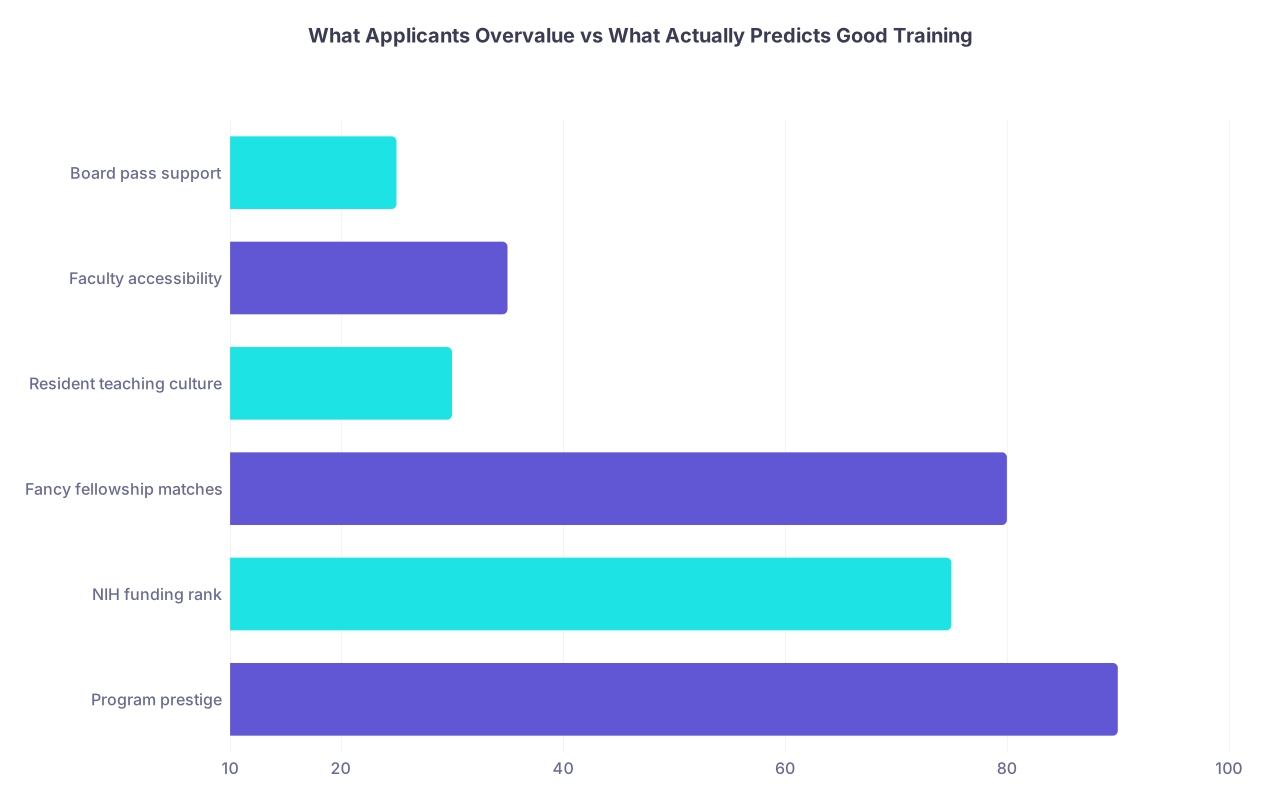
| Category | Value |
|---|---|
| Program prestige | 90 |
| NIH funding rank | 75 |
| Fancy fellowship matches | 80 |
| Resident teaching culture | 30 |
| Faculty accessibility | 35 |
| Board pass support | 25 |
I have seen this pattern repeatedly:
Resident at Big Famous University Hospital:
- Knows the p-value of every NEJM trial in their field.
- Has 12 publications.
- Panics on night float because they never had to independently run a code or manage a crashing patient without layers of backup doing the thinking for them.
Resident at “no-name” strong clinical program:
- Two or three moderate publications at most.
- Huge hands-on volume, real autonomy with graded supervision.
- Walks into fellowship comfortable running the service on day one.
When you review outcomes, do not stop at “where did they match?” Ask:
- “What percentage pass boards on first attempt?”
- “Do graduates feel ready for independent practice?”
- “How many residents left or transferred in the last 3–5 years, and why?”
- “Where do graduates end up in community practice, not just academic fellowships?”
High fellowship match + quiet attrition + board failures = training problem hiding behind prestige.
Mistake #3: Underestimating the Cost of a Toxic or Neglectful Culture
You can survive a grueling schedule if the culture is supportive and the teaching is strong. You cannot compensate for a malignant environment with “but the name will open doors.”
Warning signs that the program uses prestige to excuse dysfunction:
- Residents talk about “survival,” “making it through,” or “paying dues” more than learning.
- Faculty or leadership openly joke about hazing, “weeding out the weak,” or “this place is not for everyone.”
- No structured system for reporting mistreatment that residents actually trust.
- Residents are visibly afraid to criticize anything on interview day.
When you are on the interview or second look, watch and listen:
- Are senior residents protective of interns or dismissive?
- Does anyone talk about wellness without sounding forced or scripted?
- Do residents laugh with each other—or only at the expense of patients or weaker colleagues?
Prestige-heavy toxic programs often excuse everything with some version of: “This is how you become elite.” Translation: “We will use you as labor and call it ‘rigor’.”
If you hear that line, take two big steps back on your rank list.
Mistake #4: Believing the “Brand” Will Automatically Secure Your Future
The myth:
“If I go to the most famous place that will take me, everything after that becomes easy.”
Reality:
- For competitive fellowships, a strong letter from someone who truly knows your work at a mid-tier program beats a generic letter from a celebrity name at a top-5. Every. Single. Time.
- Program reputation matters, but your performance, skills, and advocacy matter more.
Here is what fellowship and job committees quietly look at:
- What does your PD letter actually say? Generic or specific?
- Do your evaluations describe you as safe, reliable, and teachable—or just “very smart”?
- Can your references vouch for your clinical judgment, not just your poster count?

| Step | Description |
|---|---|
| Step 1 | Choose famous program |
| Step 2 | Assume doors open automatically |
| Step 3 | Underestimate need for mentorship |
| Step 4 | Limited support for your goals |
| Step 5 | Average letters despite big name |
| Step 6 | Harder than expected fellowship or job search |
| Step 7 | Choose solid teaching program |
| Step 8 | Get real mentorship |
| Step 9 | Strong clinical skills |
| Step 10 | Specific, powerful letters |
| Step 11 | Competitive for fellowships and jobs |
I have watched residents at huge-name programs struggle to get the fellowships they wanted because no one really knew them, mentored them, or owned their success. A famous department full of superstars can leave you invisible.
Meanwhile, residents from “average” but well-structured programs, with PDs and faculty who fight for them, secure extremely competitive spots.
Brand name is a multiplier. It multiplies what you bring and what the program gives you. If the program gives you little, the multiplier does not save you.
Mistake #5: Not Doing the Hard Work of Reality-Checking the Hype
Most applicants do lazy due diligence. They read:
- Doximity rankings
- SDN threads
- Program websites with “world-class training” copy-paste language
Then they slap together a rank list based on vibe + name.
That is how people end up shocked PGY-1, saying, “I had no idea it was like this.”
Here is where you need to get ruthless and specific.
For each program (especially the famous ones), you should be able to answer:
How will they actually teach me?
- Daily structure of wards, clinics, conferences.
- Real protection for education time vs “only when census is light.”
Who will mentor me?
- Named people who have successfully mentored residents with your goals.
- Evidence those mentors actually meet with residents and sponsor them.
What does a bad day look like here?
- On-call horror stories.
- How leadership responds to safety or wellness issues.
If you cannot answer these, you are gambling.
You are allowed to email current residents (not the ones hand-picked for the interview day) and ask direct questions. You are allowed to reach out to alumni from your med school who trained there and ask, “What do you wish you had known before ranking them?”
If your mentors are all starry-eyed about the name but cannot describe how the program trains residents day-to-day, they are not giving you enough data.
Mistake #6: Ignoring How Misaligned Training Can Break You
Even a “good” program on paper can be wrong for you. The mistake is assuming that prestige compensates for terrible fit.
Misalignment examples I have seen firsthand:
- Introverted, reflective learner goes to massive, hyper-competitive powerhouse where success requires aggressive self-promotion. They disappear, their confidence tanks, their performance suffers.
- Resident with family in the area chooses a big-name city program with brutal commute and impossible call schedules. They never see their kids awake on ward months. By PGY-2, they are burnt out and resentful.
- Someone who loves outpatient work goes to a hospital that worships ICU and tertiary care only. They graduate feeling underprepared for the actual job they want.
Training is not one-size-fits-all. A mismatch between your needs and the program’s strengths will not be fixed by a famous logo on your badge.
Ask yourself:
- Do I learn best by volume, autonomy, and being thrown in— or by structured teaching and close supervision?
- Do I want a program that primarily feeds academics and research, or one that excels at training community clinicians?
- Can I handle a place where attending interactions are formal and hierarchical, or do I need accessible, hands-on faculty?
If the answers clash with what you see and hear at that name-brand program, listen to that discomfort. Do not silence it with, “But think of the prestige.”
Mistake #7: Letting Ego and Fear Write Your Rank List
This is the part no one likes to admit.
People pick brand names because:
- They want to prove they were “good enough” to get in.
- They are afraid of what classmates or family will think if they choose a “lower-ranked” program.
- They tie their self-worth to external validation.
That is a fast track to misery.
Your classmates will care for 10 minutes on Match Day. After that, everyone is busy surviving their own internship. Your family will brag on Facebook regardless. None of them will manage your cross-cover list at 2 a.m.
You are the one who has to live this.
The honest question:
“If this program had a totally average name, based only on what I saw and heard about training and resident life, where would I rank it?”
If the answer drops by more than a couple of spots… you already know the truth.
How to Evaluate Whether a Name Brand Program Will Actually Train You Well
Let us be constructive. Here is a focused checklist you can use right now.
Look for these green flags:
- Residents can describe specific ways attendings teach on rounds, in clinic, and during procedures.
- Program leadership acknowledges weaknesses openly and explains concrete plans to fix them.
- Graduating seniors express confidence about independent practice, not just excitement about their fellowship title.
- There is a track record of supporting residents in trouble (personal, academic, health) without punitive attitudes.

And these red flags should make you very cautious, regardless of brand:
- Residents say “we learn by doing” but cannot describe structured feedback or supervision.
- PD avoids or downplays questions about burnout, attrition, or board pass rates.
- Obvious disconnect between what faculty say (“we value education”) and what residents report (no protected time, constant service pressure).
- Culture of glorifying suffering and dismissing wellness as “soft” or “entitled.”
If you see more red than green and still rank the program highly “because of the name,” that is not strategy. That is ego.
A Simple Reality Check Exercise
Before you certify your rank list, do this:
- Open your rank list draft.
- Cover the program names with a piece of paper (or hide the column).
- For each spot, write 3 concrete reasons that relate to training and life, not prestige:
- “Excellent hands-on ICU experience.”
- “Residents uniformly said they feel supported.”
- “Structured board review and high pass rates.”
- “Location keeps support system intact.”
If you cannot produce 3 real reasons for a program, especially the famous ones, you are ranking a brand, not a training environment.
Then ask yourself:
“If I had to repeat intern year 3 times in a row at this place, would I still choose it?”
If the honest answer is no, do not put it at the top.
FAQs
1. Is it ever worth choosing a weaker training environment for a very prestigious name?
Rarely, and usually not at the residency level. Residency is where you become a functioning doctor. If you feel the training is genuinely weaker—poor supervision, chaotic systems, minimal teaching—you are trading your core competence for a line on your CV. That is a dangerous bargain. If you are dead set on a famous institution, you can often get it later through fellowship, once you are already solid clinically.
2. How much do fellowship programs really care about residency program name?
They care, but not as much as applicants think. A mid-tier but respected program plus strong letters, clear clinical excellence, and a coherent story will beat a big-name program with mediocre letters and average performance. Directors read between the lines. Vague, nonspecific praise from a prestigious institution is a red flag. Tangible examples of your skills from any solid program are gold.
3. What if my mentors are pushing me hard toward a big-name program?
Listen to their reasoning, but do not outsource your judgment. Ask them specifically: “What do you know about the training there? About day-to-day life? About resident satisfaction?” Many mentors know the reputation from conferences or research, not from seeing residents endure the call schedule. Use their input as one data point, then cross-check with residents and alumni who have lived it.
4. How can I tell if residents are being honest on interview day?
Assume the official Zoom panel is the most polished version. The key is to find moments where the script drops: a side comment about a tough rotation, a joke about “this is recorded,” a resident who answers more bluntly than others. If you can get an off-camera conversation (phone or email) with a current or recent resident, you will get much more candid answers. Consistency across multiple conversations is what you trust.
5. What if the program I loved most has a weaker name and I am scared I will regret ranking it first?
You will always wonder “what if” about something. That is normal. But long-term regret almost always comes from daily misery, poor training, and burnout, not from attending a less famous program where you were well-trained and supported. Rank the place where you can become the best, safest version of the physician you want to be. Then own that decision fully.
Open your rank list right now and look at your #1 choice. Next to its name, write down three concrete ways it will make you a better, safer, more confident doctor—not a more impressive LinkedIn profile. If you struggle to fill those three lines, you have work to do before you click “certify.”