
The obsession with case volume is quietly burning residents out and wrecking careers.
Let me be blunt: chasing the “highest case numbers” as your main criterion for choosing a residency is a mistake. A serious one. And I’ve watched it chew up smart, motivated people who thought they were just being “hardcore” or “maximizing exposure.”
You’re being sold a myth: more cases automatically equals better training, better confidence, better fellowship, better everything. That’s not how it actually plays out on the ground.
You’re choosing a training environment, not a meat-processing plant. If you treat residency like a numbers game, you’re setting yourself up for burnout, cynicism, and sometimes even leaving medicine altogether.
Let’s dismantle this before you sign yourself up for 3–7 miserable years.
The Lie You’re Being Sold About Case Volume
You’ll hear this line over and over during interview season:
“Our residents get insane case volume.” “You’ll get your numbers by PGY-2.” “Our grads feel very comfortable managing anything because they’ve seen it all.”
Sounds reassuring. Feels efficient. But here’s what’s usually left out:
- What’s the support ratio (attendings, NPs, PAs, fellow vs resident)?
- What’s the schedule really like when case volume is high?
- How much of that volume is repetitive, low-yield work?
- What’s the burnout rate? How many residents quietly leave or change specialties?
- How much actual teaching happens, versus “just get it done”?
High volume isn’t the enemy. Overvaluing it blindly is.
The real red flag is this: programs that lead with case volume often have very little else to sell. And they’re hoping you don’t notice.
Why “More Cases” Doesn’t Automatically Mean “Better Training”
Think about it like this: doing 1000 procedures badly, rushed, sleep-deprived, with minimal feedback does not make you an expert. It makes you exhausted and overconfident. That’s a dangerous combination.
Here’s where people screw this up:
Confusing exposure with mastery
Seeing something isn’t mastering it.
Doing something repeatedly without coaching isn’t mastering it either. It’s just repetition.Ignoring diminishing returns
The first 50 central lines? Huge learning curve.
Line #200 vs #300? You’re not gaining 50% more skill. You’re padding a logbook and losing another weekend.Underestimating cognitive overload
When your brain is maxed out from running 15–20 patients, 2 admissions, 40 notes, and a code, you’re not doing “deep learning.” You’re surviving.Missing hidden opportunity costs
Every hour stuck in pure service work is an hour you’re not:- Sitting down with an attending dissecting a case
- Studying with intention
- Doing research that actually advances your career
- Sleeping like a human being
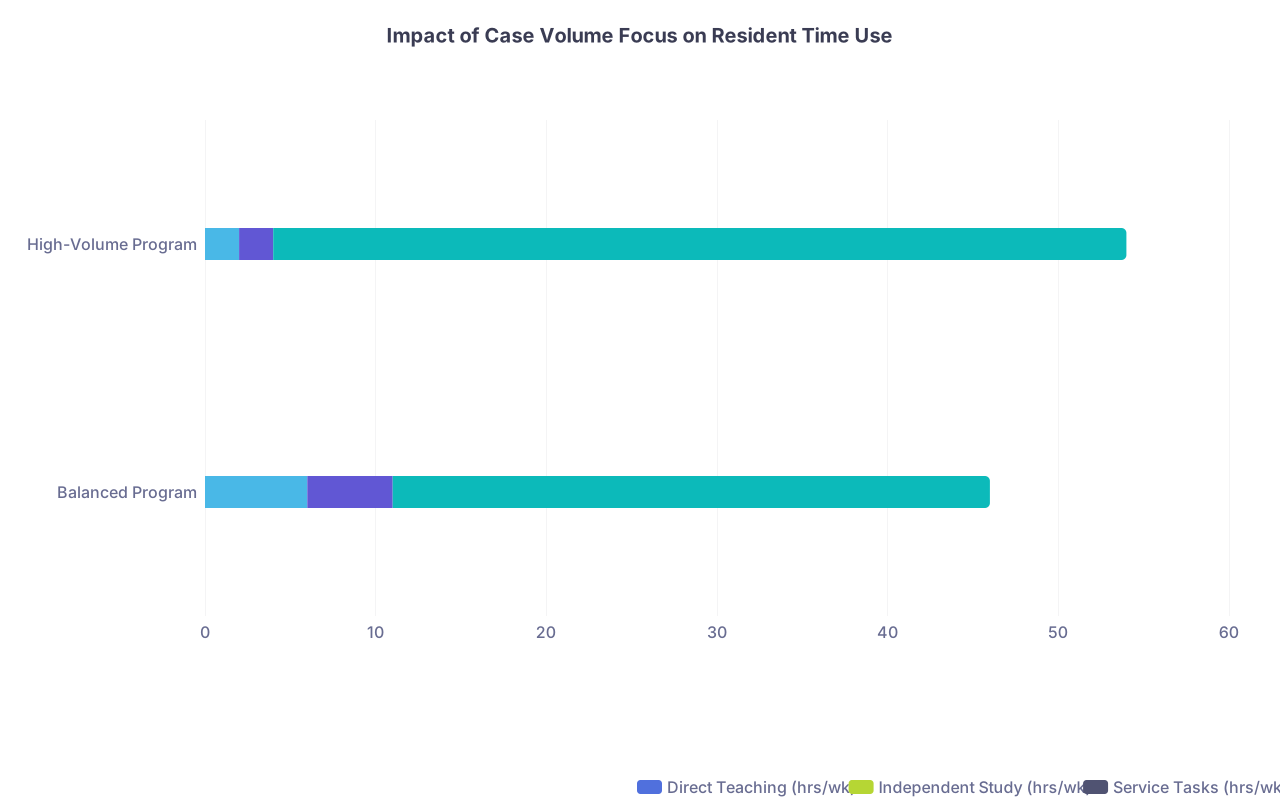
| Category | Direct Teaching (hrs/wk) | Independent Study (hrs/wk) | Service Tasks (hrs/wk) |
|---|---|---|---|
| Balanced Program | 6 | 5 | 35 |
| High-Volume Program | 2 | 2 | 50 |
Look at that distribution. High case volume often just means one thing: service dominates everything else.
How Overvaluing Case Volume Leads Straight to Burnout
Burnout doesn’t hit overnight. It’s a slow erosion. You wake up three years later wondering when exactly you stopped caring.
Programs that glorify volume at all costs create the exact conditions that produce burnout: chronic overwork, low control, weak support, and a culture that treats suffering as a badge of honor.
1. Service Over Education
Here’s the ugly truth: some programs are built on cheap resident labor, not on education.
You’ll see signs like:
- Residents bragging (or quietly complaining) about “holding 20–25 patients solo”
- “Resident-run” services where attendings appear mostly to sign notes
- Constantly being told, “We don’t have time to talk about this now”
- Morning report or academic half-day routinely getting canceled “because the list is heavy”
What actually happens:
- You stop asking “why” and only think “how do I get through this?”
- You learn to cut corners just to survive the day
- Your curiosity dies. Your motivation follows.
2. Chronic Sleep Debt from Unsustainable Schedules
Yes, everyone works hard. But there’s “hard” and then there’s “slow-motion crash.”
High-volume programs often run right at the edge of legal duty hours. Some quietly step over the line and expect you to under-report:
- Post-call “just finish up” that turns into 4–5 extra hours
- “Short call” that’s anything but short
- Night float with zero buffer followed by busy day rotations
I’ve watched residents in these setups:
- Nodding off in sign-out regularly
- Drinking 4–5 coffees or energy drinks just to function
- Making medication errors they’d never make rested
- Snapping at nurses, patients, even families because their fuse is gone
You’re not weak if this happens to you. You’re human.
3. Emotional Numbing and Compassion Fatigue
When your day is 20 tasks deep, your brain starts doing triage. Fast.
- You stop seeing patients as people and start seeing them as “the DKA in 12” or “the GI bleed in 5”
- You rush family meetings because you’re thinking about three other discharges
- You skip checking in on the dying patient because “I just don’t have time”
Then the guilt hits. You know you’re capable of being a better doctor, but your bandwidth is gone.
This mismatch between what you believe good care should look like and what you’re forced to deliver? It’s a direct pipeline to burnout.
4. Loss of Control Over Your Own Learning
In high-volume, poorly structured programs, your learning becomes random. You learn whatever walks in and whatever you have time to notice.
That means:
- Weak foundation in areas that didn’t come up much on your rotations
- Massive variability between residents’ skill sets
- Anxiety when you realize your knowledge is full of holes but you’re too tired to fix them
High volume with intentional education can be great.
High volume without structure turns into chaos and resentment.
The Hidden Metrics That Matter More Than Raw Case Numbers
You want to avoid burnout and still become competent? Stop asking “How many cases?” and start asking better questions.
Here’s what you should focus on when evaluating programs.
1. Supervision and Teaching Ratio
You don’t just need “volume.” You need help processing that volume.
Ask residents bluntly:
- “On a typical call night, how easy is it to reach an attending?”
- “Do attendings come to the bedside for sick patients or just give phone orders?”
- “How often do you get real feedback on your decision-making, not just ‘looks good’?”
You want a place where:
- Attendings actually like teaching
- Fellows (if present) support you, not replace you
- Senior residents protect juniors, not dump on them
| Factor | Red Flag Pattern | Healthy Pattern |
|---|---|---|
| Supervision | Attendings mostly remote | Frequent bedside teaching |
| Workload | Lists >18 pts regularly | Lists kept in manageable range |
| Teaching Time | Regularly canceled | Protected and respected |
| Culture | Bragging about “survival” | Pride in *learning*, not just volume |
| Feedback | Rare, vague | Frequent, specific |
If residents joke about “surviving this place” more than they talk about what they’re learning, pay attention. That’s not just gallows humor. That’s a warning siren.
2. Protected Time that’s Actually Protected
Programs love saying “We have weekly didactics.”
Ask the follow-up: “How often are they interrupted or canceled because of workload?”
Watch their faces when they answer.
Ask residents:
- “Does anyone ever tell you not to go to conference because the service is too busy?”
- “Do attendings actually cover so you can leave the floor?”
- “If you skip conference, is it your choice or pressure from the team?”
If teaching is always the first thing sacrificed to case volume, you know exactly what the program values. And it’s not you.
3. Culture Around Work-Hour Reporting
This one is huge.
Ask:
- “If you go over hours, what happens?”
- “Are people ever pressured to ‘fix’ their hours in the system?”
- “How does the program respond when residents raise workload concerns?”
Programs that respect resident well-being:
- Take violations seriously
- Adjust workflows or staffing when patterns emerge
- Don’t turn residents into liars to protect accreditation
Programs that worship volume:
- Blame residents for “inefficiency”
- Quietly encourage under-reporting
- Label complainers as “not resilient”
That second category burns people out. Consistently.
4. Graduates’ Actual Competence and Happiness
Forget the glossy brochure. Ask about people who left.
- “Has anyone quit in the last 3–5 years?”
(If they dodge, that’s your answer.) - “Where are graduates now? Do they stay in clinical practice?”
- “Do alumni ever come back to teach or hang out?”

How to Evaluate Case Volume Without Falling into the Trap
You don’t need to avoid high-volume programs automatically. You need to distinguish healthy high volume from toxic high volume.
Here’s how to do that intelligently.
Step 1: Look at the Mix, Not Just the Count
Ask:
- “What kind of cases make up most of your volume?”
- “How often do residents get to do the interesting parts, not just scut?”
For surgical fields:
- Are juniors stuck retracting while attendings and fellows operate?
- Do seniors actually get to run cases?
For medicine/peds/EM:
- Are you constantly handling low-acuity, low-yield cases solo while seniors deal with all the sick patients?
- Or do you get graduated exposure to truly complex patients with teaching?
Volume should reflect progressive responsibility, not endless grunt work.
Step 2: Ask About a “Bad Week,” Not a “Typical Day”
Nobody will give you a realistic “typical day.”
Ask instead: “What’s the worst week you’ve had on X rotation?”
Listen for:
- “I was here 6 am to 9 pm five days in a row”
- “I was crying in the call room”
- “I fell asleep driving home”
Then ask: “Was that a one-off… or does that happen every block?”
If the worst weeks are rare and addressed, that’s training.
If the worst weeks are “just how it is here,” that’s a machine that eats residents.
Step 3: Watch Body Language, Not Just Words
During interview dinners and tours:
- When case volume is mentioned, do residents look proud or exhausted?
- Do they share examples of great teaching or mostly war stories?
- When someone describes a brutal call night, is there any mention of support?
You can fake answers. You can’t fake the look of someone running on fumes.
Step 4: Resist Ego-Driven Decision-Making
This is where smart applicants fall hard.
You hear:
- “That place is soft, they don’t see enough.”
- “Real surgeons go where the numbers are insane.”
- “I want to be pushed.”
Pushed is fine. Exploited is not.
If your main motivation is to prove how tough you are, you’re vulnerable to choosing a program that will happily test that until something breaks.
Your job is not to impress a program with your suffering capacity. Your job is to build a sustainable career.
What a Healthy Relationship with Case Volume Looks Like
You want a program where volume is sufficient, not insane. Where you can say:
- “I saw a ton, and I had time to understand what I saw.”
- “By the end, I felt ready—not just because of numbers, but because of feedback and trust.”
- “I worked hard, but I didn’t lose myself.”
Signs a program gets this right:
- They talk about systems to prevent resident overload, not just “grit”
- They track not just case numbers, but resident well-being
- They adjust rotations when everyone is getting crushed, instead of calling it a “rite of passage”
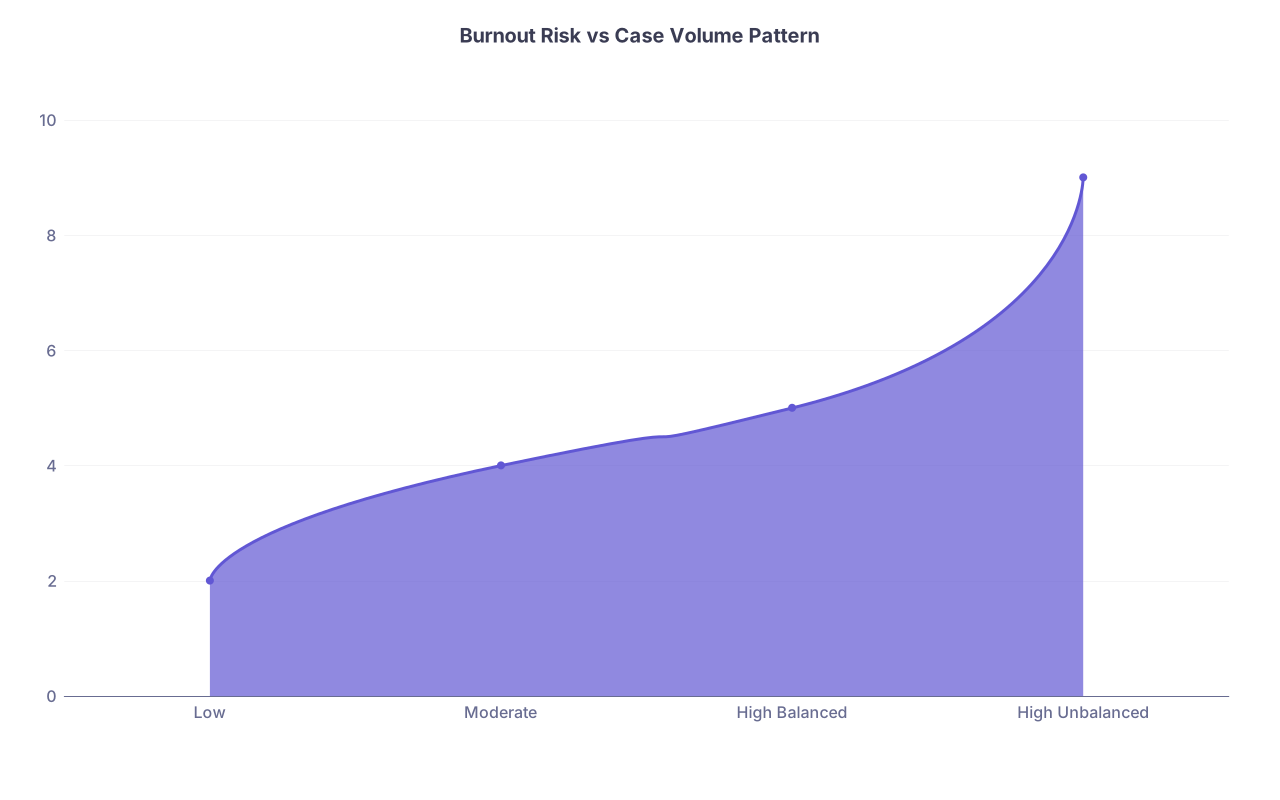
| Category | Value |
|---|---|
| Low | 2 |
| Moderate | 4 |
| High Balanced | 5 |
| High Unbalanced | 9 |
That far right spike? That’s what you’re trying to avoid: high, unbalanced volume without safeguards.
How to Protect Yourself During the Match Process
Here’s how to keep from making the “case volume above all” mistake in your rank list.
1. Write Down Your Non-Negotiables Before Interview Season
If you don’t define them, programs will define them for you.
Examples:
- “I will not train somewhere where residents routinely under-report hours.”
- “I will not train somewhere that cancels teaching weekly due to ‘volume.’”
- “I want to leave residency still liking my specialty.”
Keep that list visible when you rank. Your ego and FOMO will try to make you forget it.
2. Ask Direct, Slightly Uncomfortable Questions
You’re not there to be liked. You’re there to gather intel.
Ask residents:
- “What do you wish you’d known about workload before matching here?”
- “What rotation makes people dread the schedule?”
- “Have you personally ever thought, ‘I might not make it through this’ here?”
If everyone answers like they’re on a PR script, you’re not getting the truth. Trust the one person who pulls you aside and tells you what it’s really like.
3. Listen to the Residents Who Are Struggling, Not Just the Stars
Every program has a couple of superhumans who can do 80 hours, two kids, research, and a marathon and still smile. Good for them. They are not the standard.
Ask yourself:
- “How would average me handle this program?”
- “What happens here when someone gets sick, pregnant, depressed, or injured?”
If the answer is basically “they sink,” walk away.

Frequently Asked Questions
1. Is high case volume always bad?
No. High volume with support, structure, and real teaching can be fantastic. The mistake is treating high volume as automatically good, without asking how that volume is handled. You want enough volume to become competent, not endless volume that turns you into a burned-out service machine.
2. How do I know if a program is using residents mainly as cheap labor?
Red flags: constant talk about how “indispensable” residents are to keeping the hospital running, frequent cancellation of teaching due to workload, residents openly bragging about extreme hours, and any hint that work-hour violations are “just part of the game.” If service always wins and education always loses, you have your answer.
3. What if I want a very competitive fellowship—don’t I need massive volume?
You need strong training, good letters, maybe research, and people willing to advocate for you. Case volume helps only when it’s paired with quality supervision and time to actually learn. Fellowship PDs know which programs are meat grinders that don’t teach. Sheer volume without sophistication doesn’t impress as much as you think.
4. How do I ask about burnout without sounding weak?
Be matter-of-fact. Try: “How does the program handle resident burnout or when someone is struggling?” or “What wellness changes have been made in the last few years in response to resident feedback?” You’re not signaling weakness. You’re signaling that you’re serious about building a sustainable career.
5. If I realize after matching that I chose a volume-obsessed program, am I stuck?
Not necessarily, but options are limited. You can:
- Use every support structure available (chiefs, PD, GME, counseling)
- Push hard for boundaries around duty hours and teaching time
- Consider transferring if things are truly unsafe or toxic
But the easiest move is not to walk into the trap in the first place. That’s why you’re reading this now.
Remember these core points:
- Case volume is a tool, not a religion. more is not always better. Enough, with support and teaching, is the goal.
- Programs that worship volume at the expense of education and humanity burn residents out. Consistently.
- Your future self has to live with this choice. Pick a program that builds a competent, still-human doctor, not just an impressive case log.