
The way most applicants use ACGME citations to judge residency programs is dangerously wrong.
You’ve probably heard someone say: “That program has ACGME citations, stay away.” Lazy conclusion. And very often, flat-out misleading.
I’m going to walk you through the common misreads of ACGME citations I see every application season and how they lead smart applicants to make dumb choices: passing on solid programs, ranking shiny disasters too high, or overreacting to a PDF they barely understand.
If you use ACGME citations as a blunt weapon instead of a scalpel, you will misjudge programs. Let’s prevent that.
1. Treating “Any Citation” As A Giant Red Flag
The worst mistake: assuming “this program has citations” = “this program is unsafe / malignant / doomed.”
That’s not how accreditation works.
ACGME site visits and annual reviews exist to find problems and force improvement. Citations are one of the main tools to do that. Programs can be excellent overall and still get cited on specific issues.
Common rookie misread:
- “Program A: no citations → amazing”
- “Program B: has citations → avoid”
Reality is more like:
- Program A: no recent citations…because they haven’t had a full site visit in years, or their problems haven’t risen to the radar yet
- Program B: had issues, got cited, fixed them, and may actually be more actively improving than the “clean” program
Where applicants screw this up:
- They hear of a “warning letter” or a “citation” and assume probation is next
- They spread vague gossip: “ACGME is on them,” without knowing what “on them” means
- They rank based on fear, not detail
You should not ask, “Does this program have citations?”
You should ask, “What exactly is cited, when, and what’s been done about it?”
If you stop at “yes/no,” you’re flying blind.
2. Confusing Types of ACGME Actions: Citation vs Concern vs Probation
Not all negative language from ACGME is created equal, but applicants often treat it like one big ominous cloud.
Rough hierarchy of seriousness (simplified):
| Level | What It Usually Means |
|---|---|
| Comment/Observation | Watch this; not a formal deficiency |
| Areas for Improvement | Needs work; program is still accredited |
| Citation | Requirement not met; must correct |
| Warning/Adverse Action | Serious concern; future status at risk |
| Probation | Accreditation at significant risk |
The mistake: lumping all of this under “ACGME problems.”
I’ve heard applicants say:
- “I heard they’re almost on probation” when all that happened was a single duty hour citation
- “The ACGME is investigating them” when what actually occurred was a scheduled routine site visit
Here’s how this misread hurts you:
- You might cross off a program over one narrow citation (e.g., case minimum documentation) that’s already fixed
- You might ignore how serious probation actually is: it’s not “rumors,” it’s a formal adverse status with public implications
- You might treat vague gossip from current residents as equivalent to reading the actual action letter (which you almost never see unsanitized)
Don’t be that applicant who throws around “ACGME problems” like it means something precise. If a resident mentions “issues with ACGME,” your follow-up should be:
“Do you mean comments? formal citations? warning? probation?”
The level matters. A lot.
3. Overreacting to Old Citations Without Checking the Timeline
Another common trap: treating a 2017 citation like it happened last week.
ACGME cycles and reviews are spread over years. Programs can:
- Get cited
- Submit a progress report
- Be revisited
- Have the citation resolved
But applicants often:
- Hear “they had work-hour violations a few years ago”
- Translate it in their head to: “they violate hours now and always will”
You need to anchor everything in time.
Red flag pattern:
- PD says: “We had duty hour issues.”
- Applicant hears: “We currently break duty hours.”
- Reality: It was 5 years ago under a different PD, they built a night float system, and resident surveys now show compliance
Flip side:
- PD glosses: “We had some citations years ago but they’re all resolved now.”
- Residents quietly: “We just got cited again last year for the same thing.”
You absolutely must ask:
- When did the citation occur?
- Was it repeated on subsequent reviews?
- What concrete changes happened after?
If a citation:
- Is old
- Has not recurred
- And residents can describe exactly how things improved
Then it’s often more a sign of a maturing program than a failing one.
But if citations keep popping up over multiple cycles for the same issue (e.g., inadequate supervision, repeated duty hour violations), that’s not “ancient history.” That’s failure to learn.
4. Misreading the Severity: Content Matters More Than Count
Another sloppy habit: counting citations instead of reading what they’re actually about.
I’ve heard conversations like:
- “Program X has 4 citations, program Y has 1, so Y’s safer.” No. Not automatically.
You must look at the content:
- Citation for outdated evaluation forms = concerning but usually fixable paperwork/system issue
- Citation for “inadequate supervision of residents in the ICU” = huge safety and training problem
- Citation for “lack of scholarly activity” = academic expectation issue, but maybe less critical for some applicants
- Citation for repeatedly missing ABSITE minimums or board pass thresholds = direct hit to your future
Rough priority (for most residents) when looking at what’s cited:
- Resident supervision and safety
- Duty hours and workload
- Clinical experience and case volume
- Board pass rates / exam performance
- Faculty availability and teaching
- Administrative and documentation processes
You don’t treat a documentation citation the same way you treat one for poor supervision in the ED overnight. But many applicants just see the word “citation” and panic equally.
If you can get any details (PD, faculty, chief talk):
- Ask directly: “Were the citations primarily educational, clinical safety, or administrative?”
- Then rank them mentally by how much they would actually affect your daily life and your future practice
Not all citations weigh the same. Don’t pretend they do.
5. Ignoring Resident Survey Correlation With Citations
ACGME doesn’t just drop citations like lightning from the sky. The Resident/Fellow Survey is a massive driver. Patterns there often precede or support citations.
Applicants make two key mistakes here:
- Looking at citations in isolation, without asking what the resident survey has looked like
- Or obsessing over one year’s resident survey gossip without connecting it to formal ACGME action
You want alignment:
- If there were duty hour citations, did resident survey duty hour items show chronic dissatisfaction?
- If the PD brags that “ACGME loved our program,” but 3 residents quietly complain that “everyone failed their surveys out of frustration,” that mismatch matters
A smart question to ask residents:
- “Did the resident survey concerns show up in ACGME feedback or citations, or did leadership ignore them?”
- “After your last survey, did the program show you a summary and an action plan?”
If:
- The program gets cited for issues residents have been screaming about, and nothing changes…bad sign
- The program got cited, listened, changed schedules/curriculum, and now residents say “it’s actually better now”…different story
The mistake is treating citations as abstract bureaucratic noise instead of seeing them as downstream of resident experience data. You want a program where:
- Survey → citation/feedback → transparent changes → improved survey
Not: - Survey → complaint → PD gaslights → same citation 3 cycles in a row
6. Blindly Trusting PD Spin Or Resident Rumors About Citations
Another big trap: believing the first narrative you hear.
Two common versions:
- PD minimizes everything: “Minor citation, all fixed, nothing to see here.”
- Resident dramatizes everything: “We’re basically going to lose accreditation any day now.”
Both can be wildly off.
Patterns I’ve actually seen:
- PD framing: “We had some paperwork issues” when the citation was for inadequate supervision of interns overnight
- Resident framing: “ACGME hates this place” when there was one citation for case logging accuracy that they fixed within a year
Your job is to cross-check:
- Listen to PD: What exactly do they say was cited? How specific are they?
- Listen to residents: Do they know the nature and timeframe of the citation, or is it just rumor?
- Listen for consistency: Are details roughly aligned or do they conflict?
If PD says:
- “We had duty hour citations, but last 2 years’ surveys show full compliance.” Ask residents:
- “Do you ever feel pressure to falsely report duty hours?”
If residents say:
- “We might go on probation soon.” Ask:
- “Did the PD or GME office share any formal information about probation or status change, or is that just speculation?”
Don’t make this mistake:
- Treating vague emotional impressions (“ACGME hates us,” “we’re on their radar”) as equivalent to documented actions
You’re not an accreditation officer, but you can usually tell whether a story is coherent or just fear and gossip.
7. Failing to Connect Citations to Your Own Priorities
Not every citation is equally important for you.
Here’s where a lot of smart applicants get dumb again:
They freak out over citations that won’t meaningfully affect their training goals and ignore ones that absolutely will.
Examples:
- You’re going into community primary care, could not care less about research, but you panic over a citation for insufficient scholarly activity
- You want to be an academic surgeon, but you shrug at a citation about case volume distribution and resident autonomy
You should filter citations through your actual goals:
- If you care about operative autonomy:
Citations about inadequate case diversity, fellows doing all the cases, or lack of graduated responsibility are huge. - If you care about wellness and sustainability:
Recurrent duty hour and support issues matter more than academic output citations. - If you care about research/academics:
“Lack of scholarly activity” isn’t minor. That’s your future CV.
Do not just color-code programs “green/no citations” and “red/has citations.”
Build a mental map:
- “These citations would actually affect my day-to-day and career.”
- “These ones are annoying but secondary for my path.”
That nuance is what separates a thoughtful rank list from a panic-driven one.
8. Assuming No Citations = No Problems
This one’s subtle but dangerous.
You will meet programs proudly saying:
- “We have no current ACGME citations.” And you’ll be tempted to relax. Too much.
No citations can mean:
- They truly run a tight ship and address issues early
- Or they have issues that haven’t triggered formal action yet
- Or residents are too afraid to be honest in surveys, so nothing rises to ACGME-level visibility
- Or they just haven’t been through a deep review in a while
No-citation status is not proof of:
- Healthy culture
- Reasonable workload
- Strong training
You still need to:
- Ask about duty hour realities
- Ask about resident support and remediation
- Look at board pass rates, fellowship placement, resident attrition
- Listen to how residents talk when PD is not in the room
I’ve seen programs with:
- No active citations
- Toxic leadership, residents crying in stairwells, constant behind-the-scenes attrition
And programs with:
- A couple of recent citations
- Transparent leadership, clear QI projects, residents who say, “Things are actually improving.”
If you treat “no citations” as a safety certificate, you will get burned.
9. Misunderstanding How Citations Interact With Program Growth or Shrinkage
Another misread: ignoring whether a program is expanding, contracting, or rebuilding while looking at citations.
Think through scenarios:
Rapid expansion + citations about supervision or case volume
- Program added more residents without enough faculty or cases to go around
- Citation might signal growing pains that will hit your education hard
Program downsizing + citations about workload and duty hours
- Residents doing more with fewer hands
- Burnout, corners cut, duty hour games
New PD + citations from the old regime
- Could be a turnaround story or just a new face on the same problems
- You need to hear what’s actually changed since that leadership transition
Most applicants:
- Hear “we had some citations during our growth phase” and either panic or ignore, with no nuance
You should be asking:
- “Were the citations connected to your expansion?”
- “How did you adjust staffing or case distribution after that?”
- “Are your current PGY-3s seeing better conditions than the PGY-1s did when that happened?”
If a program is expanding or contracting, citations become even more critical. They can be the only concrete sign that the wheels were coming off.
10. Not Using A Structured Way To Compare Citations Between Programs
Applicants often keep a vague cloud of impressions:
- “That one had some ACGME issues.”
- “This one seemed better.”
That’s how you end up making decisions based on which visit you had free food at.
You need a structured comparison. Something like:
| Factor | Program A | Program B | Program C |
|---|---|---|---|
| Recent citations? | Yes | No | Yes |
| Category (safety vs admin) | Safety | N/A | Admin |
| Repeated over cycles? | Yes | N/A | No |
| Resident survey alignment? | Yes | ? | Yes |
| Clear improvement plan? | Vague | N/A | Specific |
You don’t have to get this perfect. You’re not an inspector.
But if you:
- Track what you hear
- Separate “safety/education-critical” from “administrative”
- Note time frame and repetition
You’ll be miles ahead of applicants who just remember “Program A had some issues, I think.”
To visualize how bad repetition can be, imagine something like this:
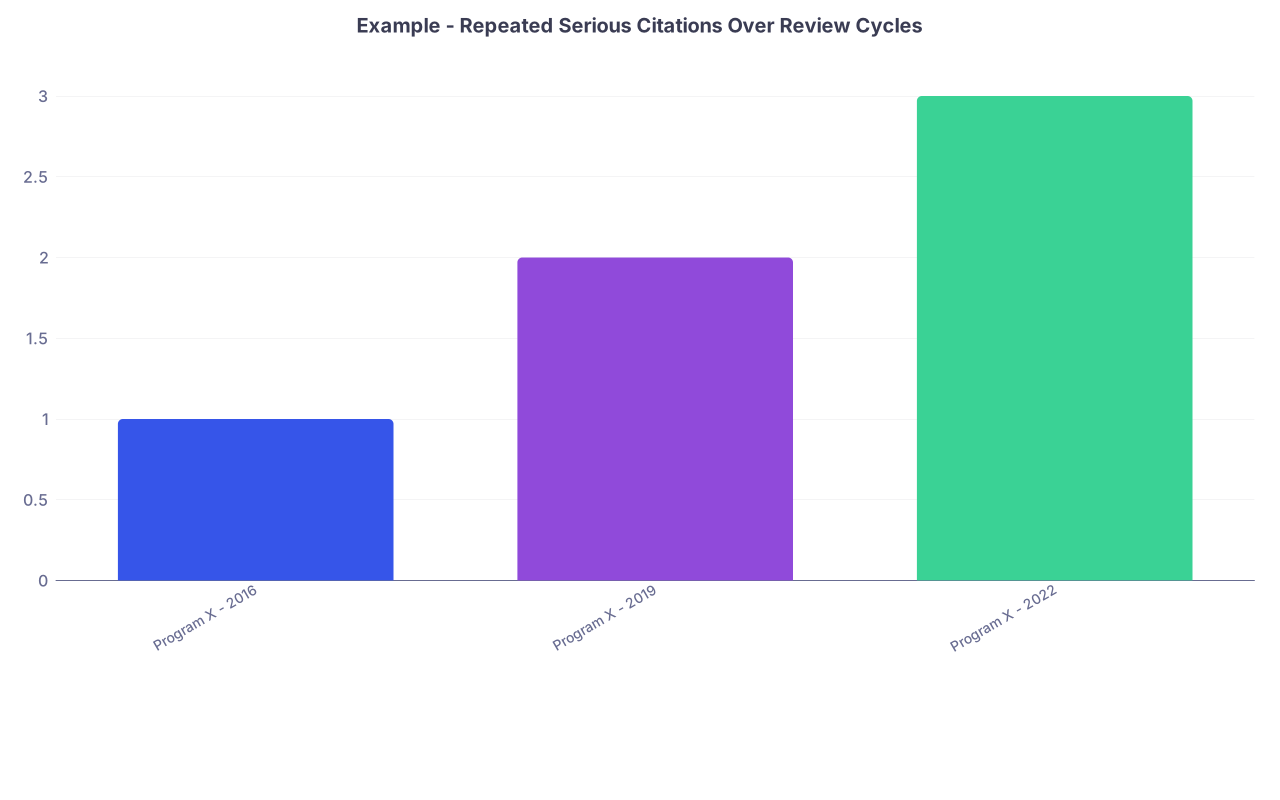
| Category | Value |
|---|---|
| Program X - 2016 | 1 |
| Program X - 2019 | 2 |
| Program X - 2022 | 3 |
A steady climb in serious citations over multiple reviews is a huge deal. Much more concerning than a one-time administrative slap on the wrist.
11. Forgetting That Trainees Can Leave, But You Can’t Undo a Bad Match Year
This is the last mistake: acting like you’ll just “transfer if it’s bad.”
Programs with serious, repeated, unresolved citations:
- Often have residents trying to leave
- Have reputational damage that makes transfers harder, not easier
- May have unstable leadership, which means no one prioritizes your letter or your future
You don’t get many chances to re-do this.
So:
- Don’t overreact to minor, old, resolved citations
- Don’t underreact to repeated, safety-related, or current ones
One genuinely useful mental shortcut:
- “If I heard this exact ACGME story about my future job instead of my residency, would I still accept the offer?”
If the answer would be “no way,” listen to that.


| Step | Description |
|---|---|
| Step 1 | Hear about ACGME issue |
| Step 2 | Ask when and if fixed |
| Step 3 | Ask details and timeline |
| Step 4 | Lower concern |
| Step 5 | Moderate concern |
| Step 6 | High concern |
| Step 7 | Moderate concern |
| Step 8 | Compare with other factors |
| Step 9 | What level is it? |
| Step 10 | Old and resolved? |
| Step 11 | Repeated over cycles? |

Final Takeaways: How Not To Screw This Up
Keep it simple:
Don’t treat all ACGME issues the same.
Level (comment vs citation vs probation), content (safety vs admin), and repetition matter more than the mere existence of a citation.Anchor everything in time and action.
Always ask: When did this happen, has it recurred, and what changed afterwards—according to both leadership and residents?Filter citations through your own priorities.
Some citations are deal-breakers for you; others are noise. Know which is which and rank programs accordingly.
If you can remember those three, you’ll avoid the biggest, most expensive misreads that applicants make with ACGME citations.