
The rank list you think you earned with scores and letters often lives or dies in the hallway, not the conference room.
Let me tell you what actually happens.
Program directors and faculty will publicly swear their process is “holistic,” “structured,” and “data-driven.” On paper, that’s true. There are rubrics, score sheets, spreadsheets, weighted formulas. But the moment the door closes and the real ranking discussion starts, informal faculty gossip quietly rewrites a shocking amount of your fate.
You’re applying to residency thinking in terms of STEP scores, personal statements, and interview performance. The people ranking you are thinking in terms of: “Oh yeah, that’s the one Sarah said was a little needy” or “Isn’t that the student who was late for sign-out twice on cards?”
That stuff sticks. And it spreads.
The Two Parallel Processes: Official Scoring vs. Real Decision-Making
On the surface, resident selection is clean. You submit ERAS. You get an interview. Faculty fill out standardized evaluation forms. A rank meeting is held. Final list goes in.
Behind the scenes, there are two tracks running at the same time:
- The official process — the one you’d be comfortable seeing published.
- The informal network — conversations, impressions, and yes, gossip.
Here’s what I’ve watched in multiple programs (IM, surgery, psych, EM — doesn’t matter, the pattern is the same).
Before rank meeting, someone in the admin office or PD’s office compiles scores: interview ratings, dean’s letter flags, STEP scores, class rank, maybe a research or “fit” score. They come in with a spreadsheet where every applicant has a clean little number.
Then they start talking.
And this is where informal faculty gossip kicks in.
A typical exchange:
“Applicant 37 – 260, strong letters, great interview.”
“Yeah, but remember what Matt said? Little arrogant. Didn’t take feedback well on their away.”
“Right, right. Drop them a bit.”
Or the reverse:
“Applicant 82 – average scores, decent interview.”
“Oh, that’s the student Sara raved about. Hard worker, great with patients, saved the team on nights.”
“Move them up. I trust Sara.”
Consciously or not, that’s gossip influencing your destiny. Not peer-reviewed data. Not a formal remediation. Just hallway talk with a badge.
Where Gossip Actually Comes From (It’s Not Just Mean People Being Mean)
The word “gossip” makes you think of petty people whispering. That’s not how most of this looks. It looks like “context,” “gut feeling,” “insider info,” or “fit.”
The main sources:
1. Rotations and Away Electives
Your away rotations are fertile ground for informal commentary.
When you leave, they don’t just fill out your evaluation and forget you. The residents and faculty you worked with will absolutely talk about you later when your name pops up on a rank list.
I’ve sat in a meeting where someone said, “This one did their sub-I with us. Hustler. Always early. Great on nights.” No one pulled up the official evaluation. That one sentence was enough to bump the applicant up several spots.
The flip side is brutal. One senior resident says, “Honestly, they were fine, but they complained a lot, especially about call.” That little comment becomes your unofficial label: high-maintenance, needy, not resilient. It’ll follow you into the rank meeting.
2. Faculty Group Chats and Email Threads
No one tells students this, but a lot of programs have informal text threads or email chains where faculty share impressions during interview season.
Things like:
- “Anyone else interview Applicant X? Came across a little detached.”
- “Applicant Y – really good clinical stories, I liked them.”
- “Applicant Z – late log-in to virtual, seemed unprepared.”
These aren’t official evaluations. They’re vibe checks. But when enough faculty reinforce a narrative, that narrative becomes your file.
3. “Do You Know This Person?” Backchannel Checks
Programs constantly run backchannel intel, especially on borderline or highly ranked candidates.
Picture this: Your application is in Chicago. Someone on that faculty knows someone at your home program or your away site. A quick text:
“Hey, you know Jane Doe from Big State? She’s on our list. Any concerns?”
What comes back is almost never a formal report. It’s gossip dressed up as “off the record insight”:
- “Solid clinically, a bit sensitive to criticism.”
- “Great team player, no drama.”
- “Wouldn’t rank them high — came across entitled.”
That one line can swing you 20–30 spots. I’ve seen it.
4. Residents Talking in Front of People Who Make Decisions
Residents forget sometimes that their offhand comments have power.
During pre-interview dinners, during interview-day tours, during late-night sign-out: they’re forming impressions. And they repeat them to chiefs and attendings.
A casual resident comment like, “Yeah, that applicant didn’t really engage with others at dinner,” gets retold later as, “Multiple residents said they were disengaged.”
Was it multiple? No. But gossip scales. Fast.
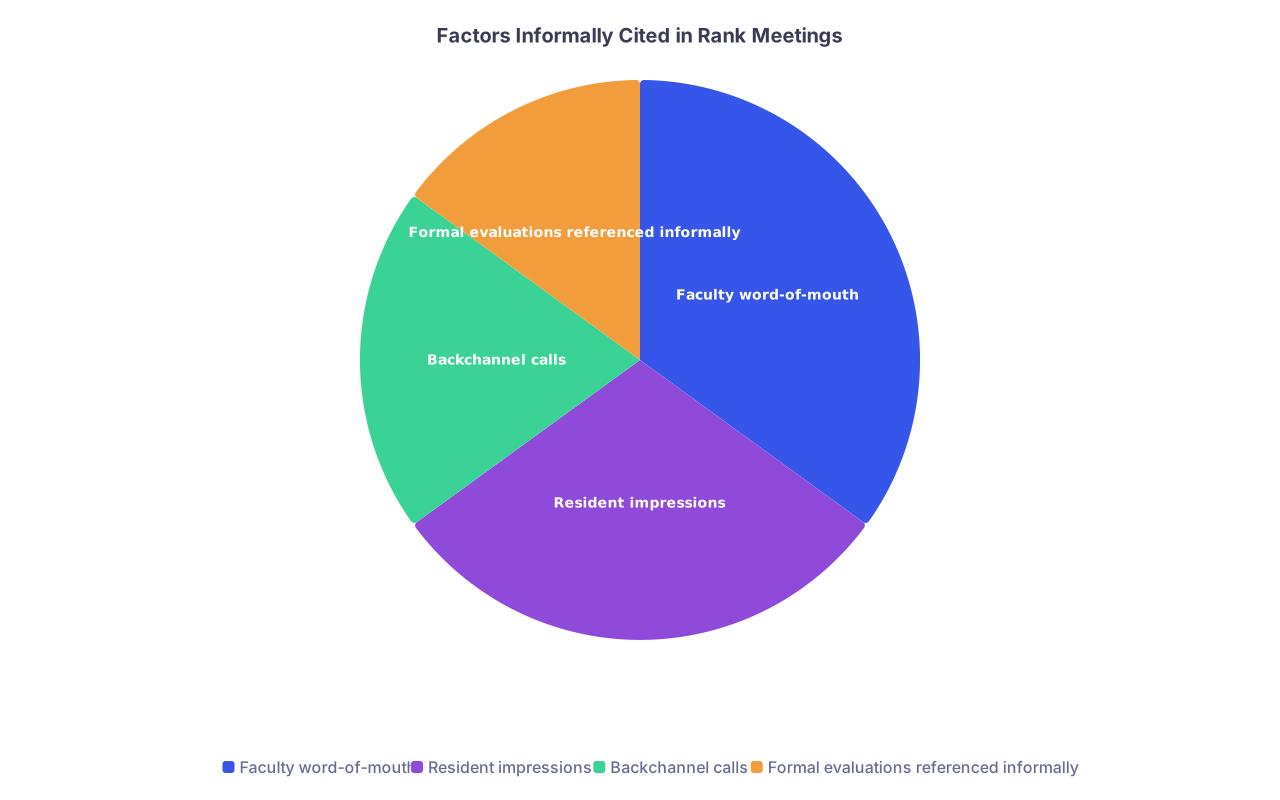
| Category | Value |
|---|---|
| Faculty word-of-mouth | 35 |
| Resident impressions | 30 |
| Backchannel calls | 20 |
| Formal evaluations referenced informally | 15 |
How Gossip Shows Up in the Rank Meeting (Exact Phrases They Use)
You won’t ever hear “Let’s destroy this person based on gossip.” It’s more subtle. The language is sanitized, but the engine is still gossip.
Here are the exact phrases used that are basically code for “informal talk”:
- “I’ve heard mixed things about them.”
- “Strong on paper but some concerns about fit.”
- “Some feedback that they may not handle stress well.”
- “I got great backchannel reports from their away.”
- “Our residents really liked / didn’t like them.”
- “There’s a bit of a personality question mark here.”
No one says: “Dr. X heard from Dr. Y that this person is annoying.” They say, “There were questions about their interpersonal style.”
You can’t defend yourself against that because you never know it’s been said.
The most terrifying form? Vague negativity.
Once someone says, “I have some reservations,” you’re done unless a strong advocate fights for you. Neutral gossip rarely helps. Negative gossip almost always hurts.
The Power of One Strong Advocate vs. One Subtle Detractor
Here’s the uncomfortable truth: one influential faculty member who likes you can offset a mediocre paper file. One influential faculty member who doesn’t can ruin a strong one.
I’ve watched this play out:
- Applicant with 250+ STEP, strong research, decent interview.
- One senior faculty: “Honestly, I didn’t love the way they talked about prior teams. Seemed a bit critical and self-promoting.”
- That applicant slid 30+ spots. No one bothered to pull up the actual interview notes.
On the other hand:
- Applicant with average scores, nothing flashy.
- But the PD says: “They did an away here; Dr. Chen said they were the best student she’s had in five years. I trust her judgment.”
- Boom. Top third of the list.
The key insight: your fate is often tied less to your objective record and more to whether anyone in the room is emotionally invested in you. Gossip is how that investment is justified or undermined.
How This Should Change the Way You Behave on Rotations and Interviews
You can’t control every whisper. But you can absolutely influence the kind of informal narrative that forms around you.
On Rotations (Especially Aways)
Your goal isn’t just “get a good evaluation.” Your goal is “create two or three people who will later say my name with obvious positivity.”
The residents and faculty who actually work with you need to walk away with a simple, memorable story about you:
- “That’s the one who stayed late without being asked and closed all the loops.”
- “That’s the one who handled a bad night calmly and effectively.”
- “That’s the one patients loved and who always followed up.”
People don’t retell complex nuance. They retell simple stories. So you create those stories deliberately through concrete behavior.
Small but lethal pitfalls on rotations that become gossip later:
- Complaining of being “bored” when the service slows.
- Consistently leaving right at sign-out without asking what else needs to be done.
- Subtle eye-rolling or visible annoyance with nurses or ancillary staff.
- Talking too much about how “toxic” another service or school was.
You may think no one noticed. They did. And they’ll remember when your name shows up.
On Interview Day
Faculty gossip from interview day often revolves around vibes more than content.
A few patterns that reliably get mentioned later:
Coming off as rehearsed or “plastic.”
They’ll say: “I didn’t get a sense of who they really are.”Talking too long when answering.
They’ll say: “Hard to redirect, not concise.”Mild arrogance: “At my school we did things this way…”
They’ll say: “A little rigid, may not adapt well.”Not asking any real questions.
They’ll say: “Didn’t seem curious about us.”
This isn’t fair. But I’m not here to tell you it’s fair. I’m here to tell you it’s true.
The Unspoken Rules About “Red Flags” and How They Spread
Most programs say they take red flags seriously and systematically. That’s half true.
There are formal red flags: failures, professionalism citations, big issues documented in the MSPE. Those trigger protocol.
Then there are informal red flags. This is where gossip becomes dangerous.
Common triggers for informal red flags:
- A student perceived as “dramatic” about a conflict.
- Someone who had “personality differences” on a service that turned into a story.
- Social media behavior that gets screenshotted and circulated.
- Rumors of dating multiple people in the same residency or messy interpersonal drama on a rotation.
Do I personally think a lot of that should impact your rank? No. But I’ve been in rooms where it absolutely did.
What actually happens:
“I don’t want to write this down, but there were some concerns about their professionalism socially.”
“They had some interpersonal boundary questions.”
“I heard from someone at their home program that there was some drama.”
No details. No due process. Just a vague shadow. That alone is enough to push a candidate from top third to bottom third, or off the list entirely if the program is risk-averse.
Programs Where Gossip Matters More vs. Less
Not all programs are equally gossip-driven.
Smaller, tight-knit, or very hierarchical programs tend to lean heavily on gossip because everyone knows everyone. A single influential voice can define your narrative.
Larger academic centers sometimes dilute the impact of one person, but they have broader networks — more backchannel calls, more cross-institutional whispers.
Here’s a rough pattern I’ve noticed:
| Program Type | Gossip Influence (Relative) |
|---|---|
| Small community programs | Very High |
| Mid-sized academic IM/psych | High |
| Large university IM/peds | Moderate |
| Highly structured EM/anesthesia | Moderate–High |
| Military/combined programs | Extremely High |
And here’s the subtle thing: programs that loudly advertise “objective, structured scoring systems” are not immune. They just use gossip to tweak the order inside their tiers.
They’ll say:
“Objectively, they’re Tier 2. But given the strong internal feedback, we’ll move them into Tier 1.”
That’s gossip functioning as a scalpel on top of the spreadsheet.
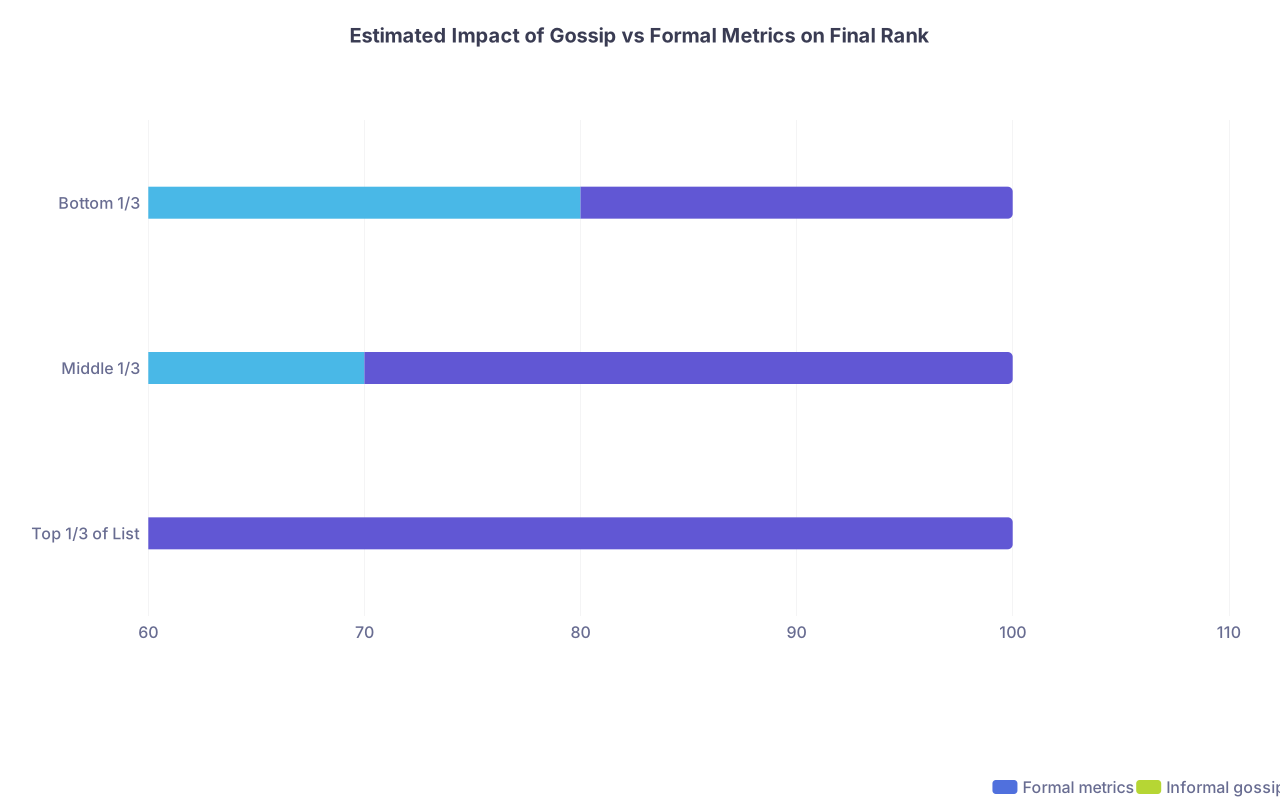
| Category | Formal metrics | Informal gossip |
|---|---|---|
| Top 1/3 of List | 60 | 40 |
| Middle 1/3 | 70 | 30 |
| Bottom 1/3 | 80 | 20 |
How to Make Gossip Work For You
You cannot eliminate gossip. You can only tilt it in your favor.
Here are the real levers, not the feel-good nonsense you see on forums.
Cultivate two or three real advocates, not twenty superficial fans.
One respected faculty member who says, “This is a star, I’d take them any day,” is better than five people who vaguely remember you were “nice.”Leave every clinical environment cleaner than you found it.
Not just in terms of work done, but in relationships. Nurses, coordinators, MAs — they all talk to residents and attendings. “We liked that student” is more powerful than you think.Do not overshare your frustrations. Ever.
Venting about another program, resident, or attending might feel good in the moment. That vent can and will be repeated later. Stripped of context. Weaponized.On aways, assume everything you do is an audition. Because it is.
Social events, call rooms, casual conversations during slow nights. Your “off” moments become the most memorable.Post-interview communication: keep it respectful and minimal.
Overly intense emails, weirdly emotional thank-yous, or aggressive “you’re my #1” messages get talked about. And not in a flattering way.

| Step | Description |
|---|---|
| Step 1 | Applicant File - Scores Letters |
| Step 2 | Interview Day |
| Step 3 | Faculty Initial Impressions |
| Step 4 | Resident Impressions |
| Step 5 | Faculty Group Chats |
| Step 6 | Rank Spreadsheet |
| Step 7 | Backchannel Calls |
| Step 8 | Informal Narrative Formed |
| Step 9 | Rank Meeting |
| Step 10 | Final Rank Position |
The Dark Side: When Gossip Gets It Wrong
You should also understand this: sometimes gossip is flat-out wrong.
I’ve seen:
- A student labeled “lazy” because they were quietly anxious and afraid to bother residents.
- Someone called “dramatic” because they appropriately reported mistreatment.
- A rumor about “unprofessional behavior” that boiled down to: they dated a resident and it ended badly.
None of that is fair. But it still slid them down the list.
So what do you do with that knowledge? You stop pretending this process is a pure meritocracy and start playing the actual game:
- Protect your reputation like it’s a clinical skill.
- Treat every rotation as if someone will talk about you later (they will).
- Make it easy for good stories about you to spread, and hard for bad ones to stick.
What You Should Take Away From All This
Your residency outcome isn’t the sum total of your worth as a physician. It’s the sum total of your application plus a messy, human, informal layer of faculty gossip and resident impressions.
That doesn’t mean you’re powerless. It means you adjust your strategy.
You don’t just aim to “do well.” You aim to be the person people remember with a little smile and a simple line:
“Yeah, I liked them. They’d be great here.”
Because in that closed-door room, when your whole future hangs on a rank list you’ll never see, that sentence can move you more than 10 points of formal scoring ever will.
Years from now, you won’t remember the exact words faculty said about you in some rank meeting. You’ll remember whether you carried yourself in a way that, if people talked, you’d be okay hearing the stories secondhand.