
The official criteria programs talk about are only half the story. The real decision about whether you “fit” their team is made on signals you don’t see—and most applicants never realize what actually swung the vote.
Let me pull the curtain back for you.
The Myth Of “We Just Want Good People”
Every program website has some version of: “We’re looking for hard‑working team players passionate about patient care.” That line is useless. Everybody says it. Nobody means it in the same way.
Behind closed doors, what they’re actually asking is more specific, more selfish, and far more practical:
- Will this person make our lives easier or harder at 2 a.m.?
- Will they adapt to how we actually run this place, not how it looks on the brochure?
- Will they embarrass us in front of patients, nurses, or our colleagues?
- Will they quit, burn out early, or become “that resident” everyone avoids?
They don’t rank “nicest” or “smartest” first. They rank for functioning member of our specific ecosystem. And they use a surprisingly consistent set of hidden signals to judge that.
If you understand those signals, you stop guessing and start controlling what they see.
Signal #1: How You Treat People Who “Don’t Matter”
This is the first thing faculty bring up in ranking meetings. Not your abstract. Not your Step score. Your behavior in the hallway when you thought nobody was watching.
Programs watch how you treat:
- The program coordinator
- The front desk clerk
- The residents who are not on your interview schedule
- The med student or applicant who looks lost
I’ve sat in meetings where a candidate with a 260+ and multiple publications was dropped 20 spots because the coordinator said, “He was polite to the PD, but he rolled his eyes at me when I asked him to sign in.” That’s game over at a well-run program.
Here’s the unspoken rule: the lower the perceived “status” of the person, the more weight their negative feedback carries. If you’re a jerk to the PD, that’s obvious and rare. If you’re disrespectful to the coordinator or the MA on a pre-interview visit, that’s a character trait.
You signal fit when you:
- Learn and use people’s names
- Say thank you to the coordinator and actually mean it
- Don’t act impatient at logistics or delays
- Ask residents and staff how long they’ve been there and what keeps them there
Faculty will ask the coordinator directly: “Any flags?” A single, “Honestly, they were kind of dismissive,” is enough to move you from “top of list” to “only if we have to.”
Signal #2: The Way You Talk About Your Previous Teams
Programs assume you’ll talk about them the same way you talk about where you’ve already been. That’s not paranoia. That’s pattern recognition.
Listen to how many applicants do this wrong:
- “My home program is really malignant. The attendings are awful.”
- “We didn’t get good teaching; it was kind of a joke.”
- “Honestly, I did most of the work; my team wasn’t that strong.”
What faculty hear:
This person will trash us the second they do not like something. They externalize every problem. They see themselves as the victim or the hero, never just a member of a normal, flawed team.
Now flip it:
- “We had some tough rotations and limited resources, but I learned to be efficient and independent.”
- “Some attendings were more hands-on than others, so I learned to ask very clear questions when I needed help.”
- “We had a mix of residents—strong personalities—but we figured out how to divide tasks and get the work done.”
This signals maturity, adaptability, and realism. That’s fit.
On a Zoom debrief once, our PD said: “If they’re willing to say this about their home institution on interview day, what will they say about us in a year?” Candidate dropped to the bottom third of the rank list immediately.
Signal #3: Your Energy Level vs. The Program’s Culture
This one is subtle but brutal.
Every program has a baseline “tempo.” Some are high-octane, type A, everyone-walks-fast programs. Others are laid back, slower, more conversational. Neither is inherently better. But a mismatch is deadly—for you and for them.
Faculty are asking themselves: Can I picture this person at 5:30 a.m. rounds on a post-call day in January with three admissions pending?
Here’s what they notice:
- Do you speak so fast and interrupt, at a place that values slow, careful discussion?
- Do you seem low-energy at a program where residents are bouncing, loud, and clearly extroverted?
- Are you overly intense at a “family” program where people seem relaxed and friendly?
They’re not looking for clones, but extremes raise red flags.
You can see this play out in real time on interview day. I’ve watched candidates come to a chill, community-heavy IM program and launch into hyper-aggressive, ultra-competitive vibes. The residents immediately whisper, “They’d be happier at Big Academic.” And they’re right.
Your job isn’t to fake a personality. It’s to choose programs where your default energy doesn’t fight theirs.
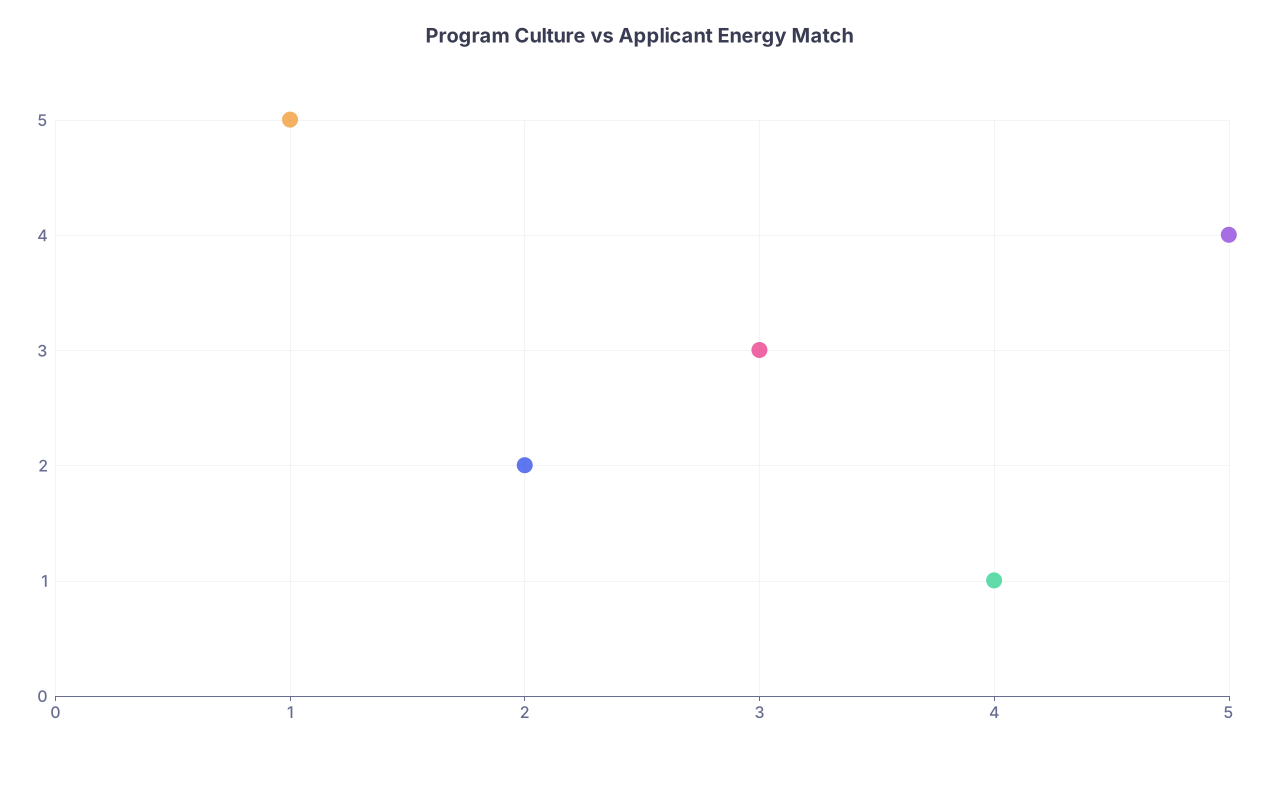
| Category | Value |
|---|---|
| Applicant 1 | 2,2 |
| Applicant 2 | 5,4 |
| Applicant 3 | 4,1 |
| Applicant 4 | 1,5 |
| Applicant 5 | 3,3 |
On that rough 1–5 scale (1 = chill, 5 = intense), the closer those numbers match, the smoother your residency.
Signal #4: How You Handle Micro-Discomfort
Most candidates perform well when everything’s smooth. The real tells come when something’s slightly off. Programs watch your micro-reactions like hawks.
Things like:
- The interview is running late. Do you look annoyed, keep checking your watch, or do you stay engaged?
- The resident mentions “we still use paper orders on X service.” Do you smirk, act superior, or say, “How does that affect your workflow?”
- You get a tough or weird interview question and stumble. Do you recover or shut down?
I watched a PD ask an applicant: “Tell me about a time you didn’t get along with a team member.” The applicant launched into a detailed story blaming a co-intern, used the phrase “they were just incompetent,” and then tried to joke it off.
Afterward, the PD said in the workroom: “She was fine until that answer. That’s not who I want at 3 a.m. when the nurse makes a mistake.” She went from high‑rank to unranked instantly.
Programs don’t need you to be perfect. They want to see you:
- Acknowledge discomfort without dramatizing it
- Own your share of problems
- Stay curious instead of sarcastic when something isn’t ideal
That tells them what you’ll do when census spikes, a nurse pushes back, or a consultant is rude. Which happens. A lot.
Signal #5: Who You Gravitate To On Interview Day
This one is almost funny because applicants think they’re “on break” during resident social hours. You’re not. Ever.
Residency dinners, pre‑interview socials, hallway walks between interviews—this is where the program really decides, “Do we like this person enough to spend 3+ years together?”
Residents notice:
- Do you only talk to the chief resident or the loudest person in the room?
- Do you include the quiet intern standing at the edge of the group?
- Are you still asking real questions at the end of the night or clearly done with the whole thing?
Then the residents debrief. Yes, formally. Usually that same day.
I’ve sat in rooms where a PGY‑2 said, “He was great with us, but he completely ignored the MS4 who came to say hi. I don’t love that.” That small data point matters more than applicants realize, especially if the rest of the field is strong.
Programs are looking for someone who can fit into the existing social fabric without disrupting it. You don’t have to be the funniest, most outgoing person. But if you consistently choose connection over clout, they notice.
Signal #6: The Hidden Scoring Categories On Their Ranking Sheets
Here’s something you almost never see: the actual score sheets used in ranking meetings. They don’t match the official website language.
Typical categories I’ve seen at multiple programs:
- “Workhorse?”
- “Team player?”
- “Maturity/professionalism”
- “Resident advocate or resident drain?”
- “Would you want to be on night float with this person?”
And yes, sometimes literally: “Red flag?” with a box.
| Category | What They’re Really Asking |
|---|---|
| Professionalism | Will they create complaints or HR problems? |
| Teamwork | Do I want them admitting with me at 2 a.m.? |
| Communication | Can they call a consultant without burning bridges? |
| Work Ethic | Will they carry their share without drama? |
| Resident Report | Do current residents actually want them here? |
Those last two—Work Ethic and Resident Report—carry more weight than your Step score at many programs once you’re at the interview stage. By the time you’re in that Zoom room, scores got you in the door. Fit decides whether you stay.
Here’s the kicker: you can have sky‑high academic marks and still get coded “no” on “night float with?” That often kills your chances.
Signal #7: Your Storyline Consistency
Programs hate cognitive dissonance. They smell it a mile away.
They’re constantly comparing:
- What you wrote in your personal statement
- What your letter writers said
- How you present yourself in person
- What residents say after meeting you
If those pieces tell the same story, you feel “real” and safe to them. If they clash, you become a risk.
Example of good consistency:
- Personal statement: Talks about loving longitudinal patient relationships and complex chronic disease.
- LORs: Mention how you stuck with a difficult patient, strong follow‑through.
- Interview: You light up talking about continuity clinic, you ask about their outpatient structure, you know their clinic half-day models.
- Resident feedback: “She asked great questions about clinic, seems like she actually cares about our outpatient time.”
Example of bad consistency:
- Personal statement: “I’m passionate about academic medicine, research, and teaching.”
- CV: One weak poster from three years ago, nothing since.
- Interview: You don’t ask a single question about research, mentoring, or conference time.
- Resident feedback: “Honestly, he only asked about vacation and moonlighting.”
The PD will say, “This doesn’t add up.” And when you don’t add up, they slide you down the list because they don’t know what they’re really getting.
If you’re not an academic gunner, do not pretend to be one “for competitiveness.” They would rather have an honest community-focused workhorse than a fake clinician-scientist who never shows up to the lab.
Signal #8: How You Talk About Boundaries and Burnout
Here’s a twist: programs are more aware of burnout now, but they’re still terrified of one thing—residents who crumble or constantly ask for exceptions.
They’re listening closely when you talk about:
- Hard rotations
- Workload
- Work-life balance
- Mental health
The wrong way:
- “I really need my sleep. If I don’t get 8 hours, I’m not functional.”
- “I prioritize wellness over everything. I don’t think we should be working 28-hour calls in 2024.”
- “I’m looking for a chill program because I value my outside hobbies.”
None of these are morally wrong. But in PD brain, that sounds like: “This person will push back on every schedule, call, and coverage need. High maintenance.”
The right way:
- “On tough ICU months, I built routines that helped me stay functional—short workouts, quick meals, brief debriefs with co-residents.”
- “I’ve had burnout scares before; I’ve learned I need peer support and some form of decompression, even if it’s just 20 minutes after shift.”
- “I know residency is intense; I’ve seen it. I’m not expecting perfect balance, but I’ve thought a lot about how I’ll protect myself from flaming out.”
That signals realism, resilience, and some self-awareness. Programs want residents who will survive, not saints or martyrs. But they do not want someone who leads with “How little can I work?” before signing a contract.
Signal #9: Your Questions Reveal Your Priorities
Programs judge you more by the questions you ask than by your polished answers. It’s one of their biggest tools for reading fit.
Here’s how your questions get interpreted:
- “How often do residents get to the OR?” → Hungry for experience. Good, if you’re not obnoxious about it.
- “How strict are you about duty hours?” → They immediately wonder how close you plan to cut it.
- “What fellowships do your residents get?” → Ambitious, academic-oriented. Fine at those programs, slightly off at pure community programs.
- “How easy is it to live here on a resident salary?” → Practical, grounded. Most PDs quietly like this.
- “Do residents hang out outside of work?” → Signals you care about team dynamics and social fabric. Big plus at “family” programs.
What kills you is asking nothing, or clearly fishing for only lifestyle and perks. I’ve heard actual lines from ranking meetings:
- “He asked about vacation three different ways.”
- “She never once asked about teaching or feedback. Just schedule.”
Residents also notice recycled, generic questions you clearly lifted from Reddit. They don’t doom you, but they don’t help you either.
Tailored questions that show you’ve thought about them specifically scream “fit.” They prove you’re not just spamming ERAS.
Signal #10: The Way You Choose Them (And Show It)
Programs are terrified of being a “backup.” They don’t want to fill their entire class with people who secretly wish they were somewhere else. That anxiety drives a lot of their behavior.
You send two big meta-signals here:
- Your application list and geographic logic
- How clearly you communicate genuine interest
If you apply to every program in three totally different regions with no obvious ties, some PDs assume: “They don’t care where they match, they just want a job.” That’s not always bad, but it lowers perceived loyalty.
When you:
- Reference specific rotations, electives, or clinic structures unique to that program
- Mention a resident or faculty you talked to and what resonated
- Show you understand their case mix, their catchment area, or their patient population
…you jump categories from “generic applicant” to “probably rank us high.”
Residents are surprisingly good at sensing if you could actually be happy there. They’re protective of their culture. If you talk like you’re just collecting interviews, they will say it: “I don’t think we’ll be in their top 5.” That subtle remark can bump you down the rank list when decisions are tight.
How To Use These Signals To Choose The Right Program For You
This cuts both ways. You’re not just trying to fit them; you’re trying to see if you’d actually survive and grow there.
When you’re evaluating programs, pay attention to the same signals in reverse:
- How do they treat their coordinators, nurses, and ancillary staff?
- How do residents talk about “difficult” attendings or rotations? Blame-heavy or honest?
- What’s their energy on pre-interview socials—do you feel drained or comfortable?
- How do they talk about boundaries, sick coverage, pregnancy, leave? Defensive or structured?
You’re looking for alignment between what they claim publicly and what they signal privately. When those match—and match you—that’s where you will fit.

| Step | Description |
|---|---|
| Step 1 | Program Visit |
| Step 2 | Low Fit |
| Step 3 | Maybe - Rank Lower |
| Step 4 | High Fit - Rank High |
| Step 5 | Energy match? |
| Step 6 | Resident culture align? |
| Step 7 | Values and workload match? |
| Step 8 | Geography and life fit? |
If you find yourself constantly performing, faking energy, or rationalizing red flags—listen to that. Residency amplifies every mismatch.
The Quiet Truth Behind “Fit”
Fit is not magic. It’s not vibes. It’s a series of very specific behaviors, stories, and reactions that people with experience have learned to interpret quickly. Sometimes unfairly, but not randomly.
Programs are asking, in a hundred different ways:
Can I trust this person with my patients, my team, and my own sanity at 3 a.m.?
If your natural behavior answers “yes” to that question, you’re their fit. If you have to contort yourself into someone else to pass their test, they’re not yours.
Years from now, you won’t care that Program X never emailed you back or that Program Y ranked you lower than you “deserved.” You’ll remember the place where you walked in, were yourself, and people thought, “Yeah. I could be on call with them.” That’s the only signal that really matters in the end.