
Chief residents quietly control more of your training than the program director ever will.
You think you’re applying to “Program X.” You’re actually applying to its chiefs. You just do not realize it yet.
Let me pull back the curtain on how this really works, and how you can spot the programs where chiefs make interns better… vs the ones where chiefs burn them out and play favorites.
The Hidden Power Structure: Chiefs vs Everyone Else
On paper, the hierarchy looks clean:
Program director at the top, associate PDs, faculty, then chiefs, seniors, interns.
In reality, when it comes to day-to-day training, case access, and how much you’re protected vs thrown to the wolves, the power looks more like this:

| Step | Description |
|---|---|
| Step 1 | Program director |
| Step 2 | Assoc PDs |
| Step 3 | Faculty |
| Step 4 | Chief residents |
| Step 5 | Seniors |
| Step 6 | Interns |
The chief is the bottleneck. Orders flow down from the PD. Reality flows up from the interns. Chiefs sit right in the choke point where both collide.
Things chiefs directly or indirectly control (even if nobody writes it down):
- Who gets “good” rotations vs service hell
- Who gets first shot at consults, procedures, and interesting cases
- Which interns get shielded when faculty are angry
- Who gets flagged as “struggling” vs “promising”
- Who gets nominated for awards, committees, leadership, cush elective spots
I’ve sat in rooms where a PD asked, “So who’s really good in this class?” and every attending turned to the chief. Not the eval system. Not the Milestones. The chief.
That’s the game you’re walking into. If you choose a program without understanding its chief culture, you’re choosing blind.
How Chiefs Quietly Decide Who Gets the Best Training
Nobody will ever tell you this on interview day, but the best training is not equally distributed. It’s rationed. And chiefs are the ration officers.
Let’s break down the biggest levers they pull.
1. The Schedule – Your Real Curriculum
The official curriculum PDF is marketing. The call schedule and rotation grid are your real curriculum. Chiefs build that.
They decide:
- Who goes to the ICU early vs late
- Who gets stacked with back-to-back heavy rotations
- Who mysteriously ends up on “easier” services before Step 3 or fellowship application season
Here’s the part you do not see: when chiefs sit down to build a block schedule, they start neutral. Then, little by little, they “adjust” for:
- The intern who’s drowning and needs a lighter block
- The superstar they want on a high-visibility team
- The difficult attending who needs “strong” residents
- The rotation that just went to hell last year and needs a steady pair of hands
Those “adjustments” add up over a year.
If you get a chief who:
- Protects learning time
- Balances heavy/light rotations
- Cares about fairness more than faculty ego
You grow. Fast.
If your chief is conflict-avoidant, disorganized, or plays favorites? Two people in your class get fantastic experiences; three get brutalized; the rest get whatever is left.
2. Cases and Procedures – Who’s in the Room
You’ll hear programs brag:
“We guarantee X number of central lines/colonoscopies/deliveries/etc.”
What they do not say is who gets which ones on which days.
In a real call night, this is how it goes:
- Two unstable admissions roll in
- A procedural case becomes available
- An attending wants “someone good” scrubbed in
- The ICU calls about a line that “needs to happen now”
Who does the chief call? Which intern do they pull off scut to see the cool case? That’s not about policy. That’s about relationships and trust.
I’ve watched chiefs say, “Grab Sarah for this one, she’ll crush it,” three times in a week. Sarah ends the month with 15 extra procedures and way more confidence. Meanwhile, someone else did flawless work in the background and never got pulled forward once.
That’s how inequality in training actually happens. Not formally. Casually.
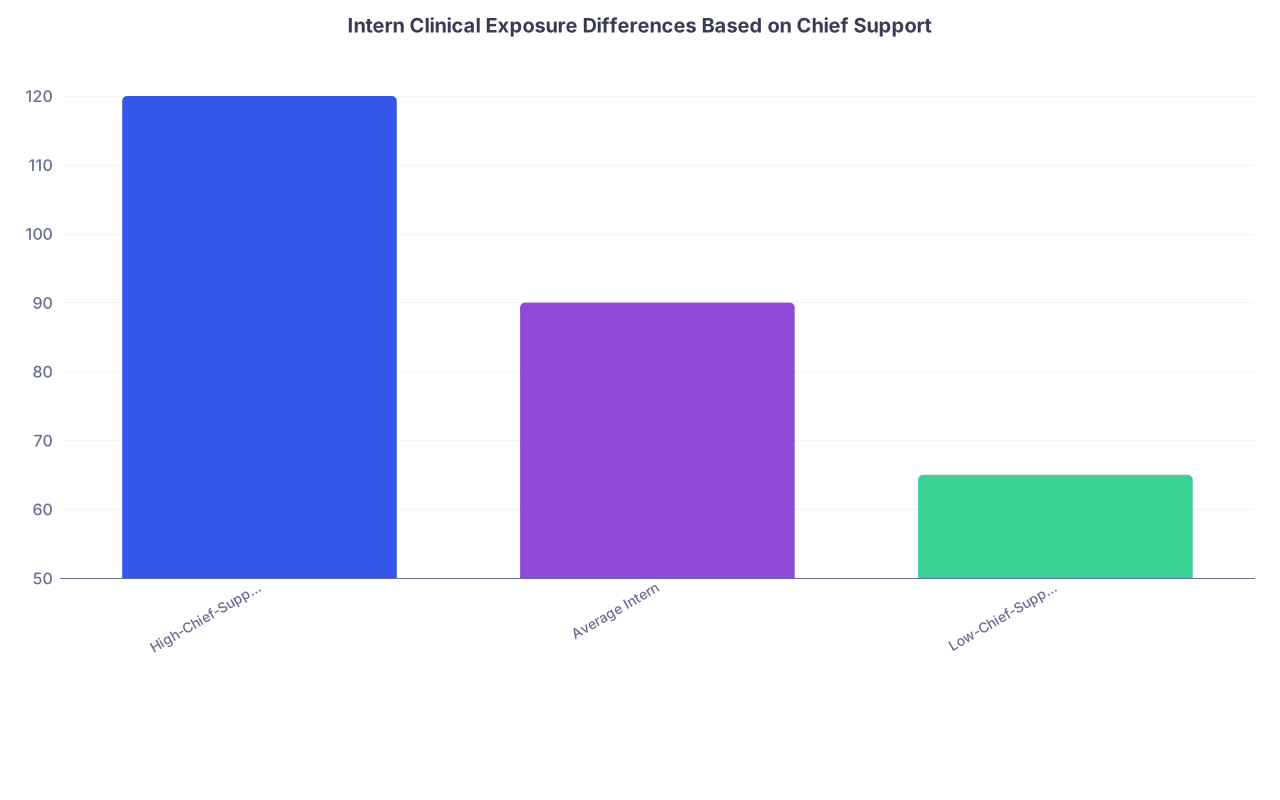
| Category | Value |
|---|---|
| High-Chief-Support Intern | 120 |
| Average Intern | 90 |
| Low-Chief-Support Intern | 65 |
Illustrative: number of “high-yield” cases/procedures over PGY-1 for different levels of chief support
Signals That Chiefs Will Make or Break Your Training
You’re not powerless here. You can read chief culture before you rank a program. But you have to know what to look for and what to ask.
1. How Chiefs Talk in Front of You
On interview day and second looks, listen carefully when chiefs open their mouths. Not what they say. How.
Red flags from chiefs I’ve heard with my own ears:
“We try to make the schedule fair, but, you know, it’s a hospital, things happen.”
Translation: chaos. No real advocacy.“Our job is to make sure service needs are covered.”
Translation: you are labor first, learner second.“We don’t really intervene unless there’s a serious issue.”
Translation: you’re on your own until you’re sinking.
Green flags:
- “If an attending is out of line, we want to know. We’ll handle it.”
- “We track workload by person and rebalance when things get skewed.”
- “We’ll pull you from a rotation if it’s unsafe, and we’ve done it before.”
You’re listening for ownership. Chiefs who say “my interns,” not “the interns.”
2. How Interns React When Chiefs Are Mentioned
This is far more honest than any formal Q&A. Watch the micro-expressions when someone says “chiefs.”
Good sign:
Interns roll their eyes in a tired but affectionate way. They joke about “bothering the chiefs again” and then immediately mention a time the chiefs fixed something.
Bad sign:
Intern pauses. Looks down. Says something neutral like, “They’re… busy.” Or “They have a tough job.” That’s resident code for “They don’t help us.”
If you only get to ask one question on a pre-interview Zoom with residents, ask:
“How often do chiefs step in when a rotation or attending is toxic?”
The hesitation before they answer tells you most of what you need to know.

How Chiefs Shape Your Reputation Behind Closed Doors
Here’s the part nobody tells you when you’re a fourth year: your narrative in the program gets written early, and the chiefs hold the pen.
Twice a year, sometimes more, programs sit for clinical competency or “Clinical Competency Committee” meetings. On paper, they review Milestones and evals. In reality, it goes like this:
- Name appears on the screen.
- There’s a 10-second pause.
- Everyone looks at the chief.
Then the chief says one of a few things:
- “Solid. Shows up, reliable, improving.”
- “Star. Give them leadership roles.”
- “Struggled early, but really turned it around.”
- “We’re concerned. Needs close supervision.”
That sentence will matter more than any single eval you ever get. It affects:
- Letters of recommendation quality
- Who gets chief next year
- Who gets nudged toward competitive fellowships
- Who gets quietly warned away from certain paths
And how did the chief form that opinion? Not from one exam. From dozens of nights, check-ins, pages, and gut feelings about who they can trust when everything goes sideways at 3 AM.
So when you choose a program, what you’re really choosing is: whose opinion will quietly define your career?
You want chiefs who are:
- Present on the wards and nights
- Known to be fair and specific
- Willing to separate “had a rough month” from “bad resident”
Programs where the chiefs barely know the interns are brutal. You get defined by gossip and one bad shift.
How to Evaluate Chief Culture Before You Rank
You can’t control which specific chiefs you’ll get four years from now. But you can absolutely evaluate the system that produces them.
1. Ask Directly: How Are Chiefs Chosen?
You’d be amazed how much this reveals. Ask the residents:
- “Who chooses your chiefs – PDs, residents, vote, mixed?”
- “What kind of people usually get chief?”
Now pay attention to the answers.
If you hear:
- “Chiefs are basically the PD’s favorites.”
- “It’s always the research star / fellowship gunner.”
- “It tends to be the politically safe choice.”
That tells you the culture values optics over advocacy.
If you hear:
- “Residents have a strong voice in who gets chief.”
- “They pick people who’ve taken care of their colleagues.”
- “The chiefs are the first people we call when things go wrong.”
Different world. It means chiefs are chosen for resident-facing skills, not just faculty charm.
| Selection Model | What It Usually Signals |
|---|---|
| PD-only appointment | Political, faculty-pleasing |
| Mixed PD + resident input | Balanced, somewhat resident-oriented |
| Resident vote heavy | Strong advocacy, peer-trusted chiefs |
| Rotation-based (by track) | Administrative convenience, variable |
2. Find Out: What Do Chiefs Actually Do All Day?
There are two kinds of chiefs:
- Administrative operators – build schedules, attend meetings, keep the machine running
- Clinical leaders – on the wards, teaching, covering, running codes, knowing the interns personally
You want a program where chiefs are forced to be both.
Ask:
- “How many clinical months do chiefs have?”
- “Are they on nights with you?”
- “Do they staff with interns on tough services?”
If chiefs are mostly in an office, or doing 80% admin, here’s what happens: they become management. You become a number on a grid.
When chiefs are visible and clinical, they see the real you. Your bad nights, yes. But also the quiet times you stepped up when nobody was watching.
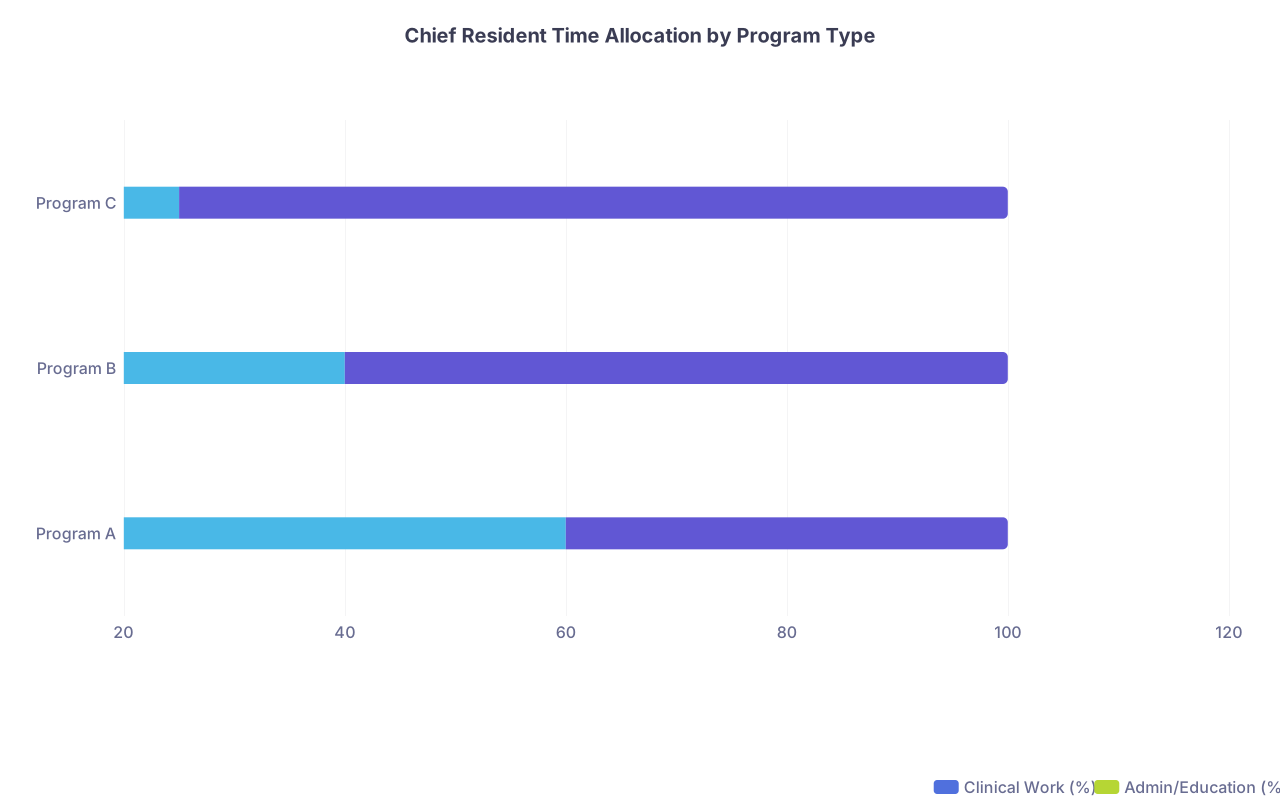
| Category | Clinical Work (%) | Admin/Education (%) |
|---|---|---|
| Program A | 60 | 40 |
| Program B | 40 | 60 |
| Program C | 25 | 75 |
Programs where chiefs keep significant clinical time tend to understand residents’ real workload and learning gaps better.
3. Ask How Conflict Is Handled – And Listen for Names
Good question:
“Can you describe a time when something wasn’t fair and how the chiefs handled it?”
Residents who trust their chiefs will tell you a specific story:
- “Last year, one of the rotations was out of control; chiefs pulled people out and rewrote coverage.”
- “We had a malignant attending; chiefs took it to the PD and actually changed how residents rotated with them.”
If they can’t come up with a single real example? Or they talk vaguely about “open-door policy”? That means nothing.
You want to hear about a time the chiefs said no to faculty. That’s the acid test.
How Chiefs Play Favorites (And How Not to Get Screwed)
I’m going to say the quiet part out loud: yes, chiefs have favorites. They’re human. You cannot fully eliminate this. The question is whether the system blunts or amplifies that bias.
Patterns I’ve seen over and over:
- Chiefs favor the interns who communicate clearly during crises
- Chiefs trust the ones who admit when they’re over their head
- Chiefs avoid the chronically negative, sarcastic, or blaming intern
- Chiefs get tired of the resident who only shows up when it benefits them
So do you need to brown-nose your chiefs? No. In fact, that backfires with good chiefs. What you need is reputation.
The interns who get the best training from chiefs tend to do a few things consistently:
- They keep chiefs in the loop early when a shift is going off the rails
- They own their mistakes without drama
- They help co-interns without announcing it every time
- They make scheduling and coverage problems easier, not harder
Chiefs remember who they can page at 2 AM and know it will get done without a meltdown.
When you’re choosing a program, listen for whether residents talk about chiefs like:
- “They’re approachable but have high expectations.”
vs - “You don’t want to get on their bad side.”
The first one means performance matters. The second means politics matters.

Red-Flag Chief Cultures That Ruin Training
Let me be blunt about a few structural patterns that almost always lead to worse training for interns.
1. Perpetual Crisis Chiefs
If every year residents say, “The chiefs are overwhelmed, the schedule is always behind, and they’re constantly apologizing,” you know what that really signals?
The program uses chiefs as cheap administrators instead of educational leaders.
Those chiefs have no bandwidth to:
- Track who’s overworked vs under-challenged
- Notice who hasn’t done a procedure in weeks
- Intervene on toxic rotations
They’re putting out fires. Always. You get whatever’s left of their attention.
2. Invisible Chiefs
If residents say, “We don’t see the chiefs much, they’re mostly in meetings or clinic,” that’s another bad sign.
Invisible chiefs are dangerous because:
- They rely on secondhand opinions about you
- They often side with faculty by default
- They can’t tell the difference between real concerns and normal intern growing pains
You want chiefs who have been in the trenches with you in the last few months. Not two years ago.
3. Hero Chiefs (Good for Them, Bad for You)
This one fools applicants all the time.
You meet a charismatic chief who “fights for residents,” everyone loves them, and they’ve single-handedly fixed multiple issues. You walk away impressed.
Here’s the problem: hero chiefs often exist in structurally unsupportive programs. The system is bad; a few exceptional humans are masking that fact.
Questions I’d ask in that setting:
- “Has the program changed any permanent policies because of the chiefs’ advocacy?”
- “Is what they’re doing sustainable year to year, or is this just because these chiefs are rockstars?”
If the program requires heroics to keep residents afloat, the year you match might not be the year with heroes.
How to Use All This When You Rank Programs
So what do you actually do with this knowledge when you’re staring at your rank list?
Here’s the lens I’d use:
You’re not just ranking “prestige + location + fellowship match.” You’re ranking:
How likely is this program to give me a chief team that will protect my learning, my time, and my reputation?
On second looks, pre-interview socials, and emails, I’d focus like a laser on:
- How chiefs are selected
- How chiefs are evaluated (do PDs ask residents “How are your chiefs doing?”)
- How chiefs talk about balancing service vs education
- Concrete stories of conflict where chiefs took a stand
If two programs look identical on paper, but in one the residents talk about their chiefs with real respect and trust — that’s the better training program, even if the other has a shinier name.
Because here’s the truth:
On your worst night as an intern, the program director will be asleep.
The fellowship director won’t pick up the phone.
The person who will actually decide whether you sink or swim is the chief.
Choose accordingly.