What PDs Look For on Your Visit Day That Never Shows Up on ERAS
It’s 7:12 a.m. You’re in a slightly-too-stiff suit sitting in a hospital conference room with a branded pen, a packet, and a lukewarm coffee. You’ve memorized your Step scores, your research blurbs, your “Why this program?” paragraph. You think the hard part was ERAS.
It wasn’t.
The real evaluation starts now—on this visit day—and most of what actually matters is nowhere in your application. You’re being watched in ways you don’t realize, by people you don’t realize, for things you didn’t know anyone cared about.
Let me walk you through what program directors, faculty, chiefs, and even the senior residents are really doing on these days. Because if you think it’s just about your CV and how well you recite your personal statement, you’re already behind.
The Hidden Scorecard: What’s Actually Being Graded
There is an unofficial checklist in every PD’s head on visit day. None of it is written down. None of it is advertised. But it drives who gets ranked where.
Here’s the uncomfortable truth: by the time you show up, they already know your numerical value. Scores, grades, class rank, research—sorted. What they don’t know is whether you are:
- Safe
- Low-maintenance
- The kind of person they want at 2 a.m. when things are going sideways
Visit day is about those three things.
Let’s break down how they figure that out.
1. How You Treat People You Think “Don’t Matter”
This is the big one. I’ve seen it tank stellar applicants more times than I can count.
The non-faculty eyes on you
On visit day, PDs quietly recruit a small army of observers: coordinators, front desk staff, residents, sometimes even the shuttle driver who picks you up from the hotel.
They’ll ask them later: “How were they?”
That answer can move you 20 spots up or 40 spots down on the rank list. I am not exaggerating.
Examples I’ve personally seen:
- Applicant with 260+ Step 2, AOA, shiny research. Was condescending to the program coordinator at check-in because his name badge wasn’t ready. Dropped out of the top 5. Ended up mid-list.
- Applicant with average scores but helped an older applicant find the right room, thanked housekeeping staff clearing the breakfast area. Multiple people mentioned her by name later—moved up significantly.
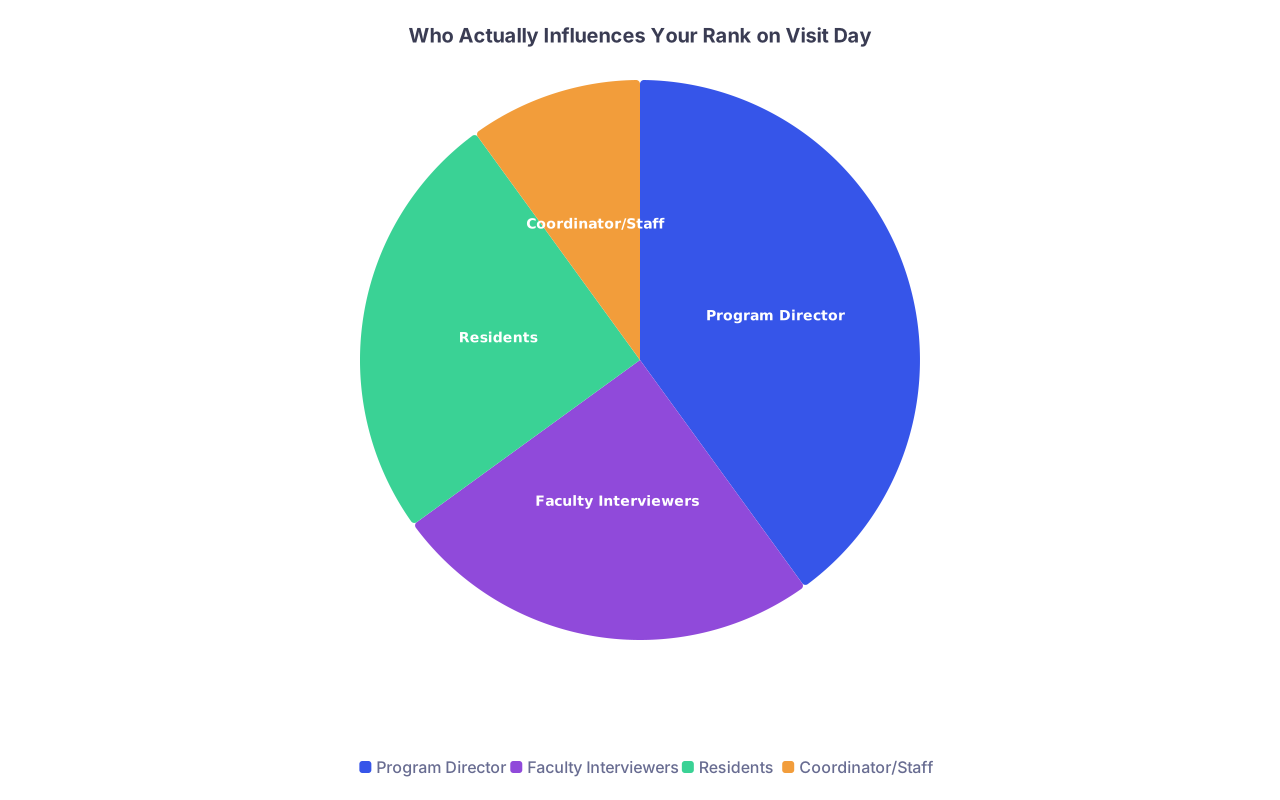
| Category | Value |
|---|---|
| Program Director | 40 |
| Faculty Interviewers | 25 |
| Residents | 25 |
| Coordinator/Staff | 10 |
No one tells you this, but PDs take “how you treat staff” as a proxy for “how you’ll treat nurses at 3 a.m.” If you’re short, dismissive, or entitled with the coordinator on interview day, they assume you’ll be worse under stress on the wards.
The micro-behaviors that get noticed
They’re not just listening to what you say. They note the tiny things:
- Do you say “thank you” when you’re handed materials or food?
- Do you hold the door for the person behind you, or let it swing shut because you’re staring at your phone?
- When the Zoom link glitches (yes, even now, hybrid stuff happens), are you visibly annoyed or calm and flexible?
Programs are sick of dealing with “high-maintenance geniuses.” They’d rather take someone slightly less impressive on paper who doesn’t create drama over breakfast logistics.
2. Your Real Personality Under Social Load
Your ERAS says you’re “a team player who values collaboration.” So does everyone else’s. Visit day is where they stress test that claim.
Here’s what they’re looking at when you’re not technically “on” in a formal interview.
Resident lunch: the trap and the opportunity
Most applicants think of the resident lunch as a chance to ask questions. The residents think of it as a vibe check. The PD thinks of it as a screening tool.
Here’s what residents report back—yes, they actually debrief afterward:
- Who dominated the conversation and didn’t let others speak
- Who asked a genuine question, then actually listened to the answer
- Who only asked performative questions to show off knowledge about the program
- Who was awkward-but-kind vs smooth-but-slimy
If you only perform for PDs and faculty and then shut down or turn into a different person with residents, they notice. The phrase “two different personalities” comes up in rank meetings more than you’d believe.
How you engage when the spotlight isn’t directly on you
During the morning overview, when the PD is going through slides you’ve heard at every program:
- Do you look engaged or bored?
- Do you subtly check your phone under the table? (Someone sees it. They always do.)
- Are you looking at whoever is speaking, or studying the schedule handout like you’d rather be anywhere else?
I’ve watched PDs quietly write down “disengaged,” “checked out,” “seems annoyed” next to an applicant’s name while they were staring at their phones. And I’ve watched those same names sink down the rank list later.
3. Your Emotional Tone: Calm, Needy, or Exhausting?
No one phrases it like this on official documents, but here’s how attendings and PDs often talk behind closed doors:
“Is this person going to be exhausting to manage for three years?”
They’re not just evaluating competence. They’re evaluating emotional maintenance costs.
The “needy applicant” red flags
You might not think you’re doing this, but PDs and residents absolutely pick it up:
- Repeatedly asking for reassurance: “Do you think I’m a good fit? Do I have a realistic shot here?”
- Fishing for compliments about your application: “With my scores and research, would you say I’m competitive for your program?”
- Over-explaining past issues when no one asked: “So about that leave of absence, let me give you all the context…” unprompted, again and again.
This is how it lands: “High-anxiety, will need constant hand-holding, potential problem when evaluated.”
Better: Answer when asked. Acknowledge context once, clearly and concisely. Then let it go.
The calm-under-friction test
There’s almost always at least one small screwup on visit day. Late start, AV issues, room change, resident running behind for lunch. PDs don’t orchestrate this, life does it for them.
They watch how you respond:
- The applicant who smiles and adjusts? Big plus.
- The applicant who sighs, looks irritated, or makes a comment about disorganization? Big minus.
I’ve literally heard a PD say after an interview day: “If they’re this annoyed on a conference day in street clothes, imagine them on night float.”
They’re not wrong.
4. Your Fit With The Resident Culture (Not The Branding Slide)
Programs love to talk about their culture in vague terms—“supportive, collegial, diverse.” That’s branding. The real question PDs are asking is:
“Can I imagine this person on our team text thread at midnight?”
And that is determined by your visit day, not your ERAS.
The unofficial “Would I take call with them?” test
After the day ends, residents will get cornered by PDs, APDs, or chiefs:
“So, who stood out?”
“Anyone you definitely don’t want?”
They do not hold back. If a resident says, “I would not want to take call with that person,” it carries more weight than your entire research section.
Reasons you get this label:
- You talked over other applicants and residents repeatedly
- You humble-bragged about your step scores or school name
- You came across as hyper-competitive or transactional
- You made subtle digs about other specialties or programs
Programs know they’re locking in people for three to seven years. They’re building a small society, not just hiring exam scores.
How your questions betray your priorities
Your questions are not neutral. They reveal what you actually care about.
Patterns PDs and residents pick up on:
- Only asking about fellowship matches and prestige? You’re tagged as “ladder climber, may not be loyal, may bail.”
- Only asking about hours and “how protected is protected time?” without any questions about education or patient care? You get the “does not want to work” label fast.
- Asking specific, grounded questions about teaching, feedback, and how residents support each other? That sounds like someone who’s actually thought about life as a resident, not just the brochure.
No one will tell you this directly, but your rank can drop based on “vibes from their questions” alone. I’ve watched it happen.
5. Your Professionalism in the Gray Zones
Everyone expects you to be “professional” in the interview itself. The real tells are in the gray zones: transitions, social times, the end of the day when you’re tired.
The 3–5 minutes before and after each interview
When the interviewer is walking you to or from the room, those minutes count more than you think.
They’re evaluating:
- Can you carry a normal human conversation, not just canned answers?
- Are you capable of small talk without trying to cram in your CV again?
- Do you show basic curiosity about the person in front of you?
I’ve heard versions of this many times: “The formal interview was fine, but on the walk back they were awkwardly self-promotional the entire time. It felt off.”
Candidates forget that transitions are still part of the interview. They’re where your authenticity (or lack of it) leaks out.
Pre- and post-event behavior
Watch how you act:
- Before the official start: are you sitting silently in a corner, face in phone, ignoring others? Or able to say hello to the person next to you?
- After the day ends: do you bolt for the door, or do you take 10 seconds to thank the coordinator and say goodbye to the PD if they’re nearby?
No, you don’t need to do performative networking. But those brief interactions create a lasting impression—positive or negative.
6. Your Self-Awareness and Insight (or Lack Thereof)
This does not show up on ERAS. But it absolutely shows up when you open your mouth.
PDs are always asking themselves: “Does this person understand themselves? Do they have insight into their strengths and weaknesses?”
How they probe this
They’ll ask questions like:
- “Tell me about a time you struggled on a team.”
- “What feedback have you gotten that surprised you?”
- “If I asked your co-residents in a year what you needed to work on, what would they say?”
The wrong answer is either vague fluff (“I care too much” nonsense) or blaming others (“Honestly, the team dynamic was just bad”).
What they want to hear—and rarely get—is something grounded and specific:
“On my sub-I, I realized I was over-documenting and slowing myself down. My senior pulled me aside and helped me prioritize. Since then, I’ve been more deliberate about asking, ‘What actually needs to be in this note?’”
That’s a resident they can mold. Someone who doesn’t think they’re already perfect.
The danger of over-perfection
If you present as relentlessly polished, flawless, and above reproach, many PDs get nervous. They’ve dealt with that type before. It doesn’t usually end well.
Behind closed doors you’ll hear: “They seem a little too slick. Like they’ve never been wrong.” That’s not a compliment.
7. The Story Residents and PDs Tell About You Later
Here’s the part people don’t realize: at the ranking meeting, no one reads your ERAS line-by-line. They remember you as a story.
One or two short sentences. That’s it.
| Applicant Label | Likely Rank Effect |
|---|---|
| “Super kind, staff loved her” | Moves up |
| “Smart but arrogant” | Moves down or off list |
| “Quiet but thoughtful” | Stable / modest up |
| “Seemed annoyed all day” | Big drop |
| “Residents really liked him” | Strong move up |
I’ve sat in rooms where people said:
- “Who was that again?” Silence. They end up in the mushy middle.
- “Oh, that’s the one who lectured the resident about another program’s name.” Instantly drops.
- “That’s the applicant our coordinator loved who helped with the coffee spill.” People smile. Rank goes up.
You are not your bullet points. You are the sentence people say when your name pops up on the screen.
Your job on visit day is to give them a story that’s easy to tell and positive to repeat.
8. The Stuff You Worry About That PDs Don’t Actually Care About (As Much)
Let me flip this for a moment.
Applicants obsess over all the wrong things on visit day:
- The exact wording of their “Why this program?” answer
- Whether their tie or blouse is the perfect color
- If it’s okay that they stumbled on one question
Honestly? PDs do not care about tiny, normal imperfections. They’re human. They know you’re nervous.
What they actually ignore far more than you think:
- One awkward moment or poorly answered question
- Minor clothing imperfections that are still professional
- Not knowing some program trivia they mention
What they don’t ignore:
- Patterns of arrogance, entitlement, or disinterest
- Being rude to staff or dismissive to residents
- Giving off “this program is beneath me” vibes

Focus less on memorizing speeches. Focus more on being the kind of person they can trust with patients— and with each other—when things get ugly.
9. How To Actually Prepare For The Parts They’re Really Grading
You can’t fake being a decent human for eight hours. But you can make sure your default settings show through instead of your anxiety.
A few concrete, non-fluffy things that matter:
Practice talking like a normal person about real things. Not everything has to be calculated. Before interview season, talk to non-medical family or friends about your rotations, what you liked, what you struggled with. Get used to sounding like yourself, not like a personal statement.
Have 2–3 specific, honest questions about resident experience. Not scripted, not designed to impress. Things you actually care about: how they support each other, how feedback is given, what a hard month really feels like.
Decide your core traits up front. If you want them to remember you as “calm,” “kind,” or “curious,” let that shape how you react to minor inconveniences and how you talk to the quieter people in the room.
And stop performing for the highest title in the room. The coordinator, the PGY-2 at lunch, the nurse you pass in the hallway—these people write the unofficial letters you never see.

| Step | Description |
|---|---|
| Step 1 | Visit Day Behaviors |
| Step 2 | Staff and Resident Impressions |
| Step 3 | Debrief with PD and Faculty |
| Step 4 | Short Story About You |
| Step 5 | Rank Meeting Discussion |
| Step 6 | Final Rank Position |
10. Virtual Visit Days: Same Rules, Different Medium
Do not relax just because the day is on Zoom.
Programs are still watching:
- Are you on time to every breakout room?
- Is your camera on, background neutral, audio acceptable?
- Do you look like you rolled out of bed five minutes ago?
They also notice:
- Are you engaged in the group room or clearly multitasking?
- Do you look at the person speaking or stare off-screen constantly?
- Do you participate at least a bit, or never unmute once?
I’ve seen applicants on virtual days obviously answering emails or talking to someone off-camera. They don’t realize PDs see that—and remember.
The Bottom Line
On visit day, PDs and residents are quietly grading things you never wrote into ERAS:
- How you treat staff, residents, and “unimportant” people reveals more about your future as a colleague than any score.
- Your emotional tone—calm, entitled, anxious-but-functional, or simply exhausting—will push you up or down the rank list faster than a publication.
- You will be remembered as a one-line story in the rank meeting. Your job on visit day is to make sure that story is one they’re excited to repeat, not one they warn each other about.