
It’s late January. You’re refreshing your email too often, pretending you’re “totally chill” about interview invites, and simultaneously trying to decide how to rank programs you barely know. Every website says the same thing: “Excellent clinical training. Collegial environment. Strong fellowship match.”
What you do not see is the other side of the table: program directors in a closed-door meeting, pulling up spreadsheets and NRMP reports, talking about “board pass risk,” “retention risk,” and “what this will do to our fill rate.”
Let me tell you what really happens in that room.
Because if you understand how programs secretly protect their reputation and stats, you’ll choose smarter—and you’ll stop taking some of this stuff personally.
What Programs Actually Care About (Behind the Marketing Lines)
Let's strip the brochure language away. When faculty and program directors talk off the record, the priorities are very clear. They revolve around four things:
- Board pass rates
- Accreditation and citations
- Fill rates and reputation in the match data
- Vibes and workload balance (and yes, that’s partially code for “will this person cause problems?”)
And they use unspoken rules—filters, biases, and defensive strategies—to guard those metrics.
Here’s the part you’re not told as an applicant:
Programs are under constant pressure from their chair, the GME office, and sometimes even hospital administration. They live and die by a few line items on an annual report.
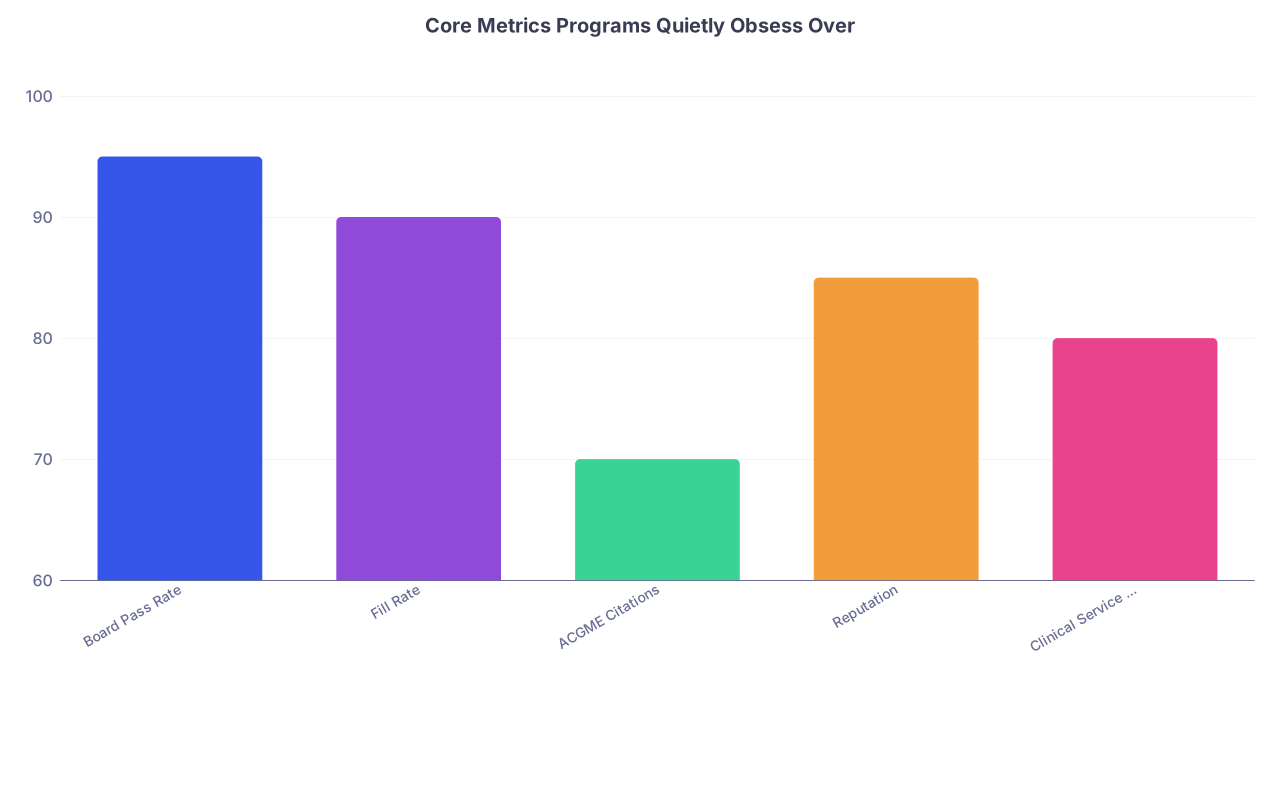
| Category | Value |
|---|---|
| Board Pass Rate | 95 |
| Fill Rate | 90 |
| ACGME Citations | 70 |
| Reputation | 85 |
| Clinical Service Coverage | 80 |
Those numbers aren’t random. I’m showing you the relative concern I hear repeatedly in meetings, not official scales. Pass rates and fill rates dominate the conversation.
When you’re choosing programs, you have to read them through this lens:
“How are they trying to protect these stats, and what does that mean for me?”
The Board Pass Rate Obsession: How It Shapes Who They Rank
I’ve sat in meetings where a PD literally said, “I like this applicant a lot, but I cannot take that Step 2 score risk this year.” That was the end of discussion.
Here’s the reality:
- Programs are judged (formally and informally) on their ABIM/ABFM/ABOG/ABS/etc. board pass rates.
- A couple of residents failing boards in a small program can drop their pass rate into the danger zone.
- Low pass rates trigger questions from ACGME and make the department look bad to the dean and the hospital.
So what happens? Quiet, defensive rules appear.
The Unspoken Filters
Programs won’t post this on their website, but internally many have lines like:
- “Anyone with multiple Step failures gets extra scrutiny or is usually screened out.”
- “Below X on Step 2 / Level 2 is a high risk; we can only take one of these per year, if any.”
- “IMGs/DOs with borderline scores must have clear compensating strengths.”
Nobody will say, “We don’t trust you,” but they’ll say:
“We’re concerned whether this applicant can handle our in-service exam and boards.”
Same meaning.
How You Can Actually See This From the Outside
You can’t read their private spreadsheets, but you can infer some things:
- Check their board pass rates on their website or FREIDA. If they’re 100% every year, they guard that fiercely.
- If the rate dipped recently, they may tighten selection and become extremely risk-averse for a few cycles.
- Look at who they match: recent match lists, current residents’ medical schools, DO/IMG representation.
| Visible Clue | Likely Behind-the-Scenes Reality |
|---|---|
| 100% board pass for 5+ years | Aggressive filtering on scores, very risk-averse |
| Pass rate dipped last 2–3 years | New “soft cutoffs,” test remediation programs, faculty under pressure |
| Many DO/IMGs with solid outcomes | Program comfortable taking “nontraditional” with careful support |
| Website emphasizes “test prep support” | They’ve had board scares or failures recently |
If you’re picking programs, understand:
Programs with pristine pass rates will protect them at almost all costs.
That often means more pressure, more mandatory test prep, tighter evaluations—and less tolerance for residents who struggle.
Are you okay with that tradeoff? Or would you rather be at a place that’s a little less obsessed with being perfect on paper?
Fill Rate & “We Can’t Afford to Scramble”: The Silent Ranking Strategy
The other obsession: fill rate in the match.
No program director wants to explain to their chair why they went into SOAP. That is perceived as failure. It can scare away future applicants. It gets noticed by peers.
So programs quietly build insurance into their ranking strategy.
The Hidden Tiers on Rank Lists
On the whiteboard (or Excel sheet), rank meetings are usually tiered mentally, even if not labeled that way:
- Tier 1: Dream candidates. They may not come.
- Tier 2: Solid fits. Likely to match and stay.
- Tier 3: Safety/rescue tier. People we think will rank us highly.
- The “do not rank” pile: huge, and larger than you think.
You’ll hear things like:
“I like her, but she’s clearly aiming top-10 academic. We shouldn’t rank her too high; we need to protect ourselves.”
Translated: “We can’t stack our list with people who won’t come here. Our fill rate matters more than wishful thinking.”
This means a few things for you:
- If you look “too competitive” for them on paper, some mid-tier programs will downgrade your rank because they assume you won’t come.
- If you signal genuine interest (sub-I, email, geographic tie, clear story), you might move way up.
- Programs that recently went into SOAP tend to overcorrect and rank more conservatively the next year.

| Step | Description |
|---|---|
| Step 1 | Interview Applicant |
| Step 2 | Risk - Might Not Rank Us |
| Step 3 | Moderate Risk |
| Step 4 | Likely to Rank Us High |
| Step 5 | Move to Tier 1 or 2 |
| Step 6 | Rank Lower to Protect Fill Rate |
| Step 7 | Safe - Higher Rank Tier |
| Step 8 | Applicant Stats vs Program Prestige |
| Step 9 | Any Strong Signals? |
What This Means When You’re Choosing
You have to flip this and ask:
How desperate is this program to protect its fill rate?
If a program:
- Recently expanded spots rapidly
- Is in a less desirable city/region
- Has had noticeable SOAP participation in the last few years
They may be running scared. That often leads to odd behavior: over-interviewing, love-bombing candidates, then still playing scared on the rank list.
As an applicant, you should:
- Take their “we loved you” emails with skepticism. Those are cheap.
- Look at who they actually match, not just who they interview. That’s the real story.
- Consider that a program constantly petrified about filling will often overload residents with service to justify its existence.
ACGME Citations, Scut Work, and Why Some Residents Get Thrown Under the Bus
Programs are terrified of ACGME citations.
Too many citations = serious trouble.
Serious trouble = leadership changes, program restructuring, and sometimes losing spots.
That fear changes how they treat you. Not always in your favor.
The Quiet Priority: “Don’t Get Us Reported”
Hours, supervision, didactics, wellness, education time—it’s all nominally “monitored.” But programs know the game. They know certain things look terrible if they end up in an ACGME survey comment or formal complaint.
So unspoken rules form:
- “Do not put this in writing.” (Yes, I’ve heard this said about schedule changes and call expectations.)
- “Remind the residents to please be thoughtful in the anonymous survey.”
- “We can’t let another duty hours citation happen this year.”
This can lead to two very different cultures:
- Protective culture: leadership actually fixes workflow, shores up staffing, and listens when residents say they’re drowning.
- Defensive culture: leadership pressures residents to stop complaining, manipulates documentation, or scapegoats “problem” residents.
You can guess which one you want.
How to Spot the Defensive Programs Before You Rank Them
You’re not going to see “we throw residents under the bus to protect our stats” on the website. But there are tells:
- Current residents give you vague, guarded answers when you ask about schedule, hours, or responsiveness of leadership.
- Nobody can tell you the most recent improvements that actually came from resident feedback.
- People say things like, “We’re told to be careful what we put in the ACGME survey.”
Contrast that with a healthier place:
- Residents can list concrete changes that happened because they spoke up.
- Chief residents are candid about what’s hard and what’s being worked on.
- PDs aren’t defensive when asked about citations; they explain the fix and move on.
When you’re choosing programs, remember:
Some places will protect their stats even if it means running you into the ground and then blaming your “resilience” when you crack.
Others will take the hit on paper to avoid destroying their people.
Pick accordingly.
Reputation Games: University vs Community vs “Hidden Gem”
Let’s talk about the word everyone throws around without understanding: reputation.
Programs care what:
- Fellowship directors think
- Other PDs think
- Their own chairs and institutional leaders think
- Applicants think (because that affects the match outcomes)
And they’ll bend decisions around that vanity.
Reputation Shapes Who They Want in the Class
Behind closed doors, conversations sound like:
“We need a couple of ‘name’ applicants to keep our profile up.”
“We want at least one resident from a top-tier med school each year.”
“We’re starting a new fellowship; we need people who can publish and make us look academic.”
So they may:
- Heavily favor applicants from big-name med schools, even over stronger applicants from lesser-known schools.
- Chase MD/PhD or high-research applicants to impress their chair, even if they don’t actually support research well.
- Select residents they think will match well into competitive fellowships later, because that back-propagates into the program’s perceived quality.
“Hidden Gem” vs “Shiny But Hollow”
You need to understand that sometimes the best place for you isn’t the shiniest.
There are:
- Prestige-heavy programs that will treat you like a replaceable brand asset. Great name, miserable experience.
- Under-the-radar programs where the training is phenomenal, the leadership is human, and they quietly place residents into strong fellowships consistently.
Look at:
- Their fellowship match list over multiple years, not just the cherry-picked names.
- How often grads stay as faculty—usually a sign people didn’t hate the place.
- The tone residents use when they talk about leadership. Pride? Exhaustion? Fear?
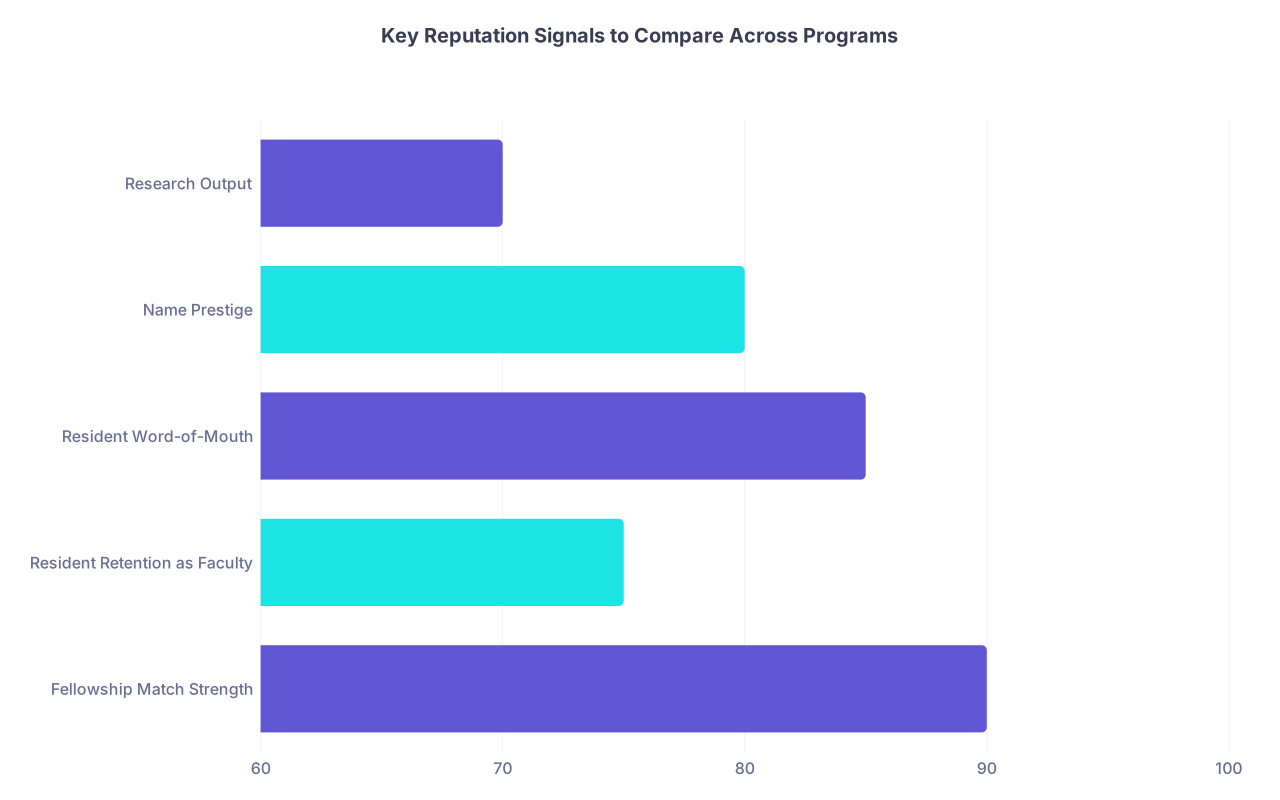
| Category | Value |
|---|---|
| Fellowship Match Strength | 90 |
| Resident Retention as Faculty | 75 |
| Resident Word-of-Mouth | 85 |
| Name Prestige | 80 |
| Research Output | 70 |
Reputation, from the inside, isn’t just “do people know our name?” It’s “do people trust the quality of our graduates?”
You want the latter, not just the former.
How Programs Quietly Sort Applicants Into “Risk” and “Asset”
Every program I’ve ever been around has some version of this mental model—even if they never put it on paper.
Residents are seen as either:
- Assets: Boost stats, carry service, match well, publish, win teaching awards.
- Risks: Might fail tests, burn out, complain to ACGME, cause interpersonal drama, or leave.
Nobody says this out loud to you on interview day. But you can feel it if you know what to watch for.
What Gets You Labeled “Asset” in Their Eyes
This is the ugly truth: they’re not just asking “Will you be a good doctor?” They’re asking:
- Are you likely to pass boards without drama?
- Will you make our rotation coverage easier, not harder?
- Are you going to be low-maintenance emotionally?
- Will you help us match better in the future (research, fellowships, reputation)?
They look at things like:
- Strong, consistent exam performance
- Prior demanding work experience (military, EMT, significant jobs)
- Genuine, appropriate warmth in interactions with staff and residents
- Evidence you can handle stress without blowing up the group
Some of that is okay. Some of it crosses into bias and unfair assumptions. But pretending it doesn’t exist is naive.
What Gets You Labeled “Risk”
Sometimes unfairly, these triggers set off concern:
- Multiple leaves of absence without a clear narrative
- Disciplinary issues, even if resolved
- Vague or evasive answers about conflict, wellness, or support needs
- Very strong demands about schedule, location, or accommodations right up front
I’m not saying you shouldn’t advocate for yourself. You should. But understand the optics: programs are paranoid about “problem residents” because one person can drain leadership time, trigger citations, and blow up morale.
As you choose programs, notice:
- How they talk about former residents who struggled. With compassion or contempt?
- Whether they have formal support structures that actually work, or just wellness buzzwords.
- If residents feel safe admitting that not everyone has had a perfect experience.
If a program throws its struggling residents under the bus to preserve image, that’s how they’ll treat you if you hit a rough patch too.
How to Use These Unspoken Rules to Choose the Right Program
Now the part you actually care about: how do you use all this to make decisions?
You’re not just picking a “brand.” You’re picking:
- The culture of how they treat vulnerable residents
- The level of pressure they put on you to protect their stats
- The strategy they’ll use when something goes wrong—blame, fix, or hide
When you interview or research, test for three things.
1. How Do They Balance Humans vs Numbers?
Ask residents:
- “What happens when someone struggles academically?”
- “Has anyone failed boards or needed extra time? How did leadership respond?”
You’ll hear one of three vibes:
- “We support them, adjust schedules, get them tutoring. It’s stressful, but people get through.”
- “Leadership freaks out, there’s a lot of pressure and passive-aggressive comments about bringing down the program.”
- “I…don’t really know.” (Which is often code for: they don’t talk about it, or it’s not safe to bring up.)
Trust that answer more than the PD’s polished response.
2. What’s Their Real Relationship With ACGME and GME?
You can ask:
- “Have you had any citations in the last few years? What were they, and what did you change?”
- “Have residents ever gone to GME or the DIO with concerns?”
A mature program will say, “Yes, we had X. We did Y to fix it, and now things are better.”
A paranoid one will dodge, minimize, or blame “one disgruntled resident.”
You want honest, not perfect.
3. Are Residents Proud or Just Surviving?
Watch faces on interview day. Listen between the lines.
Signs you’ve found a better place:
- Residents openly acknowledge what’s hard but clearly still like each other and the program.
- They’re not afraid to describe things that need work; there’s no weird uniform script.
- When leadership walks in the room, people don’t shut down or suddenly change tone.
Programs that are truly secure in their reputation don’t have to control the narrative so tightly.
Final Thought: You’re Not Just Matching to a Name. You’re Matching to a Strategy.
Every program has a survival strategy.
Some protect their residents first and take the hit on stats when necessary.
Some protect their stats first and let residents absorb the damage.
When you’re ranking, you’re not just deciding, “Is this a good program?” You’re actually deciding:
- “Whose reputation am I going to be responsible for protecting?”
- “Will they protect me back when it counts?”
Look past the glossy website and the “we’re a family” lines. Try to understand how they think behind closed doors—about board risk, fill rate, citations, and reputation.
Once you start seeing the unspoken rules, you won’t unsee them.
And that’s precisely when you start making smart, adult decisions about where to spend the most important training years of your life.
With this lens in place, you’re ready to build a rank list that isn’t just about name brands but about how you’ll actually be treated when things get real. The next step is learning how to ask the right questions on interview day and on second looks to expose all of this in real time—but that’s a story for another day.