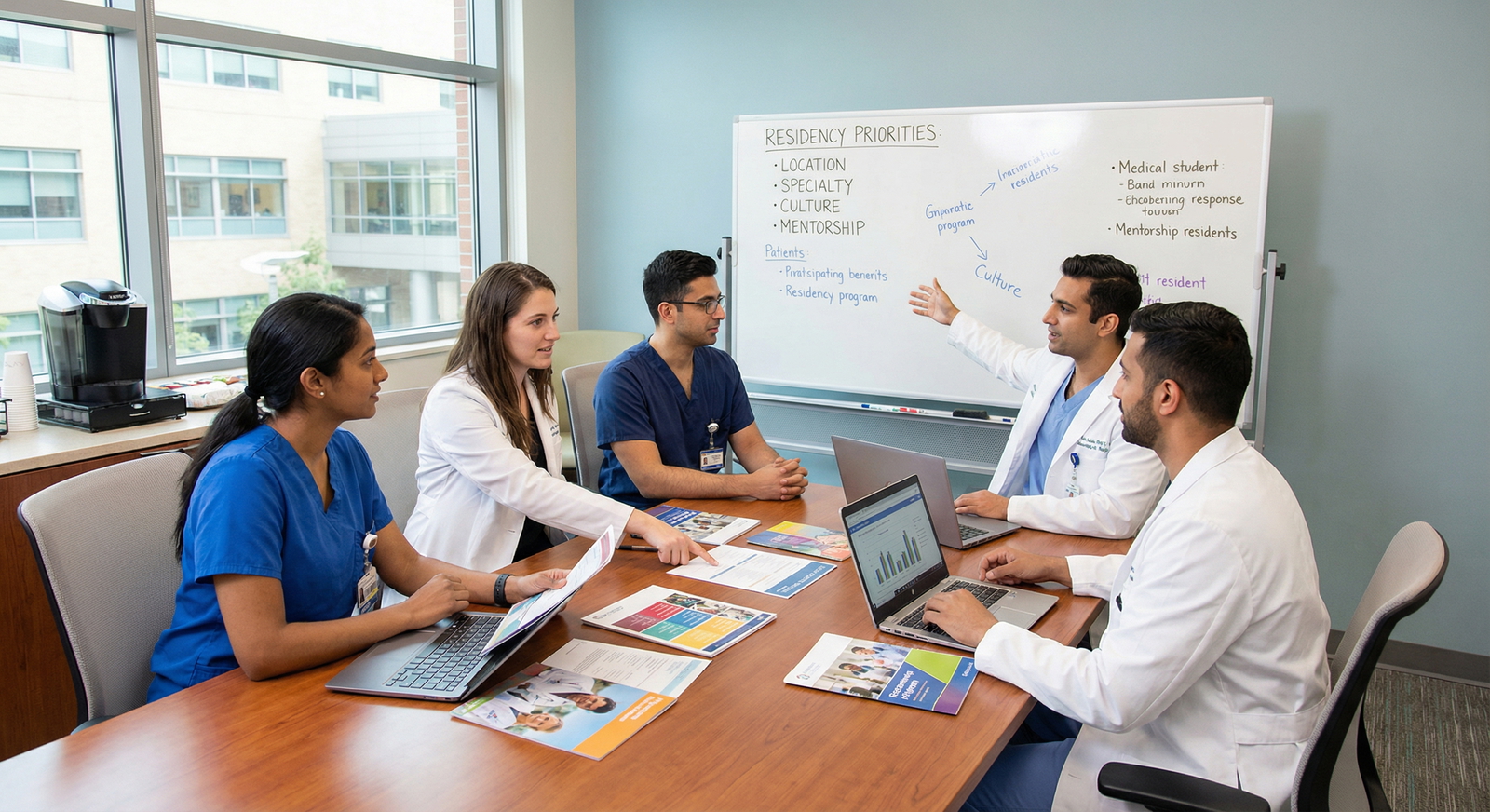
Why Researching OB GYN Programs Is Different for Non‑US Citizen IMGs
For a non-US citizen IMG interested in OB GYN residency, program research is not optional—it is the core of your match strategy. Obstetrics and gynecology residencies in the US are competitive, and many programs have specific policies regarding:
- Visa sponsorship (J-1 vs H-1B)
- Types of medical schools they accept (ECFMG status, recognized schools)
- Graduation year limits
- Minimum USMLE/COMLEX thresholds or attempt limits
- Prior US clinical experience (USCE) expectations
Because of this, how to research residency programs becomes a critical skill. A strong personal statement and good scores cannot overcome a poor program list. A carefully curated list, however, can significantly increase your chances in the obstetrics match.
This article walks you step-by-step through a program research strategy tailored to the foreign national medical graduate applying in OB GYN, with practical tools, examples, and common pitfalls to avoid.
Step 1: Define Your Personal Filters Before You Start Searching
Before opening FREIDA, Residency Explorer, or program websites, you need clarity about your own profile and constraints. This prevents you from wasting time on programs that are unrealistic or unsuitable.
1. Academic and Exam Profile
Be honest and granular about your current standing:
USMLE/COMLEX
- Step 1: pass/fail (and whether on first attempt)
- Step 2 CK: numeric score, number of attempts
- Any exam failures or attempts pending
Medical school profile
- Year of graduation
- School location and recognition (e.g., listed in World Directory of Medical Schools)
- Class rank or academic distinctions, if available
Clinical background
- US clinical experience (externships, observerships, electives), especially in OB GYN
- Home-country OB GYN experience (rotations, internships, residency, or practice)
- Research experience (OB GYN or women’s health preferred)
Your academic profile will influence which filters you apply when evaluating residency programs later (e.g., programs that accept older YOG, those that are IMG-friendly despite lower scores, etc.).
2. Visa and Immigration Status
As a non-US citizen IMG, this is non‑negotiable and needs to be the first hard filter.
Clarify:
- Do you require visa sponsorship?
- Which visas are you eligible/interested in?
- J-1 (via ECFMG) – most commonly sponsored
- H‑1B – fewer programs offer; usually requires all USMLE Steps passed before rank list
- Are you already in the US on another visa (F‑1, H‑4, etc.)?
When researching OB GYN residency programs, you must tag each program as:
- J‑1 only
- J‑1 and H‑1B
- No visa sponsorship / US citizens or permanent residents only
- Unclear / conflicting information (requires email confirmation)
3. Personal and Lifestyle Constraints
These factors are often ignored but strongly influence where you will thrive:
- Geographic preferences:
- Proximity to relatives/friends
- Climate (very cold vs mild)
- Urban vs suburban vs rural
- Financial considerations:
- States with higher cost of living may require more savings before starting
- Family considerations:
- Schools and employment opportunities for spouse/children
- Access to specific cultural or religious communities
Use these as soft filters—they should not totally prevent you from applying to good programs, but they can help prioritize your list.
Step 2: Build Your Initial List Using Objective Data Sources
With your filters in mind, start constructing a broad preliminary list of OB GYN programs. At this stage, do not over-filter; your goal is to gather possibilities.
1. FREIDA: Your Baseline Directory
FREIDA is usually the starting point for how to research residency programs.
Search for:
- Specialty: “Obstetrics and Gynecology”
- Filter by:
- Program type: ACGME accredited
- State(s) you prefer (optional at this stage)
- Visa sponsorship (J‑1, H‑1B) – if the filter is available
From each FREIDA entry, capture:
- Program name and ACGME ID
- Location (city, state)
- Program size (number of residents)
- Visa info (if listed)
- Whether international graduates are accepted (if visible)
However, FREIDA is often incomplete or outdated for visa and IMG information. Treat it as a rough guide, not final truth.
2. Residency Explorer: Matching Your Profile to Programs
Use Residency Explorer if available in your application year. This tool allows you to compare your academic metrics to those of residents who recently matched at a program.
Focus on:
- Step 2 CK median and range for matched applicants
- Percentage of IMGs in matched cohorts
- Program’s overall competitiveness relative to your profile
For a foreign national medical graduate in OB GYN, prioritize programs where:
- Your Step 2 CK is at or above the median of matched residents
- There is some history of IMGs matching, even if small
Residency Explorer does not show visa details, but it helps you avoid programs where your profile is extremely misaligned.
3. NRMP Data and Specialty Reports
Download and review:
- NRMP Charting Outcomes in the Match (for IMGs and for OB GYN specifically)
- NRMP Program Director Survey (OB GYN section)
Use these to:
- Understand typical Step 2 CK ranges for matched non-US IMGs in OB GYN
- See which application components OB GYN PDs value most:
- Step 2 CK score
- MSPE and letters of recommendation
- US clinical experience
- Personal statement, etc.
This background informs how aggressive or conservative your program list should be.

Step 3: Deep Dive into Program Websites (Where the Real Answers Are)
Once you have a preliminary list, you move into the most important phase of evaluating residency programs: reading the program’s own website carefully. Many IMGs skip this or only skim; that is a major error.
1. Confirm Visa and IMG Policies Directly
On each program’s website, look for sections like:
- “Eligibility and Requirements”
- “International Medical Graduates”
- “Application Information”
- “FAQ”
Key questions to answer:
Do they accept IMGs?
- Some programs explicitly say: “We only consider graduates from LCME-accredited medical schools” (i.e., US and Canadian MD schools).
- Others say: “We accept applications from international medical graduates with valid ECFMG certification.”
Do they sponsor visas?
- Common statements:
- “We sponsor J‑1 visas only via ECFMG.”
- “We sponsor J‑1 and H‑1B visas for eligible candidates.”
- “We do not sponsor visas. Applicants must be US citizens or permanent residents.”
- If visa policy is not clear, mark the program as “needs email confirmation.”
- Common statements:
Graduation year limits
- “We prefer applicants who graduated within the last 5 years.”
- “No more than 3 years since medical school graduation.”
If you are a 2016 graduate applying in 2026, a strict 3-year YOG cutoff likely means the program is not practical for you—unless you have substantial recent clinical experience or prior residency.
2. Identify IMG-Friendliness Through Resident Rosters
Many OB GYN programs list current residents with:
- Medical school name and country
- Sometimes visa type (rare, but occasionally visible)
Clues that a program is IMG-friendly for a non-US citizen IMG:
- Multiple current or recent residents from:
- Caribbean schools
- South Asian, Middle Eastern, Latin American, or Eastern European schools
- Clearly listed international medical graduates among PGY‑1 to PGY‑4/PGY‑5
- Alumni lists with IMGs proceeding to fellowships
If a program’s resident list is exclusively US MDs over several years, it may still be possible but is likely more challenging for a foreign national medical graduate.
3. Assess Program Culture and Training Strength
You’re not just trying to match—you’re trying to train well in OB GYN.
From the website, identify:
Clinical exposure
- Number of annual deliveries
- Level of NICU
- Tertiary referral vs community hospital
- Breadth of gynecologic surgery (laparoscopy, oncology, urogynecology)
Curriculum and didactics
- Protected educational time
- Simulation labs
- Ultrasound training
- Family planning experience
Fellowships and advanced training
- In-house fellowships (MFM, Gyn Onc, REI, FPMRS, etc.)
- Track records of graduates entering fellowships vs general practice
Wellness and support
- Mention of mentorship programs
- Resident support for board exams
- Policies on parental leave and wellness initiatives
As a non‑US citizen IMG, you may face cultural and logistical challenges early in residency. Programs that emphasize mentorship, diversity, and wellness can make your transition smoother.
Step 4: Build a Structured Program Research Spreadsheet
A proper program research strategy requires organization. Memory and bookmarks are not enough when you’re tracking 60–120 programs.
Create a spreadsheet (Excel, Google Sheets, or Notion) with columns such as:
Basic Program Information
- Program name
- ACGME ID
- City, state
- University vs community-based
- Program size (number of residents per year)
Eligibility and IMG Information
- Accepts IMGs? (Y/N/Unclear)
- Current IMGs in program? (Y/N/Unknown)
- YOG limit (e.g., “≤5 years”)
- US clinical experience required/preferred?
- Minimum USMLE/COMLEX criteria (if listed)
- Number of attempts allowed per step
Visa and Immigration
- J‑1 sponsorship: Y/N
- H‑1B sponsorship: Y/N
- Statement from website (copy exact wording)
- Status of confirmation: Verified via website / Verified via email / Unclear
Training and Culture
- Annual deliveries (if listed)
- Major affiliated hospitals
- In-house fellowships
- Research opportunities (Y/N, structured research time vs case reports)
- Notes on diversity and inclusion
- Red flags (e.g., high attrition, recent major leadership changes)
Your Personal Evaluation
- Fit score (1–5 or 1–10)
- Competitiveness relative to your profile (Reach/Target/Safety)
- Application priority (High/Medium/Low)
- Personal notes (e.g., “Strong MFM,” “Good for research,” “No H‑1B”)
This spreadsheet becomes your master tool for both the application and interview seasons.
Step 5: Use Email Strategically to Clarify Uncertain Information
Many OB GYN residency websites are incomplete or outdated, especially about visas and IMGs. As a non‑US citizen IMG, you often must confirm details directly.
1. Who to Email
Look for:
- Program Coordinator (PC)
- Program Administrator
- Occasionally, a generic residency email
Avoid emailing the Program Director initially unless instructed or if there is no coordinator contact.
2. How to Write a Professional Inquiry
Keep your emails short, respectful, and specific. For example:
Subject: Eligibility Inquiry – Non-US Citizen IMG for OB GYN Residency
Dear [Ms./Mr./Dr.] [Last Name],
I am an international medical graduate from [Country/Medical School], planning to apply to your Obstetrics and Gynecology residency program this upcoming ERAS cycle. I had a question regarding eligibility for non-US citizen IMGs.
Could you please confirm:
- Whether your program accepts applications from international medical graduates who require visa sponsorship, and
- Which visa types (J‑1 and/or H‑1B) your program sponsors?
Thank you very much for your time and assistance.
Sincerely,
[Your Full Name]
[Medical School, Graduation Year]
[USMLE Step 2 CK score – optional]
[AAMC ID – optional once ERAS is open]
Log responses in your spreadsheet, with date and exact wording.
3. How to Interpret Responses
- A clear “We only sponsor J‑1 visas” means:
- You can apply if you are willing to be on J‑1.
- A “We do not sponsor visas” means:
- Do not apply unless you already hold work authorization (e.g., green card, EAD).
- A non-response after 2 polite attempts:
- Treat as “uncertain/likely no” or low priority unless all other signals are positive.
Remember that visa policies can change year to year. Confirm again in the application season if you’re reapplying or using older information.
Step 6: Balance Your List: Reach, Target, and Safety Programs
Once data collection is complete, you must convert information into a realistic and strategic application list.
1. Categorize by Competitiveness and Fit
For each OB GYN residency, label it:
Reach
- Median Step 2 CK significantly above yours
- Few or no IMGs in recent classes
- Highly reputed academic centers and top-tier university programs
Target
- Your metrics around or slightly below reported medians
- Some IMGs present in current or past residents
- Balanced case volume, some research
Safety
- Clear history of recruiting IMGs, including non‑US citizens
- Program in smaller cities or less popular geographic areas
- Requirements that closely match your profile (YOG, USCE, scores)
For many non-US citizen IMGs in OB GYN, a possible distribution might be:
- 20–30% Reach
- 40–50% Target
- 30–40% Safety
Your exact distribution depends on your competitiveness (scores, YOG, USCE, research).
2. Geographic Strategy for OB GYN
Certain regions have more IMG-friendly OB GYN programs than others. Historically, IMGs tend to have more success in:
- Some Midwest and Southern states
- Smaller cities and community-based university-affiliated programs
- Regions with a need for women’s health providers
Conversely, highly desirable locations (large coastal cities, famous academic centers) may be more competitive and less IMG-friendly. As a foreign national medical graduate, do not limit yourself to popular “name-brand” locations only.
3. Apply Broadly but Intelligently
OB GYN is competitive; non-US citizen IMGs often need to apply broadly. Depending on your profile and finances:
- Many IMGs apply to 60–120 programs in OB GYN
- Use your spreadsheet to exclude:
- Programs that explicitly do not sponsor visas
- Programs that do not accept IMGs
- Programs with strict YOG cutoffs that you do not meet
It is better to apply to slightly fewer, well-researched programs than to spend money on many that are clearly unsuitable.

Step 7: Use Networks, Social Media, and First-Hand Reports
Data from official sources is essential, but qualitative information can help refine your program research strategy further.
1. Connect with Current or Recent Residents
Try to identify and (respectfully) contact:
- Current OB GYN residents from your home country or region
- Alumni from your medical school who matched into OB GYN in the US
- IMGs listed on program’s resident roster
You can reach out via:
- Alumni networks
- Email (if listed on the program’s website)
- Professional social media (e.g., X/Twitter for academic physicians)
Keep messages brief and focused on learning, not asking for favors. Example:
Dear Dr. [Last Name],
I am an international medical graduate from [Country/School], interested in applying to OB GYN residency in the US. I saw that you are a resident at [Program Name], and I was hoping to ask a few brief questions about how supportive the program is toward non-US citizen IMGs and the training experience in general.
If you are able to share any advice or insights, I would greatly appreciate it.
Kind regards,
[Your Name]
Questions to ask:
- “How supportive is your program toward IMGs and visa issues?”
- “How is the surgical and obstetric exposure?”
- “How would you describe program culture and workload?”
- “Would you recommend this program to a non-US citizen IMG?”
2. Use Social Media Carefully
Many programs now have:
- Instagram accounts
- X/Twitter feeds
- YouTube channels
Look for:
- Resident “takeovers” showing typical days
- Posts about diversity, inclusion, and wellness
- Educational conferences and simulation sessions
- Social events and resident life
Social media is marketing, so it shows a polished picture—but you can still infer whether the program values resident engagement, education, and diversity.
3. Beware of Unreliable Forums
Online forums and anonymous posts can be:
- Outdated
- Biased (based on one individual’s experience)
- Not representative of current leadership or culture
Use them only as supplemental information and never as the sole reason to include or exclude a program.
Step 8: Continuously Update and Refine Your List
Program research is not a one-time task. Between the start of your ERAS preparation and the final rank list, information will change.
Before Applications Open
- Finalize your primary list of programs
- Confirm visa and IMG policy for any program with unclear or conflicting information
- Double-check that you meet all stated requirements (e.g., Step 2 CK completion before rank list, ECFMG certification timing)
During Interview Season
Add new columns for:
- Interview offer status
- Post-interview impressions (training quality, culture, supportiveness to IMGs)
- Red flags (e.g., residents seemed burnt out, unclear leadership)
After each interview, write a short reflection the same day:
- Did I feel welcomed and respected as an IMG?
- How did the PD and residents talk about international graduates?
- Does this program align with my long-term career goals (fellowship vs general OB GYN)?
Before Submitting Rank List
Return to your spreadsheet:
- Re-sort based on:
- Training quality
- Personal fit
- Visa stability
- Geographic and family considerations
If a program appears risky for visa issues (e.g., uncertain H‑1B support and you cannot accept a J‑1), that should lower its rank—even if it is otherwise prestigious.
FAQs: Program Research for Non‑US Citizen IMGs in OB GYN
1. How many OB GYN programs should a non-US citizen IMG apply to?
There is no universal number, but many non-US citizen IMGs apply to 60–120 OB GYN programs, depending on their competitiveness and budget. With weaker scores or older YOG, you may need to apply more broadly. The key is to apply to programs that you know accept and sponsor non-US citizen IMGs; 70 well-chosen programs are more valuable than 120 random ones.
2. How do I know if a program truly accepts foreign national medical graduates and not just US IMGs?
Look for:
- Clear statements on the website: “We accept applications from international medical graduates requiring J‑1 visas.”
- Current residents from non-US schools on the roster
- Direct confirmation from the program via email
If all resident photos and schools are US MD/DO only and there is no mention of IMGs or visas, the program may not be friendly to foreign nationals. Always email in cases of doubt.
3. Should I avoid programs that only offer J‑1 visas if I’m hoping for an H‑1B?
Not necessarily. Many IMGs complete excellent training on J‑1 visas and later use waiver programs or academic positions. However, if your long-term plan absolutely requires H‑1B (e.g., spouse’s immigration path), prioritize programs that explicitly sponsor H‑1B. Be realistic: relatively few OB GYN programs offer H‑1B, and these can be more competitive.
4. Is US clinical experience in OB GYN essential for non-US citizen IMGs?
It is highly recommended, especially in obstetrics and gynecology, where hands-on skills and familiarity with US systems are important. Programs often prefer applicants with:
- US electives, externships, or sub-internships in OB GYN
- Strong letters from US OB GYN faculty
If you cannot obtain direct OB GYN USCE, consider broader women’s health rotations (family medicine with OB, maternal-fetal medicine clinics) and highlight your OB GYN experience from your home country in your application.
By combining structured data, careful website review, direct communication, and strategic networking, a non-US citizen IMG can build a powerful and realistic OB GYN program list. Thoughtful program research strategy doesn’t just improve your odds in the obstetrics match—it helps ensure you train in a place where you can grow, feel supported, and build the career in women’s health you envision.