
Scared I’m Not ‘Strong Enough’ for a High-Volume Residency: Reality Check
What if you match into a high-volume program… and you just break? Like, actually can’t keep up, fall behind, get labeled “weak,” and spend three years drowning while everyone else somehow thrives?
That’s the fear, right?
Not just “will I match,” but “if I do, will this place eat me alive?”
You’re looking at program descriptions with words like “high-acuity,” “Level 1 trauma,” “busy safety-net hospital,” “high volume of complex patients” and your brain immediately goes:
- I’m already exhausted as a student
- My anxiety is not fake
- I’m slow on notes, I second-guess orders
- What if I’m just not built for that grind?
Let’s walk straight into that fear instead of dancing around it.
What “High-Volume” Actually Means (Not the Instagram Version)
Programs love using dramatic language. “High-volume.” “Rigorous.” “Intense clinical exposure.” It sounds macho and impressive and… also kind of vague.
When people say “high-volume residency,” they usually mean some combo of:
- Lots of patients per day per resident
- Sicker, more complex patients (ICUs, trauma, tertiary or quaternary centers)
- More admissions overnight, more cross-cover, more pages
- Less “cushion” in the system – you are the workforce
So instead of:
- 8–10 patients on a day team
you might be at: - 14–18 (or more) on days, 10+ admissions overnight, plus cross-coverage
And yeah, that’s a lot. For anyone.
But here’s the part programs don’t print on their glossy brochures:
Almost everyone going into those programs is a bit scared.
The hardos who say “I want the biggest, baddest, most malignant place so I’m prepared for anything”? I’ve watched those same people on week 4 of wards whisper “I’m so tired I could cry.”
Nobody is actually ready for PGY-1. High-volume just magnifies that reality.
The Real Question: Is It “I Can’t” or “I’m Scared It’ll Hurt”?
You’re not really asking: “Am I capable of learning medicine at a high-volume place?”
You’re asking:
“Will this crush my mental health, my relationships, my sense of self-worth? Will I feel unsafe, unsupported, or constantly at the edge of failure?”
Those are different questions.
Because here’s the uncomfortable truth:
Most reasonably functioning med students can get through a high-volume residency.
That doesn’t mean they should.
You and I both know people who:
- Have chronic anxiety or depression
- Freeze under pressure
- Already need a full day to emotionally recover after a heavy call
- Feel physically sick when they’re behind or being watched
And they’re still considering “big name, heavy-hitter, high-volume” programs because that’s what everyone says is “best.”
But “best” for the herd is not “best” for you.
So let’s stop pretending this is just about “strength” and start asking better questions:
- What kind of pressure makes you perform?
- What kind of pressure shuts you down?
- How do you actually respond when you’re overloaded? Not in theory—in real life.
Write this down somewhere:
“I’m not weak for wanting a residency that doesn’t destroy me.”
How to Tell If You’d Survive vs Actually Grow in a High-Volume Program
Surviving and growing are not the same thing.
You could white-knuckle your way through a brutal program and come out trained… and also burnt to a crisp, disengaged, or hating medicine.
On the flip side, you could under-train in a way that leaves you anxious forever because you always feel behind.
You’re trying to avoid both extremes.
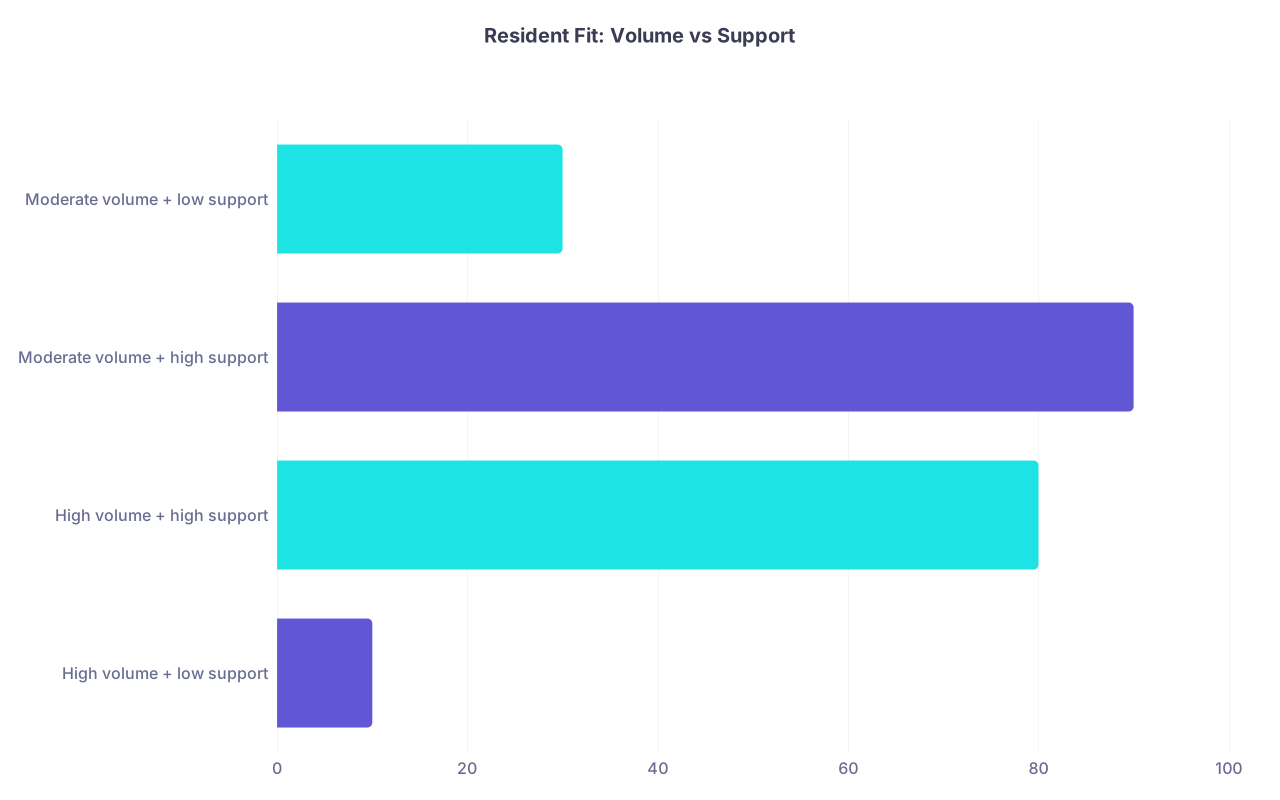
| Category | Value |
|---|---|
| High volume + low support | 10 |
| High volume + high support | 80 |
| Moderate volume + high support | 90 |
| Moderate volume + low support | 30 |
Let me be blunt:
Volume alone is not the problem. Volume + low support is.
Here’s where you look for clues (and yeah, you can actually ask these):
Supervision and backup
- How quickly does an attending respond when called at night?
- Are senior residents expected to handle everything alone before escalating?
- What do interns say when you ask, “Who do you go to when you’re drowning?”
Culture around “struggling”
- If you directly ask a resident, “Have you ever felt behind? How was that handled?” do they give you a real story or a fake, polished answer?
- Do they have remediation stories that end in “and now they’re one of our strongest residents” vs “they just quietly disappeared”?
Schedule reality, not brochure fantasy
- What are the true caps on patients?
- How many 24s/28s (or admitting 16+ hours) are you doing per month as an intern?
- Is there actual protected time for clinic or conference… or is it “protected” but everyone still pages you and you’re charting the whole time?
Resident turnover and vibes
- Are they losing residents mid-training?
- When you watch residents interact—do they look like a team or a bunch of individuals just trying to survive?
You’re not trying to find out if they’re “tough.” You’re trying to find out if they’re safe for someone like you.
Your Stats and Personality vs “High-Volume” Mythology
There’s this toxic myth:
“If I’m anxious, introverted, slower, or not ‘type A+++,’ I can’t handle a big program.”
That’s lazy thinking.
Some of the best residents I’ve seen in high-volume places were:
- Quiet, methodical, non-screamers
- Anxious but organized anxious (the type who double-checks orders in a good way)
- Not the fastest off the starting block, but rock-solid consistent
The ones who struggled the most were:
- Too proud to ask for help until way too late
- Image-obsessed, so they hid their insecurities and let things pile up
- Convinced they had to know everything on day one so they spiraled when they didn’t
So no, you don’t need to be:
- The loudest
- The smartest
- The most confident
You do need:
- A baseline willingness to ask “I don’t know, can you walk me through this?”
- Some system for not letting tasks and notes pile up unchecked
- Enough self-awareness to say, “I need backup” before you break
If your entire personality is “I never speak up, I apologize for existing, I’d rather suffer than look needy” — that’s the problem in a high-volume place. Not your Step score or raw intelligence.
Red Flags That a High-Volume Program Might Actually Break You
Let’s be honest. There are places that might be wrong for you right now.
If any of these are true, you should at least think hard before going all-in on a famously brutal program:
- You’re already barely holding things together on rotations with 8–10 patients
- You’re actively struggling with untreated or unstable mental health issues
- You routinely shut down (not just get stressed—actually freeze) when the ED is busy or multiple things happen at once
- You’ve needed multiple extensions, incompletes, or leaves because stress knocks you out physically or mentally
- You rely heavily on external structure; when that disappears, everything collapses (sleep, eating, basic functioning)
That doesn’t mean you’re doomed or “too fragile for medicine.”
It means you should aim for:
- Strong teaching
- Reasonable volume
- Explicit wellness and backup systems
Instead of “we boast the highest admission numbers and our residents wear trauma like a badge.”
What To Actually Ask on Interview Day (Not the Polite Stuff)
You can’t just ask, “Are you supportive?” Every program will say yes.
You have to ask about behavior, not adjectives.
Try things like:
- “If an intern is consistently struggling with notes and time management by month 3, what actually happens?”
- “Can you tell me about a resident who had a really hard rotation or personal crisis? How did the program respond?”
- “What’s one thing residents complain about that hasn’t changed yet?”
- “Who runs codes at night—PGY-2s, PGY-3s, or do attendings come in?”
- “Is it ever considered acceptable to call an attending in the middle of the night for help, or do people get shamed for that?”
Watch their faces.
Do residents answer first, fast, and honestly? Or do they glance at faculty?
You want specific stories, not vague reassurance.

| Step | Description |
|---|---|
| Step 1 | Know your limits |
| Step 2 | Prioritize support |
| Step 3 | Consider high volume if culture fits |
| Step 4 | Ask about backup and wellness |
| Step 5 | Deprioritize program |
| Step 6 | Rank higher |
| Step 7 | High anxiety or burnout risk |
| Step 8 | Interview vibes |
The Prestige Trap: “If I Don’t Go Big, I’m Weak”
Here’s the part that really messes with your head.
You will hear:
- “You’ll only be prepared if you go to the busiest places.”
- “Community programs don’t see enough sick patients.”
- “Fellowships only take from high-powered residencies.”
Some of this is exaggerated. Some of it’s just outdated.
You know what fellowship directors actually care about?
- Are you competent?
- Do your letters say you’re reliable and safe?
- Can you present a patient calmly and clearly?
- Did you get involved in something—research, QI, teaching—without falling apart?
You can absolutely become a phenomenal physician from a medium-volume, high-support program.
You can also come out of a “top” high-volume place technically strong but with massive gaps because you were always in survival mode, cutting corners just to get through the day.
There’s a difference between:
- “This will stretch me in a good way”
and - “This will repeatedly push me past my limits and call it grit.”
Don’t rank something highly just because people on Reddit worship it.
Reality Check: You’re Probably Underestimating Yourself (But Overdisregarding Your Limits)
The irony: most applicants having these thoughts are not the lazy ones.
You’re scared you’re not “strong enough” because:
- You care about patients
- You’re aware of your own anxiety
- You know what it feels like to be overwhelmed, not just “busy”
That self-awareness is actually a strength.
But here’s where people like you screw yourself over:
- You assume everyone else is coping better than you (they’re not, they’re just quieter)
- You dismiss your actual needs because you think they sound weak
- You ignore patterns: every time your schedule goes above X, you crash… but you tell yourself residency will be “different”
You’re not porcelain.
You’re also not a robot.
You can probably handle more than you think—but not infinitely more. There is a breaking point, and pretending you don’t have one is how people get hurt.
How to Use This When Building Your Rank List
Let’s make this less abstract. When you’re staring at your list, drowning in “what ifs,” do this.
Make two brutally honest lists:
- Environments where you historically shut down
- Environments where you’re stressed but still functional and even proud of yourself
Categorize programs in your head:
- High-volume, high-support
- High-volume, unknown support
- High-volume, questionable support
- Moderate volume, high-support
Here’s the order I’d aim for (if you’re worried like you are):
| Priority | Program Type |
|---|---|
| 1 | Moderate volume + high support |
| 2 | High volume + clearly high support |
| 3 | Moderate volume + unknown support |
| 4 | High volume + unknown/iffy support |
The exact rank order is personal, but that prioritization is not crazy or cowardly. It’s sane.
One More Thing You’re Afraid to Say Out Loud
You might be thinking:
“What if I just don’t want that life? Does that mean I’m not cut out for medicine?”
No.
Wanting:
- A place where you can sometimes see sunlight
- A program where you’re trained, not exploited
- A culture where you’re a learner, not just a warm body
…does not make you less of a physician.
It makes you someone who plans to last in this field.
Because the real flex isn’t surviving a brutal residency.
It’s still liking medicine 10 years later.
Do This Today
Open a blank document or a notebook.
At the top, write:
“Conditions under which I do my best work.”
List 5–10 specifics. Not generic things. Actual patterns from your own life.
(Example: “I need at least one person on my team I can be fully honest with.” “I deteriorate quickly if I’m sleeping less than 5 hours for more than 3 nights in a row.” “I do better in collaborative than competitive cultures.”)
Then, for your top 5 programs, write honestly next to each one:
“Does this place seem compatible with that list—or directly opposed to it?”
That’s your reality check.
Not the name. Not the volume. Not what your classmates think is impressive.
Just you, and what it actually takes for you to function and grow.