
It’s January 12th. You’re staring at your evolving program list, again, and your stomach drops every time your eyes land on the “safety” column. You can practically hear your classmates’ imaginary voices: “Oh… you’re ranking that place?”
You’re thinking:
“If I end up there, did I fail?”
“Am I wasting all the work I put into Step, research, everything?”
“Will people think I couldn’t match anywhere better?”
Let me just say the quiet part out loud: a lot of us secretly feel ashamed of our ‘safety’ programs. Even when we pretend we don’t.
Let me also be blunt: that mindset can absolutely wreck your Match strategy and your sanity.
Let’s break this down in a way that respects your anxiety but doesn’t let it drive the car.
First: What You’re Really Afraid Of (It’s Not Just the Program)
You’re not just scared of “settling.” You’re scared of what “settling” means.
Some greatest hits I’ve heard (and felt myself):
- “If I go to a community or lower-tier academic program, I’ve basically thrown away any chance at a competitive fellowship.”
- “Everyone from my school tries for university X / big-name Y. If I don’t, I’m the weak one.”
- “If I end up at my safety, it means I wasn’t good enough and the algorithm exposed me.”
- “If I match at a ‘lower’ program, my career is capped forever. Period.”
Here’s the ugly truth: residency culture feeds this. People flex interview invites like trading cards. PD gossip, Doximity rankings, “top tier vs mid tier” nonsense. It all makes it feel like anything other than the shiny places = failure.
But residency is not college. It’s your job training. The prestige calculus everybody uses is often lazy and flat‑out wrong.
We’ll get to how to evaluate “safety” programs realistically. But first, let’s rip apart the word “safety” itself.
“Safety” Programs Are Not Real. This Is.
The term “safety” program is misleading for residency. You’re not guaranteed anything. You just feel like your stats are above their usual.
Here’s what’s actually going on in your head when you say “safety”:
- “They take lots of IMGs / lower scores → I should be fine.”
- “People from my school always match there → it’s my backup.”
- “They’re not in a big city / big-name place → must be easier to get into.”
Sometimes that’s true. Sometimes that’s fantasy.
What matters more than this fake ‘safety’ label is:
- Can you see yourself actually training there and not hating life?
- Does the program reliably graduate competent residents who get decent jobs/fellowships?
- Will you have any support if things go sideways (illness, family crisis, burnout)?
If the answer to those is yes, that’s not a “safety.” That’s a viable program. And viable programs save careers.
How Programs Actually See You (vs How You Think They Do)
You’re imagining PDs sitting there like:
“Wow, this person from [strong med school] with [solid scores, research] is ranking us? They must be a failure who couldn’t get better.”
No. That’s not how they think. They’re asking:
- Will this person show up, learn, and not be a disaster at 3 a.m. on night float?
- Will they pass boards?
- Will they get along with the team and not make others quit?
- Are they reasonably interested in what we actually offer, not just chasing a name?
If anything, your “safety” program may be thrilled you’re interested. I’ve seen residents at so‑called “non-competitive” programs get more opportunities simply because attendings trusted them and there wasn’t a feeding frenzy for every project and letter.
You’re imagining judgment. They’re thinking staffing, coverage, reliability, and who’s going to carry the pager.
Sanity Check: What Actually Predicts a Good Training Experience
Forget the tier-system gossip for a second. If you’re trying to decide whether you’re “settling” or making a smart choice, you need to know what really affects your life day to day.
Here’s what actually matters for your training and happiness:
| Factor | Why It Matters Most Day-to-Day |
|---|---|
| Culture & Residents | Determines burnout, support, toxicity |
| Volume & Case Mix | How competent you’ll be at graduation |
| Autonomy & Supervision | Balance between independence and safety |
| Fellowship/Job Output | Shows real doors opened, not just claims |
| Location & Support | Affects mental health, relationships, life |
If your “safety” program checks those boxes decently well? You’re not settling. You’re being strategic.
The trap is when you chase “prestige” at the cost of these basics. That’s how people end up in miserable places they only chose for the name.
A More Honest Framework: “Floor, Middle, Stretch” Instead of “Safety”
Let’s re-label things in a way that doesn’t feel like self‑insult.
Instead of “safety,” try thinking in three buckets:
Floor programs
The lowest level you’d still be okay training at. Not your dream. But not a nightmare. You can picture yourself there and not feel dread.Middle programs
Solid fit. Reasonable odds. You’d be happy there.Stretch programs
Places that might be a reach based on scores, research, or competitiveness, but are worth a shot.
Your job isn’t to avoid the Floor tier. Your job is to define a realistic floor.
Your real disaster scenario isn’t “I matched at my floor program.”
It’s “I didn’t put any honest floor programs on my list, and I didn’t match.”
That’s the scenario people don’t like talking about. I’ve watched strong applicants skip true floor options because they were too proud. Then scramble for SOAP in a specialty they didn’t want, or reapply a year later with way more anxiety and baggage.
How to Tell If You’re Actually “Settling” vs Being Smart
Let’s be concrete. Here’s how to check if you’re about to make a fear-based or ego-based mistake.
Step 1: Compare what grads actually do
Not what the website claims. What graduates actually do.
- Look at recent fellowship matches (if relevant to your specialty)
- Look at where people work afterward: academics? community? decent cities? leadership roles?
If the program constantly places residents into fellowships/jobs that you’d be happy with—even if not the absolute top tier—then ranking them high is not “settling.” It’s picking a path that has shown itself to work.
Step 2: Listen carefully on interview day
Every program can say “we’re a family.” Watch what they demonstrate:
- Do residents joke with each other, or do they look like hostages?
- When someone mentions leadership, are they rolling their eyes subtly?
- When you ask “What would you change?” do they give canned nonsense or real gripes?
A supposedly “safety” program with authentic, honest, decent residents is better training (and better life) than a famous program where PGY-2s look dead inside.

Step 3: Look at the call schedule and support
If the schedule is brutal, that’s sometimes okay… if the support is strong. But if the schedule is brutal and the culture is toxic? That’s when prestige stops mattering and daily life turns into survival mode.
Questions to consider:
- How many days off per month, really?
- How is cross coverage handled when someone is sick?
- Are there wellness days that actually happen, not just on paper?
If your ‘safety’ program seems humane while your “dream” program casually glorifies suffering, ask yourself who’s really winning.
The Prestige vs Outcome Myth (That Will Mess With Your Head)
You’re probably stuck in a mental loop like this:
“Okay, sure, community/lesser‑known programs might be fine… but surely a big-name academic center = better fellowship/job every time, right?”
Not necessarily. I’ve seen:
- Residents from mid‑tier community IM programs match GI and cards at excellent places because they had strong mentorship and killer letters.
- People from “top programs” who were miserable, under‑supported, and barely built a CV because the environment chewed them up.
- Applicants who thought, “I’m too good for that place,” and then ended up reapplying after a no-match while their classmates quietly thrived at those same “lower” programs.
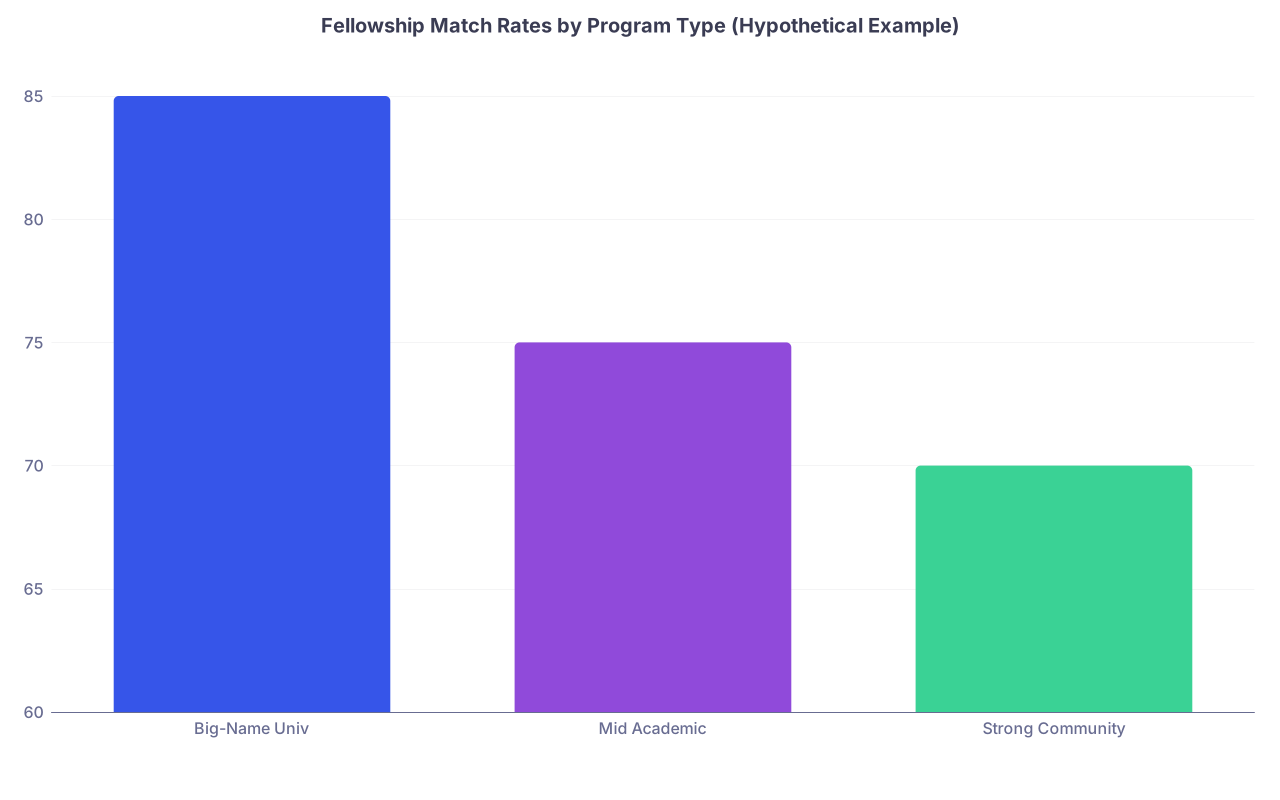
| Category | Value |
|---|---|
| Big-Name Univ | 85 |
| Mid Academic | 75 |
| Strong Community | 70 |
See that? Sure, the big-name place may have higher overall match rates to certain flashy fellowships. But strong community programs are not the black hole people make them out to be. If you’re an above‑average resident there, you can absolutely get where you want to go.
The real bottleneck is:
Do you have time, sanity, and mentorship to build a reasonable application?
If a “lesser” program gives you that, it can be a power move, not a downgrade.
The Ego Piece No One Wants to Admit
A lot of this “I don’t want to settle” talk? It’s ego. Mine, yours, all of ours.
You worked your butt off. You imagined yourself in shiny jackets with Harvard / UCSF / Mayo on them. You pictured family bragging rights. You don’t just want to be a doctor. You want to look like a certain kind of doctor.
I get it. But residency is humbling. You’ll be up at 3 a.m. covered in God-knows-what, arguing with lab, trying to get a CT accepted. In those moments, the logo on your badge doesn’t keep you going.
What does:
- A co-resident who answers your text when you’re drowning.
- An attending who backs you up when a consultant is being unreasonable.
- A program where you don’t feel like total trash for asking questions.
If your “safety” program looks like it might actually care about you as a human? That’s not settling. That’s self‑preservation.
Redefining “Success” So You Don’t Sabotage Yourself
Try this exercise. It’s uncomfortable but clarifying.
Imagine two paths:
Path A: Prestige, but misery
You’re at a big-name place. Everyone is obsessed with optics. You’re exhausted, unsupported, and barely functioning. You start doubting your abilities. Your mental health tanks. By graduation, you’re just trying to survive, not aiming for big dreams anymore.
Path B: Not-famous, but solid
You’re at a program no one brags about at conferences. The residents are decent humans. You get good feedback, learn a ton, and feel like you actually belong. You have time and mental space to do a few research projects, network, and apply smartly to next steps.
If someone told you guaranteed: Path B gets you to your ideal job or a solid fellowship, and Path A gets you burned out and average—would you still call Path B “settling”?
Probably not. But because none of this is guaranteed, ego and anxiety scream louder than logic.
This is where you have to be a little ruthless with yourself:
Are you making your rank list based on how Match Day photos will look, or how the next 3–7 years of your actual life will feel?
How to Reframe Your “Safety” Programs, Practically
Let’s get tactical. Here’s how to rewire your brain around those so-called safety programs:
Rename the column in your spreadsheet
Literally change “Safety” to “Floor (I’d still be okay here)”. Force yourself to only keep programs in that column that you could actually live with.For each floor program, answer 4 questions:
- Can I see at least 2 specific upsides if I ended up here? (location, schedule, supportive PD, strong hands-on training)
- Do graduates seem to land in careers/fellowships I could live with?
- Does the program seem at least neutral, not toxic?
- Would not matching and having to reapply be clearly worse than spending 3 years here?
If you can’t say yes to that last question, it’s not a floor program. It’s a panic add.
Talk to one current or recent resident at each floor program
Ask them what surprised them—good and bad. You’re not looking for perfection. You’re looking for “this place has flaws, but it’s workable and I’m becoming competent.”Imagine your Match email says that program name
Pay attention to your body. Do you feel disappointment… or actual dread/panic? Disappointment is normal. Dread means: think twice.

| Step | Description |
|---|---|
| Step 1 | Program on your list |
| Step 2 | Remove from list |
| Step 3 | Move lower or cut |
| Step 4 | Keep but low rank |
| Step 5 | Accept as true floor option |
| Step 6 | Could I survive here? |
| Step 7 | Any real upsides? |
| Step 8 | Worse than reapplying? |
You’re Not Weak for Wanting a Backup. You’re Smart.
The Match is brutal because you only need to be wrong once. One overconfident “I don’t need safeties” move can mess up a year of your life. Or more.
Choosing solid, realistic floor programs isn’t a sign you “couldn’t do better.” It’s a sign you understand:
- The algorithm doesn’t care about your pride.
- Life happens—illness, personal crises, weird interviewer bias.
- Application cycles are a gamble, and you’re allowed to hedge.
I’ve never heard a resident who matched at a good-but-not-glamorous program say, “I regret ranking them highly; I should’ve risked not matching to avoid ‘settling.’”
But I have heard:
“I wish I hadn’t been so arrogant. I thought I was above these places. Now I’d kill for that chance.”
Don’t be that story.
FAQ: Four Questions You’re Probably Still Stressing About
1. If I match at a so-called safety program, is it obvious to everyone I ‘couldn’t do better’?
No. People outside your immediate circle have no idea what your rank list looked like or what your goals were. Even your classmates are too busy spiraling about their own lives to analyze yours in detail. Later in your career, nobody cares “why” you went where you went. They care if you’re competent and not awful to work with.
2. Will a community or lower-tier academic program ruin my chances at a competitive fellowship?
Not by itself. What matters is: your performance, letters, research/quality improvement work, networking, and board scores. Plenty of people get into competitive fellowships from non-big-name programs every year. It may take a bit more intentional effort, but it’s absolutely not a deal-breaker. A supportive “safety” program can give you the time and backing to build a strong application.
3. How many floor/safety-type programs do I actually need?
More than your ego wants, fewer than your panic suggests. For most core specialties (IM, FM, Peds, Psych, etc.), I’d feel uneasy with fewer than 3–5 true floor programs—places you’re likely to match and can tolerate training at. For highly competitive specialties, many people dual-apply or have a separate “backup specialty” entirely. The exact number depends on your stats, but the principle is the same: don’t let pride push that number down to zero.
4. What if I honestly hate all my ‘safety’ options?
Then you have a tough decision. Either:
a) Expand your geographic or program-type tolerance (e.g., consider community, different regions, smaller cities), or
b) Accept that you might not match this cycle and plan a reapplication with a stronger CV.
But don’t lie to yourself: if you’d rather not match than go to those programs, they shouldn’t be on your list. Rank only places you’re truly willing to attend. That might mean doing the scary thing and intentionally widening your search now instead of pretending options are acceptable when they’re not.
Open your spreadsheet or notes right now and rename that “Safety” column to “Floor (I’d still be okay here).” Then, for each program in that column, write one sentence about why future-you might be grateful to have matched there. Not “settled.” Grateful.