
It’s January. Your interview season is winding down. You’re staring at your spreadsheet with 18 programs and 27 columns and you’re supposed to…what…put numbers next to them and trust that you’re not about to pick a place that will chew you up and spit you out in three years?
Everyone keeps saying, “Rank where you’ll be happiest,” and you’re sitting there thinking, “I will not be happy if I’m so burnt out I cry before every shift.”
And the worst part? Every program says they care about wellness. Every PD smiles and says, “We really prioritize work–life balance here.” Residents nod on Zoom and talk about “great camaraderie.” But nobody ever says, “Yeah, PGY‑2s here are one bad call away from walking out.”
So you’re stuck with the real question: how the hell do you figure out the true workload before you rank?
Let’s walk through this like two paranoid, overthinking applicants together. Because I promise you: there are ways to see past the glossy brochure.
First reality check: the red flags you’re afraid are “overreacting” to
Let me be blunt: your fear of burnout is not overdramatic. You’re not “too sensitive.” I’ve watched residents go from excited interns to hollow-eyed shells in less than a year because they didn’t catch the signs up front.
Here are things you might be noticing and quietly second-guessing:
- Programs hand-wave away 80‑hour weeks with, “Well, some rotations are a bit heavier…”
- Residents joke about “dying” on nights, but no one really answers when you ask, “So how many patients are you actually covering?”
- The schedule slide during interview day is one line that says “Night Float” and then they move on.
- Whenever someone asks about wellness, faculty say, “We have a wellness committee!” but not one concrete thing that changes workload.
Your anxiety is actually trying to protect you. The trick is to translate that “something feels off” into specific, checkable details. Because programs lie by omission constantly. Sometimes intentionally, sometimes because they’re so used to their reality they forget it’s insane.
What “true workload” actually means (beyond just 80-hour weeks)
Burnout isn’t just about number of hours per week. If it were, this would be easy.
You’re really trying to judge things like:
- How many high-acuity patients you’re responsible for at once
- How much scut and clerical work gets dumped on residents
- How much backup actually exists when you’re drowning
- How often the schedule changes last minute
- Whether you can ever safely say, “I’m not okay” without being punished
So when you think “workload,” don’t just think: “Is it 60 vs 80 hours?” Think: “Will I constantly feel unsafe, behind, and alone?”
That’s what we’re really trying to detect.
Concrete questions to ask residents that actually get real answers
Vague questions get vague answers. If you ask, “How’s the workload?” they will literally always say, “It’s busy but manageable.”
You need pointed, specific, slightly uncomfortable questions. Ask them privately if you can (post-interview emails, second looks, or breakout rooms without faculty).
Try things like:
- “On your worst inpatient month, how many patients do you typically carry during the day? What’s your cap?”
- “On nights, how many patients are you cross-covering? What’s a ‘normal’ number of pages per night?”
- “How often do you actually hit 80 hours? And how often do you go over and just…not log it?”
- “How many days off did you actually have last month vs what the schedule said?”
- “When was the last time someone said, ‘This is unsafe’ or ‘We’re overwhelmed’? What happened after that?”
- “What rotation would you remove from the program if you could, and why?”
- “If someone is seriously struggling, what real changes get made to their schedule? Can you give an example?”
- “Have you ever had to choose between going to a doctor’s appointment and not screwing over your team?”
And the most blunt one, which is weirdly powerful:
“If your best friend were choosing between this program and another solid one, would you strongly tell them to pick this one? Or would you say, ‘Eh, they’re both fine’?”
Watch how quickly the veneer cracks when you ask specifics.
How to read between the lines of what residents say (and don’t say)
Because yes, residents are sometimes coached, or they feel loyal and don’t want to trash their own program. So you have to listen to how they answer.
Green-ish signs:
- They give numbers: “Our cap is 10–12. Nights is usually 30–35 cross-cover with 2–3 admissions.”
- They acknowledge hard stuff but show specific fixes: “Our ICU month was brutal three years ago, but they added an extra resident and NP coverage after we complained.”
- Different residents tell roughly the same story about workload, not wildly opposite extremes.
- Someone openly says: “We have bad months, but I don’t feel unsafe or abandoned.”
Yellow/red flags:
- Laughing everything off with jokes, no specifics: “Haha, yeah, we’re always here!”
- Dodging questions: “It depends…you know…residency is just hard everywhere…”
- One person calls it “chill” and another says “soul-crushing” for the same rotation.
- They blame you in subtle ways: “Well, I mean, it’s fine if you’re efficient…”
That last one? Huge warning sign. Programs that equate “not burning out” with being “tough enough” will absolutely steamroll you.
What program structure secretly tells you about burnout risk
Forget the wellness slide. Look at the structure.
Ask about and pay attention to:
- Call vs night float vs shift work
- Q4 28‑hour call everywhere? That’s going to be heavy. Some people learn a ton and love it, but it burns many out.
- Night float with reasonable caps and backup is usually more humane than endless 28h calls.
- Documentation burden
- “Do you have scribes, NPs, or PAs? Does nursing handle most of the calls to families, or is that all on residents?”
- No support staff + clunky EMR = you writing notes until 9pm for a 5pm sign-out.
- Non-clinical requirements
- Mandatory weekly half‑day clinic + didactics + research meetings + QI projects + mandatory teaching sessions. All on top of full inpatient months.
- None of that is bad…unless it’s just piled on top without protected time.
- How many hospitals you cover
- Big geographic spread can be soul-sucking. Commuting 30–40 minutes between sites on top of long days adds up fast.
| Factor | Lower Burnout Risk Example | Higher Burnout Risk Example |
|---|---|---|
| Call System | Night float with clear caps | Q3–Q4 28h call with vague expectations |
| Support Staff | NPs/PAs, scribes, strong nursing | Residents do everything, minimal support |
| Non-clinical Load | Protected time for projects | Projects on your “own time” |
| Hospital Sites | 1–2 main sites | 4+ sites with long commutes |
| Backup Culture | Senior/attending easily reachable | “Figure it out, we all did” |
If a program checks multiple “higher risk” boxes, I don’t care how shiny the name is. That’s a potential burnout factory.
Using data: ACGME, case logs, and the “we’re always compliant” lie
You’re probably hearing the same line: “We’re always 80‑hour compliant.”
Sure. On paper.
You can still pressure-test this a bit.
Here’s what you can do:
- Ask directly: “What happens if you go over 80 hours? Have you ever been told not to log everything?”
- Ask residents: “Is logging hours honest here, or is there pressure to underreport?”
- If you can, look at:
- Board pass rates (if they’re dropping, could be a sign of people too exhausted to study or teach)
- Case logs for procedure-heavy fields (if they’re insanely high, that might mean insane volume)
- Pay attention if the program bragged about being “very busy” and “the powerhouse for the hospital” in a proud way. Translation: “We do the work no one else wants to do.”
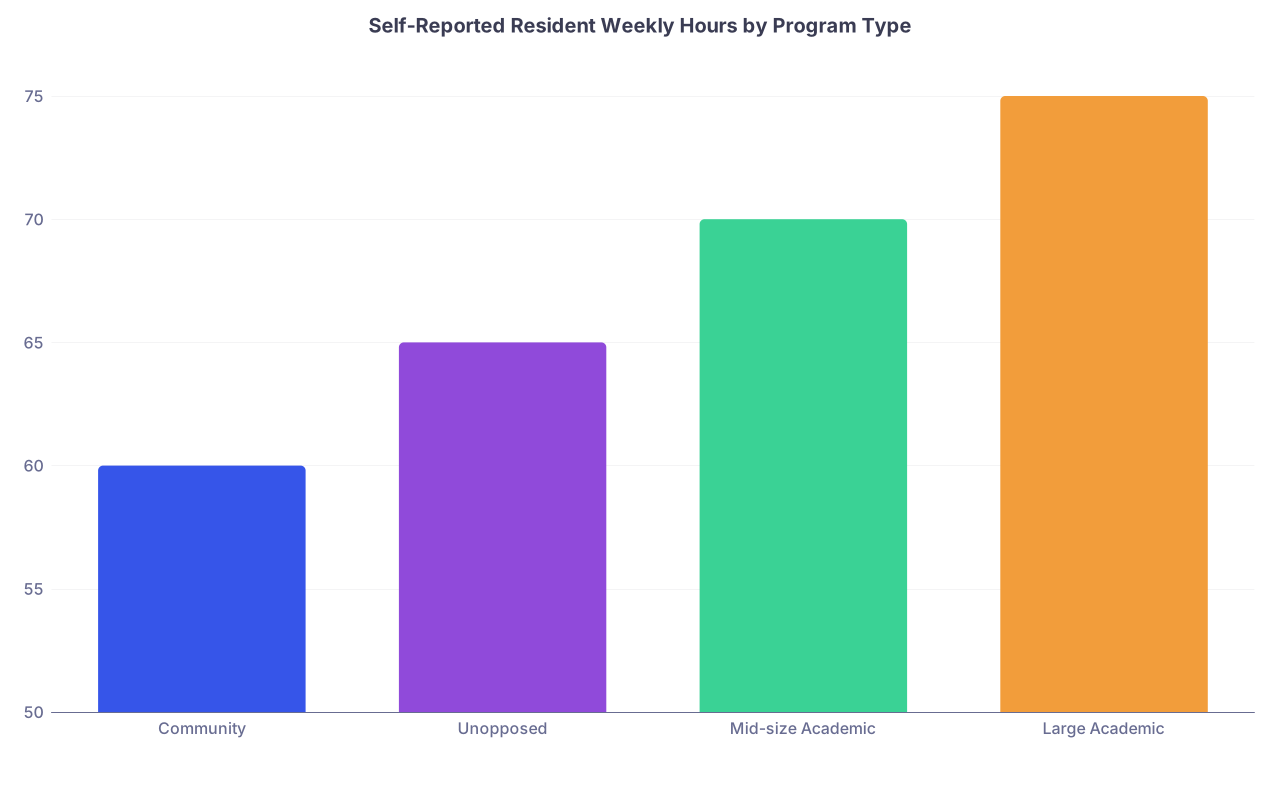
| Category | Value |
|---|---|
| Community | 60 |
| Unopposed | 65 |
| Mid-size Academic | 70 |
| Large Academic | 75 |
These numbers are made up, but you get the point: “Busy academic” rarely means “chill.”
If residents keep emphasizing words like “grind,” “workhorse,” or “we run the whole hospital,” take that seriously. Those are not neutral phrases.
Zoom interviews made this harder, but not impossible
Zoom killed the casual “pull a resident aside in the hallway” moment. You’re not overthinking it; you are getting less unfiltered information than people did years ago.
So you have to be more intentional.
Ideas:
- After interviews, email the coordinator:
“Would it be possible to connect with a current resident for a brief 10‑15 minute call? I had some specific questions about typical patient load and schedules that I didn’t get to ask during interview day.” - On that call, be honest:
“I’m excited about your program but I’m pretty anxious about burnout. Can I ask you some detailed questions?” - Watch their reaction. A resident who says, “Totally, I get it, ask away,” vs one who seems tight or evasive—that difference matters.
And if a program says no to any additional contact with residents? That’s not normal. That’s controlling. I’d put a big question mark next to that one.
How to weigh “prestige” vs not totally annihilating your mental health
Let’s talk about the quiet fear:
“What if I pick the ‘easier’ program and it ruins my fellowship chances or my career?”
I’m going to be very direct: blowing yourself up in a toxic program is worse for your career than training at a solid, non-famous place where you stay functional.
Fellowships care about:
- Your letters
- Your performance
- Your research (for some fields)
- Your interview
They do not care that you did intern year at the program that chews residents into dust and brags about their malignant culture.
If you are so burnt out that:
- You barely study
- You don’t show up as your best self
- You have gaps in your performance
That will hurt you more than, “Oh, they trained at a smaller program but clearly crushed it.”
So if you’re torn between:
- Prestige + chronic 75–80+ hr weeks with weak support
vs - Solid but less famous + 60–70ish hours with decent backup, humane leadership, and time to recover…
I’m going to tell you straight: Pick the second one. Every time.
Using your own gut without gaslighting yourself
There’s this awful thing that happens: you feel something is off, but then you tell yourself you’re being dramatic, weak, or picky.
You’re not.
Your impression matters. Some questions to ask yourself, program by program:
- Did I feel tense or relaxed listening to residents talk?
- Could I picture myself surviving there as a low-energy, sick, or struggling version of myself? Not just my best-day self.
- Did they talk about each other and faculty with warmth or just sarcasm and “we suffer together” jokes?
- Did anyone say anything like, “We’re a family”—but then their faces didn’t match the words?
Pay attention to your physical reactions. If you’re scrolling through programs and your stomach drops at the thought of going back to one, believe that.
Quick sanity ranking exercise: how to factor workload in practically
Right now, your brain has 20 variables bouncing around. Make it simpler.
Try this:
For each program, on your spreadsheet, add columns for:
- Inpatient workload (1–10, where 10 = terrifying)
- Nights/call brutality (1–10)
- Support staff / backup (1–10, where 10 = amazing support)
- Culture safety (can people say “I’m not okay”? 1–10)
Be honest. Use your gut plus what you heard. Don’t obsess about being “accurate”; just capture your sense.
Then ask:
“Would I rather be at a program with a 7/10 workload but 9/10 support…or a 4/10 support with a 9/10 workload?”
You know the answer.
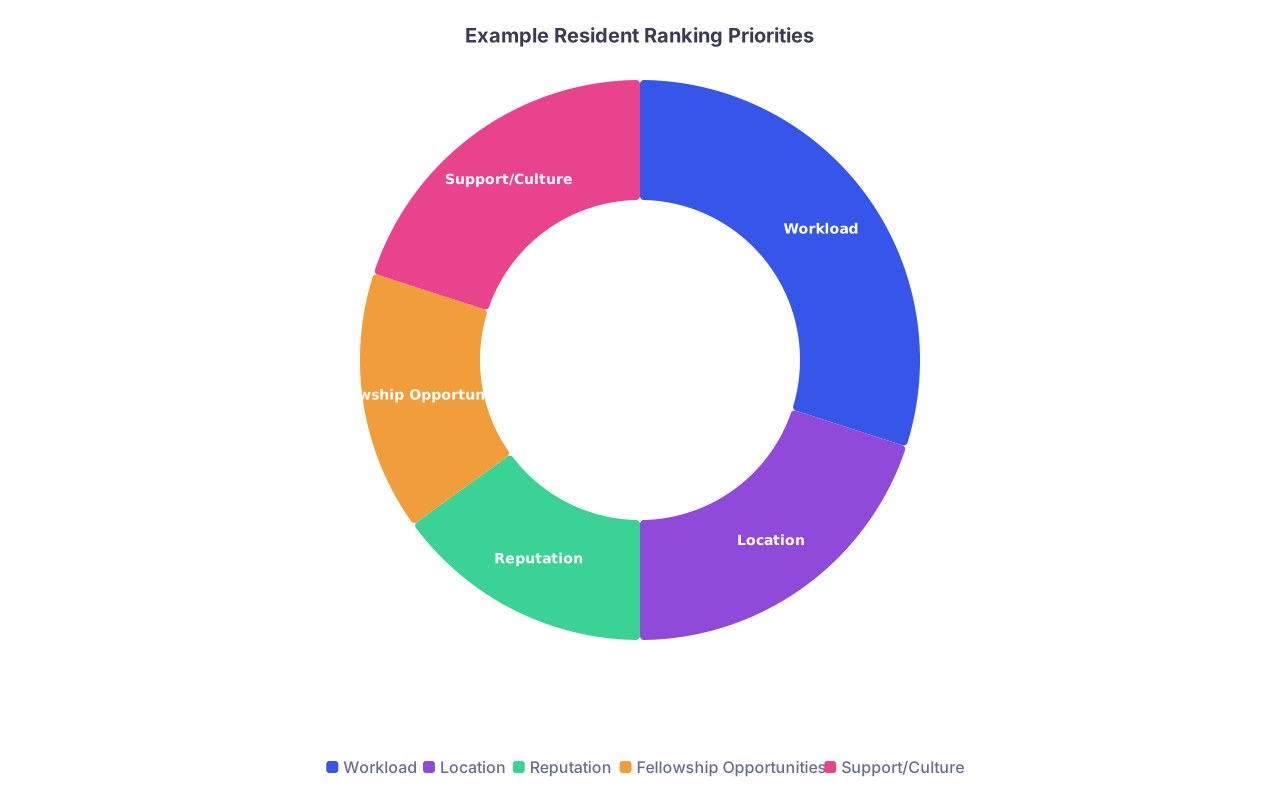
| Category | Value |
|---|---|
| Workload | 30 |
| Location | 20 |
| Reputation | 15 |
| Fellowship Opportunities | 15 |
| Support/Culture | 20 |
You’re allowed to give “not destroying my brain” the biggest slice of the pie.
What to do if everything looks bad and you’re spiraling
This is the part nobody says out loud: there’s a non-zero chance you look at your list and think, “Honestly, they all sound brutal.”
Residency is hard. Some days will be brutal. There’s no magical unicorn program where you work 40 hours and learn everything.
But there’s a difference between:
- “Hard but I feel supported, I have backup, people treat me like a human,”
and - “Hard and I feel disposable, alone, and scared.”
If your list is full of places that sound like the second category, you need to seriously consider:
- Did you apply too top-heavy/malignant-heavy?
- Are there community or mid-tier programs you underrated that actually sounded kinder?
- Should “slightly weaker fellowship name but not soul-crushing” move up your list?
This is where you sit with the uncomfortable truth: saving your mental health isn’t weakness. It’s strategy. Burnout is not some badge of honor. It’s a risk factor for actual harm—to patients and to you.
One thing you can do today
Pick 3 programs on your list you’re most worried about workload-wise.
Right now:
Open your spreadsheet.
Under each of those 3, write down:
- One specific question you still don’t know the answer to about workload.
Email the coordinator for each program and say something like:
“I’m working on my rank list and had a couple of detailed questions about resident workload that I didn’t get to ask on interview day. Would it be possible to connect briefly with a current resident?”
Then, when you get that resident on the phone or Zoom, don’t sugarcoat it. Say the thing you’re afraid to say:
“I’m really anxious about burnout and I want to understand what my worst months would actually look like. Can I ask you some very specific questions about patient load and hours?”
You’re not being needy. You’re doing due diligence on the next 3–7 years of your life.
Open that spreadsheet now. Highlight those three programs. Type in those questions. That’s your next step.