
What happens if you wake up halfway through intern year and realize: “I chose the wrong specialty. I can’t do this for 30 years”?
Let’s just say it: this is one of the fears almost nobody admits out loud on the interview trail, but everybody has in their head.
And it feels high‑stakes because it is. You’re locking yourself into years of training that basically define your entire adult life. The schedule you live, the patients you see, the way you think. Everything.
And yet… people do switch. People do quit. People do re‑train. And a lot of them end up much, much happier.
So let’s talk about it like adults instead of in vague “follow your passion” posters.
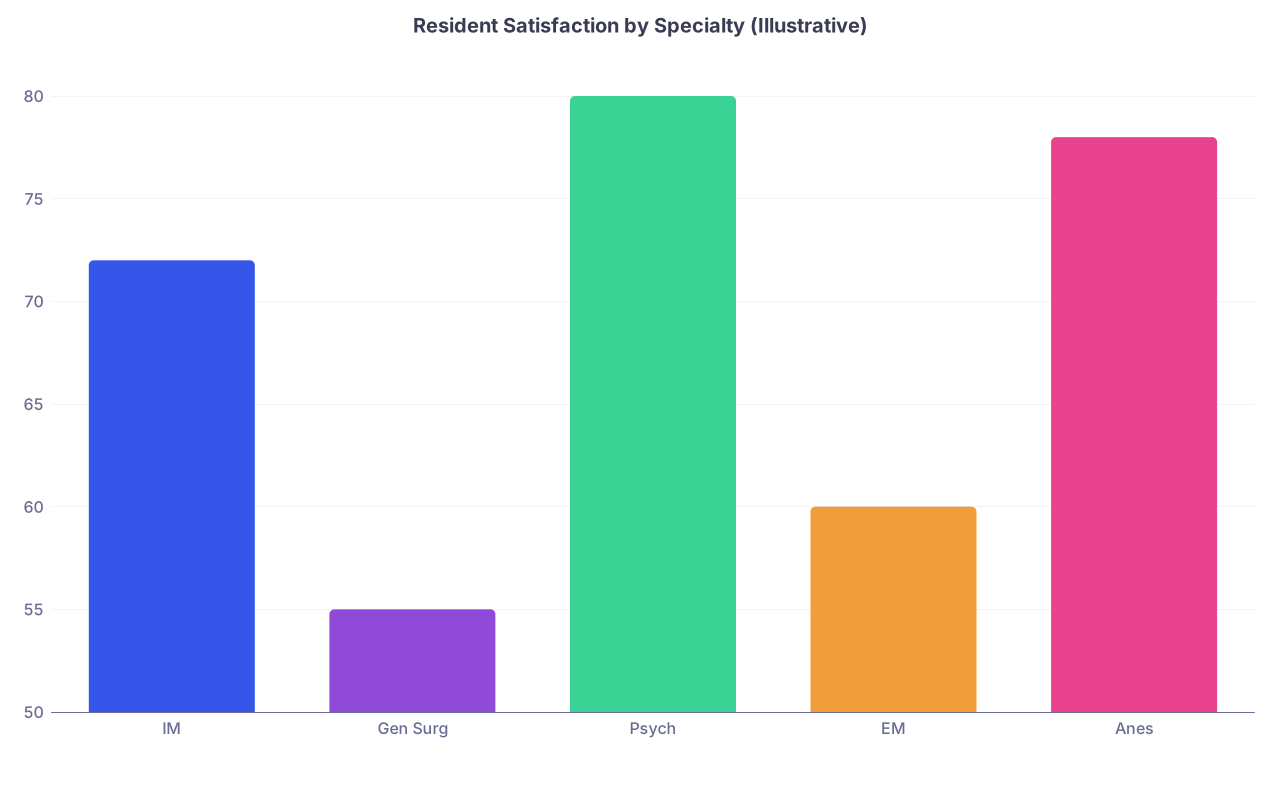
| Category | Value |
|---|---|
| IM | 72 |
| Gen Surg | 55 |
| Psych | 80 |
| EM | 60 |
| Anes | 78 |
First: Are You Wrong Specialty… or Just Miserable Right Now?
Before you start imagining yourself as the 38‑year‑old PGY‑1 starting over, you have to untangle two very different problems:
- I picked the wrong specialty
- I picked the wrong program / environment
Those are not the same thing, even though they can feel identical at 3 a.m. post‑call when your attending just humiliated you.
Ask yourself a few uncomfortable questions. And be brutally honest.
When I’m actually doing the core work (clinic, OR, rounding, procedures), do I ever feel: “This is kind of cool” or at least “I could see this being ok once I’m less overwhelmed”?
If the answer is never, that’s data.If I imagine doing this job at a supportive, non-toxic program with reasonable hours and kinder seniors… do I still hate it?
If yes, that’s more than just burnout.What exactly makes me dread work:
– The content (e.g., can’t stand chronic disease management, hate the OR, hate psych interviews)
– The culture (toxic, malignant, humiliating)
– The schedule (nights, weekends, chaos)
– My own adjustment (imposter syndrome, skill gaps, anxiety)
I’ve watched residents in brutal surgical programs who absolutely loved the OR but were ready to quit purely because their program was malignant. They switched to another surgery program and suddenly looked like different humans.
And I’ve seen PGY‑2s in very chill, “friendly” IM programs who were quietly dying inside because they hated rounding and wanted to be in radiology or anesthesia.
You don’t fix a specialty mismatch by hoping the vibes improve.

How Common Is Switching or Re‑Training Really?
It feels like nobody talks about it because residency culture loves the “grind it out” narrative. But people switch. More than you think.
Rough numbers from what I’ve seen and from program chatter:
Almost every large academic program has at least 1–2 residents over a few years who:
- Transfer to another program same specialty
- Switch specialties
- Or leave medicine altogether
Certain paths are very common:
- Gen surg → anesthesia, radiology, EM, IM
- Pediatrics → psych, PM&R, allergy/immunology (after some IM/peds base)
- EM → anesthesia, critical care
- IM → radiology, cards, heme/onc (that’s more fellowship, not switching, but still “course‑correcting”)
True “I finished residency then did a second full residency” is less common, but it’s absolutely real. I’ve personally seen:
- A psychiatrist who did a full FM residency first
- An anesthesiologist who started in general surgery
- A hospitalist who went back and did radiology
So no, you’re not inventing some impossible scenario. You’re imagining something that is already happening around you — just quietly.
| Starting Specialty | Common Switch To | Reason (Typical) |
|---|---|---|
| General Surgery | Anesthesia | Prefer OR without surgical lifestyle |
| Internal Medicine | Radiology | Prefer diagnostic work, less rounding |
| EM | Anesthesia | More predictable schedule, procedures |
| Pediatrics | Psych | Interest in development/behavior |
| IM/Peds | PM&R | Rehab focus, MSK, lifestyle |
The “Oh No” Moment: What If You Realize You Chose Wrong?
Let’s say it hits you in a very specific way:
- You’ve been in residency 6–18 months
- You’re not just tired — you feel a heavy, sinking dread every time you put on your badge
- The attending work you see doesn’t excite you; it scares you because you don’t want that life
- You keep catching yourself thinking about another specialty you actually miss or envy
That’s not nothing. That’s not just “intern blues.”
Here’s what you do before you explode your life:
1. Document your feelings like a consultant, not a panicked intern
Take one week and track your reactions:
- Which rotations make you most miserable?
- Were there moments you actually enjoyed your day? What were you doing?
- Are there cases you actively look forward to?
Write it down. Because your brain will gaslight you later (“Maybe it wasn’t that bad…”).
2. Do quiet reconnaissance on the specialty you’re eyeing
You don’t blast this on group chat. You:
- Talk to one trusted senior or attending (ideally someone known to be reasonable)
- Reach out quietly to a resident or fellow in the specialty you’re considering
- Ask specific questions:
- What does your average week actually look like?
- What sucks about your field that people don’t say out loud?
- If someone switched into your field from mine, how would that work?
You’re not committing. You’re gathering intel like an adult.

| Step | Description |
|---|---|
| Step 1 | Feeling Wrong Specialty |
| Step 2 | Track Feelings 1-2 Weeks |
| Step 3 | Explore Transfer Same Specialty |
| Step 4 | Explore Different Field |
| Step 5 | Talk to PD or Trusted Attending |
| Step 6 | Contact Target Programs |
| Step 7 | Arrange Transfer |
| Step 8 | Finish/Delay and Reapply |
| Step 9 | Hate Core Work or Just Program? |
| Step 10 | Spot Available? |
Paths Out: Your Actual Options (Not Fantasy)
1. Transfer to another program, same specialty
Sometimes you don’t hate medicine. You hate your program:
- Personality clashes
- Malignant seniors
- Horrible schedule
- Location destroying your support system
In that case, the path of least damage is a lateral transfer.
What this usually looks like:
You talk (carefully) with:
- A trusted attending
- Or a chief who isn’t toxic
- Then eventually your program director (PD)
You frame it as:
- Family/location needs
- Program fit
- Not “your program sucks and I’m miserable” (even if that’s how you feel)
Your PD:
- May help you find open PGY slots elsewhere
- Or may be unhelpful and you’ll have to network yourself
This is the least scary on paper because you’re not changing specialty. You’re just changing institutions. Boards, training track — same.
2. Switch specialties mid‑residency
This is the one that lives rent‑free in your brain.
The reality:
- Mid‑residency specialty switches do happen, but they’re logistically messy
- You’re hunting for either:
- A PGY‑2+ spot in your target specialty (rare, but exist when someone drops out)
- Or a chance to re‑enter the Match / SOAP as essentially a “re‑applicant” with residency experience
Things programs care about if you’re switching:
- Are you switching from a strong, respected field into theirs? (e.g., surgery → anesthesia/rads)
- Did you perform well where you were? Or were you failing out?
- Can your PD honestly write: “We’d keep them if they wanted to stay”?
This sucks but I’ll say it bluntly: switching because you’re failing or constantly unprofessional is way harder than switching because you’re talented but mis‑aligned.
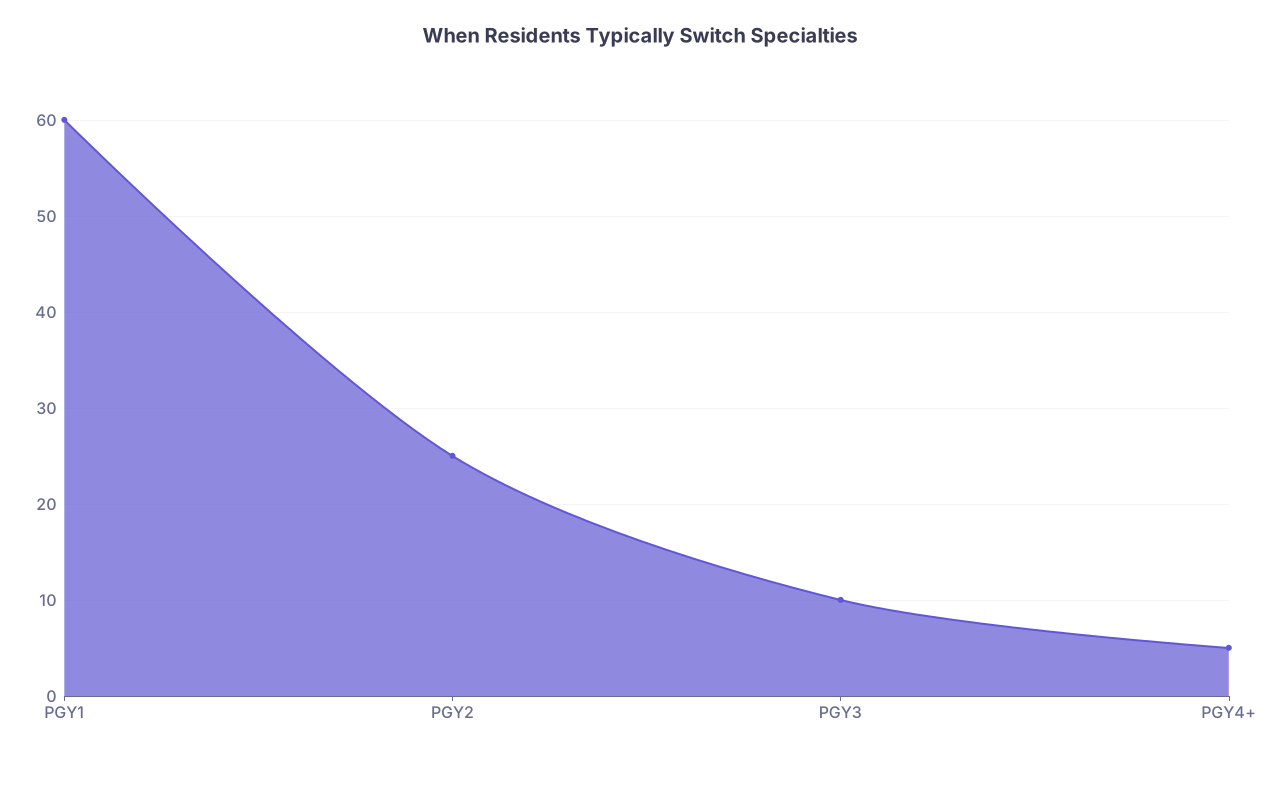
| Category | Value |
|---|---|
| PGY1 | 60 |
| PGY2 | 25 |
| PGY3 | 10 |
| PGY4+ | 5 |
3. Finish one residency, then do a second
This sounds insane at first pass. But if you’re still early, your future self at 50 might not care that you “wasted” 3 years in a prior specialty if you love the final destination.
Common pattern:
- Finish FM, IM, peds, psych, or surgery
- Work for a bit (or go directly)
- Do a second residency in something like:
- Anesthesia
- Radiology
- PM&R
- Psych
- Occasionally EM or another primary care field
Downsides:
- More years as a trainee
- Financial delay (but you still got paid as a resident the first time)
- More exams, more applications
Upside:
- You enter the second residency with maturity, clinical confidence, and much better judgment about what you want
- Programs like second‑career trainees more than you think. They know you’re not choosing blindly this time.
4. Walk away from clinical medicine entirely
I won’t sugarcoat this: some people opt out completely.
They go into:
- Industry (pharma, medtech)
- Consulting
- Informatics / tech
- Public health / policy
- Non‑clinical roles in hospitals, insurance, or startups
This is the nuclear option in your mind. But for some, it’s actually the sanest option. Especially if:
- Clinical work is destroying your mental health
- You don’t enjoy patient care, at all, in any format
- You’re drawn to systems, data, writing, or strategy instead
If the only reason you’re clinging to residency is “I already invested too much,” that’s a sunk cost fallacy, not a life plan.

How to Switch Safely Without Blowing Up Your Life
This is what you actually want: a way out that doesn’t torch every bridge.
Step 1: Get your performance as solid as you can
Cruel twist: the more miserable you are, the less you want to perform well. But good performance gives you leverage.
Why it matters:
- You need strong evaluations
- You want your PD to say, “They’re good, just mis‑aligned”
- Programs in your target specialty will ask, “Why are they leaving? Are they a problem?”
So while you’re exploring options, your actual daily job is:
- Be reliable
- Show up
- Don’t pick fights
- Don’t disengage so much that people think you’re unsafe
You’re not performing for ego. You’re buying optionality.
Step 2: Loop in the right people, in the right order
This can blow up if you tell the wrong person too early.
Better order:
- One trusted attending or mentor (even outside your specialty)
- Maybe a chief you truly trust
- Then your PD — once you have:
- A clearer idea of what you want
- Some sense of timing (immediate transfer vs future Match)
What you tell your PD:
- Be specific but not dramatic
- Own that this isn’t them being “bad” (even if they are) but you being mis‑aligned
- Show that you’ve thought this through: “I’ve been struggling with X, I’ve explored Y, I’m drawn to Z for these reasons…”
You want them thinking: “Rational person making a tough decision,” not “fragile mess I’m glad to get rid of.”
Step 3: Strategize the actual mechanics
Depending on timing, you may:
- Look for off‑cycle PGY spots in your target specialty
- Plan to re‑enter the Match while still finishing the year
- OR commit to finishing your current PGY‑year / entire residency, then applying for the next thing
Expect at least one “gap” or awkward transitional period. People survive this. You can moonlight, do research, or just… rest.

Hard Truths You’re Afraid to Say Out Loud
Let me just speak the stuff you’re probably circling around.
You will never have 100% certainty.
At some point you make a call with incomplete data. That’s adulthood. The goal is not zero risk; it’s acceptable risk.Staying in the wrong field for 30 years is a much bigger “waste” than 3–5 years of re‑training.
Your future self does not care that you were a PGY‑1 in something else once.Switching will probably feel embarrassing for about 2–6 months.
Then everyone moves on, you get busy in your new life, and it becomes an interesting footnote, not your entire identity.You are not trapped at 24 because of a decision you made at 21.
The system likes to act like you are, but you’re not. It’s rigid, but not impenetrable.Mental health is not “secondary” to training.
If a specialty or program is crushing you into the ground, that’s not some noble sacrifice. That’s damage. And it follows you.
How to Reduce the Odds You “Choose Wrong” in the First Place
If you’re not in residency yet and you’re spiraling about this, you can at least stack the deck in your favor.
Look for these when choosing a specialty/program:
- Can you find attendings you actually want to become in this field? Not a mythical unicorn — a real person you’ve met.
- Did you like the day‑to‑day on rotations, or just specific “glory moments”? (Liking codes doesn’t mean you like EM; liking the OR doesn’t mean you like every part of surgery.)
- Pay attention to what you envy:
- On rotations, who did you look at and think, “I wish I were doing that today instead”?
- Consider your nervous system, not just your CV:
- Do you handle chaos well?
- Do you crave structure?
- Does talking all day drain you or energize you?
And with programs:
- Ask residents off‑script: “If you could start over, would you rank this program first again?”
- Look at actual schedules, not just happy talk on interview day
- Watch how they talk about graduates who left or switched — huge red flag if there’s only contempt
FAQ (Exactly 4 Questions)
1. Will switching specialties ruin my career or reputation?
No. People will gossip for 5 minutes and then go back to worrying about themselves. Programs care about whether you’re competent, safe, and reasonably stable — not whether you took a detour. If anything, a thoughtful switch with good performance behind you can make you look more self‑aware and mature. You’ll tell this story in interviews a few times, then it just becomes part of your backstory.
2. When is it “too late” to switch or re‑train?
Technically, it’s “too late” when you’re more unwilling to extend training than to tolerate your current path. Practically, most people who switch do it in PGY‑1–PGY‑2 or after finishing a first residency. I’ve seen people in their late 30s start second residencies and still be glad they did. The real constraints are financial, family, and your own willingness to delay the “final” attending life, not some arbitrary age limit.
3. Should I just push through and hope I learn to like it?
Sometimes you do grow into a specialty, especially once the steep part of the learning curve flattens. But if you’ve been in it for a solid year or more, you’ve seen decent versions of your field, and you still feel heavy dread and misalignment, “pushing through” usually just means a slow, quiet burnout. If the only argument for staying is “I’m scared to change,” that’s not a great reason.
4. How honest should I be with programs about why I’m switching?
Honest but strategic. You don’t rant about your current program or insult your original specialty. You frame it as: you learned a lot, you performed well, but through real experience you realized your strengths and interests fit better elsewhere. Concrete examples help: “I found myself looking forward most to X part of the job, which aligns with Y specialty.” Programs want to hear insight and responsibility, not blame and chaos.
Key points:
- You’re not trapped; residents switch specialties, programs, and even careers more often than anyone admits.
- Perform well where you are, gather real data about what you want, then make a deliberate move — not a panic jump.
- A few “lost” years are nothing compared to decades in the wrong field. Your future self will care much more about fit than about taking the straightest possible path.