
The wrong residency culture can quietly break you faster than a brutal call schedule.
The Fear You Don’t Say Out Loud
You keep hearing “fit matters more than prestige,” but nobody actually tells you how to spot bad fit before you’ve signed away the next 3–7 years of your life.
So you start catastrophizing.
What if I match somewhere and everyone’s fake nice on interview day and then it’s malignant?
What if I’m the weird one and everyone else somehow loves this place?
What if I only realize it’s wrong after orientation and then I’m just… stuck?
You’re not overreacting. I’ve watched residents go from excited and hopeful on July 1st to hollow-eyed and counting down the days to graduation by October—not because they couldn’t handle the medicine, but because the culture was toxic and they didn’t see (or didn’t believe) the warning signs.
Let’s talk about those signs. The ones you can actually pick up during interviews, socials, and your obsessive stalking of program websites and Reddit at 1 a.m.
And yeah, I’ll walk through the worst-case scenarios too—and what to do if you only figure it out after you match.
What “Culture Fit” Actually Means (And What It Doesn’t)
Culture fit isn’t “do they like me.” It’s:
- How people treat each other when they’re tired and stressed
- What behaviors get rewarded vs quietly punished
- How honest people can be without paying for it later
- Whether residents have lives outside the hospital (or are shamed for it)
It’s not:
- Whether they have a resident yoga club
- Free food, fancy lounges, or “wellness days” on the website
- A nice PD speech with buzzwords like “supportive,” “family,” “mentorship,” “innovation”
Every program claims to be supportive. No one gets up there and says, “We’re low-key malignant and your well-being is optional.”
So you can’t just listen to what they say. You have to watch how people act and where their stories don’t line up.
Early Red Flags During Interview Day
You actually get a ton of data on interview day; it just gets drowned out by your own anxiety. Here’s what I’d be hyper-attuned to.
1. Residents Look… Dead Behind the Eyes
Not “I’m post-call tired.” That’s normal. I mean that flat, detached, don’t-care-anymore vibe.
You ask, “How’s the program?” and they say, “It’s fine,” but they don’t light up about anything. Not the teaching. Not the friendship. Not anything.
Or they say the right words, but their body language says otherwise—shrugging, glancing at each other before answering, forced smiles.
Pay attention to small things:
- Do residents laugh with each other at all, even offhand?
- Does anyone make fun of themselves or the attendings in a safe, relaxed way?
- Or does it feel like they’re all walking on eggshells even around you?
If residents seem emotionally checked out across the board, that’s not just “a bad week.” That’s culture.
2. Everyone Answers Your Questions Like They’re Reading from a Script
You ask, “What are some weaknesses of the program?” and you get the same nonsense:
- “We just care too much.”
- “Honestly, I can’t think of any.”
- “We work hard, play hard.” (This one is code for “you will suffer” more often than not.)
If three different residents give you the exact same vague line, they’ve been coached. That means:
- They don’t feel safe telling the truth.
- Or they’ve been told explicitly what not to say.
- Or they assume anything critical will get back to leadership and hurt them.
In a healthy culture, at least one resident will say something real.
“We’re short on electives but working on it.”
“The ED rotation is brutal, but we get good autonomy.”
Slightly messy but honest answers are good signs.
3. Residents Disagree with Leadership… Only with Their Eyes
This one’s subtle.
Watch when the PD or APD says things like:
“Our residents leave by 5 most days.”
“We strongly value wellness and time off.”
“We never exceed work hour limits.”
Then look at the residents’ faces. Do you see any:
- Side-eye between residents
- Tight smiles
- Small eye rolls they try to hide
- A quick cough-laugh followed by silence
That disconnect—what leadership claims vs what residents wordlessly communicate—is one of the biggest early-warning signs you will ever get.
If you see that, believe the residents’ faces, not the slides.
4. They Brag About Things That Should Be Basic
If a program loudly promotes:
- “We follow duty hour rules!”
- “Our residents have post-call days!”
- “You can actually go to the doctor when you’re sick!”
That’s like bragging your apartment has running water.
Those should be minimum standards, not unique selling points.
What they brag about reveals what’s unusual in that environment. So if they’re hyping normal human rights, I start wondering what the baseline must be.
5. They Make Fun of Other Programs More Than They Talk About Their Own
A little light roasting of neighboring programs is normal. But if most of what you hear is:
“Well, at least we’re not [X program], they’re brutal.”
“Other programs just don’t prepare you like we do.”
“We’re not a lifestyle program. Our people actually know medicine.”
There’s usually insecurity under that.
Programs that are confident in their culture talk more about what they are than what others aren’t. When the tone is constantly “we’re tough, they’re soft,” it can slide into subtle shaming of anyone who wants balance.
And that will be you when you’re exhausted and need help.

Red Flags at the Pre-Interview Social (Where the Truth Leaks Out)
The pre-interview social is where people forget they’re being watched. This is your gold mine.
1. Only PGY-1s Show Up. And They’re Weirdly Positive.
If it’s all interns and no seniors, ask yourself why.
Seniors are more likely to be honest because they’re almost out. If they never show, it can mean:
- They’re too exhausted to care
- They’ve emotionally detached from the program
- They’re sick of pretending everything’s great
Then listen to the PGY-1s. If every answer is hyper-positive and vague—“It’s amazing, I love it here!”—with no nuance, they may still be in the “I must justify my Match choice” phase.
You want to hear at least some realism:
“It’s been hard, but people actually help each other.”
“Sometimes the hours suck, but I feel supported.”
Perfect = suspicious.
2. Nobody Talks About Life Outside the Hospital
Ask: “What do you do for fun here?”
If the answer is just awkward silence, or some version of:
“Uh… sleep?”
“We don’t really have time for much.”
“Honestly, we mostly hang out in the call room.”
I’d be concerned.
You’re not expecting a fully balanced life with hobbies and weekly book clubs. But if nobody can name anything—gym, family time, hikes, random Netflix shows—you’re probably looking at a culture where your identity collapses into “resident and nothing else.”
That burns people out. Fast.
3. They Trash Colleagues or Other Services
If during a casual hangout you hear:
“Don’t go into [X specialty], those people are useless.”
“Our PD is… yeah, you’ll see.” (followed by nervous laughter)
“Med students are so annoying; we don’t really use them.”
That’s not “venting.” That’s the default way they talk about others. When people are comfortable degrading other groups to you—someone they just met—they will absolutely talk about you like that later.
You want residents who can joke, complain, and be real… without constant contempt.
Hidden Clues in How They Talk About Mistakes and Struggle
This is a big one and most applicants don’t ask about it directly. You should.
Ask some version of:
- “How does the program respond when a resident is struggling?”
- “What happens if you make a clinical mistake?”
- “Has anyone ever needed time off for health or family reasons? How was that handled?”
Then listen for what they actually say, not just the words.
Reassuring answers sound like:
“We’ve had people who needed remediation—there’s a clear process, and they still matched into solid fellowships.”
“We have a sick call system that’s used without guilt.”
“Our chiefs and PD check in early if they see you struggling.”
Concerning answers sound like:
“You just have to push through.”
“We’re all a family, so no one really needs time off.”
“People know not to call out unless it’s serious.”
“Well… it’s never really come up.” (It has. They’re just not talking about it.)
If no one can give you a specific example, or they dodge the question, assume residents don’t feel safe admitting difficulty.
And if you’re anxious now, imagine dealing with that in an environment where you’re not allowed to be human.
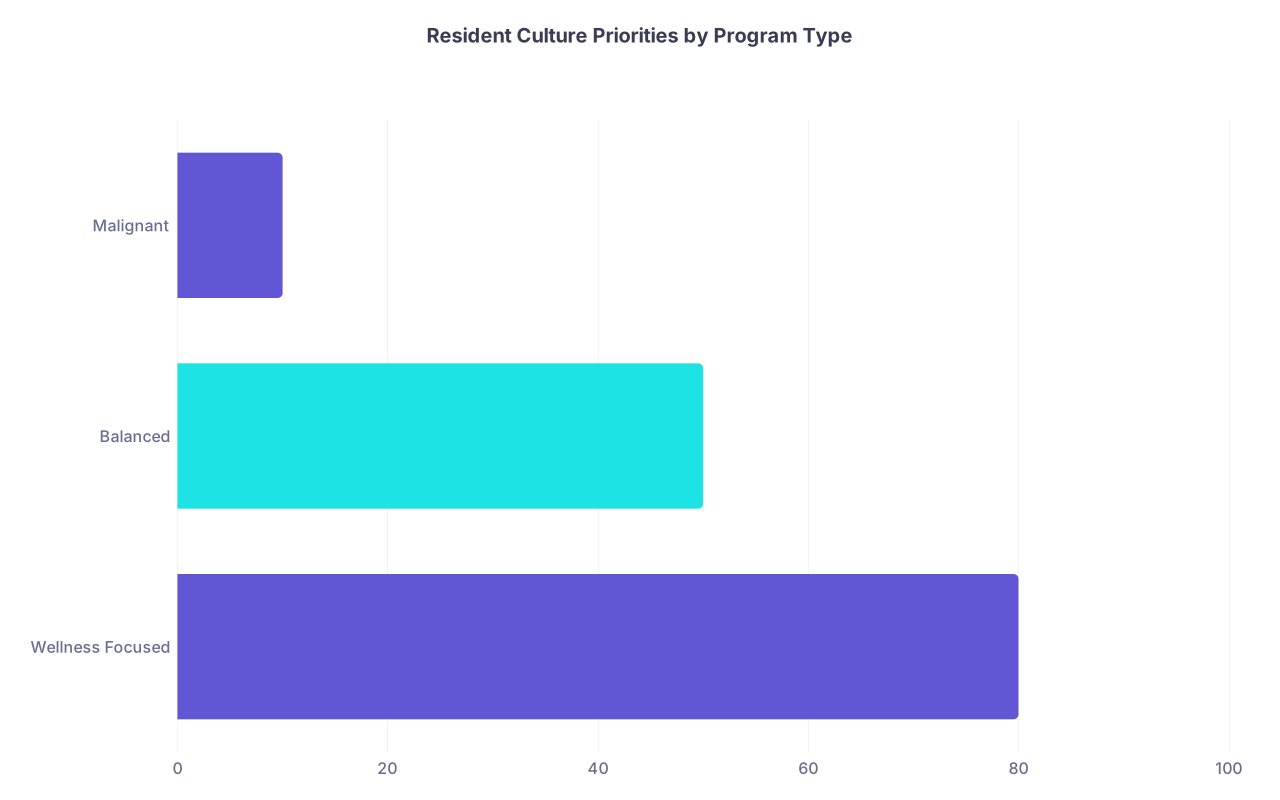
| Category | Value |
|---|---|
| Wellness Focused | 80 |
| Balanced | 50 |
| Malignant | 10 |
Social Media, Websites, and the “Too Perfect” Problem
You’re probably doom-scrolling program Instagrams already. Use them, but don’t be fooled.
Programs usually post:
- Graduation dinners
- Wellness days
- Retreats
- Research awards
What they don’t post:
- Residents crying in their car after a shift
- Being shamed for calling in sick
- Getting passive-aggressively questioned about vacation requests
So what should you look for online?
Consistency.
Do they:
- Show a mix of classes, or only the same 3 “poster residents”?
- Ever acknowledge real challenges or just constant “We’re a family!!”?
- Highlight resident-led initiatives (journal clubs, interest groups), or is everything top-down?
If everything feels polished, glossy, and corporate with no actual “real life” moments, assume they’re branding hard—sometimes to cover deeper issues.

| Step | Description |
|---|---|
| Step 1 | Interview Day |
| Step 2 | High Risk - Culture Mismatch |
| Step 3 | Medium Risk - Mixed Signals |
| Step 4 | Medium Risk - Burnout Culture |
| Step 5 | Lower Risk - Potential Good Fit |
| Step 6 | Residents seem genuine |
| Step 7 | Stories match PD claims |
| Step 8 | Residents have lives outside work |
Signs You Might Not Fit (Even If the Program Is “Good”)
Here’s the painful part: not all misfit = bad program. Sometimes it’s just bad for you.
Ask yourself:
- Do they brag nonstop about being the “busiest,” “hardest,” “most intense” training? If that secretly makes you dread things, not excite you, that’s information.
- Does everyone seem extroverted, constantly social, hanging out together? If you’re more private or need alone time to recharge, will you feel lonely or pressured?
- Is the vibe very “aggressive, competitive, we roast each other for fun”? Some people love that. If you’d be crushed by it, don’t tell yourself you’ll “just adapt.”
There’s this weird pressure to convince yourself you can thrive anywhere. No. You’re going to be chronically sleep-deprived, emotionally stretched, and exposed to human suffering daily. Your baseline has to match the environment at least a little.
You don’t need a perfect match. You just need enough alignment that you’re not fighting the culture every second.
| Signal Type | More Red Flag Side | More Green Flag Side |
|---|---|---|
| Resident vibe | Flat, guarded, overly polished | Honest, nuanced, some humor |
| Talk about work | “We grind, we’re the toughest” | “We work hard, but people help each other” |
| Talk about mistakes | Vague, dismissive, or blaming | Concrete examples, clear support process |
| Life outside work | “No time for anything” | Specific hobbies, family, local activities |
| Leadership-resident match | Stories don’t line up | Same themes, similar tone |

What If I Miss the Signs and Match Somewhere Wrong?
This is the nightmare scenario your brain keeps replaying at 2 a.m.
Let me be blunt: yes, people end up in cultures that don’t fit them. It sucks. Some transfer. Some gut it out. Some change specialties. That’s real.
But here’s the part your anxious brain conveniently ignores:
- Most programs are not truly malignant.
- Culture varies wildly even within the same program (by service, attending, class year).
- You have more power than you think once you’re there—co-residents, chiefs, mentors, therapy, boundaries.
If you do end up somewhere that feels wrong:
- Find your people fast. One or two residents who get you can make an unbearable place survivable.
- Document everything if it’s truly toxic—emails, duty hours, unsafe situations. Malignant programs hate paper trails.
- Talk to someone outside the program (school advisor, therapist, trusted attending) before making big decisions. Your perception when you’re exhausted can be distorted.
- Know that transferring is possible, even though it’s not common. People do it. Quietly. You’re not trapped forever.
The more you assume you’re permanently doomed if you misjudge culture, the more likely you are to ignore red flags right in front of you because admitting they exist feels too terrifying.
You’re allowed to see problems and walk away.

How to Sanity-Check Your Own Impressions
Last thing: your anxiety will sometimes label neutral things as red flags just because you’re on edge.
So after each interview, try this quick reality check:
- Write down exactly what happened that worried you. Not just “bad vibe.” Specific moments.
- Ask: “If my friend described this to me, what would I think?” Sometimes you’re kinder to them than to yourself.
- Compare across programs. If every place feels wrong for the same vague reason, that might be more about your anxiety than their culture.
- Watch for one thing: Did any resident say something that made you feel like you’d be okay there, even on a bad day? If yes, that’s a big deal.
You’re not trying to find a place where you’ll never be stressed. You’re trying to find a place where, when you are stressed, the culture doesn’t crush you further.
Years from now, you won’t remember the exact wording of the PD’s speech or the color of the resident lounge couches. You’ll remember whether you felt like you could be yourself—and still belong.
FAQ (Exactly 5 Questions)
1. What if I liked the program on interview day but now I’m second-guessing everything?
Totally normal. Your brain loves to rewrite history under stress. Go back to your notes (or your memory if you didn’t take any) and force yourself to list specific positive moments: a resident who felt real, a story that impressed you, a time you felt yourself relax. If there were concrete good signs and no glaring red flags, don’t let vague anxiety outweigh actual evidence. Rank based on what you saw, not on the spiral two weeks later.
2. Is it dumb to rank a “less prestigious” program higher because I liked the vibe better?
No. It’s smart. A slightly less famous program where you feel supported will almost always produce a stronger, more confident, more functional physician than a “top” program where you’re miserable and afraid to ask questions. Fellowship directors know the difference between someone who trained at a big-name place and looks broken, and someone from a solid mid-tier program who clearly thrived.
3. How do I ask about culture without sounding annoying or negative?
Ask about patterns, not complaints. Things like: “Can you describe a time the program really supported a resident?” or “If a resident is having a rough month, what tends to happen?” or “What do graduating seniors usually say they appreciated most?” Those questions force them into real examples instead of generic buzzwords. You’re not being negative; you’re being smart about where you’re going to spend your twenties.
4. What if residents give me mixed signals—some love it, some seem miserable?
That’s actually pretty normal. Personalities differ, rotations differ, life circumstances differ. In that situation, ask yourself: Which residents felt most like me? The sarcastic ones, the quiet ones, the academic gunners, the chill ones? Weigh the opinions of the people whose energy and goals match yours. There is no program where everyone is happy. You’re looking for “people like me can be okay here,” not universal bliss.
5. Can I email residents after the interview to ask more honest questions?
Yes, you can, and sometimes you should. The trick is to pick one resident who gave off a real, grounded vibe and send a short, respectful note: thank them, say you appreciated their honesty, and ask if they’d be open to answering 2–3 follow-up questions. Don’t demand gossip. Ask things like, “How would you describe the overall attitude toward wellness?” or “Do you feel comfortable asking for help when you’re overwhelmed?” If they ignore you or send only PR answers, that’s data too.
Years from now, you won’t remember how many nights you spent refreshing your email or reordering your rank list. You’ll remember whether you listened to your instincts about where you could still feel human while you learned how to be a physician.