
What if that glowing word-of-mouth recommendation about a residency program is five years out of date—and completely wrong for you now?
The Seduction of Word-of-Mouth (And Why It Burns People)
You know how this goes.
MS4 ahead of you says, “Oh, that program? Amazing. Super chill. Everyone’s happy.”
Your favorite attending: “You’d fit perfectly at X. They take care of their residents.”
Reddit thread from 2021: “Hidden gem, 100% recommend, best decision I ever made.”
And just like that, a program jumps to the top of your rank list.
I’ve watched people do this every cycle. They treat residency choice like restaurant reviews. “My friend loved it, so it must be good.” Then halfway through intern year they’re saying, “I wish I’d asked harder questions. This is not what I was promised.”
Word-of-mouth is useful. Ignoring it would be dumb.
Trusting it as your primary data source? That’s how you end up:
- In a malignant culture everyone swears “used to be bad but it’s better now”
- With ridiculous call schedules that magically did not come up on interview day
- In a program that looks “supportive” from the outside but tanks fellowship or job placement
Let me walk you through the most common verification steps people skip, and how to stop yourself from making those same lazy, costly mistakes.
Problem #1: Believing One Person’s Experience Is “The Truth”
The most dangerous phrase in residency gossip: “I know someone there and they love it.”
You’re hearing:
- One specialty (or even one track within a specialty)
- One PGY level
- One personality type
- In one specific year of that program’s life cycle
Programs change. Chairs flip. PDs retire. A new hospital merger happens. The golden class graduates and a rotten one comes in. I’ve seen “best program in the region” turn into “do not rank” in 18 months.
The mistake:
You give disproportionate weight to:
- Your home institution’s narrative
- One alumnus who matched there five years ago
- That one loud person in your class who “knows everyone”
How to verify instead
Do not rank a place highly unless you’ve done all of this:
Talk to at least three current residents
Spread across PGY levels and ideally including a chief.Ask each of them privately (not on Zoom with the PD lurking in another square):
- “What made you almost not choose this program?”
- “If you could change one thing, what would it be?”
- “Who thrives here and who struggles?”
- “What do people complain about that the program would rather you not know?”
Time-stamp your intel
Anything older than two years? Treat it as background, not decision-making data.
“My friend graduated in 2018 and loved it” is basically historical fiction.Cross-check perspectives
If a resident says “our work hours are very reasonable” and then later admits they log 2–3 hours of notes from home most nights—you’re not getting the full story. You’re getting normalization of dysfunction.
You’re not looking for one person’s truth. You’re looking for patterns. Mismatched narratives are your red flags.
Problem #2: Letting “Good Reputation” Replace Actual Data
Here’s a sentence I hear way too often:
“Everyone says it’s a strong program. I don’t need to dig too much.”
This is how people match to:
- Programs with zero interest in resident education (“service first, teaching if there’s time”)
- Toxic hierarchies where seniors are over-empowered and PDs are hands-off
- Systems that look prestigious but leave you underprepared or burned out
Reputation is 2–10 years behind reality. People at your med school talk about what the program was when their alumni matriculated, not what it is this year.
Verification steps people skip
- Concrete clinical exposure questions
On interview day, most applicants ask vague nonsense like “How is the clinical experience?” and programs answer with rehearsed fluff.
Ask specifics they cannot fake:
- “How many continuity clinic half-days do PGY1s get?”
- “How often are you doing procedures—and which ones are realistic by end of PGY3?”
- “Who does the first pass on central lines, LPs, paracenteses? Residents, fellows, or IR?”
- “How many ICU months total, and how much autonomy do seniors have overnight?”
If answers are hand-wavy or wildly inconsistent between residents and faculty, that’s your sign.
- Outcomes, not adjectives
Do not settle for “good fellowship placement” or “strong board pass rates.”
Ask:
- “Can I see a list of where graduates have gone for fellowship over the last 3–5 years?”
- “How many residents failed boards or had to repeat a year in the last 3 years?”
- “What percentage passed boards on the first try, and how does that compare to national averages?”
- Formal feedback and remediation structure
If a program “never puts anyone on remediation,” that does not mean they’re supportive. It might mean they’re neglectful.
Ask:
- “When someone struggles clinically, what actually happens?”
- “Can you walk me through how feedback is given—formally and informally?”
- “Has anyone been let go in the last 5 years? What were the circumstances?”
You’re not trying to catch them. You’re trying to see if they even have a system.
Problem #3: Ignoring Objective Workload Data (Because Someone Said It’s “Chill”)
Word-of-mouth about workload is almost always wrong. People normalize suffering. Or brag about it. Or downplay it because they like the program for other reasons.
I’ve literally heard this:
“Yeah our q3 28-hour calls are kinda rough but honestly it’s chill and you learn a ton.”
You’ll only know what “chill” means when you see the numbers.
At minimum, you should verify:
| Metric | Target Questions |
|---|---|
| Call Frequency | How often? Any 24+ hour calls? |
| Weekly Hours | Typical range, not just ACGME max |
| Home Work | Notes/EPIC work done off-site |
| Patient Load | Caps per intern/senior per service |
And then press past the polished answer.
Ask residents privately:
“What was your worst month in terms of:
- Average hours per week
- How often you went over 80 hours
- How many notes you finished from home”
If nobody ever goes over 80 hours, either they’re lying, under-reporting, or the program is a unicorn. Proceed with skepticism.
Problem #4: Not Checking ACGME and FREIDA Data Against The Hype
Almost no one does this, and they should. Because it exposes a lot of the fantasy.
Programs can talk all day about “resident wellness” and “support.” The ACGME data quietly tells you where residents are actually miserable or leaving.
What you need to check (and people rarely do)
You cannot see raw survey responses, but citations often result when:
- Duty hours are consistently violated
- Supervision is poor
- Education is weak or unsafe
- Environment is hostile
Search:
- ACGME accreditation status
- Any recent warnings, citations, or probation
If a program has “continued accreditation with warning,” your follow-up questions on interview day should be very blunt:
“What changes are you making in response to ACGME feedback over the last 3 years?”
- FREIDA and public data discrepancies
Use FREIDA as a rough baseline:
- Number of residents per year
- Number of hospitals/sites
- Required rotations
Then compare what they told you vs what’s listed. If they “forgot” to mention a heavy community site with minimal teaching, that’s not an accident.
- Program size vs workload reality
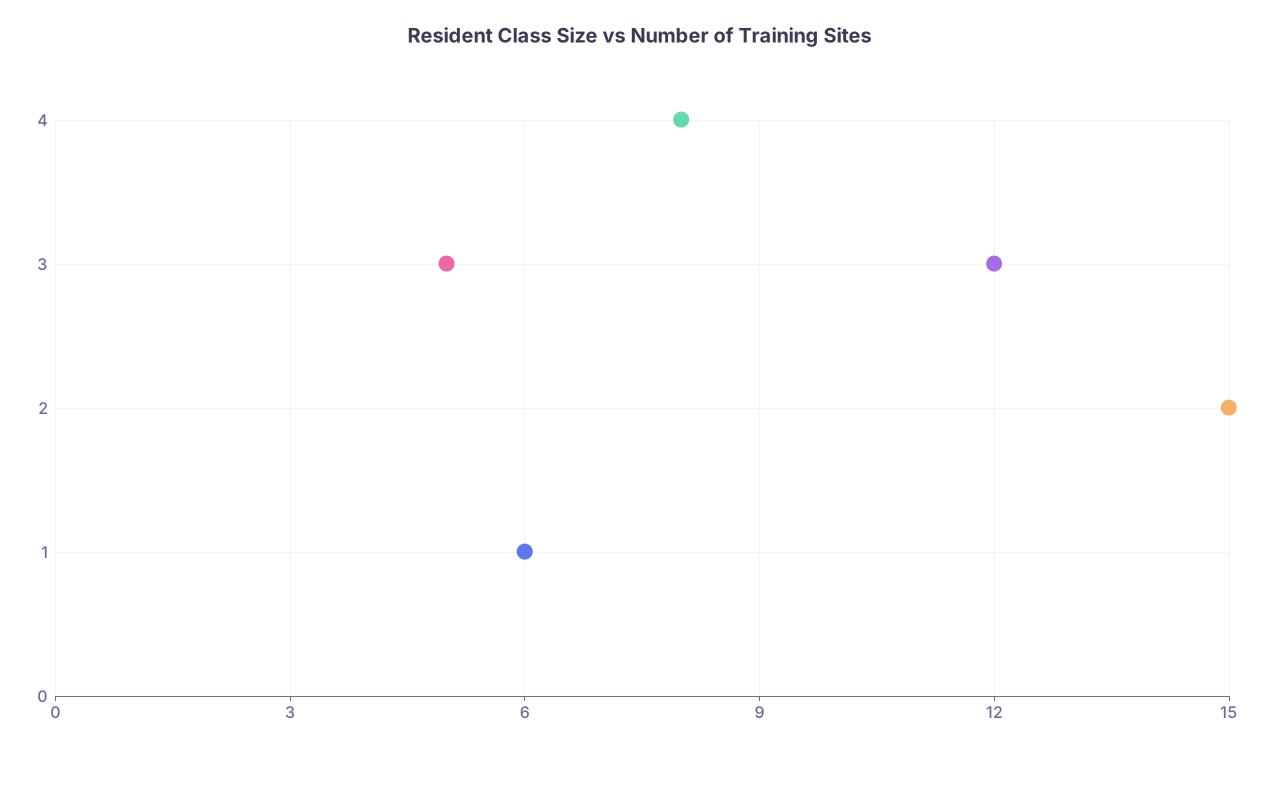
| Category | Value |
|---|---|
| Program A | 6,1 |
| Program B | 12,3 |
| Program C | 8,4 |
| Program D | 15,2 |
| Program E | 5,3 |
A small program spread across many hospitals often means:
- More cross-coverage
- More commuting
- Less peer support on tough rotations
If they market “tight-knit small program” without talking honestly about these trade-offs, be careful.
Problem #5: Assuming Interview Day Vibes = Real Culture
Interview days are theater. You’re seeing the highlight reel. Carefully selected residents. Carefully choreographed answers.
The most common mistake:
“I really liked the residents I met. They seemed happy. So the culture must be good.”
Maybe. Or maybe:
- The most discontent residents “weren’t available” that day
- People were warned “don’t bring up X or Y issues”
- There’s a split between day-team favorites and night-float workhorses you never meet
Culture verification steps almost nobody takes
- Ask specifically about “unhappy” residents
To a senior resident (away from leadership):
- “Have any residents left or switched programs in the last few years? Why?”
- “What do the most burned-out residents here say when they vent?”
- “If someone’s really miserable, do they get real help or just told to ‘hang in there’?”
- Probe for how conflict is handled
Everyone says “we’re like a family.” Families can be extremely dysfunctional.
Ask:
- “Tell me about a time residents had a serious issue with a rotation or attending. What happened?”
- “When residents have feedback that leadership doesn’t like, what realistically happens with that feedback?”
- Night float and off-service reality check
The worst toxicity is often on:
- Night float
- Off-service rotations
- Surgical rotations for medicine residents (and vice versa)
Ask:
“Which rotations have the worst morale? What’s actually being done about that?”
If they pretend every rotation is “amazing,” they’re lying or oblivious. Neither is good.
Problem #6: Not Using Social Media and Alumni Quietly (Instead of Public Gossip)
Reddit, SDN, and private Discords can give you some signal. And a lot of noise.
The mistake is either:
- Ignoring online chatter entirely (“it’s all toxic”)
- Or believing every dramatic post (“they said it’s malignant, so I’m out”)
The smarter move is to use it as a lead generator for what to verify, not as proof.
How to use online info correctly
Look for consistent themes, not one-off horror stories
If 8–10 different posts, across years, mention:- “Program leadership is unresponsive”
- “Terrible surgical co-management dynamics”
- “Didactic time constantly canceled for service”
That’s not random. That’s a smoke cloud.
Reach out to alumni directly
Quiet email or LinkedIn messages:- “I’m considering ranking X. Would you be willing to share what you liked and didn’t like, off the record?”
- “What surprised you about the program compared to what you expected from interview day?”
Cross-check what alumni say vs what current residents say
Alumni have distance: they’re often more honest.
Current residents have immediacy: they know the latest changes.
If alumni paint a much darker picture than current residents, ask yourself if recent leadership turnover or major structural changes explain the difference. If not, be suspicious.
Problem #7: Never Asking Hard, Awkward Questions
A lot of applicants are so scared of “seeming difficult” that they avoid any question that might make the program uncomfortable. That’s how you end up in preventable disasters.
You are not buying a sweater. You are signing up for 3–7 years of your life, sleep, health, and career trajectory.
Awkward questions you should ask anyway
To the PD or APD:
- “Have you ever removed a resident from the program? Under what conditions?”
- “What’s something from your last ACGME survey that you’re actively trying to fix?”
- “What would your residents say is the weakest part of this program?”
To residents (off-camera / off-record):
- “If you were advising your younger sibling, would you tell them to come here?”
- “Who here is struggling the most, and what support are they actually getting?”
- “What do people say in the group chat that would never be said on interview day?”
If anyone gets defensive or evasive, that’s not your fault. That’s information.
Problem #8: Ignoring Fit Because “Everyone Says It’s a Great Brand”
One last trap: chasing name prestige or “strong reputation” when the actual structure is terrible for you.
- You want outpatient-heavy, but your “dream” program is basically an ICU bootcamp
- You care about research time, but the “big-name” place expects you to figure it out on your own time
- You have a partner, kids, or caregiving responsibilities, but your top-ranked program has notoriously brutal schedules
Word-of-mouth will pressure you: “You have to rank that high, it’s such a big name.”
You do not.
Verify fit explicitly
](https://cdn.residencyadvisor.com/images/articles_svg/chart-top-residency-priorities-vs-program-reality-8938.svg "Top Residency Priorities vs Program Reality")
| Category | Value |
|---|---|
| Procedural volume | 80 |
| Outpatient experience | 60 |
| Research time | 40 |
| Lifestyle | 50 |
| [Name prestige](https://residencyadvisor.com/resources/choosing-residency-program/ranking-trap-why-choosing-prestige-over-fit-can-backfire-hard) | 90 |
Before rank lists, write down your top 4–5 priorities and then force yourself to get real answers on each:
- “How much protected research time is guaranteed vs theoretically available?”
- “How many half-days of clinic per week in PGY2/3?”
- “What formal support exists for residents with families—schedule flexibility, parental leave, childcare?”
Then compare what you heard to what your classmates and mentors are pushing you to do. If there’s a gap, trust your own data, not their ego.
Quick Checklist: Verification Steps You Should Not Skip
Before you lock in a high rank for any program, you should be able to say “yes” to all of this:
- I’ve spoken with at least three current residents at different levels, privately.
- I’ve asked specifically about worst rotations, worst months, and most burned-out residents.
- I know the real call schedule, typical work hours, and how much work happens from home.
- I’ve checked accreditation status and any recent program changes (new PD, mergers, lost sites).
- I’ve seen or heard specific fellowship/job placement outcomes for the last 3–5 years.
- I’ve heard at least one thing residents don’t like about the program—and how leadership responded.
- I’ve confirmed that the program structure aligns with my priorities, not just its reputation.
If you cannot check these boxes, you’re not “trusting your gut.” You’re gambling based on anecdotes.
FAQs
1. If I really liked the residents I met, isn’t that enough?
No. That tells you they can find a handful of happy, articulate people to represent the program. You still do not know how many residents are burned out, ignored, or quietly transferring. You need multiple conversations, ideally including someone who’s more neutral or even mildly critical.
2. How do I ask tough questions without coming off as negative?
Be calm and direct, not combative. Preface with: “I’m trying to make an informed, long-term decision, so I’d like to ask about some of the challenges residents face here.” Programs that interpret that as “negative” are waving a giant red flag.
3. Should I trust my home institution’s opinion about outside programs?
Treat it as one data point, not gospel. Faculty often have outdated views or limited experience with programs in other regions. Always cross-check with current residents at those programs and whatever recent match/fellowship data you can access.
4. What if online forums say a program is malignant, but interview day felt great?
That discrepancy is exactly when you should verify aggressively. Ask residents (privately) about leadership responsiveness, duty hours, and why they think the program has a negative online reputation. If their answers are vague or dismissive without specifics, be careful.
5. I’m exhausted and overwhelmed—how do I realistically do all this verification?
You do not need to do it for every single place you interview. Focus on your top 5–8 programs. Schedule 15–20 minute calls with residents, send 2–3 concise emails to alumni, and check ACGME/FREIDA data. A few focused hours now can prevent years of regret later.
Remember:
- Word-of-mouth is a starting point, not a verdict.
- If a program cannot withstand hard, specific questions, you do not want to train there.
- Your future sanity depends more on what you verify than on what “everyone says.”