
Ignoring program stability is how you end up training in a place that no longer exists.
You worry about Step scores, letters, and prestige. Meanwhile, the program you are ranking number one is quietly losing key faculty, negotiating a merger, and sitting on probation with the ACGME. I have watched residents matched into programs that literally closed or merged mid‑training. Their lives were turned upside down while their classmates in “less shiny” but stable places just kept learning and graduating on time.
Program stability is not “extra credit.” It is survival.
This is the blind spot that burns otherwise smart applicants:
- They chase name and location.
- They trust glossy interview-day presentations.
- They never ask what happens if the hospital sells, merges, or loses accreditation.
Then suddenly their training plan depends on lawyers, the ACGME, and whether anybody else will take them.
Let me walk you through how people get burned—and how you avoid being one of them.
The Hidden Disaster: When Your Program Collapses Under You
Program instability is not theoretical. I have seen:
- Residents scrambling for new spots after a community hospital abruptly shut down its residency.
- A big-name academic center swallowed by a health system merger, shredding call schedules, clinics, and fellowships in under a year.
- Programs put on ACGME probation where residents could not be sure they would even graduate from an accredited program.
What does “instability” really look like from a resident perspective? A few ugly realities:
- Core faculty disappear, and your continuity clinic changes hands three times in a year.
- Key rotations vanish because the hospital no longer has that service (goodbye, inpatient peds, goodbye OB volume).
- Program leadership turns over repeatedly. Every year a new PD. Every year a new “vision.”
- You hear the words “we’re working with the ACGME” way too often and never with specifics.
The problem is that as an applicant, you only get the polished version. The “we’re excited about our new partnership” slide, not the “half our graduating class just scrambled to other programs” story.
Your job is not to trust the presentation. Your job is to interrogate stability like your future depends on it—because it does.
The Three Big Stability Mistakes Applicants Keep Making
1. Treating Mergers and Closures as Rare Freak Events
They are not rare. Health systems are consolidating aggressively. Community hospitals are bought, stripped, or converted. Safety-net hospitals live in permanent financial limbo.
Here is the pattern I have seen too many times:
- Year 1: Hospital announces “strategic partnership” or “affiliation change.”
- Year 2: Service lines are “restructured.” Some fellowships disappear. A few long‑time faculty “retire.”
- Year 3–4: Either the residency is “reorganized” or the hospital itself closes or shifts to a low-acuity model. Residents are forced to move or scramble.
The mistake: Students see the press release and hear, “More opportunities! Bigger system!” Instead of asking, “Why did this hospital need to be bought in the first place? Is this a rescue or a power play?”
Assume any major structural change introduces risk until proven otherwise.
2. Ignoring ACGME Status and Warning Signs
Too many applicants never even look up accreditation status. They assume if a program participates in ERAS and NRMP, it is fine.
That is naive.
You need to know:
- Is the program on Continued Accreditation, Warning, Probation, or Initial Accreditation?
- Has there been recent adverse ACGME action?
- Are there patterns of citations that scream systemic problems (duty hours, supervision, lack of educational resources)?
When I see a program casually brushing aside ACGME issues with “every program gets citations,” I pay attention. Because yes, everybody gets minor citations. Not everybody gets warnings or probation.
The mistake: Believing that “we’re working closely with the ACGME” is reassuring. It usually is not.
3. Confusing Busyness With Strength
A busy ED. A packed OR board. Overwhelmed inpatient wards. You see “great clinical exposure.”
Sometimes that is true. Sometimes it is under‑resourced chaos that burns residents out while the system quietly bleeds money and plans to shut down less profitable lines of service.
Programs that are “indispensable to the hospital” are actually high risk if the hospital itself is unstable. Volume does not protect you if the parent institution fails.
The mistake: Equating volume with security, instead of asking who actually controls the money, the building, and the long‑term plan.
How to Actually Check Program Stability (Beyond the Sales Pitch)
You cannot eliminate all risk, but you can stop being blind. Use this like a checklist.
1. Do Your Homework Before You Interview
Do not walk into an interview clueless about the basic health of the institution.
Minimum background check:
- Google “[Hospital Name] financial problems,” “[Hospital Name] closure,” “[Health system] merger,” “[Hospital] layoffs,” “[Hospital] bankruptcy.”
- Read local news, not just national headlines or the hospital’s own PR.
- Pull up the program’s ACGME info (you may not see every detail, but you can usually see accreditation status and sometimes warnings).
- Look at past match lists from your med school. Has this program been a common destination or did it suddenly appear/disappear?
You are looking for patterns: repeated layoffs, service closures, leadership turnover, affiliations changing every few years. That is smoke. Sometimes fire.
2. Ask the Hard Questions On Interview Day
Most applicants lob softballs: “What is the call schedule like?” “How is the culture?” Fine. But stability questions are where you separate the adults from the children.
You should be asking:
- “Have there been any recent or upcoming mergers, acquisitions, or major system changes that affect residents?”
- “Have any services or rotations been cut or moved to other sites in the past 2–3 years?”
- “How long has the current program director been in place? The DIO? What is faculty turnover like?”
- “What is your current ACGME accreditation status? Any recent site visits or citations you are addressing?”
- “Have any residents had to transfer out because of instability, volume issues, or accreditation concerns?”
If they dodge, minimize, or change the subject, note it. Programs that are stable and proud of it will answer plainly.
Now, the key: You do not just ask faculty. You ask residents privately.
Residents after conference. Residents walking you between rooms. That is when you say quietly:
- “I have heard of programs impacted by mergers and closures. Do you feel this place is safe for the next 3–4 years?”
- “Have there been rumors of big system changes—closing units, moving services, or selling the hospital?”
- “Has anyone had to transfer out recently? Why?”
Listen for hesitation, vague language, or “off the record” comments. That is data.
Red Flags: When You Should Start Backing Away
Let me be blunt: Some programs are so risky that you should drop them down your rank list, even if they are “prestigious” or in your dream city.
Here are concrete red flags that should make you very cautious.
1. Shaky Accreditation or Recent Probation
If you hear:
- “We were on probation but that has been resolved.”
- “We had some serious citations, but we are working on them.”
- “We are still on Initial Accreditation after several years.”
You need to ask, “What specifically happened? What changed? Can you give an example of what is different now?” If they cannot articulate clear, sustained improvements, you are stepping into a minefield.
2. High Faculty and Leadership Turnover
A new PD is not inherently bad. Four PDs in six years is a disaster warning.
Ask residents directly:
- “How many PDs have you had in the last 5–7 years?”
- “How many long‑term core faculty have left in the past 2–3 years?”
If people keep saying, “We are in transition” as if that is a permanent state—that is not a transition. That is instability.
3. Hospital Financial Turmoil or Frequent Restructuring
Clues:
- Major layoffs or staff strikes in the last couple of years.
- Repeated service line closures: inpatient pediatrics, OB, trauma downgrade, ICU consolidation.
- Hospital being bought, sold, or flipped between systems within a short window.
That does not mean you automatically run. But you should not treat it as a neutral fact. Each of those events increases your risk that your training environment will change drastically while you are locked into a contract.
4. Residents Leaving Quietly
One resident transferring out for family or spouse reasons is normal. Multiple residents leaving over “fit” or “seeking different opportunities” within a small program? No.
Ask: “How many residents over the last 3–5 years have left the program before graduation?” If they give you a number, ask why. The way they answer that question will tell you a lot.
Comparing Stability: Not All Risk Is Equal
You are never choosing between “perfectly stable” and “doomed.” You are choosing levels of risk.
Here is a way to think about it:
| Program Type | Relative Stability | Typical Risks |
|---|---|---|
| Long-standing university program | Higher | Leadership shifts, politics |
| Large university-affiliated community | Moderate-Higher | Occasional system mergers |
| Standalone community hospital | Moderate-Lower | Financial viability, closures |
| New program (<5 years) | Lower | Accreditation, unproven ops |
| Program in hospital with recent sale | Variable-Low | Restructuring, service cuts |
This is not absolute. I have seen rock-solid community programs and chaotic academic giants. But if you are ranking a brand-new internal medicine program at a financially shaky standalone hospital above a 40‑year‑old university program, you better have thought very carefully about why.
How Mergers and Closures Actually Disrupt Training
People imagine if a program closes, the ACGME or NRMP will just “take care of it.” That is fantasy.
Here is what I have seen residents actually deal with:
- Sudden displacement: You get 3–6 months’ notice that your program is closing or dramatically downsizing. Now you are scrambling for a spot while still on call.
- Geographic chaos: Replacement positions may be hours away, in different states, with different patient populations and case mixes. Your partner’s job, kids’ schools, and your housing are collateral damage.
- Training gaps: New programs often cannot give you one‑to‑one credit for everything. You may repeat rotations, extend training, or lose electives.
- Credentialing headaches: The story of your training now includes “mid‑program transfer due to closure.” Reasonable people understand, but credentialing committees and boards still ask extra questions.
Best case, you land fine but stressed, with some lost electives and a chaotic year. Worst case, you do not find a comparable spot in your specialty or location and your career trajectory veers off-course.
Do not assume the system will save you. It will try. It is not built for your convenience.
How to Build Program Stability Into Your Rank List
You are not ranking safety schools; you are ranking safety programs.
Here is a sane way to incorporate stability:
- Identify your “must not fail” category. Programs where even if everything goes as advertised, the underlying institutional risk feels too high. Drop them, or put them low.
- Flag your “watch closely” programs. New programs, recently merged systems, prior probation. If you love them, fine—but they should not crowd out long‑proven, stable options.
- Give explicit bonus points to boringly stable programs. Ten years of the same PD. Minimal resident attrition. No major system changes. Not flashy, but safe. Those places are gold.
If two programs feel similar in fit and training but one has a long, boring history of stability and the other is in the middle of a major system upheaval, the tie is not a tie. Choose the boring one.
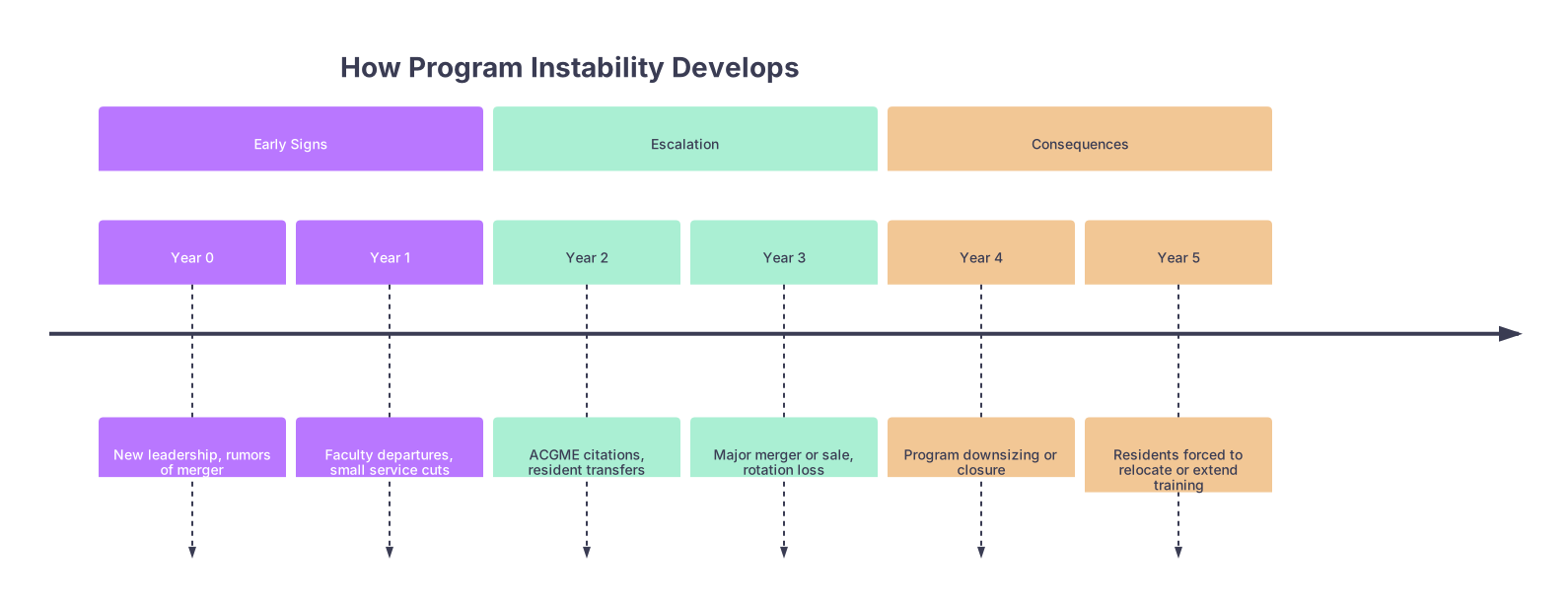
Quick Visual: Where Instability Creeps In
| Period | Event |
|---|---|
| Early Signs - Year 0 | New leadership, rumors of merger |
| Early Signs - Year 1 | Faculty departures, small service cuts |
| Escalation - Year 2 | ACGME citations, resident transfers |
| Escalation - Year 3 | Major merger or sale, rotation loss |
| Consequences - Year 4 | Program downsizing or closure |
| Consequences - Year 5 | Residents forced to relocate or extend training |
You may be arriving at Year 2 or Year 3 without realizing it. That is why you must look backward—what has happened in the last 3–5 years—not just at the shiny present.
What To Do If You Already Matched Somewhere Wobbly
Sometimes you are reading this too late. You matched. Then you learn about an announced merger, financial distress, or an ACGME warning.
Do not panic, but do not go passive either.
You should:
- Talk to your PD and DIO directly. Ask about concrete plans, accreditation status, and contingency planning for residents.
- Document everything. Save emails, official notices, and any communications about program changes.
- Contact your RRC or ACGME if there is serious risk to your ability to complete training. They care about resident outcomes more than institutional PR.
- Quietly explore options. If the writing is on the wall, you want to know which nearby or related programs might consider transfers.
The mistake here is denial. Residents who get burned are the ones who keep saying “it will probably be fine” while the walls are already cracking.
Charting Your Own Risk Tolerance
Different people have different appetites for risk. Some are willing to gamble on a new program with visionary leadership. Others want a near‑zero chance of disruption because they have kids, a mortgage, or a partner’s career to consider.
You are allowed to choose. You are not allowed to pretend there is no risk.
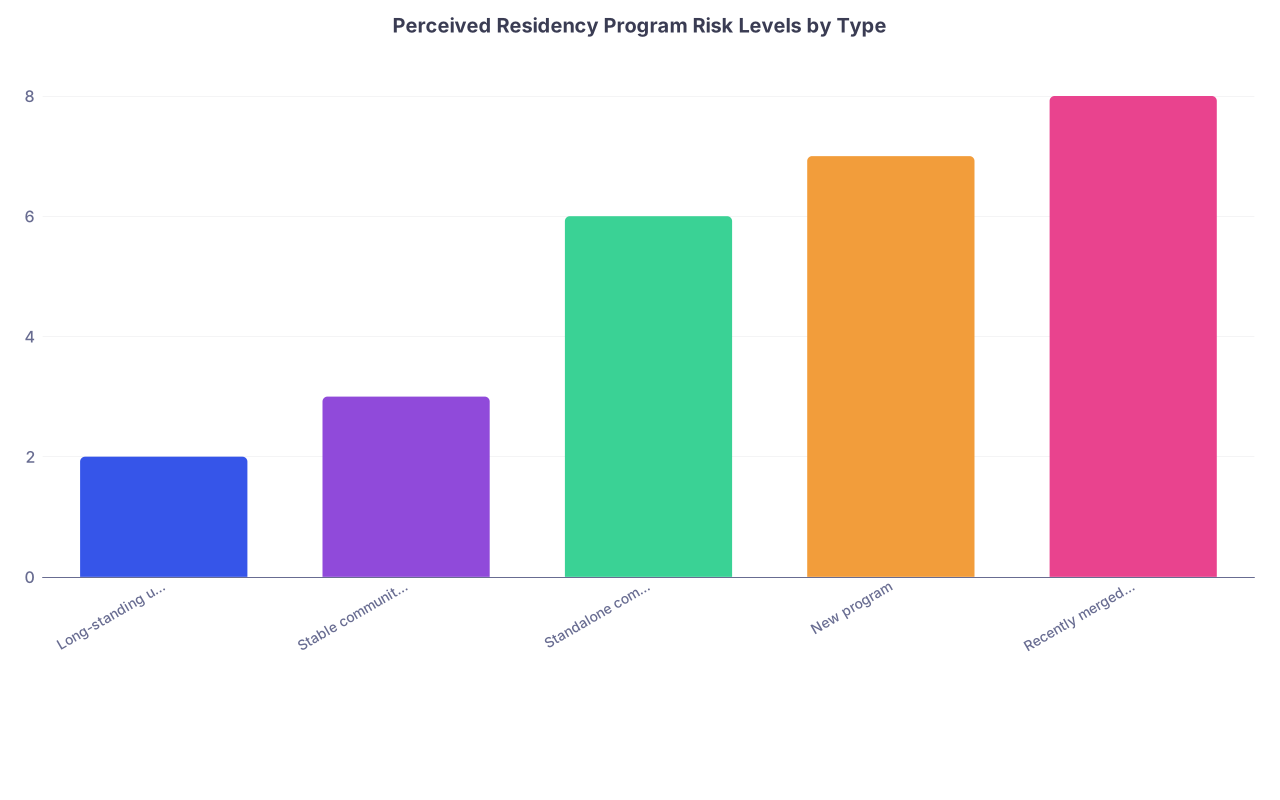
Here is a simple way to think about it:
| Category | Value |
|---|---|
| Long-standing university | 2 |
| Stable community affiliate | 3 |
| Standalone community | 6 |
| New program | 7 |
| Recently merged system | 8 |
(Think of 1 as very low risk, 10 as very high. These are illustrative, not gospel.)
If you are someone who cannot tolerate waking up in PGY-2 to news that your hospital is being sold, then you rank accordingly. If you are willing to ride out some chaos for location or unique training, do that with your eyes open, not shut.
Bottom Line: Do Not Be Naive About Program Stability
Underestimating program stability is not a minor oversight. It is how people end up:
- Moving cities mid‑residency.
- Repeating rotations they already did.
- Graduating from programs that no longer exist on paper.
- Explaining to every future employer why their training record has gaps and transfers.
You can avoid most of this by being slightly more skeptical and a lot more informed.
Remember these core points:
- Major system changes, ACGME issues, and leadership churn are not background noise; they are risk signals you must weigh seriously.
- You should interrogate stability with the same intensity you apply to case volume, prestige, and location—before you sign yourself up for 3–7 years.
- It is better to match at a slightly less “shiny” but stable program than to roll the dice on a place that might not finish the race with you.
Do not just ask, “Will this program train me well next year?” Ask, “Will this program still be standing when I graduate?”