
The word “pipeline” gets thrown around a lot in residency, and most applicants misunderstand it. A “pipeline candidate” is not magically special, and it does not mean what you think it means when you hear attendings say, “Oh, that student is pipeline for us.”
Let me tell you what “pipeline” really means behind closed doors—and exactly how it changes your rank position.
What “Pipeline Candidate” Actually Means Behind the Scenes
In PD meetings, “pipeline” is shorthand for: we already have a relationship and a history with this person or their institution, and they’re statistically safer picks for us.
That’s it. Strip away the fluff, and pipeline is about risk management and predictability. Programs are terrified of two things:
- Residents who struggle or fail out
- Residents who are miserable and leave for another specialty or program
Pipeline is how they try to reduce those risks.
When faculty say “pipeline,” they usually mean one of these:
- A student from their own medical school / home institution
- A student who rotated with them and impressed them enough
- A student from a “feeder” school or program whose grads have historically done very well there
- Less common but real: a student connected to trusted faculty (mentors, alumni, prior residents) who vouch for them strongly
Nobody writes this on the website. But in the ranking meetings, this is exactly the language:
- “She’s one of ours. She’ll be fine.”
- “He’s from our usual Caribbean school; their grads do okay here.”
- “She rotated here twice. She knows what she’s getting into. Pipeline.”
Pipeline = familiarity + a positive track record + reduced risk.
If you want to understand how your application will be treated, you need to understand which programs see you as pipeline—and which ones absolutely do not.
The Three Real Types of Pipeline (And How They Affect You)
There are really three flavors of pipeline that matter.
1. True Internal Pipeline: “One of Ours”
This is the strongest—and most misunderstood—type.
These are:
- Students from the program’s own med school
- Students in their own transitional/prelim/TY years
- Sometimes research fellows embedded in the department for a year or more
At rank meetings, these people are rarely debated the same way as outsiders. I’ve sat in meetings where someone said, “We have to take at least X from our own school,” before any discussion about USMLE scores or research.
Why? Three reasons:
- They know exactly what they’re getting—letters from colleagues, direct observation, reputation
- Political pressure: departments are judged on how many home students they “keep”
- Retention: home students tend to stay for fellowship, faculty, and long-term loyalty
How this impacts rank:
- Internal pipeline candidates get automatic “defensive” ranking. Programs rank them high enough to essentially guarantee they’ll match there if they rank the program highly.
- A borderline internal candidate will often be ranked above a stronger-on-paper external candidate. I’ve seen a 225 internal beat out a 240 external in IM because faculty trusted the internal more.
Does that mean every home student is safe? No. But if you are a home student and you’re not on probation territory, you’re usually starting with a baked-in advantage.
If you’re external, you’re competing against that advantage and you need to know it.
2. Rotator Pipeline: “We’ve Seen This Movie Before”
The second level is visiting students / audition rotators who made a strong impression.
There’s a brutal truth here: a good rotation can turn you into a pseudo-internal. A mediocre one can quietly bury you.
Programs use rotators as a live audition. Not just for competence, but for:
- Work ethic
- Fit with culture
- Ability to handle their specific volume and workflow
- Professionalism when tired and frustrated
In ranking committee, the language is blunt:
- “He rotated with us, zero drama, hard worker—pipeline.”
- “She was on nights with me. No attitude. Gets it.”
- Or the opposite: “I know he rotated here. I would not rank him.” (Yes, that happens.)
Rotator pipeline influence is strong, but not as automatic as internal pipeline. It’s like this mental hierarchy:
- Internal student = default yes unless red flag
- Excellent rotator = probable yes with active champions
- Non-rotator external = paper file + interview impression only
If you crush a rotation, you don’t suddenly become the #1 rank, but you likely get:
- A real discussion where faculty push for you
- Protection against lower board scores or nontraditional background
- A higher placement on the list than your paper alone would earn
The catch: programs remember specific behavior. That one time you disappeared for 45 minutes? That comment you made about “this place being malignant”? The senior resident who did not like your “energy”? Those show up in the meeting.
You become pipeline, but pipeline with a judgment attached.
3. Institutional Pipeline: “We Trust Their People”
The third type is subtle: where you trained, who trained you, and the patterns programs have seen over time.
Programs keep a mental ledger:
- “Students from X osteopathic school have done well for us.”
- “Caribbean grads from Y campus are usually solid but need more support intern year.”
- “Z top-tier med school students sometimes struggle here because they are not used to our workload and system.”
No one says this on the record. But in the room, it’s very candid.
What this means: you may be “pipeline” and not even realize it because:
- Your med school sends 1–3 residents there every year or two
- Your dean has a personal relationship with the PD
- Your school’s chair trained there or sends strong letters there consistently
You feel like an outsider. They see you as a known product.
This type of pipeline doesn’t guarantee a match, but it shifts how your weaknesses are interpreted:
- A 230 Step 2 from a historically strong feeder school is seen as “solid, we know they’ll handle it.”
- The same 230 from a totally unknown school may be classified as “risky, unknown training environment.”
Here’s the part no one tells you:
| Candidate Type | How They’re Discussed | Typical Rank Effect |
|---|---|---|
| Home med student | “One of ours” | Ranked protectively high |
| Strong visiting rotator | “We know them, good fit” | Bumped up multiple tiers |
| Known feeder school grad | “Their people do well here” | Borderline issues forgiven |
| Unknown school, no ties | “Paper only, unknown risk” | Needs standout metrics |
How Being (or Not Being) Pipeline Changes Your Rank
Here’s the uncomfortable truth: programs do not rank everyone by one universal metric. They rank groups of people differently depending on perceived risk.
Think about it like this. During rank meetings, we’re not sitting there sorting a spreadsheet by Step score and rolling with it. We’re having conversations like:
- “We should protect our home students.”
- “We need at least 2–3 rotators we liked.”
- “We can take a swing on 1–2 riskier candidates because we have a strong class otherwise.”
Pipeline status directly changes which “bucket” you’re in.
Rank List Buckets (The Real Ones)
PDs rarely admit this publicly, but internally they think in layers:
- Must-have candidates
- Very solid / likely to thrive
- Safe, acceptable residents
- Risky but interesting (big upside, big downside)
- Do not rank
Pipeline tends to shove you up one bucket.
- A home student who would otherwise land in “safe, acceptable” often gets nudged into “very solid” just to protect the relationship and reduce the chance of a disastrous mismatch.
- A strong rotator who’d normally be “solid but unknown” gets nudged into “must-have” or “very solid” because the faculty trusts what they’ve seen.
On the flip side, not being pipeline generally keeps you in your literal bucket. You need your numbers, letters, and interview to be so strong that you force the discussion.
If you’re a non-pipeline candidate with a borderline part of your application (low Step 1 before pass/fail era, gap year, failed course), programs ask themselves:
“Are we willing to take this risk on someone we don’t know, when we could fill this spot with someone from our own school or someone we’ve seen on rotation?”
Often the answer is no, and you slide down the rank list—not necessarily to “do not rank,” but to the part of the list that may never be reached.
How to Turn Yourself Into Pipeline (Even If You’re Not A Home Student)
You can’t change where you went to med school. But you can absolutely change whether you look like a known quantity or a stranger when rank meetings happen.
Here’s how you build “pipeline” from the outside.
1. Strategic Away Rotations (Not Random Tourism)
Visiting rotations are currency—if you spend them correctly.
Programs actually notice:
- Which students choose to be with them
- How early you reach out
- Whether you act like someone who might stay, or like a tourist checking a box
If you rotate somewhere and then list ten higher-ranked competitors on your ERAS or in conversations, it’s obvious. Residents pick up on what you say. They tell faculty. It gets mentioned.
To build pipeline from a rotation:
- Pick 1–2 realistic target programs that genuinely fit your stats and story
- Rotate there early enough that residents and faculty still remember you when interview season hits
- Make it clear (without being clingy) that you would actually come there if offered a spot
And then, after the rotation:
- Send concise follow-up emails to key faculty and residents
- Mention them specifically in your thank-you notes and in your ERAS signaling where applicable
- Stay visible but not needy—an occasional “just wanted to update you, I interviewed at X and Y, you remain at the top of my list for reasons A/B” is fine
That’s how you go from “we saw this student once” to “this person is in our orbit—pipeline-ish.”
2. Letters from Their People
Programs give disproportionate weight to letters from people they know and trust. If Dr. Smith, former faculty or alumnus, writes, “I would take this person in my own program,” that flags you very differently.
This is the whisper effect: PDs email each other. Chairs call each other. Alumni text each other. That “one strong letter from someone we know” can convert an unknown candidate into quasi-pipeline.
If you have any of the following:
- A mentor who trained at your target program
- A faculty member who knows the PD personally
- An alumnus of the residency who now works with you
You leverage that. Explicitly ask:
“Would you feel comfortable reaching out to Dr. X at [target program] to let them know you’re strongly supporting my application there?”
Some will say no. Some will say yes. The ones who say yes are effectively giving you a shortcut into the pipeline category.
3. Visibility Without Being Annoying
Pipeline is as much about familiarity as it is about prestige. You want decision-makers to recognize your name in January when they stare at the rank list.
Tactics that work (when done professionally):
- Email the coordinator/PD once, maybe twice, with a clean, short update if you have a major change: new Step 2 score, publication, honor, AOA, Gold Humanism.
- If you interviewed and loved the place, send a specific post-interview email: what about the culture or curriculum fit you, not just “you’re my top choice” fluff.
- If you rotated there, mention cases, teams, or experiences that show you truly remember and valued your time.
What you’re building is a mental story: “This is the student we met on rotation/interview who really wanted to be here.” That’s pipeline-lite.
The Dark Side: When “Pipeline” Works Against You
You should also understand when pipeline status sinks you.
1. If You’re Internal and Underperforming
Home students think they’re safe. Many are. But there’s another conversation that happens off the record:
“We already struggled with him in third year.”
“She barely passed that Sub-I, and you want us to put her here for three more years?”
“I do not want to supervise him as a resident.”
An external candidate can hide weak clinical years behind polished letters and a good interview. You can’t. As a home student, everyone remembers that one unprofessional moment, that stretch of poor effort, that borderline eval.
I’ve seen home students not even offered interviews by their own home residency, while external students get ranked highly. That’s not rare.
So if you’re internal and you know your performance has been shaky, do not assume pipeline will save you. You need to control the damage early, have honest conversations with mentors, and build a specific defense: strong Sub-I, strong letters from people who formerly had concerns, visible growth.
2. The “We Know Too Much” Problem for Rotators
Same dynamic with visiting rotations. Auditions are double-edged.
If you rotated and:
- Frequently showed up late
- Acted disinterested
- Pushed back on feedback defensively
- Made it clear you saw the program as a backup
Your name will come up, but not how you want. You go from anonymous risk to known negative quantity.
Programs will choose a totally unknown candidate with okay stats over a known rotator with attitude. Every time. I’ve been there when a PD said, “I’d rather take someone I have not met than deal with that again.”
So if you rotate, you’re playing a high-stakes game. You’re asking: “Judge me on the real thing, not just paper.” If you’re not ready to perform at that level, don’t do an away there.
Choosing Programs With Pipeline In Mind (Instead of Fantasy)
Here’s how you use all this to choose smarter and understand your odds.
First, stop pretending all programs see you the same way. They don’t.
Think about your list in three buckets:
Strong pipeline potential
- Your home program
- Programs where your school has matched people repeatedly
- Places where you’ve rotated and done well
- Programs where mentors/alumni are actively advocating for you
Neutral but realistic
- No specific ties, but your metrics and profile line up comfortably with current residents
- Maybe geographic ties, but not deep institutional ones
Fantasy / lottery tickets
- Hyper-competitive places where they overwhelmingly take their own or top-tier feeders
- Places with zero history of taking your kind of profile (IMG/DO/caribbean, low Step, etc.)
You should absolutely apply broadly. But you should not emotionally invest in programs where you’re the exact opposite of their pipeline and bring nothing unusual (massive research, unique skillset) to compensate.
Instead, lean hard into the places where you either already are pipeline—or can become pipeline with targeted rotations, letters, and contact.
And yes, that may mean ranking a “mid-tier” program that loves your school and knows your mentors above a “top-tier” name brand that has never met someone like you. If your goal is to match and be supported, that’s the intelligent move.
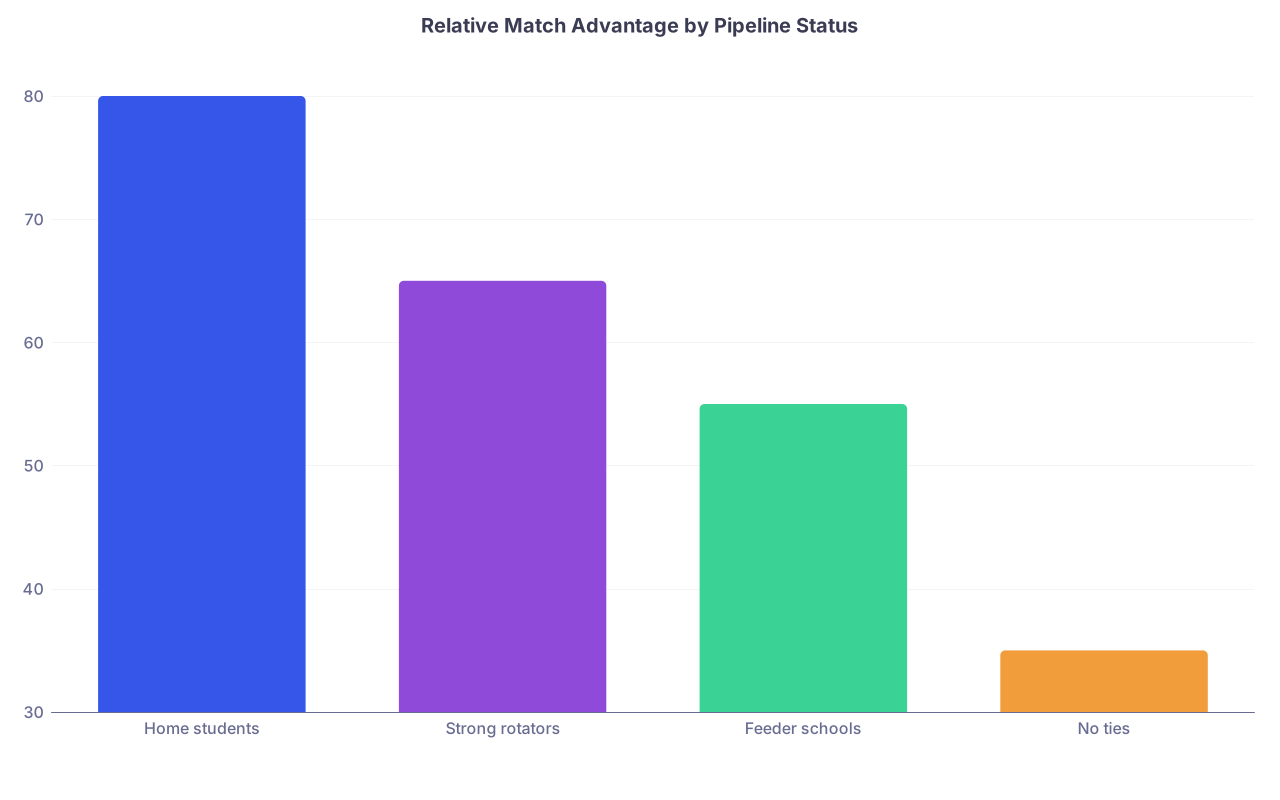
Visualizing Where You Actually Have an Edge
Here’s roughly how applicants usually break down in a typical program’s real rank behavior:
| Category | Value |
|---|---|
| Home students | 80 |
| Strong rotators | 65 |
| Feeder schools | 55 |
| No ties | 35 |
Those numbers aren’t from any specific paper; they’re the rough odds I’ve watched play out year after year in rank meetings. You don’t have to like it. But ignoring it is foolish.
When to Ask Directly About Pipeline
One last inside tip: you can ask about this—indirectly—during interviews and communication.
On interview day, instead of “What can I do to improve my chances?” (which every PD hates), ask:
- “Where do most of your residents come from? Are there particular schools or rotations that tend to feed into your program?”
- “For visiting students who rotate here, how does that experience usually influence how you view them on the rank list?”
Their answers will tell you instantly whether you’re aligning with their pipeline or trying to batter your way in from the outside.

| Step | Description |
|---|---|
| Step 1 | You apply to program |
| Step 2 | More discussion in ranking |
| Step 3 | Leniency on minor weaknesses |
| Step 4 | Paper metrics drive decisions |
| Step 5 | Likely higher on list |
| Step 6 | Moderate position on list |
| Step 7 | Needs standout file to move up |
| Step 8 | Pipeline connection |

FAQ – The Real Questions You’re Afraid to Ask
1. If I’m not pipeline anywhere, am I screwed?
No. You’re just playing on “hard mode,” which means your file has to be clean and compelling. Non-pipeline candidates match all the time, especially if:
- Their scores and clinical performance are consistent
- They apply broadly and choose programs whose resident profiles look like them
- They build at least some form of pseudo-pipeline with targeted rotations and letters
You cannot rely on good vibes and geographical preference alone. You have to give programs a reason to take a chance on someone they don’t know.
2. Should I always rank my home program first because of pipeline?
Absolutely not. Pipeline increases their desire to keep you, not your obligation to stay. If culture, geography, or fit are wrong for you, rank accordingly. Programs want residents who want to be there. A miserable internal resident is politically worse than losing you to a better fit elsewhere.
Just be honest with yourself: if you walk away from a strong pipeline advantage, make sure it’s for a compelling reason and that you have realistic backup options.
3. Is it worth doing an away rotation if I’m not a “superstar”?
Yes—if you’re solid, professional, and self-aware. You do not need to be a once-in-a-generation rockstar to benefit. You just need to be reliable, easy to work with, humble, and engaged. Those traits convert you into pipeline far more than flaunting knowledge. But if you know you struggle with professionalism, work ethic, or basic clinical performance, an away at your dream program can hurt more than help. In that case, fix those issues at home first.
Key points to walk away with:
Pipeline means “less risk” and “known product” to programs, not “chosen one.” It quietly bumps some candidates up the rank list and keeps others stuck in the generic pile. You can’t fake being a home student, but you can create your own version of pipeline with smart rotations, targeted letters, and visible interest.