7 Mistakes Applicants Make When Evaluating Residency Night Float Schedules
Night float will either teach you medicine at 3 AM or break you before you ever become an attending. Most applicants treat it like a side note on the interview trail. That's the first mistake. By the time you realize it, you're 14 weeks into intern year with a circadian rhythm that belongs to a vampire and a relationship that's dissolving by text message. Don't be this person. Learn what to look for now.

Before finalizing your decisions, understanding how call schedules differ by specialty can reveal hidden lifestyle pitfalls.
This article is for educational purposes only. It is not financial advice, not legal advice, and not tax advice. Figures vary by individual circumstances, consult a qualified professional before acting.
The Danger Zone: Why Night Float Can Make or Break Your Residency
Here's the truth most program directors won't say out loud: a poorly structured night float system corrodes you. Not dramatically. Not all at once. It accumulates like microvascular damage in a diabetic. You sleep 4 hours. Then 4. Then 5. You stop going to the gym. You skip your sister's wedding. You start crying in the supply closet for reasons you can't fully articulate. By month three, you don't recognize yourself.
I watched a brilliant internal medicine resident quit during his second night float block because nobody warned him that "block night float" at his program meant six weeks of consecutive nights with one single day off in between. The brochure said "resident-friendly scheduling." The actual schedule said "we own you."
To prevent these issues, it is vital to review how to systematically compare call schedules across residency programs before submitting your rank list.
The warning: Never trust the brochure. Brochures are marketing. Testimonials from current residents are intelligence. If you can't get a resident alone at a second-look dinner or over coffee, you're flying blind.

Mistake #1: Ignoring the Brutal Math of Rotation Frequency and Cumulative Fatigue
"Every fourth night" sounds reasonable until you do the math. In a traditional Q4 call system, you're working 24+6 hours every fourth day for the entire month. That's 7-8 calls. Your total hours still meet ACGME standards, technically. Your soul doesn't.
But here's what applicants miss: the type of night float matters enormously. Programs run three models:
- True night float blocks, 2-6 consecutive weeks of nights, then days off
- Hybrid systems, weekly rotations between days and nights
- Q4 traditional call, the old-school 24+6 marathon every fourth day
The hybrid sounds humane. It's often the worst. Flipping your circadian rhythm every week prevents your body from ever fully adapting to either schedule. You'll be perpetually jet-lagged for 12 months. I've seen residents gain 30 pounds, develop heart palpitations, and require melatonin prescriptions just to function.
The cumulative sleep debt chart below shows why block scheduling isn't automatically better either. The first week feels brutal but survivable. By week four, you're running a deficit most people can't recover from in one weekend off.
The red flag: If a program can't articulate which model they use and why they chose it, they haven't thought critically about resident wellness. Run.
Mistake #2: Falling for the 'Protected Time' Illusion
Every program boasts "post-call days off" and "protected educational half-days." Every program lies about these. Some lie unintentionally. Some lie aggressively.
Ask any third-year resident in private: "When you finish a 28-hour shift at 7 AM, are you actually out by 9 AM, or are you stuck finishing notes until noon?" The honest answer will horrify you. The dishonest answer, the one the chief resident gives during the official lunch, will sound reassuring.
Same goes for educational half-days. In theory, Wednesday afternoons are protected for didactics. In practice, half the residents are paged out to cover admissions because the day team is short. The "protected" time becomes a joke. You attend three didactics all year.
Don't accept the schedule grid at face value. Demand specifics:
- What percentage of post-call days actually see you leaving within 30 minutes of your shift end?
- Are conference attendance rates tracked? If so, what's the average?
- How often are residents pulled from didactics for clinical duties?
If the program director dodges these questions, the answer is "constantly."
Mistake #3: Overlooking Post-Call Extraction and Hand-Off Traps
Here's a scenario that plays out in 70% of programs I've consulted for. Your shift ends at 7 AM. You have four patients to hand off. The day team is late. The night attending wants a full debrief on a complicated case. The EMR crashes. The new intern has 47 questions. You're still in the hospital at 10:30 AM. You finally drive home. You sleep for 90 minutes before your phone rings with a clarification question about Patient #3.
This is the post-call extraction trap. It's not officially part of your shift. It doesn't count toward duty hours. It destroys you anyway.
A clean hand-off protocol protects you. A chaotic one robs you of your recovery time. The difference between these two systems is the difference between leaving at 7:30 AM with a chance at real sleep versus leaving at 10:30 AM with a 90-minute window before you start your post-call day.
Ask to see the actual hand-off template. If they don't have one, or if it's 47 bullet points long, you're about to lose three hours of your life every morning.
Mistake #4: Disregarding Isolation, Burnout, and the Disconnect from the Core Residency Team
This one gets zero airtime during interviews. Nobody talks about it. Everybody feels it. Night float residents are ghosts. You arrive when the day team leaves. You leave when the day team arrives. You cover admissions while your categorical co-residents are at an off-site retreat you weren't invited to. You miss the inside jokes. You miss the bonding. You become professionally homeless.
Some programs integrate night float residents into the main cohort through weekly dinners, scheduled check-ins, or shared rotation experiences. Most don't. Most treat you as coverage labor.
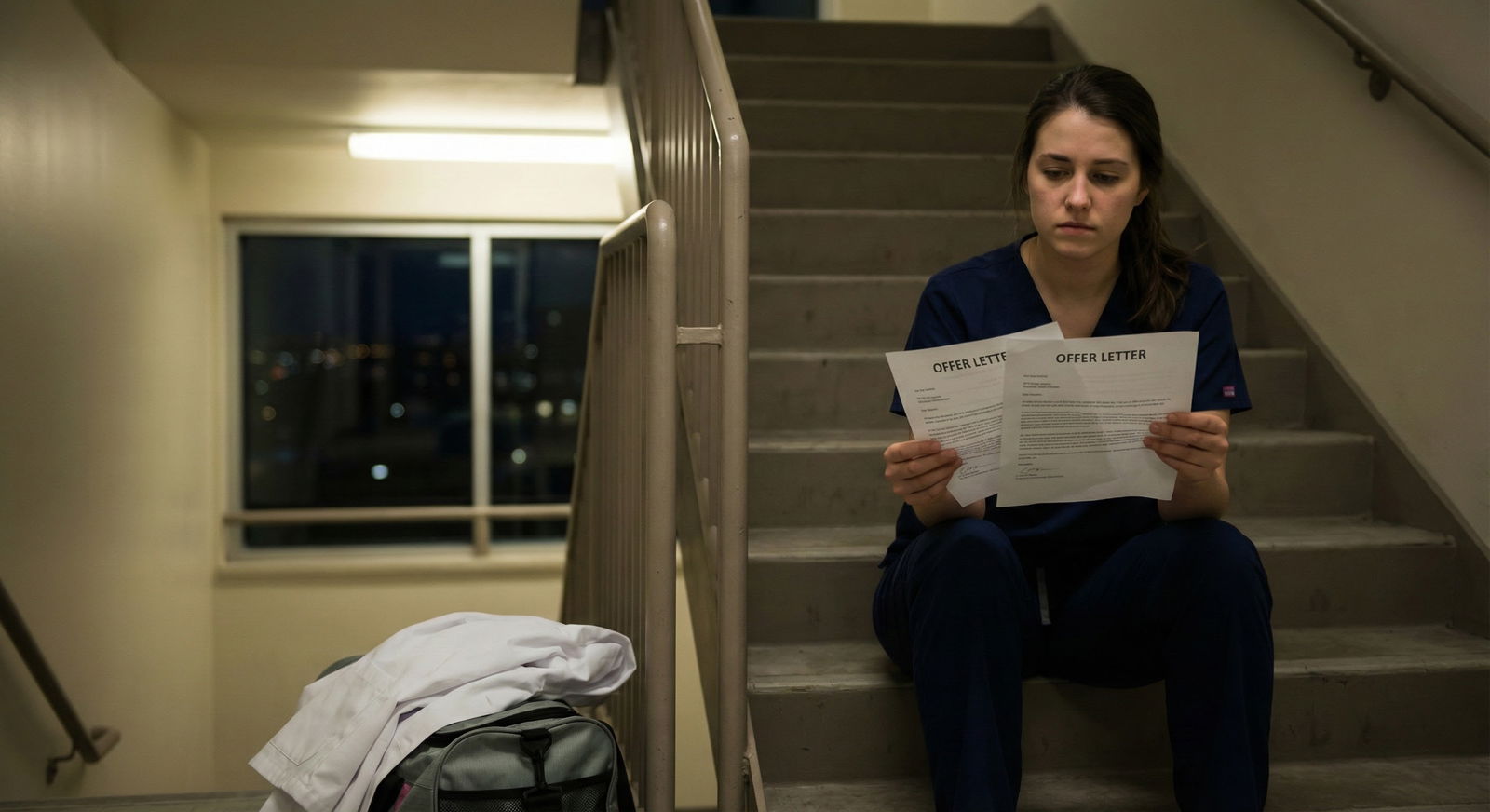
The psychological toll is real. A 2022 study in Academic Medicine found night float residents scored 30% higher on burnout inventories than their day-shift peers. The disconnection from the core team was the single strongest predictor, stronger than sleep deprivation, stronger than workload.
The question to ask: "What does the program do to keep night float residents connected to their categorical class?" If they stammer, you know the answer.
Mistake #5: Failing to Interrogate Supervision Levels and Attending Availability at 4 AM
Here's a nightmare scenario that happens more often than you'd think. You're a new intern. It's 4 AM. A patient is crashing. The senior resident is tied up in a code across the hospital. You page the attending. No callback for 20 minutes. The patient's family is screaming. You're alone. You're 7 months into residency. This is your first job where people can die because of your decisions.
Who you call at 4 AM matters more than who you call at noon. Some programs have in-house attending coverage 24/7. Some have attendings who take home call and respond from bed. Some have senior residents as the primary backup with attendings available but rarely involved.
The most dangerous setup: "shadow supervision" where an attending is technically reachable but functionally absent. You think you're supervised. You're not. You're practicing medicine independently with a safety net that has holes.
The red flag: Programs that can't clearly articulate their night supervision chain. If the answer involves phrases like "attendings are always available by phone" without specifying response time benchmarks, you're looking at shadow supervision.
Mistakes #6 & #7: Missing Moonlighting Opportunities and Violating ACGME Duty Hours
Mistake #6: The moonlighting myth.
Internal moonlighting sounds like a perk. "Work extra shifts for extra cash while you're already in-house." The reality: most night float schedules are already optimized to ACGME limits. There's no moonlight time built in unless the program actively carves it out. And those that do often pressure residents into it, blurring the line between optional supplemental income and unspoken obligation.
Programs that genuinely support moonlighting will tell you exactly when it's available, how to sign up, and what the rates are. Programs that offer "moonlighting opportunities" as a recruitment line without details are using it as bait.
Mistake #7: The duty-hour averaging trap.
ACGME rules say you can't work more than 80 hours per week averaged over four weeks. Sounds protective. The trap: programs schedule you at 78-79 hours, leaving zero margin for post-call extraction, hand-off delays, or chart completion. One slow day and you're in violation. But because the violation doesn't show up on paper until the four-week average tips, nobody catches it until you're already burned out.
The chart shows how programs manipulate scheduling to stay technically compliant while functionally abusive. Look at the averaging windows. Look at the "buffer hours" in green. Look at how quickly those buffers disappear when clinical load increases.
Ask the program: "Show me your actual duty hour logs from the last quarter. Not summary data. The real numbers." If they refuse, they have something to hide.

Key Takeaways Before You Submit That Rank List
- Never trust the schedule grid. Verify with at least three current junior residents in private settings. Ask the same questions to each one and look for inconsistencies.
- Calculate cumulative sleep debt. Block night float isn't automatically better than Q4 call. Ask about the actual sleep recovery windows.
- Investigate hand-off culture. Disorganized hand-offs steal hours from your post-call recovery every single time.
- Watch for isolation patterns. Night float residents who are disconnected from their cohort burn out faster and quit more often.
- Demand supervision specifics. "Attendings are available" means nothing without response time benchmarks and escalation protocols.
- Verify moonlighting reality. Programs that offer moonlighting as a perk should be able to show you the schedule slots and rates.
- Audit the duty hour logs. Programs confident in their compliance will share real data. Programs that hide it are hiding something.
Final Warning: Your Schedule is Your Life for the Next 3-7 Years
You're going to spend more waking hours with your night float schedule than with your family, your hobbies, and your self-care combined. If you rank a program based on its fellowship match rate or its hospital's reputation without auditing how it treats its residents at 3 AM, you're choosing a career on incomplete data.
The polished version of residency you see on Interview Day is a fiction. The real version lives in the group chats of current residents, the anonymous survey results, and the body language of the junior residents you corner at the second-look dinner. Find that version. Ask the uncomfortable questions. Listen for the pauses. Watch for the eye contact that drops when you mention specific concerns.
Your rank list is a five-year decision built on five hours of facetime. Don't let the night float schedule be the thing you didn't investigate. It's the thing that will define whether you finish residency as a whole physician or a hollowed-out shell counting down to your escape.
Pick the program that respects your sleep, your sanity, and your supervision. The rest is noise.