
You’re logging into the computer at 6:57 p.m. Night float again. The day team is speed‑talking through sign‑out, your pager already went off once during check‑in, and you’re staring at a list of 40 patients you’ve never met.
By 9:30 p.m., here’s what’s waiting for you:
- A “just watch him” patient who is now hypotensive.
- A “stable” elderly lady whose sodium came back at 118.
- A post‑op “doing great” patient with a heart rate of 140 the nurse has paged about three times.
If your nights feel like this, it’s usually not “bad luck.” It’s cross‑cover errors.
Let me walk you through the seven big ones that consistently blow up night float. The mistakes that turn manageable nights into chaos. And more importantly—how to stop making them.
1. Accepting Vague Sign-Out As “Good Enough”
The first landmine is right at sign‑out. You’re tired, the day team is fried, and everyone wants to get out. That’s exactly when dangerous shortcuts creep in.
You hear stuff like:
- “He’s kind of sick but okay right now.”
- “She’s been tachy all day but that’s just her.”
- “If anything happens, just give fluids.”
This is garbage sign‑out. And if you accept it, you’re the one paying for it at 2 a.m.
Here’s the mistake: you don’t pin people down. You let vague language pass without specifics.
You should be demanding:
- What’s the active problem list tonight?
- What are they actually worried about?
- What’s the threshold for calling the attending?
- What exact interventions are okay vs not okay?
If they say, “He’s a little hypotensive at baseline,” you clarify: “Numbers. What were his pressures today? What range are you comfortable with? At what BP do you want me to call you or the attending?”
If they say, “Just give fluids,” you ask: “What kind? How much? Over how long? What’s his EF? Last echo? Any history of HFpEF/HFrEF?”
If they say, “He’s septic but improving,” you ask: “Last lactate? Last blood pressure trend? Is he still on pressors? What antibiotics is he on and what source?”
Do not be afraid to slow sign‑out down. I’ve watched interns nod along to a 20‑patient sign‑out in 10 minutes, then get destroyed later because they never questioned lazy phrases like “okay for the floor” or “probably fine overnight.”
Red flags in sign-out:
- “Soft” words: kinda, a little, borderline, probably, maybe.
- No vitals ranges discussed.
- No clear “if X then do Y” plans for the sick ones.
- No code status mentioned for high‑risk patients.
You don’t need perfection. You do need clarity.
2. Not Identifying Your “Can’t Miss” Patients Early
Huge cross‑cover mistake: treating all sign‑out patients as equal.
They’re not.
On night float, you have three tiers:
- People who might die or crash tonight.
- People who will probably annoy you with pages.
- Everyone else.
If you don’t identify tier 1 in the first 30–60 minutes, they’ll introduce themselves to you later. Usually via a STAT page.
You should walk into every night with a mental rule: I will know my top 5 risk patients before 8 p.m.
That means:
- You ask the day team directly: “Who are your 3 sickest?” for each service.
- You actually open those charts right away.
- You scan vitals from the last 24 hours, labs trends, and oxygen requirements.
- You read the last note problem list for those specific patients.
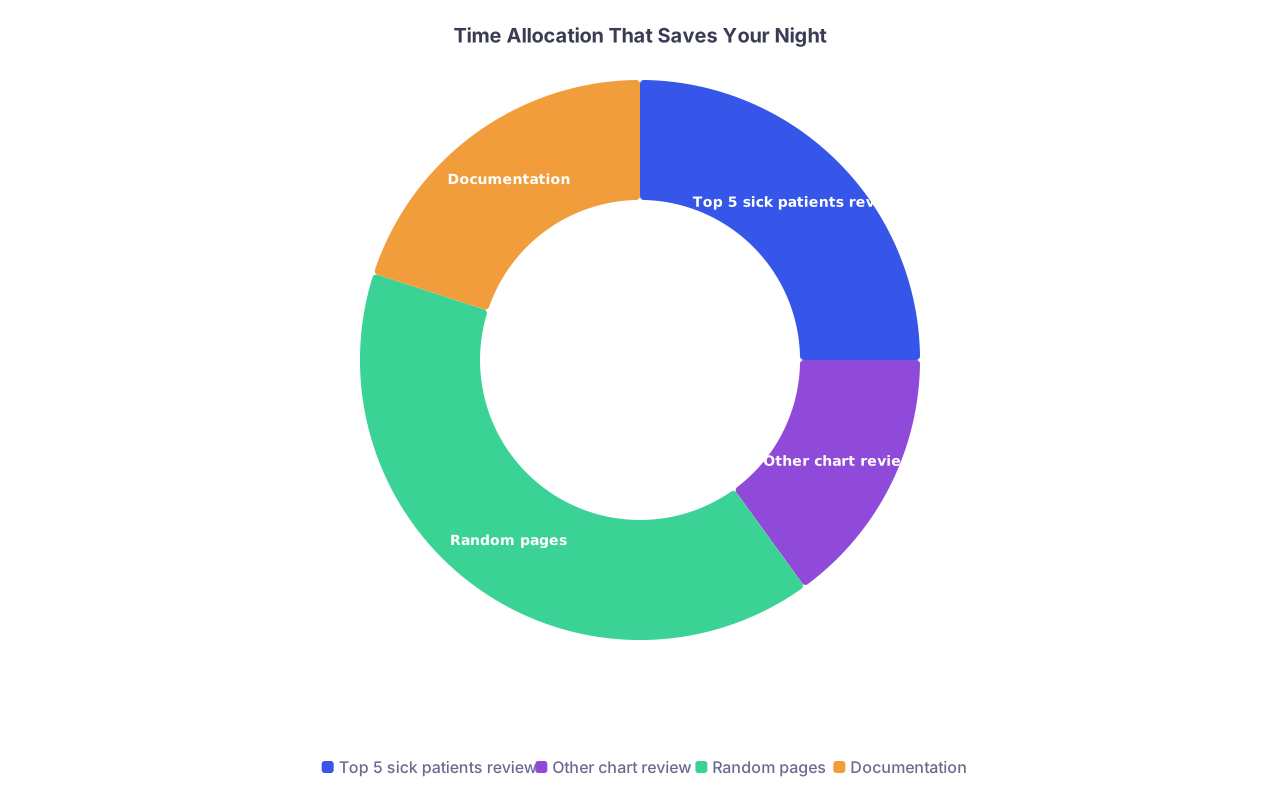
| Category | Value |
|---|---|
| Top 5 sick patients review | 25 |
| Other chart review | 15 |
| Random pages | 40 |
| Documentation | 20 |
That first 30 minutes you “don’t have time” for? That’s exactly what prevents the 3 a.m. train wrecks.
I’ve seen this play out:
- Post‑op day 1, borderline pressures, minimal urine output, “keep an eye on him.”
- No one looks at his I/O, baseline EF, or meds.
- At 1 a.m., he’s 70/40, anuric, altered, and now you’re starting levophed on the floor and begging ICU for a bed.
If you’d scanned:
- Urine output for last 12–24 hours.
- Creatinine trend.
- EF report.
- Whether home antihypertensives were continued.
You would’ve seen where this was going and maybe called the day team or attending early.
Do not let your first interaction with a high‑risk patient be a code.
3. Treating Every Page as Equal Priority
Your pager isn’t a to‑do list. It’s triage. If you handle pages in chronological order, you’re doing it wrong and you will hurt someone.
Big mistake: not having a mental triage framework.
You need a default hierarchy. Something like:
- Airway / Breathing / Circulation alarms.
- New neuro changes.
- Big vital sign changes (hypotension, tachycardia, hypoxia, fever in neutropenic).
- Lab results that can kill people (K 2.8, K 6.2, Na 118, Hgb 5.8, troponin trending up).
- Pain / nausea / sleep / routine requests.
And you need to get comfortable telling nurses, “I’ll be there, but I have to see a sicker patient first.” That’s not being rude; that’s being safe.

Common cross‑cover trap:
- You rush to the loudest problem, not the most dangerous.
- So you spend 20 minutes writing for melatonin, adjusting bowel regimens, or reconciling home vitamins while a different patient slowly desaturates in another hallway.
When a page comes in, your first action should not be walking to the room. It should be:
- Ask for vitals.
- Ask what the nurse sees right now.
- Ask what’s changed from baseline.
Example: Page: “Pt c/o 9/10 pain, wants dilaudid, refusing other meds.” Wrong move: Drop everything and go argue about opioids. Better move: Ask vitals, ask if this is new or chronic, ask if there are any red flags. If stable and chronic, that can wait if someone else is hypotensive or newly hypoxic.
You will feel pulled everywhere. Your job is to resist becoming purely reactive. Triage is what protects you.
4. Believing “Just Give Fluids” Is a Universal Fix
If there’s one instinct that wrecks cross‑cover nights, it’s this: “They’re hypotensive? Just give fluids.”
This is how you tank a heart failure patient. Or drown a cirrhotic. Or delay pressors in septic shock.
I’ve watched this pattern:
- Patient with EF 25%, baseline leg swelling, gets “just 1L LR” at 11 p.m.
- Another “gentle 500” at 2 a.m.
- By 5 a.m., they’re on BiPAP with flash pulmonary edema and you’re calling ICU.
Fluid is a drug. You should be just as cautious and deliberate as starting a new medication.
Before you push fluids at night, you ask:
- What is this patient’s likely volume status?
- What’s their cardiac function?
- What’s their renal function?
- What’s their exam? Lung sounds? JVD? Edema?
- What was done during the day? Did they already get 3L?
| Scenario | Why It Blows Up |
|---|---|
| EF 25%, crackles present | Risk of pulmonary edema |
| Cirrhosis, tense ascites | Third spacing, no benefit |
| ESRD with minimal urine | Fluids just stay intravascular |
| Septic shock, already 4L | Need pressors, not more fluid |
Your safer approach:
- If you think they’re fluid responsive and not overloaded: okay, a small bolus (250–500 mL), then reassess.
- If they’re high risk for overload: consider smaller bolus, very close monitoring, or calling senior/attending/ICU early.
- If you suspect true shock and they’ve already had fluid: stop playing whack‑a‑mole with boluses and get help to start pressors or escalate care.
Don’t reflexively order a liter because you’re tired and it feels like “doing something.” That “something” is often what ruins your night.
5. Ignoring Baseline and Trends
Another recurring cross‑cover rookie mistake: you look at a single number in isolation and freak out (or blow it off), instead of looking at the pattern.
Examples I’ve seen over and over:
- Patient with chronic HR 100–110 is 118 at 2 a.m. and you get called. You order labs, fluids, EKG, make it a huge event. But for them, that’s baseline and unchanged.
- Patient with “BP 95/60, soft” gets ignored because “they’re always like that,” but in reality they’ve been 130s/80s the entire admission until tonight.
- A hemoglobin dropping from 10 to 8 overnight gets shrugged off as “probably lab variation,” even though yesterday it was 13.
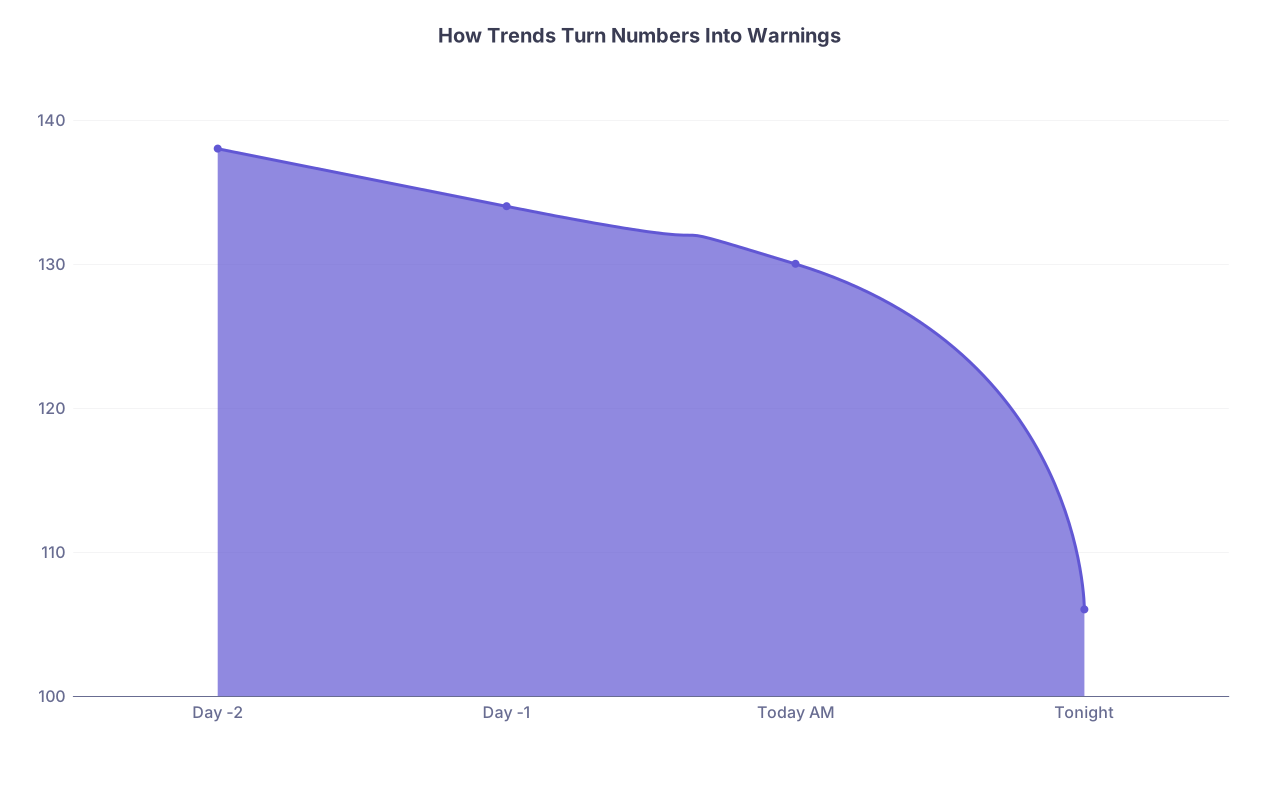
| Category | Value |
|---|---|
| Day -2 | 138 |
| Day -1 | 134 |
| Today AM | 130 |
| Tonight | 106 |
See that BP trend? That “106/60, seems okay” becomes a lot less okay when you realize they were hypertensive all week.
At night, every time you’re paged for:
- Hypotension
- Tachycardia
- Hypoxia
- Fever
- Lab abnormality
Your default workflow should include:
- Scroll vitals for last 24–48 hours.
- Check labs trend, not just today’s result.
- See what interventions were done today (new meds? diuretics? transfusions? procedures?).
You’re not just asking “What is this now?” You’re asking “What direction is this going, and how fast?”
The mistake is reacting to snapshots. Good cross‑cover is pattern recognition.
6. Over-Treating “Numbers” and Under-Treating Patients
Night float seduces insecure residents into chasing labs instead of treating humans. Because numbers feel concrete. They give you something to “fix.”
That’s how you end up:
- Repleting potassium from 3.4 to 4.0 at 4 a.m. in a stable patient.
- Pushing insulin for a glucose of 220 in a non‑critical diabetic at 1 a.m., then dealing with hypoglycemia at 5 a.m.
- Drawing serial troponins on an 89‑year‑old with CKD and zero chest pain because “it was 0.06 and that’s high.”
Let me be blunt: most mild abnormalities do not need aggressive correction at 2 a.m.
What does need action:
- Dangerous deltas: K 2.8, K 6.2, Na 118, Na 160, Hgb 5.8, platelets 8k, lactate 5.2, troponin climbing with symptoms.
- Numbers that correlate with real clinical changes: new hypoxia, new confusion, new chest pain, new focal deficits.

Ask yourself every time:
- Is this number new or chronic?
- Does this number match how the patient looks?
- Will acting now change anything meaningful before morning?
If not, document your reasoning briefly and move on. Do not create extra problems with unnecessary interventions.
Common example: Page: “Mag is 1.7, can we replete?” Stable patient, no arrhythmias, no special indication? Sure, order mag—but that’s a 10‑second order, not a 20‑minute workup. And you don’t cancel five other tasks to obsess over it.
Remember, you’re responsible for everyone on the list, not for perfecting each lab value overnight.
7. Failing to Escalate Early (Or At All)
The last mistake is the most dangerous: you wait too long to ask for help.
I see this constantly:
- Intern gets called for hypotension.
- Gives fluid. Marginal response.
- More fluid. Marginal.
- Orders labs. Waits.
- Checks back two hours later. Still bad. Now they call the senior. By then, the patient is much sicker and options are narrower.
You’re not being “strong” by managing alone. You’re gambling with someone’s life and your license.
Your rule at night should be: If your gut says “This feels bad,” or if you’ve done your first reasonable intervention and they’re not clearly heading the right way, you loop in someone else.
That might be:
- Your senior resident.
- The on‑call fellow.
- The attending.
- The ICU team.

| Step | Description |
|---|---|
| Step 1 | Get page |
| Step 2 | Assess vitals and exam |
| Step 3 | Basic orders and monitor |
| Step 4 | Immediate intervention |
| Step 5 | Continue close monitoring |
| Step 6 | Call senior or ICU early |
| Step 7 | Unstable or concerning trend |
| Step 8 | Improving after first step |
If you feel embarrassed to call, here’s the reality: every good senior would rather be woken up early for a maybe‑sick patient than dragged in late for a code.
You should particularly have a low threshold to escalate for:
- Persistent hypotension after a trial of fluid or when fluid is risky.
- Escalating oxygen needs (especially if moving from NC to NRB or from NRB to BiPAP).
- New chest pain, neuro deficits, or acute mental status change.
- Any time you think “If this goes bad, it will go bad fast.”
The quiet mistake is telling yourself: “Let me just check back in an hour and see.” That’s how you inherit disasters.
Putting It All Together Without Losing Your Mind
You don’t need to be perfect. You do need a structure that keeps you from making the predictable, avoidable night float errors.
Here’s a simple pattern that keeps nights from blowing up:
During sign-out
- Force clarity on sick patients.
- Get ceilings and thresholds: “When do I call? What is too low/too high?”
Right after sign-out (first 30–45 minutes)
- Identify top 5 risk patients.
- Review their vitals trends, labs, recent notes.
- Actually lay eyes on 1–3 of the sickest if you can.
For each page
- Triage: Is this life‑threatening or annoying?
- Get vitals and trend, not just the complaint.
- Decide if this is a “see right now,” “10–15 minutes,” or “can wait.”
For interventions
- Treat causes, not just numbers.
- Use fluids like a drug, not water.
- Reassess after each step—don’t just fire and forget.
For borderline cases
- Escalate early, not late.
- Document briefly what you saw, what you did, and why.

One more thing: the emotional part. Nights feel lonely. It’s easy to slip into “I’m alone, I have to fix all this myself” thinking. That mindset drives almost every dangerous cross‑cover error on this list.
You’re not alone. There is always someone else in the chain above you. Use them.
Your Next Step Tonight
Do something concrete right now.
Open your last night float sign-out (or imagine tonight’s) and make a list of the 5 questions you will ALWAYS ask about any “sick” cross‑cover patient.
Write them down. Physically. On your sign‑out sheet, on your phone, on a sticky note you keep in your pocket.
Then, on your very next night, force yourself to ask every one of those questions for the top 3 sickest patients at sign‑out. Even if it slows things down. Especially if it slows things down.
That tiny bit of friction at 7 p.m. is how you avoid the 3 a.m. disaster.