
The way most residents run family meetings on busy inpatient days is broken.
You know the scene. It is 4:45 p.m., pages are stacking, the ED just called sign-out on two admissions, and someone from Room 812’s family corners you in the hallway: “Doctor, can we all talk together for just a few minutes?” You say yes. You always say yes. Then you wander in, stand at the foot of the bed, and ad‑lib for 25 minutes. You walk out behind on notes, behind on orders, and still not convinced the family truly understood a thing.
There is a better way. And it is not “be nicer” or “spend more time.” It is using a tight, repeatable framework so you can run an efficient, humane family meeting in 10–15 minutes and get back to managing the rest of your service.
Let me break this down specifically.
The Reality: Family Meetings in the Middle of Chaos
Before I give you the framework, I want to anchor it in reality. Not in ideal-world palliative care consult time. In your actual life.
You are:
- Carrying 12–20 patients.
- Fielding nonstop pages.
- Juggling ED admits, discharges, and social issues.
- Charting in Epic/Cerner until your eyes cross.
Yet you are also the primary face of “the team” for patients and families. That tension is not going away. The solution is not magically getting another 2 hours into the day. It is compressing the work of a solid family meeting into a predictable, efficient structure.
A good structure does three things for you:
Decreases cognitive load.
You do not have to invent the conversation from scratch each time.Creates time boundaries.
You know where you are in the meeting and what is left.Prevents emotional landmines.
You systematically check the “danger zones” (misaligned expectations, undocumented surrogate, unclear code status) instead of discovering them on hospital day 7 at 2 a.m.
The 10–15 Minute Framework: The “7‑Move” Family Meeting
I use the same seven moves for basically every inpatient family meeting. Adjust the depth depending on complexity, but keep the skeleton.
- Pre-brief (2–3 minutes)
- Opening and roles (1 minute)
- Ask for understanding and concerns (“Ask first”) (2 minutes)
- Update in plain language (3 minutes)
- Prognosis and “what this means” (2–3 minutes)
- Decisions and next steps (3–5 minutes)
- Close and document (2 minutes)
Think of it like running ACLS. You do not “wing” a code. You follow a sequence. Same here.
Step 1: Pre-Brief – The Work You Must Do Before Entering
The most efficient family meetings actually start before you open the door.
A. Decide if this is a quick check-in vs. a formal meeting
You do not need this full framework for every “How is she doing?” hallway question. Reserve the full structure for:
- New critical illness / ICU transfer / rapid deterioration
- Change in prognosis (better or worse)
- Serious decisions (intubation, dialysis, surgery, PEG, code status)
- Recurrent conflict or obvious misunderstanding (“But the doctor yesterday said she’d be home tomorrow” when that is fantasy)
If it is a basic update with no big decisions, you can run an abbreviated 5–7 minute version. Same steps, shorter depth.
B. Get your facts straight
If you walk in fuzzy on the plan, you will stay longer, say vague things, and confuse everyone.
You need, in your head, one-sentence answers to:
- Working diagnosis and major problems.
- Best explanation for why they are as sick as they are.
- Concrete next 24–48 hour plan.
- Realistic best case and worst case in the short-term.
If you cannot say each of those out loud in one simple sentence, you are not ready. Take 60 seconds at a workstation and fix that.
C. Clarify decision authority
Ask the nurse or check the chart:
- Who is the legal surrogate or health care proxy?
- Are there existing documents (POLST/MOLST, advance directive)?
- Any known family conflict?
This takes maybe 1–2 minutes but saves you dozens of minutes of grief.
Step 2: Opening and Roles – Control the First 30 Seconds
Most residents drift into a room, mumble an intro, and let the loudest relative take over. That is how meetings become chaotic, repetitive, and long.
You take control early with three pieces:
Clear introduction and purpose.
“Hello, I am Dr. Singh, one of the internal medicine residents taking care of Mr. Lopez. I wanted to update you on what is going on and talk about next steps.”Time boundary.
“I have about 10–15 minutes right now before I need to get back to the rest of the team’s patients, but I wanted to make sure I spent this time with you.”You are not being rude. You are being transparent. Most families respect this more than the vague “Do you have any questions?” that never ends.
Identify who is in the room and who is the decision-maker.
“Can we start with names and how you are related to Mr. Lopez?”
Then: “Just so I am clear, who is the person he chose or who is legally the one to make decisions if he cannot speak for himself?”
If you skip this and launch into a monologue, you will spend the back half of the meeting cleaning up relational mess.
Step 3: Ask for Understanding and Concerns – “Ask First, Then Tell”
This is the step residents rush through or delete entirely because they are in a hurry. That is a mistake. This step controls everything that follows.
Your goals:
- Surface misconceptions early.
- Let them set the agenda for their biggest worries.
- Gauge emotional temperature.
You can do all of that in 2 minutes if you are intentional.
Use two questions almost every time:
- “Before I explain things, can you tell me what you understand so far about why he is in the hospital and how he is doing?”
- “What are you most worried about right now?”
Then shut up.
You will hear one of a few patterns:
- The “everything is fine, going home soon” fantasy.
- The “I think he is dying but no one will say it” anxiety.
- The “blame and anger” narrative (“The last hospital messed this up”).
- Occasionally, a surprisingly accurate read.
Whatever you hear, you now know where to spend your limited time. Do not spam them with details they already understand; correct the gaps and address the fears.
Step 4: Update in Plain Language – 3 Sentences, Then Pause
Most residents massively over-explain here. Lab values, imaging minutiae, every med change. That is how a 10-minute meeting becomes 30 minutes of white noise.
Stick to a 3-part update:
High-level summary of hospital course in 1–2 sentences.
“He came in about a week ago with pneumonia, which is a bad lung infection, and his lungs have been very weak.”Current status in 1–2 sentences.
“Right now he is on high levels of oxygen and his blood pressure has been low, so we have him on medications to support that.”Concrete plan for next 24–48 hours in 1–2 sentences.
“Over the next day or two, our focus is on treating the infection, supporting his breathing, and seeing whether his organs are recovering or getting weaker.”
Then you stop and ask:
“Does that line up with what you have been hearing? Is there anything in that you want me to go over more slowly?”
Notice what I am not doing. I am not:
- Listing all 11 problems.
- Reciting every abnormal lab.
- Explaining the pathophysiology of ARDS.
If they ask, you answer. But you do not lead with detail. You lead with a digestible structure.
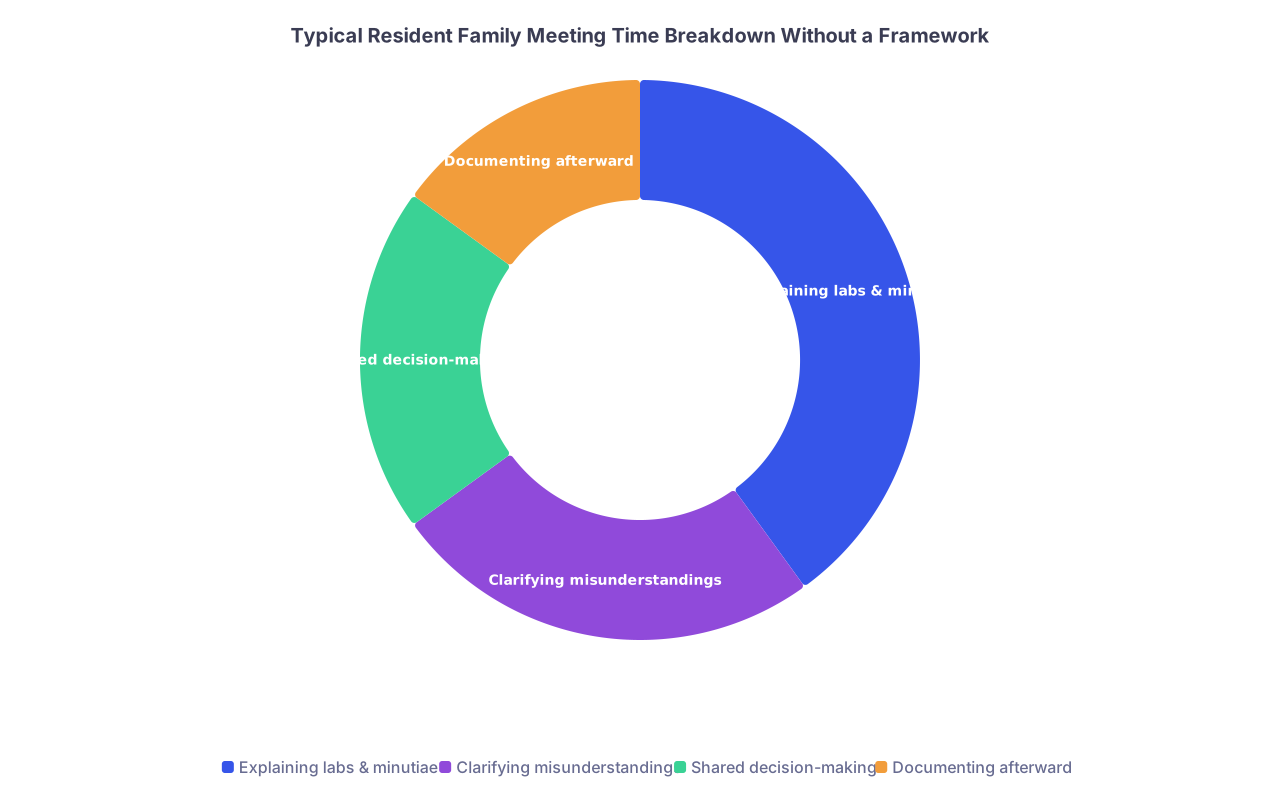
| Category | Value |
|---|---|
| Explaining labs & minutiae | 40 |
| Clarifying misunderstandings | 25 |
| Shared decision-making | 20 |
| Documenting afterward | 15 |
The worst time sink is the unfiltered “teaching session” about labs and imaging. Cut that by half and your meetings shrink dramatically without losing quality.
Step 5: Prognosis and “What This Means” – Say the Quiet Part Out Loud
Here is where people freeze. Prognosis. “Is she going to make it?” “How much time does he have?” Residents either dodge it, overpromise, or drop a vague “he is very sick” and hope the family reads between the lines.
You need a repeatable, honest way to talk about prognosis that does not take 10 minutes.
The 3-piece prognosis statement
I use a simple structure:
Big-picture category
(“Getting better”, “Unclear but serious”, or “Declining / unlikely to recover meaningfully”)Time frame
(Hours–days, days–weeks, weeks–months, months–years)Functional expectation
(Back to baseline vs. new limitations vs. non-independent)
Example:
- “Right now, he is in a very serious situation and I am worried. Best case, if everything goes well, we are talking about weeks to months to recover, and even then he is unlikely to get back to the level of independence he had before.”
Or:
- “She is slowly moving in the right direction. This is not a quick turnaround; we are thinking weeks in rehab, but I do think she has a good chance to get back to living at home with some support.”
Say it plainly. Then stop. Let it land.
You can add:
- “I wish I had more certainty, but based on patients I have cared for in similar situations, that is my honest assessment.”
What you do not do is hide behind “We are hoping for the best” as the only line. That is not communication. That is avoidance dressed up as optimism.
Step 6: Decisions and Next Steps – From Info Dump to Action
This is where most meetings completely fall apart. Residents spend 12 minutes explaining, then with 1 minute left, drop: “So what do you want us to do if her heart stops?” as they back out the door.
No. You flip that.
Once you have updated and given a rough prognosis, you:
- Connect back to patient values.
- Translate that into a recommendation.
- Offer a clear choice if there really is one.
- Name the plan and the follow-up.
A. Elicit values with one or two sharp questions
You do not need a 30-minute life history. You need a couple of anchoring statements.
Try:
- “Before he got sick, what was most important to him in his day-to-day life?”
- “What would he say about living in a situation where he could not recognize you, or needing machines to stay alive long-term?”
- “Knowing him, what would he consider an acceptable quality of life and what would he not want?”
Take what they say and reflect it back in their language.
B. Make a recommendation – stop forcing them to invent the plan
Families hate being handed a menu of equally unframed options. “We can intubate or not intubate, do CPR or not, dialysis or not—what do you want?” That is abandonment.
Use what you know clinically and what they told you about the patient’s values and make a recommendation:
- “Given what you have told me about how independent she has always been and how she would not want to be kept alive by machines without a strong chance of recovery, I would recommend that if her heart were to stop, we focus on keeping her comfortable and not do CPR.”
Or:
- “Based on the fact that she is young, did well before this, and has a good shot at recovery, I recommend we continue full treatment, including intubation if her lungs get worse in the short-term.”
You then add:
“I want to hear how that sits with you. It is ultimately your decision, but I do not want you to feel alone in it.”

| Step | Description |
|---|---|
| Step 1 | Pre-brief |
| Step 2 | Open and set time |
| Step 3 | Ask understanding and worries |
| Step 4 | Plain language update |
| Step 5 | Prognosis statement |
| Step 6 | Explore values |
| Step 7 | Make recommendation |
| Step 8 | Confirm decisions and plan |
| Step 9 | Document and handoff |
C. Clarify specific decisions in concrete language
Do not say: “Do you want everything done?” That phrase is clinically meaningless and emotionally loaded.
Say exactly what you are deciding about:
- “If her heart stops, do you want us to do CPR—chest compressions, shocks, putting a breathing tube in—with a low chance of bringing her back and a real risk of brain injury?”
- “If his kidneys stop working, are you open to us starting dialysis, which is a machine that cleans the blood, several times a week, possibly long-term?”
- “If his breathing worsens, are we allowed to put in a breathing tube and connect him to a ventilator?”
Then tie it:
“Given what we have talked about, here is what I would write in the chart…”
You want them to walk away with a named plan, not a fog of “we talked to the doctor, but I am not sure what we decided.”
Step 7: Close and Document – Protect Yourself and Your Patient
You are not done when you walk out. You are done when:
- The family can repeat the plan in simple words.
- The chart reflects what happened.
- The nurse and your team know what was decided.
A. Ask for a “teach-back” in normal language
“Just so I know I did a good job explaining this, can one of you tell me what you are taking away from this conversation and what the plan is if things get worse?”
You will catch misunderstandings right there. Fix them before they get baked in.
B. Set expectations and follow-up
Families want to know: What now? Who do we call? When will we hear from you again?
One sentence does the job:
“Today, we will continue the current treatments and not do CPR if his heart stops. I will update you again after we see how he does overnight, and the daytime team tomorrow will also check in.”
Name the next touchpoint. People relax when they know what to expect.
C. Document like a professional
Your note should be lean but complete. A few core elements:
- Who was present, and who is the decision-maker.
- Diagnosis and clinical context in 1–2 sentences.
- Values and goals you heard (“Family states…” “He has said in the past…”)
- Key information given (prognosis framing).
- Specific decisions (code status, intubation, dialysis, surgery, etc.).
- Any unresolved conflict or need for consult (palliative, ethics, spiritual care, social work).
| Section | Key Content |
|---|---|
| Participants | Names, relationships, surrogate |
| Clinical Context | 1–2 line illness summary |
| Values/Preferences | What matters to patient/family |
| Prognosis Discussed | Category and time frame |
| Decisions Made | Code status, interventions |
| Follow-up Plan | Next update, consults, tasks |
This does not have to be a 30-line essay. A tight 8–10 line note is enough, but it must be specific.
Running This Framework in Real Time: 3 Scenarios
Let me walk you through how this plays out on the floor when the day is already on fire.
Scenario 1: The “Quick but Serious” Check-in (10 minutes)
Patient: 82-year-old with septic shock in ICU day 2.
Family: Two adult children at bedside.
You have 10 minutes between ED admits.
You run a compressed version:
- 1 minute: Open, time boundary, identify surrogate.
- 2 minutes: Ask understanding and biggest worry.
- 2 minutes: Plain-language update and trajectory.
- 2 minutes: Prognosis in category + time frame.
- 2 minutes: Focus on code status and intubation recommendation.
- 1 minute: Teach-back and documentation.
Not every life detail. Not future hospice planning. You stabilize expectations and make one or two key decisions.
Scenario 2: Ward Patient Slowly Declining (15 minutes at end of day)
Patient: 70-year-old with advanced COPD and CHF, now hospitalized for the 4th time this year, slowly worsening.
Family: Spouse and son want “another meeting with the doctor.”
You can:
- Schedule this at the very end of your work-day or after rounds.
- Sit down (yes, for this one you sit).
- Run the full framework with emphasis on: prognosis, function after discharge, and code status / future ICU care.
You are not doing a “goals of care masterpiece.” You are setting realistic expectations and documenting a trajectory so that the next team is not stuck reinventing this exact meeting in 3 days.
Scenario 3: Unexpected Deterioration (5–7 minute bridge)
Patient: 60-year-old post-op, sudden PE, now intubated in ICU. Family arrives panicked. You are called as the primary team.
You do not have the luxury of a full framework. So you do a bridge version:
- 1 minute: “I am Dr. X, I am so sorry this has happened. I have 5 minutes right now and then I will be back with more time later.”
- 2 minutes: Ask what they understand and what they are most scared of.
- 2 minutes: Super-high-level update and immediate next steps (“Right now our focus is on stabilizing…we will not make any long-term decisions until we see how he responds over the next hours”).
- 1–2 minutes: Reassure about follow-up: “Either I or the ICU team will circle back with you this afternoon for a longer discussion once we have more information.”
Then you schedule a formal meeting later, with the full 10–15 minute framework once the dust settles.
Common Pitfalls That Waste Time (And How to Stop Doing Them)
If you want efficiency, you have to be a bit ruthless about what you stop doing.
Pitfall 1: Letting the loudest relative hijack the meeting
You know the one. Talks over everyone. Asks 17 questions in a row. Half of them irrelevant.
Tactic:
- Early on: “These are good questions. I want to make sure I answer what is most important to everyone. Can we take turns and start with the surrogate / spouse, then I will come back to others?”
You are not a hostage.
Pitfall 2: Explaining at the wrong “altitude”
If you are explaining lactate trends to someone who still thinks pneumonia is “a cold,” you are wasting everyone’s time.
Fix:
- After your first explanation, ask: “Was that too detailed, not detailed enough, or just right?”
- Adjust. Some want more labs. Many do not.
Pitfall 3: Avoiding the real topic
Residents often skate around prognosis and code status until the last 90 seconds.
Solution:
- After your 3-part update, move directly to “what this means” and “what happens if things get worse.”
- Force yourself to say the words “serious,” “unlikely to get back to how he was before,” or “I am worried he is dying” when they are true. Those sentences save time in the long run because they prevent families from clinging to false narratives that you then spend days undoing.
Pitfall 4: Leaving with no clear plan
If the family leaves saying, “Well, the doctor said she is sick, but we are not sure about anything else,” you have not finished the job.
Fix:
- Before you stand up: “Let me summarize the plan we agreed on today in one sentence…”
- Then write it in your note in almost the same language.
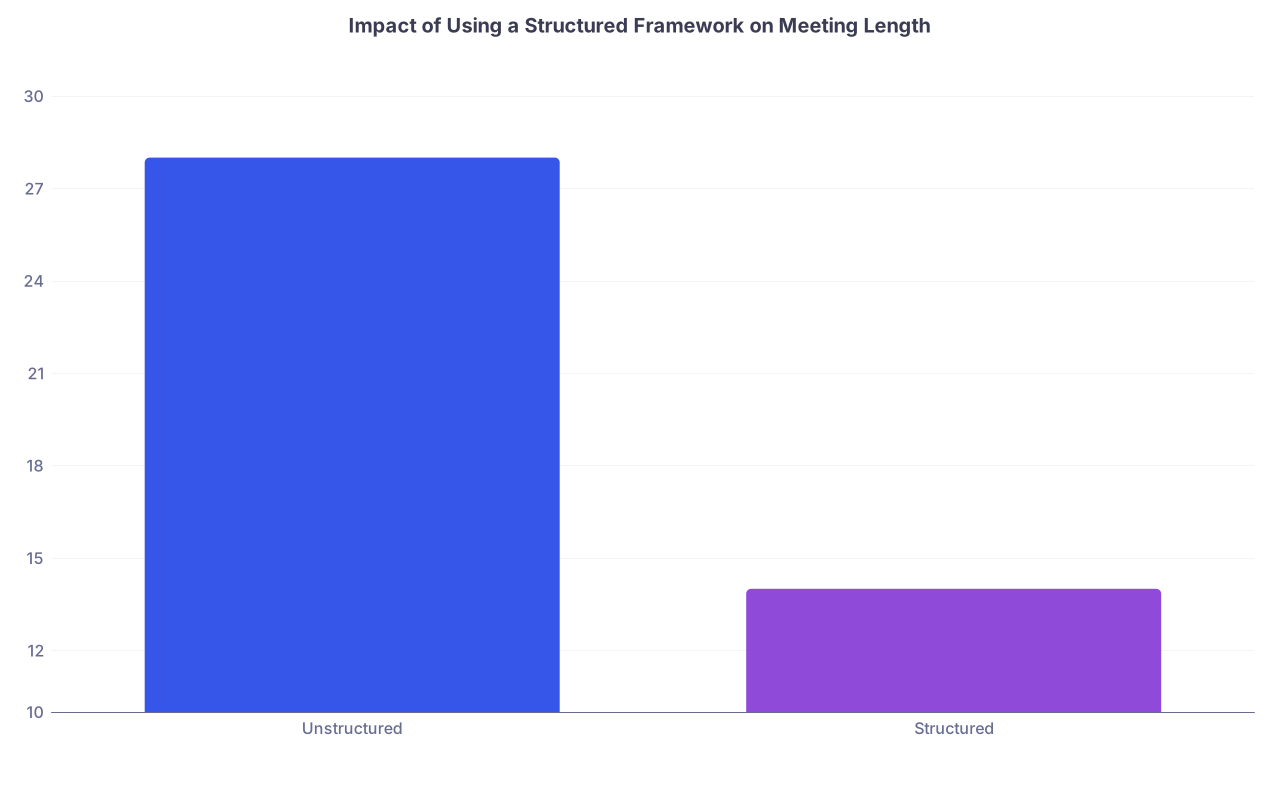
| Category | Value |
|---|---|
| Unstructured | 28 |
| Structured | 14 |
Cutting the average from 28 to 14 minutes per serious family meeting is realistic once you stop improvising.
Integrating This Into Your Actual Resident Day
You are probably thinking: “This sounds nice, but my day is chaos.” Fair. Let us talk integration.
Micro-scheduling
You will not survive if every family meeting is “whenever they catch me.” You start taking control of timing.
Examples:
- “I cannot do this right now, but I can come back between 1 and 1:15 p.m. Can your family be here then?”
- “I round until 11. I will swing back after that to talk with everyone altogether.”
Then actually show up. Reliability buys you breathing room later.
Use your team
PGY-2/3’s: your job is not to shield interns from all family meetings. It is to model this framework and then let them run parts.
- Have the intern gather understanding and worries.
- You step in for prognosis and recommendations.
- Debrief for 90 seconds afterward: “What went well, what would you say differently?”

Know when to call palliative care early
If you find yourself doing the same 30-minute family meeting three days in a row for the same patient, you are stuck.
That is your cue:
- “I am going to ask our palliative care colleagues to join us. They are excellent at guiding these conversations and helping us align treatment with what matters most to your father.”
You are not failing. You are recognizing complexity.
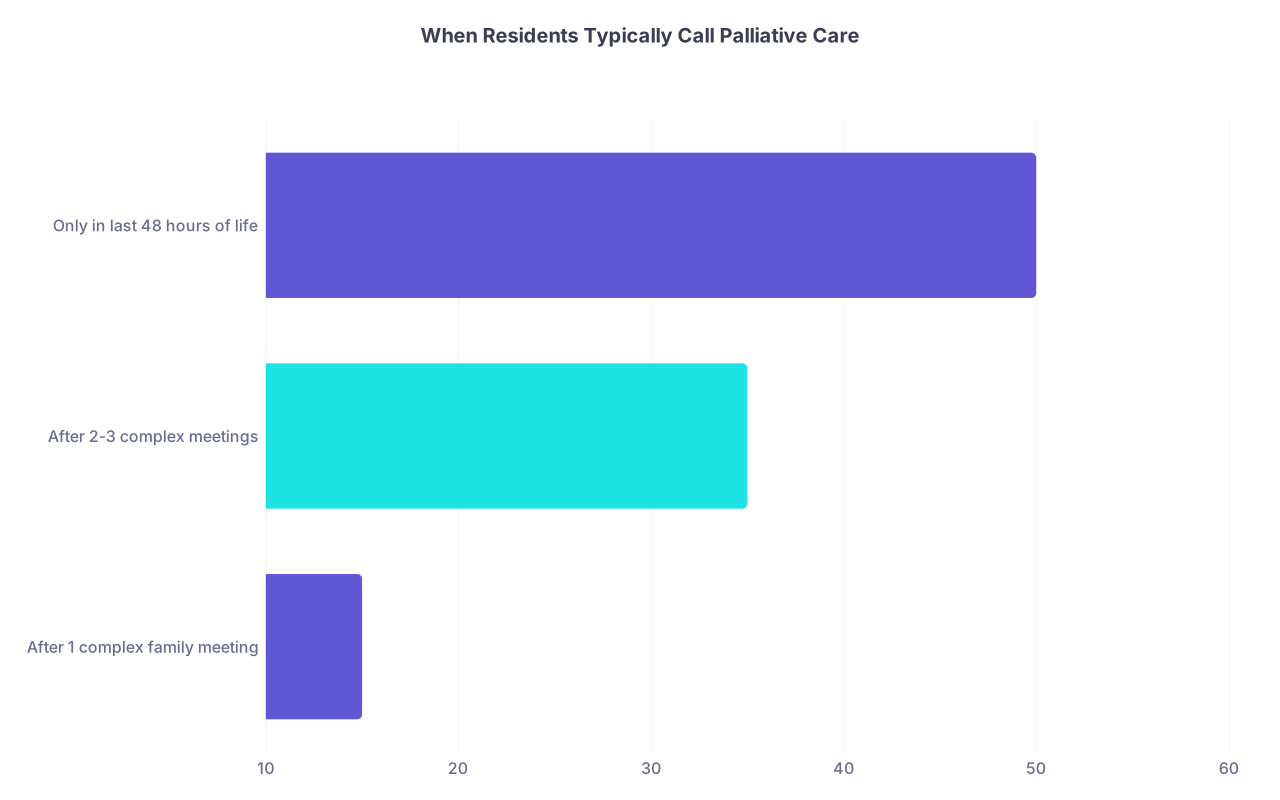
| Category | Value |
|---|---|
| After 1 complex family meeting | 15 |
| After 2-3 complex meetings | 35 |
| Only in last 48 hours of life | 50 |
Most residents wait until the last 48 hours. That is late.
The Emotional Load: Protecting Your Bandwidth
Family meetings are emotionally heavy. When you are also covering 18 patients and cross-covering another service at night, it adds up.
Two quick habits to protect yourself:
Micro-debriefs with co-residents or nurses.
“That was rough. I felt like they did not hear anything.” 60 seconds. Out loud. Let it go.Stock phrases for high-emotion moments so you are not squeezing your brain for words:
- “I can see how much you care about him.”
- “I wish I had better news.”
- “This is a lot to take in all at once; we can revisit this again.”
You are allowed to feel tired by these conversations. But you are not allowed to avoid them entirely or wing them into chaos. That is how burnout and conflict both get worse.

Turning This Framework Into Muscle Memory
Reading a framework once does nothing. You need reps.
Here is how you make it automatic:
- Put the seven steps on a small card or in your notes app. Glance at it before walking into any serious family meeting for a week.
- For the next three meetings, time yourself. Aim for 12–15 minutes. Notice where you bloat (usually the update).
- Ask a nurse you trust: “Did that seem clear to the family?” Nurses are brutally honest about this and often know when you lost them.
- Teach the framework to a junior. Nothing cements a skill like teaching it.
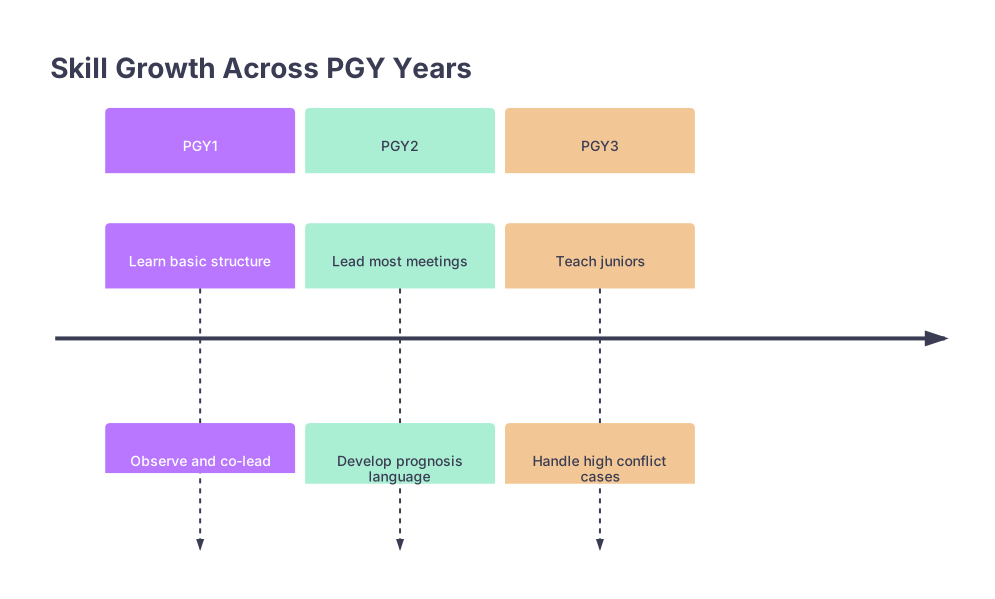
| Period | Event |
|---|---|
| PGY1 - Learn basic structure | Observe and co-lead |
| PGY2 - Lead most meetings | Develop prognosis language |
| PGY3 - Teach juniors | Handle high conflict cases |
By the end of residency, you want this to feel as automatic as pre-rounding. Not perfect. But structured, deliberate, and efficient.
With a simple, repeatable framework, you stop dreading family meetings as time bombs in your day and start treating them like any other core procedure you can perform reliably under pressure. You will still have the outlier epic conversations, the family that needs an hour, the case that demands palliative care, ethics, and three specialties at the table. That is fine.
But most days, most meetings, can be 10–15 minutes: clear, honest, and focused.
Once this framework is second nature, the next evolution is learning to handle the really hard versions—high-conflict families, angry relatives, cultural mismatches, lawsuits-in-the-making. That is a different skill set, and it deserves its own playbook. But that is a story for another day.