
The fastest way to lose credibility in residency isn’t a missed zebra diagnosis. It’s a sloppy morning report.
Morning report is where people quietly decide who they trust, who they listen to, and who they mentally tune out. Not on paper. Not in evaluations. In their heads. And once you’re labeled as the resident who presents messy, overlong, or clueless cases, that reputation sticks.
Let me walk you through the missteps I’ve seen tank otherwise smart residents. And how you avoid becoming “that” presenter.
Mistake #1: Not Knowing Why This Case Was Chosen
The first credibility killer: presenting a case with no clear learning purpose.
You stand up, start: “So this is a 72-year-old male with a history of…” Fifteen minutes later, everyone’s thinking, “Why are we talking about this? What’s the point?”
You look unprepared, not because you didn’t memorize the sodium, but because you didn’t frame the case.
Here’s what people get wrong:
- They pick a case just because it was “interesting” to them.
- They bring a straight‑forward CHF exacerbation with nothing unusual about it.
- They present a wildly complex ICU trainwreck that’s impossible to discuss in 30–45 minutes.
- They haven’t thought about what the actual teaching points should be.
That tells your program director and attendings one thing: you don’t understand how to think like a teacher or a senior resident. Even as an intern, they’re watching for that.
What you should do instead (and too many people skip):
Before you commit to a case, answer this in 1–2 sentences:
“If I do this case well, the group will walk away better at _______.”
Examples:
- Narrowing a broad differential for acute kidney injury.
- Structuring the workup of new-onset ascites.
- Recognizing atypical presentations of PE.
- Choosing the initial diagnostic approach to pancytopenia.
If you can’t complete that sentence, do not present that case. Or rewrite it until you can.
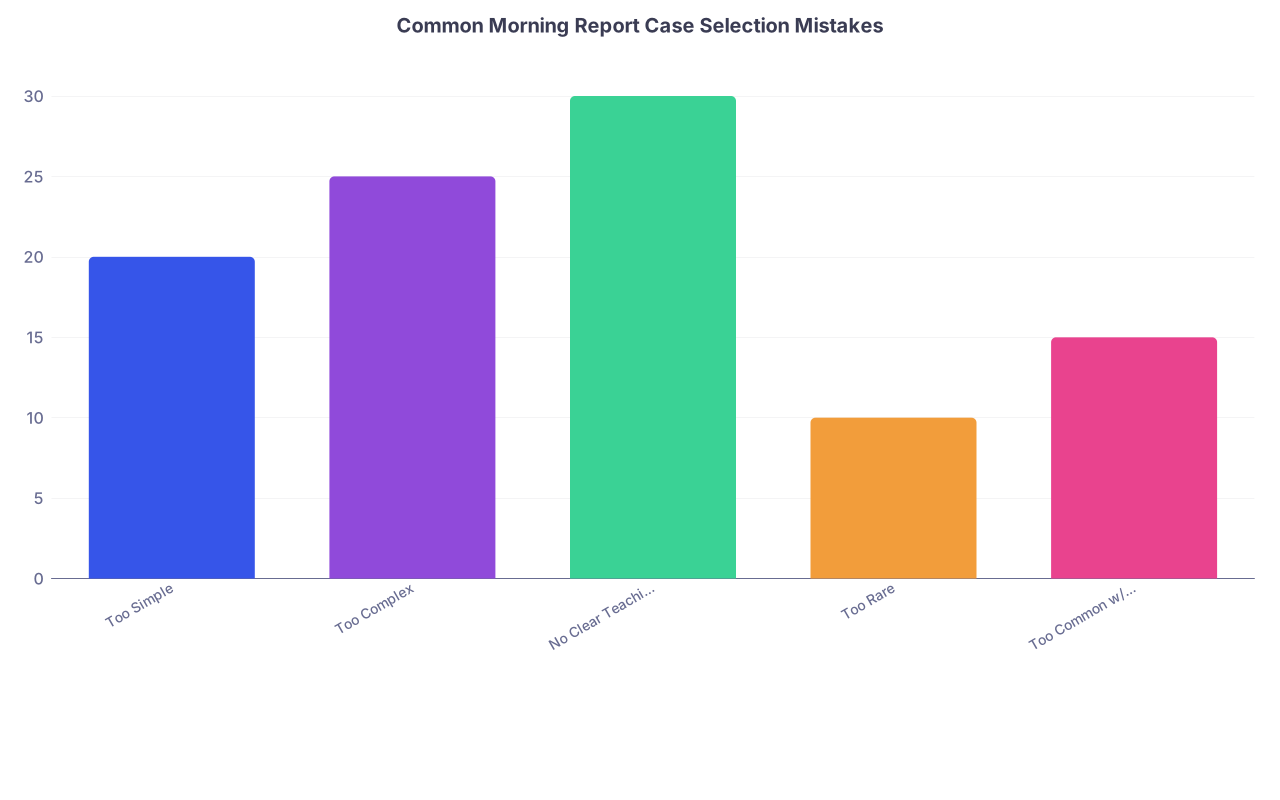
| Category | Value |
|---|---|
| Too Simple | 20 |
| Too Complex | 25 |
| No Clear Teaching Point | 30 |
| Too Rare | 10 |
| Too Common w/o Twist | 15 |
And then: tell the room your purpose. Early.
“Today’s case is about an older adult with new transaminitis. The goal is to focus on how to structure evaluation of abnormal liver enzymes in a medical ward patient.”
If you skip that, you sound like you’re reciting, not leading.
Mistake #2: Drowning Everyone in Irrelevant Details
The most common sin of morning report: the never‑ending HPI.
You know the version:
- Five minutes on “lives with spouse, 3 steps to enter the home, has 2 cats.”
- A paragraph on surgeries from the 1990s that have zero bearing on the problem.
- Med list read verbatim from Epic, including multivitamins and PRN antacids.
By the time you reach the actual chief complaint, half the room has already checked out.
Here’s the truth nobody tells you early enough: excess detail makes you sound less competent, not more. It screams, “I don’t know what’s important, so I’ll just include everything.”
The filter you’re not using (but should)
Every single data point should pass one test in your head:
“Does this reasonably affect the differential, the workup, or the management for this problem?”
If no, cut it. Or at least shorten brutally.
You don’t need:
- Childhood asthma in a 78-year-old with stroke symptoms (unless relevant).
- Seven prior orthopedic surgeries for a patient with hyponatremia.
- Full social history of every family member for a simple cellulitis.
You do need:
- A crisp 1–2 line summary of chronic conditions relevant to the current issue.
- Medications that affect the organ system in question (e.g., nephrotoxins in AKI, hepatotoxins in liver injury).
- Key risk factors (travel, exposures, sexual history, substance use) when the presentation warrants it.
If you can’t say the chief complaint within the first 20–30 seconds, you’re already losing ground.
Fix: Build a mental skeleton and stick to it:
- One line: age + key comorbidities + chief complaint.
- Brief story: opening sentence, then 3–5 of the most relevant details (time course, red flags, modifiers).
- Focused past medical history (what really impacts this problem).
- Meds/allergies: only highlighting relevant ones, not reading the whole list unless explicitly asked.
This isn’t just efficient. It makes you sound like someone who knows what matters in a chart packed with noise.
Mistake #3: Reading the Chart Instead of Owning the Story
Nothing drains your authority faster than clearly presenting a case you don’t actually know.
I’ve sat in morning reports where the resident:
- Keeps turning back to the screen or paper for every single lab.
- Can’t remember if the patient had a fever overnight.
- Has never talked to the patient personally.
- Is obviously seeing half of this for the first time while standing at the front.
That’s a dead giveaway that the case was pulled from the EMR at 7:45 AM and skimmed.
Everyone in the room can tell.
Ownership is what they’re actually grading. Not just knowledge.
How you accidentally signal “I don’t own this”
- Saying “the chart says…” instead of “the patient reported…”
- Constantly double‑checking simple facts like “was it right‑sided chest pain?”
- Not knowing the timeline of when things happened (admission, decompensation, consults).
- Being surprised by your own slides when someone asks a question.
The fix is unglamorous but non‑negotiable
If at all possible, you should:
- Talk to the patient yourself (or at least the primary team if the patient isn’t communicative).
- Recreate the story in your own words, not copy‑paste from the note.
- Know the key milestones: when they came in, when they worsened, which tests turned the case.
If something wasn’t clear, be honest but specific:
“Neurology documented no focal deficits on exam. I re‑examined him this morning and still found no asymmetry in strength or sensation.”
That’s very different from: “I think neuro didn’t see any deficits… I’m not totally sure.”
And if you truly got the case late and never met the patient, own that clearly once, then present confidently anyway. Don’t keep apologizing; it just advertises insecurity.
Mistake #4: Turning Morning Report into a Lab-Reading Contest
Another way people quietly undermine themselves: presenting labs like you’re reading a dictionary.
“WBC 8.1, hemoglobin 12.3, platelets 250, sodium 138, potassium 4.2, chloride 108, bicarbonate 24, BUN 18, creatinine 0.9, glucose 102…”
Eyes. Glazed.
Nobody is impressed that you can read down a CBC and BMP. That’s not analysis. It’s transcription.
What strong presenters do differently:
- They group labs by significance, not by panel.
- They verbally highlight what’s abnormal and clinically relevant.
- They avoid reading normal values unless they clarify a specific question (e.g., normal lactate in suspected sepsis).
Example of weak vs strong:
Weak: “On admission labs, sodium 134, potassium 4.1, chloride 100, bicarb 22, BUN 18, creatinine 1.6, glucose 110, WBC 11.2, Hgb 10.4, platelets 370…”
Strong: “On admission, he had a mild leukocytosis at 11.2, a new creatinine of 1.6 from baseline 0.9, and mild normocytic anemia. Electrolytes and glucose were otherwise unremarkable.”
The second one tells me you:
- Actually looked at trends.
- Understand what’s unusual for this patient.
- Can filter data into a mental model.
That’s what builds credibility.

Mistake #5: Ignoring the Differential or Dumping a Grocery List
Here’s the painful one: you’ve set up a beautiful case…and then completely blow the differential.
Two common mistakes at opposite extremes:
- Way too short: “So our differential is pneumonia, PE, or COPD exacerbation.”
- Way too long and random: “So our differential includes pneumonia, PE, COPD exacerbation, CHF, ACS, pericarditis, pneumothorax, sarcoidosis, pulmonary fibrosis, ILD, malignancy…”
Both make you look less senior than your PGY level.
Your attendings are not looking for “every possible cause of cough.” They’re looking for:
- A prioritized, reasoned list.
- Evidence of understanding pathophysiology.
- Why some diagnoses are less likely, not just what’s possible.
Don’t make this rookie move
Saying, “The differential is pretty broad,” and then listing diseases without structure. That’s pure hand-waving.
Instead, show you can organize thinking, not just recall.
For example, for shortness of breath:
- Obstructive airway (COPD, asthma).
- Parenchymal/lung (pneumonia, ILD).
- Vascular (PE).
- Cardiac (CHF, ACS).
- Others (anemia, metabolic acidosis, neuromuscular).
Then pick your top 3–4 and justify them.
A program director is listening for this kind of reasoning:
- “PE is high on our list given subacute dyspnea, tachycardia, pleuritic component, and recent surgery.”
- “CHF is less likely because there’s no orthopnea, JVD is absent, lungs are clear, and BNP was normal.”
That’s how you sound like someone who can run a team safely.
Mistake #6: Freezing When Someone Pushes Back
If you melt at the first probing question, your credibility drops fast.
Common pattern:
- You present.
- Someone asks, “Why was CT done before ultrasound?” or “Why did you choose cefepime instead of pip-tazo?”
- You panic, mumble something vague, or default to “that’s what the attending wanted.”
You’ve just sent a very loud message: “I’m not actually thinking; I’m just following orders.”
You do not have to justify every decision as if you were the attending. But you do need to show that you can engage with the reasoning.
Better answers:
- “We were concerned about X, which pushed us toward Y. In retrospect, an ultrasound-first approach might have been safer/cheaper, and I’d consider that next time.”
- “Our ED attending was concerned for Pseudomonas risk given prior admissions. I admit I didn’t challenge that assumption at the time — hearing you say this, I’d re-examine that choice.”
This does two things:
- Shows you can think and reflect.
- Signals humility without collapse.
Don’t get defensive. Don’t argue yourself into a corner. And don’t throw your attending fully under the bus. But do show that there was at least some logic behind the actions—even if imperfect.
Mistake #7: Forgetting That Morning Report Is a Performance
You can have brilliant content and still lose the room because your delivery is a mess.
Here’s what sinks people:
- Speaking in a monotone while staring at the floor or the screen.
- Talking so fast no one can follow the reasoning.
- Never pausing to let the room think.
- Reading your slides verbatim.
- Using slides crammed with text and microscopic labs.
Morning report is part teaching, part case conference, part performance. You’re not on Broadway, but you are on stage.
| Area | Common Mistake | How It Hurts You |
|---|---|---|
| Content | Irrelevant details | Signals poor judgment |
| Content | No clear teaching goal | Feels unfocused, weak |
| Delivery | Reading from slides | Looks unprepared |
| Delivery | No eye contact | Breaks engagement |
| Delivery | Too fast / no pauses | Kills discussion |
A few simple corrections go a long way:
- Look at the audience, not the screen, whenever you’re not quoting a value.
- Build in actual pause points: “Let’s stop here. What are you thinking about the differential at this moment?”
- Use fewer words on slides. If they can read everything without you, your design is wrong.
- Stand or sit where you can see both the screen and the room easily. Sounds trivial; isn’t.
You don’t need to be charismatic. You do need to be intentional.
Mistake #8: Making It All About “What Happened” Instead of “What We Learned”
The worst ending to a morning report is: “…and then the biopsy came back as X. Any questions?”
That’s narration, not education. You just watched everyone’s learning opportunity evaporate.
People will remember you as the resident who “tells stories” but doesn’t teach.
The more senior you get, the more this matters.
Strong presenters explicitly close the loop:
- “So what should we actually do differently on the wards because of this case?”
- “How would we structure the next similar admission more efficiently?”
- “What were our cognitive errors here—anchoring, premature closure, over-reliance on one test?”
You’re not just describing events. You’re dissecting decisions.

| Step | Description |
|---|---|
| Step 1 | Case Intro |
| Step 2 | Key History and Exam |
| Step 3 | Initial Differential |
| Step 4 | Key Data and Tests |
| Step 5 | Refined Assessment |
| Step 6 | Management Decisions |
| Step 7 | What We Learned |
Notice that “What We Learned” isn’t optional. That’s the part too many residents skip.
If you never say: “Here are the 2–3 take-home points,” people leave with vague impressions instead of sharpened skills. And they subconsciously tag you as someone who can’t synthesize.
You want the opposite tag.
Mistake #9: Underestimating How Much People Are Watching
One last reality check: morning report is not a throwaway hour.
Attendings notice:
- Who is always unprepared.
- Who can’t summarize.
- Who dodges questions.
- Who never volunteers to present.
- Who clearly improves over time.
Program leadership absolutely uses these impressions when:
- Choosing chief residents.
- Writing letters of recommendation.
- Deciding who gets high‑responsibility rotations.
- Assigning you to admissions-heavy or lighter blocks.
I’ve watched a resident with middling test scores get an outstanding fellowship letter because every single attending had the same thought: “When she presents, the room actually learns something.”
I’ve also seen the opposite—brilliant on exams, but repeatedly disorganized and evasive in morning report. Those residents do not get the same trust.
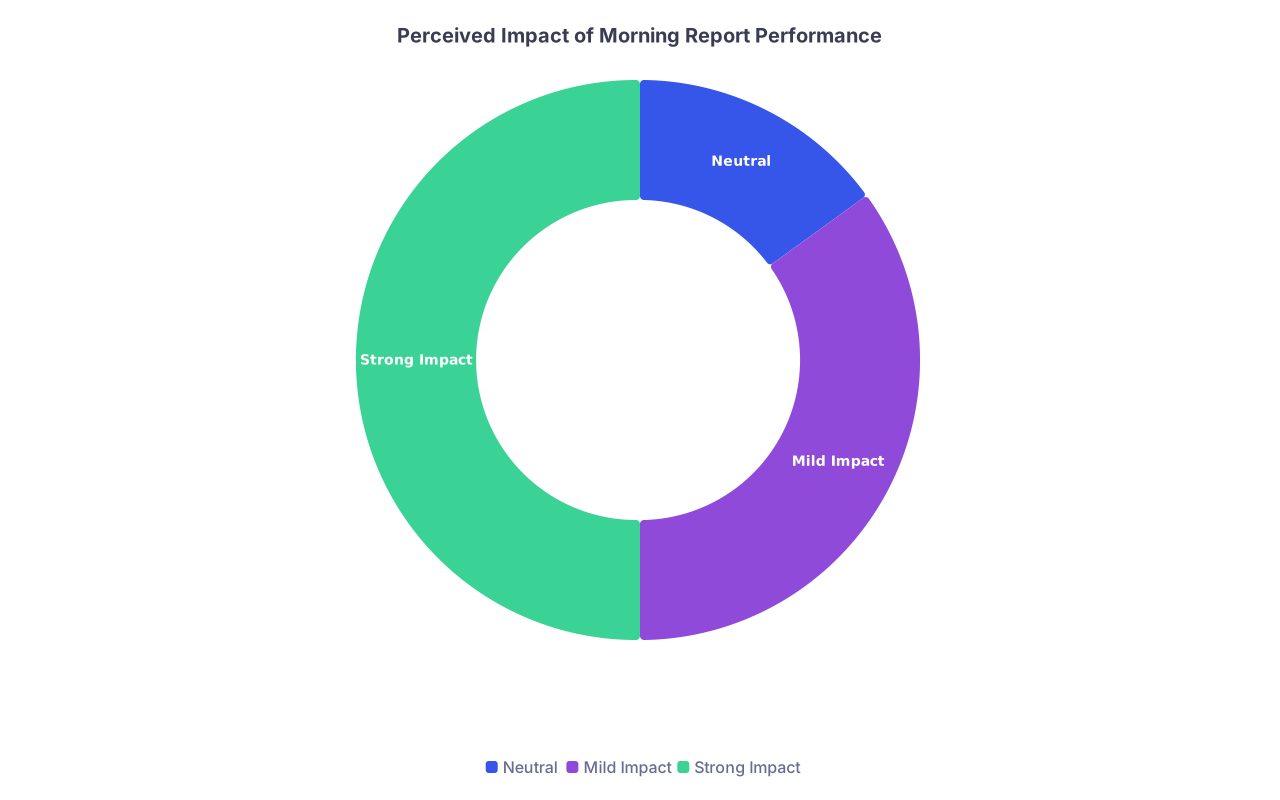
| Category | Value |
|---|---|
| Neutral | 15 |
| Mild Impact | 35 |
| Strong Impact | 50 |
You don’t have to be perfect. But if you dismiss morning report as some annoying mandatory conference, you’re walking past one of the easiest credibility-building opportunities in residency.
Mistake #10: Not Practicing the Skills Morning Report Actually Tests
Residents treat morning report like some innate talent: “Oh, she’s good at this; I’m just not a presenter.”
No.
Morning report reveals three trainable skills:
- Clinical reasoning.
- Data filtering.
- Teaching and facilitation.
If you never deliberately practice any of those, of course you look shaky up there.
A few simple, unsexy habits that prevent you from stalling out:
- When you admit a patient, mentally structure the story as if you’ll present it tomorrow. Even if you won’t.
- After a confusing night, write down the “two things I wish I’d thought of earlier.” Those become future teaching points.
- Occasionally practice a 60-second “elevator summary” of your sickest patient and ask a co-resident, “Did that make sense? What was missing?”
And here’s the one hardly anyone does but works extremely well: record yourself once. Audio only is fine. Present a case to your phone. Listen to it the next day when you’re less tired. You’ll immediately hear:
- Where you ramble.
- Where you bury the lede.
- Where you sound unsure.
You can’t fix what you never see.

The Short Version: Protect Your Credibility
If you remember nothing else, hang on to this:
- Own the purpose. Never present a case without a clear teaching goal you can state in one sentence.
- Filter ruthlessly. Too much irrelevant detail screams “I don’t know what matters.” Choose only what changes the differential, workup, or management.
- Close the loop. End with what the team should actually do differently next time. Don’t just tell a story—extract the lesson.
Morning report is not busywork. It’s where people quietly decide whether they’d trust you on a rough call night.
Do not give them a reason to say no.