
The worst thing about a bad shift is not the shift. It is carrying it into the next one.
You cannot stop bad nights. You can absolutely stop them from poisoning the rest of your month. That requires a structured, repeatable debrief, not vague “self-care” advice and a doom-scroll in the call room.
Here is how you reset in a way that actually works on a resident schedule.
The Core Principle: You Need a Protocol, Not a Vibe
Bad shifts follow a pattern:
- The code that went sideways.
- The angry attending.
- The impossible patient load.
- The consult that made you feel incompetent.
- The near miss you keep replaying in your head at 3 a.m.
What most residents do after those nights:
- Go home, collapse into bed, wake up anxious.
- Text co-residents complaining but not actually processing.
- Eat garbage, watch something numbing, pretend it is fine.
- Show up next shift more brittle, more distracted, more behind.
Then they call it “residency burnout” like it is an abstract concept. It is not abstract. It is cumulative, unprocessed stress.
You need something surgical: a short, structured debrief you can run in 15–30 minutes that does four things:
- Discharge acute emotion enough to think clearly.
- Extract learning points so the night was not “just suffering.”
- Separate “my error” from “system failure” from “impossible situation.”
- Close the file in your head so you can rest, not ruminate.
I am going to give you that protocol.
Step 1: Hard Stop – Contain the Shift
First rule: the shift ends. Psychologically. Even if you are post-call and have sign-out tasks, you must draw a line.
Within 10 minutes of signing out:
Name it in one sentence.
Literally say (quietly, to yourself, or into a notes app):- “This was a brutal trauma call with a code on a teenager.”
- “Tonight I felt completely out of my depth on cross-cover.”
- “This shift was bad because of conflict with [name].”
Labeling shuts down the vague, formless dread.
Ground your body for 60–90 seconds.
You cannot think if your nervous system is still in alarm mode. Stand or sit somewhere semi-private (stairwell, bathroom, empty room):- Put both feet flat on the floor.
- Inhale for 4 seconds, hold 4, exhale 6–8 seconds.
- Do 5–8 cycles.
This is not wellness fluff. I have watched residents’ voices literally stop shaking after 30 seconds of exhale-heavy breathing.
Decide: debrief now or later.
Quick decision tree:- Post-call with at least 30 min before you will crash? → Do full debrief now.
- So exhausted you feel sick or dizzy? → Do mini debrief now (5 minutes), full debrief after a nap.
- On a night float, with another shift in < 12 hours? → Do abbreviated version but still do it.

| Step | Description |
|---|---|
| Step 1 | Shift ends |
| Step 2 | Full 20 min debrief |
| Step 3 | 5 min mini debrief then sleep |
| Step 4 | 10 min abbreviated debrief |
| Step 5 | Time and energy now? |
| Step 6 | Too exhausted to think? |
The mistake is saying “I’ll think about it later” and never doing it. Decide upfront which version you are doing.
Step 2: Dump the Story – 7-Minute Unfiltered Download
You need a thought download, not a curated narrative. This is where residents usually go wrong: they only tell the story in “presentation mode” (to attendings, M&M, documentation). That filters out the emotional reality.
Take 5–7 minutes. Pen and paper or a note that is not in the EMR. You are writing for you, not for litigation.
Prompt yourself:
- “What actually happened, in order?”
- “Where did my stress spike?”
- “What am I still replaying?”
Write in bullet points, fragments, curses, whatever. For example:
- 18:30 – got sign-out with 20 patients, 4 unstable.
- New admit septic, BP 70s, nurse angry I had not seen yet.
- Missed high lactate until 2nd page – feel like an idiot.
- Attending: “Why did you not pick this up earlier?” in front of team – shame.
- Code at 02:00 – chest compressions, kids screaming outside room.
- I froze for a second when asked for next step in ACLS – someone else jumped in.
- Walking away thinking, “Maybe I am not cut out for this.”
Do not tidy it. You are emptying the mental cache.
Why this matters: Your brain is trying to compress a huge emotional + cognitive event into some coherent story. If you do not externalize it, the story becomes: “I am bad at this.” The download lets you see the story as a sequence of discrete events, not a global indictment.
Step 3: Triage the Bad Shift – Sort, Do Not Blend
Not all “bad” is created equal. You need to separate:
- Clinical uncertainty – Did you truly not know what to do?
- Cognitive overload – You knew, but were overloaded.
- Systems failure – Staffing, ED boarding, broken pager, etc.
- Interpersonal conflict – Attending, consultant, nurse, family.
- Moral injury – You knew what should be done, but could not do it.
Grab a clean piece of paper or a new section in your note. Make five short headings:
- Knowledge / skills
- Workload / cognitive load
- System issues
- People / communication
- Values / moral distress
Now quickly sort the bullets from your story dump under one or more headings.
Example:
Knowledge / skills
- Froze on ACLS step
- Unsure about initial vent settings
Workload / cognitive load
- 20 patients, 4 unstable
- Multiple pages while writing orders
System issues
- ED boarded patient 6 hours, no early warning to floor
- Only 1 nurse for 6 high-acuity patients
People / communication
- Attending shaming comment in front of team
- Nurse angry at delay
Values / moral distress
- Family pushed for full code when prognosis was awful
- Felt like we prolonged suffering
This sorting matters. Residents often blend all of it into “I failed.” That is lazy thinking and it eats you alive. Separate domains so you can address each rationally.
Step 4: Extract 1–3 Actionable Learning Points
Here is the productive part. Under Knowledge / skills and Workload / cognitive load, ask three questions:
- “What do I wish I had known before this shift?”
- “What do I wish I had done 10 minutes earlier at each critical moment?”
- “What was outside my bandwidth or training level, honestly?”
From your answers, pull out 1–3 specific, realistic changes. Not 15. You are a resident, not a robot.
Examples:
- “I will create a 1-page ACLS cheat sheet in my pocket for next call.”
- “When I get sign-out on a septic patient, I will eyeball them in the first 30 minutes before anything else.”
- “For every ED admit with MAP < 65, I will double-check lactate and fluids ordered before leaving the ED.”
You want items that:
- You control.
- Are tiny enough to remember at 3 a.m.
- Directly map to what hurt about this shift.
Now schedule them:
- Put a 15-minute calendar block tomorrow: “Review ACLS algorithm / print card.”
- Put a sticky note in your white coat: “First: eyeball sickest 2 patients.”
- Tell a co-resident: “Next call I’m trying X. Ask me if I did it.”
Without this step, “learning from a bad shift” is just a phrase. This turns it into protocol.
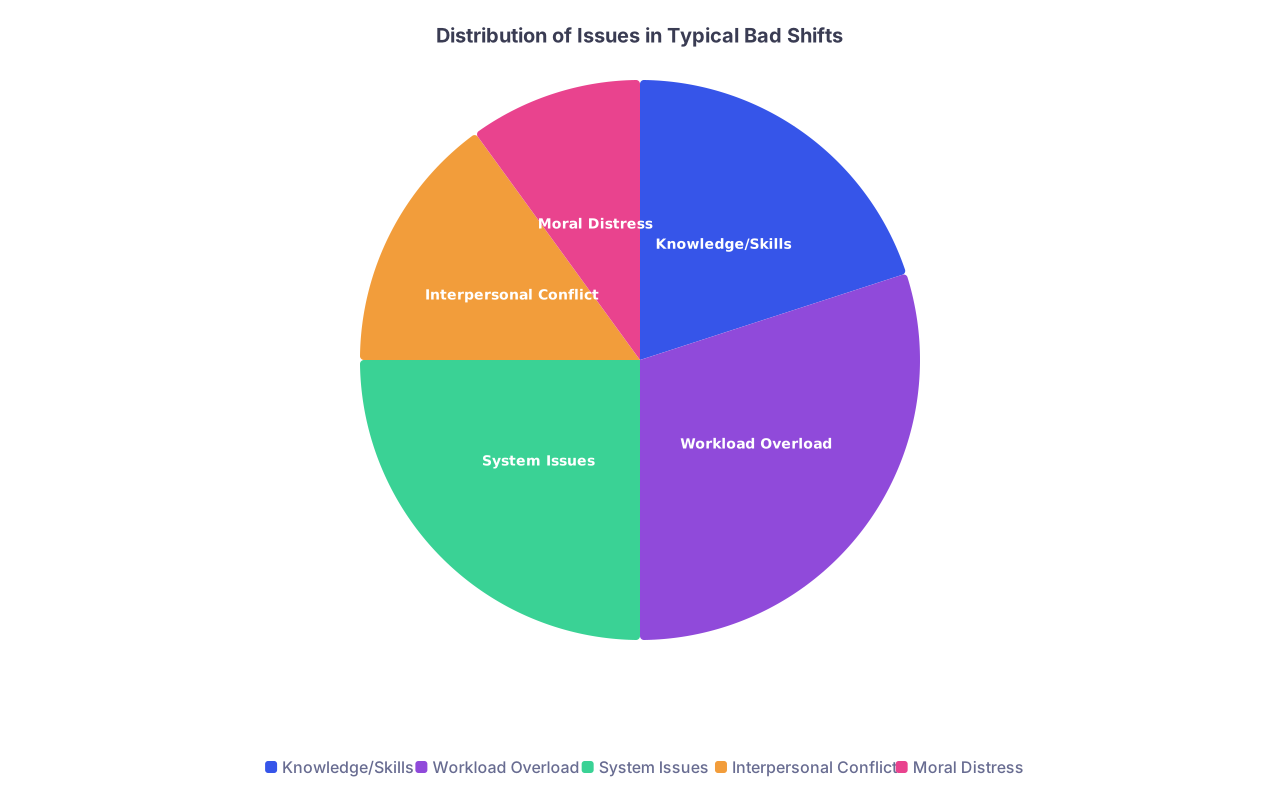
| Category | Value |
|---|---|
| Knowledge/Skills | 20 |
| Workload Overload | 30 |
| System Issues | 25 |
| Interpersonal Conflict | 15 |
| Moral Distress | 10 |
Step 5: Reality Check – Separate Responsibility from Blame
This is where a lot of residents get lost. They accept global blame for events that are mostly system failure + impossible load. Or they avoid responsibility when they actually missed something.
You need a short, brutal honesty exercise.
Under each domain, answer these:
- What was 100% on me?
- What was partly on me, partly on the system?
- What no resident could have fixed?
Be specific.
Example:
100% on me:
- I did not push back when the attending tried to add a non-urgent consult despite my 4 unstable patients.
- I skipped re-checking vitals on a borderline patient because I prioritized notes.
Partly me, partly system:
- Delay to antibiotics: I was juggling cross-cover, but I also did not use the nurse to draw labs earlier.
- Missing lab result: pager chaos, but I also did not build a system to flag criticals.
No resident could fix:
- 20 patients, 4 unstable, 1 nurse for 6 sick patients.
- Bed shortage leading to 8-hour ED boarders.
This is not about absolving yourself. It is about clarity. You own what you can change. You stop fake-owning what you cannot.
If something feels ethically heavy (moral distress case, avoiding palliative conversation, coerced decision), mark it separately: “Needs values conversation later.” That might mean:
- Talking with a trusted attending.
- Using your institution’s wellness or chaplain resources.
- Bringing it up in supervision or Balint-like group.
You do not need to “solve” moral injury today. You do need to tag it and not bury it.
Step 6: Targeted Emotional Decompression (10–15 Minutes)
You have handled the cognitive side. If you stop here, you will still lie awake replaying things. You need a brief, intentional emotional decompression.
Choose one of these options, based on your style and available time. This is not a spa day fantasy; think 10–15 minutes.
Option A: Verbal Debrief with a Safe Person
Not every attending is safe. Not every co-resident is helpful. Pick someone who:
- Has seen you on good days (so they know this shift is not “you”).
- Will not turn it into a competition of misery.
- Is capable of saying both “Yeah, that was rough” and “Here is one thing you did right.”
Script for yourself:
- “I need 10 minutes to talk through last night. I am not looking for fixes, just to say it out loud and get one outside perspective.”
Then hit 3 beats:
- What happened (brief, not chart note).
- The 1–2 parts bothering you most.
- What you are afraid this says about you as a physician.
Let them respond. You do not need a full therapy session. Just a human mirror.
Option B: Solo Physical Reset
If you are too tired or no one is available, do a short body reset:
- 5–10 minutes of:
- Hot shower focusing on feeling of water, not your thoughts.
- Slow stretching or yoga like child’s pose, cat-cow, forward fold.
- 10-minute walk outside around the block, phone in pocket.
During this, give your mind a script:
- “Shift is over. Information is captured. Learning is extracted. Body can let go now.”
Sounds corny. Works anyway.
Option C: Brief Written Emotional Check-in
If you are a writer by nature, two prompts, 5 minutes total:
- “Right now I feel… because…” (write 5–10 sentence fragments)
- “If my co-intern had this night, I would tell them…” (write what you would say)
This bypasses the self-attack voice and engages the part of you that is decent to others.

Step 7: Close the File – A 60-Second Ritual
Ruminating is not “thinking it through.” It is your brain trying to keep the file open so you do not forget something important.
You need a closure ritual that tells your brain: “Everything necessary has been captured. You can stand down.”
This takes 60–90 seconds:
Review your notes quickly:
- Story dump.
- Domain sorting.
- 1–3 action points.
- Responsibility breakdown.
Write a one-sentence summary that you choose to keep:
- “This was a brutal shift in a broken system where I still learned to prioritize early bedside checks.”
- “I froze on ACLS, and I am building a pocket guide so that does not happen again.”
- “The outcome was awful, but my actions were reasonable with the information and resources I had.”
Physically mark closure:
- Draw a line under the page.
- Or type “END OF SHIFT [date/time]” at the bottom of the note.
- Close the notebook or app intentionally.
You are not erasing what happened. You are telling your brain: “This has been processed and filed.” That is how you get some sleep instead of three hours of self-cross-examination.
Step 8: Protect the Next Shift – Pre-Brief, Not Just Debrief
Resetting is only half the job. You also need to slightly redesign your next shift so today’s pain is not wasted.
Before your next call or clinic:
Re-open your last debrief (2 minutes).
Read only:
- The 1–3 action items.
- The closure sentence.
Translate into a micro pre-brief for the upcoming shift:
- “Tonight, I have two priorities: eyeball the sickest early and use an ACLS card if my brain blanks.”
- “If my patient load is unsafe, I will say out loud: ‘I am at capacity; what can we defer?’”
This does three things:
- Anchors your attention on specific improvements, not vague dread.
- Gives you a sense of agency before chaos hits.
- Turns a bad shift into a performance lab, not a trauma loop.

| Step | Description |
|---|---|
| Step 1 | Bad shift |
| Step 2 | Structured debrief |
| Step 3 | Action items |
| Step 4 | Pre-brief next shift |
| Step 5 | Improved performance |
| Step 6 | Reduced distress |
A Realistic Time Budget: What Fits on a Resident Schedule
You do not need a 1-hour “processing” block. You will not do it. Let’s be honest.
Here is a realistic menu you can use depending on the day:
| Debrief Level | Time Needed | When To Use | Core Steps |
|---|---|---|---|
| Mini | 5–7 min | Utterly exhausted, need sleep now | Name the shift, 3–5 bullet story dump, 1 learning point, closure sentence |
| Standard | 15–20 min | Post-call with an hour before sleep | Full story dump, domain sorting, 1–3 action items, responsibility check, closure |
| Expanded | 30–40 min | Especially traumatic shift, day off next | Standard debrief plus verbal or written emotional decompression and short walk/shower |
Pick one. Do not “aspire” to the expanded debrief if you never actually will. Consistency beats perfection.
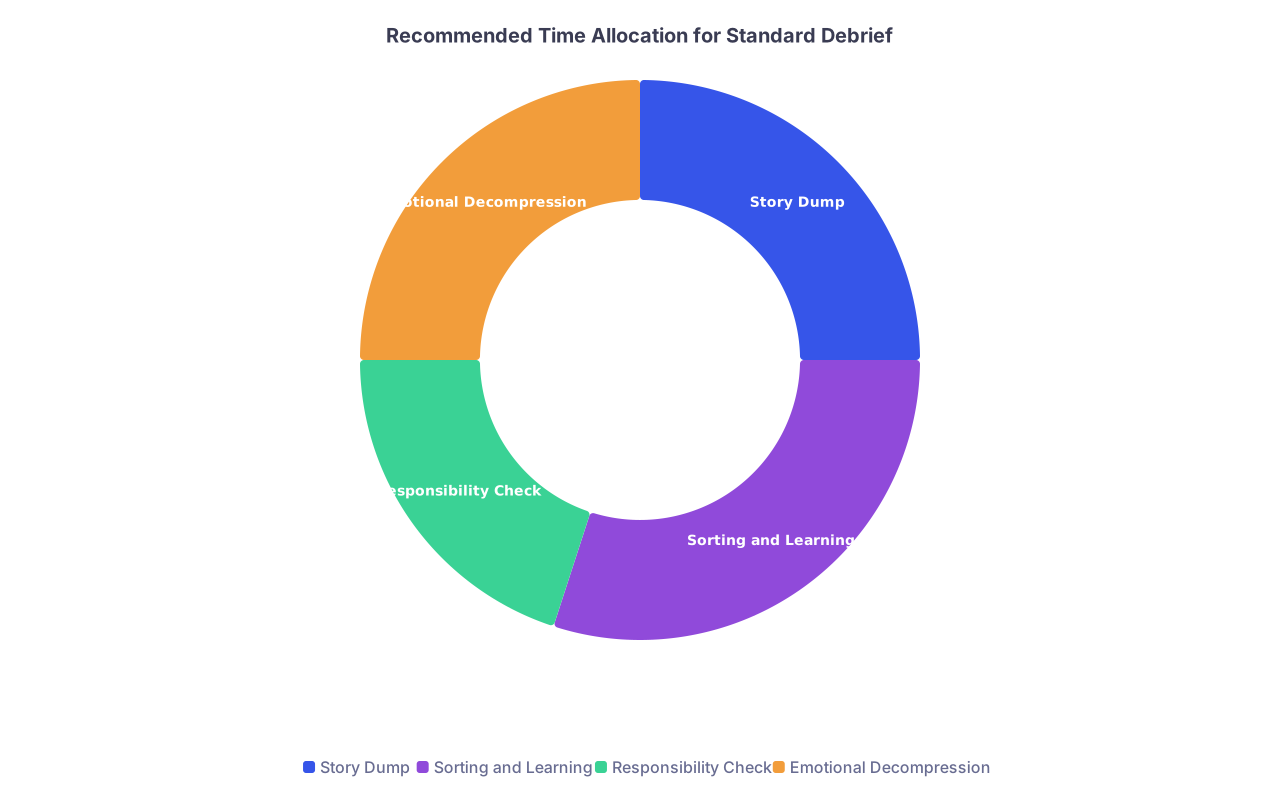
| Category | Value |
|---|---|
| Story Dump | 5 |
| Sorting and Learning | 6 |
| Responsibility Check | 4 |
| Emotional Decompression | 5 |
Handling Specific Bad-Shift Scenarios
Not all bad shifts are the same. The structured debrief is your base, but you should tweak it for certain scenarios.
Scenario 1: A Patient Died and You Feel Responsible
Extra steps:
In your responsibility check, be granular:
- “I did X at time Y based on information Z.”
- Ask: “Would a reasonable resident at my level, with this information, have done differently?”
If the answer is honestly “yes, they would have,” then:
- Turn that into a very specific skill target (reading, simulation, asking for supervision).
- Schedule a time to discuss with a senior or attending you trust. Use this script:
- “I want to walk through this case from A to Z to see what I could have reasonably done differently.”
If the answer is “no, this was not realistically preventable by me,” document that in your closure sentence. Explicitly.
Scenario 2: You Were Humiliated or Berated
This one lingers the longest.
In your People / communication section:
- Write down exact phrases said. Humiliation lives in the fuzzy memory. Clarity often exposes it as inappropriate.
Then ask:
- “Was this feedback (even if badly delivered) or abuse?”
- Feedback: Specific to an action, offers correction, not global statement of your worth.
- Abuse: Global, shaming, personal; no path to improvement.
If it was abuse:
- Tag it for action:
- Document it (date, time, context, witnesses).
- Discuss with chief, PD, or trusted faculty if pattern persists.
- Do not gaslight yourself into thinking this is “normal residency teaching.”
Your closure sentence might be:
- “Dr X spoke to me in an unacceptable way; that is not a reflection of my worth or potential, and I will not internalize their voice as my own.”
Scenario 3: You Froze in an Emergency
Freezing is a nervous system overload, not a moral failing.
In your debrief:
Under Knowledge / skills:
- Identify if you truly lacked algorithmic knowledge or if you blanked under stress.
Under Workload / cognitive load:
- Note what else was in your head at that moment (pagers, tasks, fatigue).
Action items might be:
- Schedule a sim lab session or run ACLS scenarios with a co-resident.
- Write a one-line script for next time:
- “I am taking 5 seconds to think – someone start compressions / narrate steps.”
Naming your process out loud next time often prevents full shutdown.
How to Make This a Habit, Not a One-Off
This only works if you do it repeatedly. Habits under residency conditions require frictionless design.
Here is how you make this stick:
Create a dedicated debrief note or notebook.
- Title: “Post-Shift Debriefs.”
- One entry per bad shift, date at top.
Pre-write the headings on each blank page:
- What happened
- Knowledge / skills
- Workload / cognitive load
- System issues
- People / communication
- Values / moral distress
- Action items
- Responsibility check
- Closure sentence
Tie it to an existing routine.
- Always do at least the mini debrief before you brush your teeth post-call.
No debrief = no toothpaste. Yes, I am serious.
- Always do at least the mini debrief before you brush your teeth post-call.
Review every 4–6 weeks.
Scan for patterns:
- Same attending?
- Same type of case?
- Same point of failure (triage, sign-out, nights 4–5 of a block)?
Use that to guide:
- What you read.
- What you discuss with mentors.
- What boundaries you set.

The Bottom Line: How You Walk Out Matters More Than How the Shift Went
You will have shifts that are objectively awful:
- Impossible ratios.
- Losses that should not have happened.
- System chaos that would break anyone.
You do not control that. You do control whether those shifts:
- Become vague, corrosive beliefs about your competence.
- Or become brutal but useful data that sharpens your practice.
Use a structured debrief to:
- Contain and process the shift instead of letting it bleed into everything.
- Extract 1–3 concrete improvements so the pain buys you skill.
- Close the file in your head so you can rest and show up to the next shift as something close to yourself again.