
The way you behave on night float will do more for your reputation than six months of daytime rotations. Chiefs talk. Attendings listen. And yes — people absolutely remember who was a mess at 3 a.m.
Let me tell you what chiefs really notice. It is not what you think.
Day shifts are theater. Rounds, presentations, consultants everywhere, senior residents hovering. Night float strips all that away. What is left is how you think, how you act when no one is watching, and how safe you are when the hospital feels like it is running on fumes.
I have sat in those chief meetings. I have heard: “That intern? Great during the day. Unsafe at night.” Guess which one sticks.
The first thing: do I feel safe with you overnight?
This is the real question in every chief’s head: If I am cross-covering two services and asleep for 45 minutes, do I trust you not to hurt anyone?
Nobody says it that bluntly in your evaluation, but behind closed doors, that is exactly how it gets phrased.
What makes a chief feel safe with an intern on night float?
You do not need to know everything. You do not need to be fast. But you do need three things: judgment, humility, and pattern recognition.
Judgment is knowing when a “weird but okay” vital sign becomes “I’m coming to the bedside now.” Chiefs clock very quickly whether you’re the intern who pages for help early, or the intern who tries to “handle it” until the patient is coding.
I’ve seen this play out way too many times. Two interns, same night, same hospital.
Intern A gets paged: “BP 82/48, HR 115, patient a little more confused.” Intern A walks to the bedside. Checks the chart. Looks at the trend. Thinks: “This patient was 130/70 an hour ago.” Calls the senior: “Hey, this feels off. Can you come look with me?” That gets talked about in a good way.
Intern B gets the same page. Orders a fluid bolus from the computer. Never lays eyes on the patient. An hour later the rapid response team is in the room. BP 60 systolic. Lactate 6. Guess what the overnight senior writes in the chief chat the next morning.
Humility is knowing when you are in over your head and not trying to hide it. Chiefs notice how often you say, “I’m not comfortable with this” versus how often you disappear behind the order screen and pretend everything is under control.
Pattern recognition comes with time, but even early on, we can see whether you’re trying to build it. Do you look back at labs, vitals, notes from earlier that day? Or do you treat every page like an isolated event?
There is a phrase I have heard chiefs use word-for-word: “I sleep better when X is on nights.” That is not about intelligence. That is about safety. If you want one line to summarize what you’re really being judged on during night float, it is that.
The second thing: how you handle pages — the pages tell your story
If you want to know how your night is being judged, do not look at your notes. Look at your pager patterns. Chiefs absolutely ask the overnight nurses about you. They do it casually, like: “How were nights with the new interns?” The nurses’ answers are brutal and accurate.
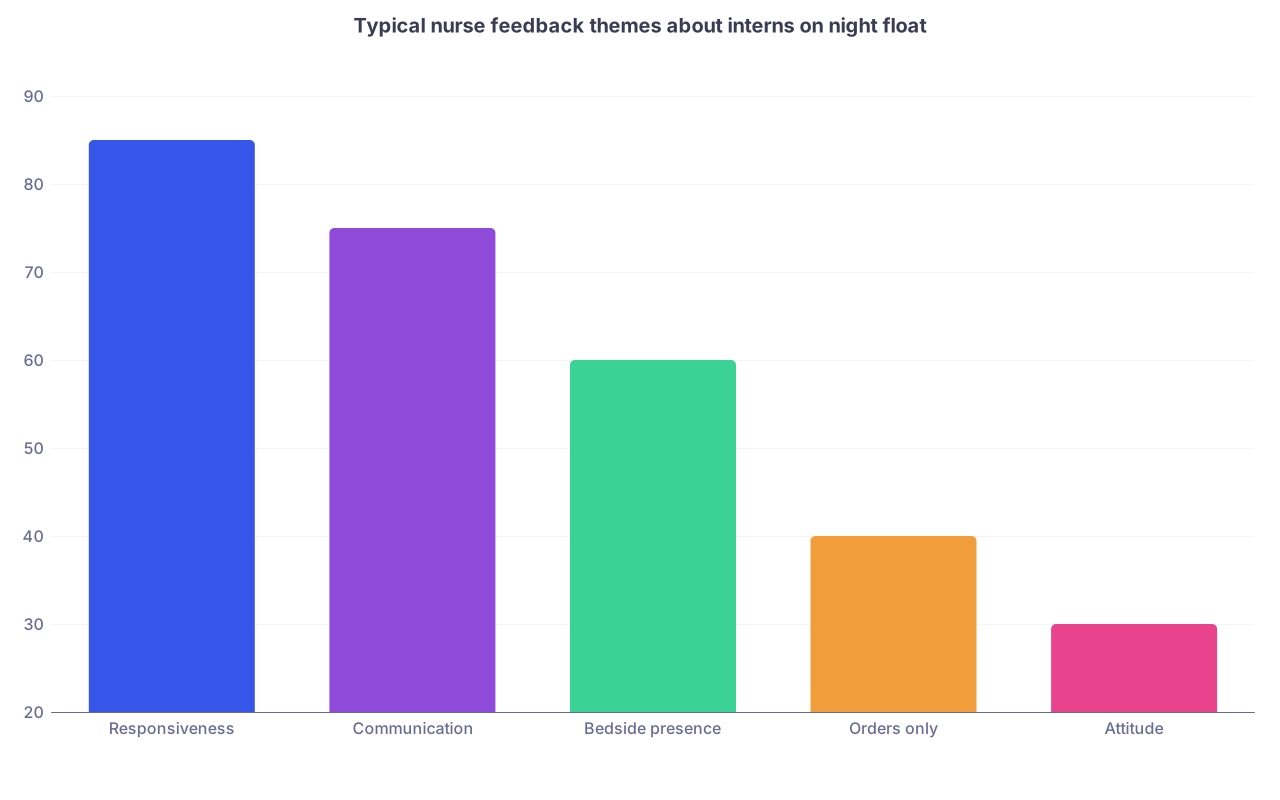
| Category | Value |
|---|---|
| Responsiveness | 85 |
| Communication | 75 |
| Bedside presence | 60 |
| Orders only | 40 |
| Attitude | 30 |
Here’s what chiefs and nurses actually pay attention to:
You answer pages. Quickly. Not five minutes later, not after you finish scrolling through Epic. You do not need to run to the bedside for every Tylenol question, but you do need to acknowledge the nurse like a human being. “Got it, I’ll put the order in,” or “Hold on, I’m in a patient room, I’ll come by in 10 minutes.” That simple communication separates you from the interns who get labeled “unreachable.”
You do not practice EMR medicine. Chiefs hate “Epic-only” interns. The ones who, when paged for hypotension, stay in the workroom and click through vitals, labs, and orders, then throw in a bolus from their chair. Nurses notice who actually shows up. And they tell us.
You ask focused questions before you reflex-order things. When a nurse calls, “Patient short of breath,” the lazy intern orders a chest x-ray and nebulizers without leaving the desk. The intern who gets respect says: “Is the patient on oxygen? What are the sats? Any chest pain? What were the lungs like earlier? I’ll come see them.” That last sentence — “I’ll come see them” — is the one that changes how people talk about you.
Chiefs also notice your “page signature” over time. Are you the intern who gets 3-4 calls about the same patient because you keep band-aiding the problem? Or do you deal with the underlying issue once?
Here is a simple truth no one tells you: nurses will defend you to attendings and chiefs if they feel you show up. I have watched a nurse in the ICU tell a notoriously difficult attending, “No, that intern came right away, they were at the bedside, they called the senior appropriately.” That single sentence salvaged an evaluation.
The third thing: your tone at 3 a.m. when you’re tired and annoyed
The mask slips at night. Chiefs know this, and they watch how you talk to people when you’re exhausted, hungry, maybe two admissions behind and getting paged nonstop.
No one cares how nice you are at 9 a.m. on rounds with the attending present. They care what you sound like when a nurse calls you for the fourth time about a confused patient trying to climb out of bed.
There are patterns here too:
- The interns who treat night nurses like obstacles.
- The interns who treat them like partners.
- The interns who snap, then apologize.
- The interns who snap, then justify.
Guess which groups get championed for chief resident one day.
You do not need to be fake-sweet. In fact, that reads as inauthentic. You can be blunt and still be respectful. “I hear you, I’m swamped, but I’ll come after I finish this admission,” buys you more goodwill than “Do you really need me for that?”
Chiefs also notice how you talk about nurses and other staff in the workroom when you think only residents are listening. The intern who rolls their eyes and says, “They page for everything” gets mentally tagged. The one who says, “I think they’re just worried, I’ll go look,” also gets tagged. In a very different column.
I’ve sat in resident-only rooms where a chief says: “She’s solid clinically, but she’s rude at night. Nurses hate calling her. That’s a problem.” People underestimate how fast that reputation spreads.
The fourth thing: how you handle your own fatigue and limits
Here is a secret that will probably surprise you: chiefs do not respect the “I never sit, I never eat, I’m dying but still going” intern as much as you think.
We’ve watched that movie. It ends with mistakes.
What chiefs really notice is whether you have situational awareness of your own exhaustion. If you are on night 5 of 6, no nap, getting sick, making typos in orders, the strongest move is not to grind harder. It is to say to your senior: “I’m hitting a wall — can you double check these drips with me?”
That is not weakness. That is exactly the kind of honesty we look for when we decide who we can trust with more responsibility.
I remember one specific intern. Brilliant. Fast. The kind of person who could cross-cover two busy services and still bang out clean notes. On night float, around 4 a.m., they started entering insulin orders on the wrong patient. Caught it themselves. Instead of hiding it, they went to the senior: “I think I’m getting unsafe. I need you to look over my orders for the rest of the night.”
That story circulated among the chiefs not as “Watch out, they almost made a mistake,” but as “That’s someone I trust. They saw their own blind spot.”
What worries chiefs is the opposite: the intern who proudly says, “I don’t need breaks, I can go all night,” but then is too proud to ask for a second set of eyes when they are drowning in admits.
The fifth thing: your admission notes and sign-out — the paper trail of your brain
Your night admission notes and your morning sign-out are not clerical tasks. They are x-rays of your thinking. Chiefs read them mercilessly.
Let’s talk notes first.
The daytime attending will judge you based on what you write at 2 a.m. That’s the dirty little truth. The note where you wrote “sepsis” with no documented vitals, no lactate, no blood cultures? They see that. They go to the chief: “Your intern is slapping labels on people.”
On the other hand, a lean, problem-focused H&P that nails the working diagnosis, documents what you were and were not thinking — that earns a lot of respect. Not because it’s pretty, but because it tells us your brain was on even when your body wanted to lie down on a stretcher.
Morning sign-out is where chiefs watch your professionalism.

| Step | Description |
|---|---|
| Step 1 | Night intern pre-round check |
| Step 2 | Update active issues |
| Step 3 | Prioritize sick patients |
| Step 4 | Face to face sign-out |
| Step 5 | Answer clarifying questions |
| Step 6 | Confirm pending tasks |
What do they look for?
You show up on time. The day team is there at 6:30 a.m., you stroll in at 6:40, half your notes unfinished, still “working on sign-out”? Chiefs notice. And they remember.
You do not hide problems in the fine print. If someone was hypotensive overnight, that is the first thing out of your mouth, not buried in your tenth sentence. Nothing infuriates a chief like finding out about a night scare from the nurse at 10 a.m. instead of from your sign-out at 7.
You own your uncertainties. Saying, “I admitted this as possible pneumonia, but the imaging was borderline, and I’m not fully convinced” is much better than pretending you were fully sure of something you clearly weren’t. Chiefs trust the intern who flags diagnostic uncertainty more than the intern who always sounds 100% confident and is wrong 40% of the time.
The sixth thing: how you respond the first time you screw up
You will make a mistake on night float. It is not hypothetical. It is guaranteed.
What the chiefs care about is what you do in the hour after you realize it.
I’m not talking about catastrophic errors; I’m talking about all the small but real things that happen at 3 a.m.:
- You didn’t go see a patient you should have.
- You entered an order on the wrong patient (and caught it).
- You dismissed a nurse’s concern that turned out to be right.
- You failed to call your senior when you should have.
The interns who grow — the ones chiefs promote, recommend, fight for — do the same three things:
They tell someone. Sooner rather than later. “I think I messed this up. Here’s exactly what happened.” That level of directness is rare and memorable.
They analyze, not justify. “I was tired, I thought it was okay” does not go far. “I didn’t look at the trend. I only saw the last BP. That’s on me. I’ve started always scrolling back through the last 12 hours now” is much stronger.
They change their behavior quickly and obviously. If you got in trouble for not seeing a hypotensive patient at the bedside, and then the next three nights you are physically in the room for every concerning vitals page, nurses will notice and tell us: “They’re really stepping up.”
Chiefs are not looking for a flawless intern. They are looking for a self-correcting one.
The seventh thing: your quiet leadership — even as an intern
Night float accelerates your growth more than any other month. You’re alone more. You have more autonomy. That means chiefs start watching for early leadership, even when you’re not technically in charge of anyone.
Leadership on nights is subtle: it’s how you stabilize chaos.
You set the tone in the workroom. Are you the intern who radiates panic? The one who sighs loudly, complains constantly, and broadcasts how miserable you are? That mood spreads. Fast. Chiefs hear about it.
Or are you the intern who, even when slammed, keeps it contained? “Okay, we’re behind, but let me finish this admit and then I’ll help you with cross-cover.” That kind of quiet steadiness reads as leadership, even when you do not have a title.
You support your co-interns. On some services, you’ll be on night float with another intern. Chiefs pay attention to whether you hoard the easier tasks or share the pain. If your name comes up and your co-intern says, “They always helped me with admits when I was drowning,” that carries a lot of weight.
You remember the patients, not just the checkboxes. When the day team asks, “How did Mrs. X do overnight?” and you can picture her room, remember her story, and give a coherent clinical update — that tells chiefs you are not just processing tasks, you’re owning your patients.
The hidden scoreboard: how chiefs actually sort interns after nights
Let me take you behind one more curtain.
After a few months of intern year, particularly after the first night float block, chiefs and seniors will sit in a room or a group chat and start categorizing in their heads. Nobody says it as bluntly as this, but functionally, it looks like this:
| Tier | How they’re described behind closed doors |
|---|---|
| A | “Safe, early calls, good judgment, nurses love them” |
| B | “Fine, needs supervision, improving” |
| C | “Slow to call, questionable judgment, nurses do not like nights with them” |
| D | “Liability overnight, needs close monitoring” |
You want to be A or a strong B by the time you’re done with your first real night block. Not because of some ego thing, but because those early impressions decide:
- Who gets the complex patients later.
- Who gets backed for competitive fellowships.
- Who chiefs think of when a leadership role opens.
- Who attendings trust on busy services.
And yes, there is movement. You can climb tiers. A rough first night block is not a death sentence. But you have to know that this is how you’re actually being evaluated.
Most interns think it’s all about “knowledge” and “work ethic.” Chiefs are asking: “Would I trust you with my family member at 2 a.m.?”
Night float is the answer to that question.
How to actually show up the way chiefs remember
If you want something concrete to hold onto, boil all of this down to a few habits:
When in doubt, see the patient. If your gut pings you even a little, leave the screen and go. Chiefs never criticize an intern for too many bedside checks. They absolutely criticize the opposite.
Call early, not late. If you are on the fence about calling your senior, that means you should already have called. I have never heard a chief say, “They call me too often about sick patients.” I have heard plenty say, “They sat on it.”
Tell nurses what you’re thinking. Even briefly. “I’m worried about sepsis; I’m going to get labs and I’ll be back after I talk to my senior” turns a nervous nurse into an ally instead of a critic.
Protect your brain. Eat something. Sit for five minutes between blasts of chaos. Ask for a second set of eyes when you feel fuzzy. The intern who knows their limits is the one we trust with more.
Take responsibility for your nights. Not just the orders you place, but the tone you bring, the way you talk, the honesty with which you own your learning curve.
Years from now, you will forget most individual admissions and most of the 3 a.m. pages. What will stick — for you, and for the people who trained you — is who you became when the building got quiet, the lights dimmed, and it was just you, your pager, and a handful of very sick strangers depending on your judgment.
Night float is where that version of you gets built. Or exposed.