
The way most residents “reflect” at the end of the year is almost useless: a vague sense of being tired and a half-remembered list of things that went badly. You can do much better than that.
This is your promotion year exam that no one gives you. If you do it seriously, you start the next PGY level sharper, more protected, and with a plan instead of just “hoping this year is better.”
I am going to walk you through it as a timeline: what to do in the last month, then the final week, and finally a day-by-day checklist in the last few days before you advance to the next PGY.
1. Four Weeks Before Your PGY Changes: Set Up the Reflection
At this point you should stop pretending “I’ll think about this when things calm down.” They do not calm down. You have to schedule it.
Week -4: Block Time and Gather Data
Block 2–3 hours in your calendar, just like you would for clinic or conference. If you do not schedule it, someone else will schedule over you.
By the end of this week, you should have:
Time protected for reflection
- Pick:
- One evening (post-call if lighter)
- Or a weekend morning
- Tell your co-resident or partner: “I’m offline for 2–3 hours Sunday morning. Year-end review.”
- Pick:
Your raw data in one place Pull together:
- Rotation evaluations (formal and informal)
- Procedure logs (from your EMR, ACGME, or program log)
- In-basket metrics or clinic numbers (no-show rates, panel size, continuity)
- In-service or board-style exam scores
- Feedback emails or texts from attendings / fellows
- Notes from CCC (Clinical Competency Committee) or semi-annuals
Use a simple folder:
- A digital folder:
PGY1_Reflection(rename for your year) - Or a physical folder you throw printed evals into
A simple structure to capture thoughts Create a 3-part document:
- Section 1: Clinical / Skills
- Section 2: Professional / Systems
- Section 3: Personal / Wellness
That is all. Too fancy, you will not use it.
| Section | Focus Area |
|---|---|
| Clinical/Skills | Diagnoses, procedures, handoffs |
| Professional/Systems | Teamwork, leadership, time management |
| Personal/Wellness | Sleep, boundaries, identity outside work |
2. Three Weeks Before: Start the Memory Download
At this point you should start pulling experiences out of your head before they decay into “this year was fine, I guess.”
Week -3: High-Yield Memory Pass
Give yourself 60–90 minutes.
Run through your year rotation-by-rotation For each block:
- List the rotation (e.g., “MICU, July,” “Gen Peds wards, October”)
- Under each, write:
- 1 thing you learned that changed your practice
- 1 thing you struggled with
- 1 moment that stuck (good or bad)
Keep it tight. Bullet points. This is not a diary.
Mark the “spikes” Put a symbol next to certain memories:
★– high-impact success!– significant error / near-miss?– unclear what you should have doneΔ– something that changed how you see medicine or yourself
Those are the ones you will process more deeply later.
Capture feedback phrases verbatim The exact words matter because they stick:
- “You own your patients. That is rare for a PGY1.”
- “You disappear when things get chaotic.”
- “Good fund of knowledge, needs to speak up on rounds.”
- “Solid technical skills, but handoffs are thin.”
Drop them into your document under the right section. Do not sanitize them.
3. Two Weeks Before: Zoom In on Core Competencies
Now you have the raw material. At this point you should organize it into specific domains that will matter as a more senior resident.
Week -2: Competency-by-Competency Review
Plan for 1.5–2 hours, broken into two sessions if needed.
Use these six buckets:
Clinical Reasoning and Knowledge Ask yourself:
- When did I actually change my differential because of new data?
- Did I miss patterns? (e.g., kept over-ordering imaging, or missing sepsis early)
- How did my in-service exam compare to peers?
Write:
- 2–3 strengths (e.g., “pattern recognition in heart failure,” “guideline-based diabetes management”)
- 2–3 gaps (e.g., “neuro exam under pressure,” “vent management,” “peds rashes are a black box”)
Procedural and Technical Skills Look at your logs honestly:
- Are your numbers behind expected for your PGY?
- Which procedures still make you tense?
Categorize:
- Competent and comfortable – minimal supervision needed
- Technically okay but anxious – do fine, but stress is high
- Not where you should be – skills or volume too low
Communication and Teamwork This is where residents often lie to themselves.
Review:
- Feedback from nurses, case managers, and co-residents
- Any patient complaints or compliments
- Moments when:
- Nurses bypassed you and called your attending
- You defused a family conflict
- You froze or got defensive when challenged
Ask:
- Do people trust me to be reachable and responsive?
- Do I give clear, concise plans?
- Do I close the loop with consultants, nursing, and families?
Leadership and Autonomy Critical for the next PGY.
Think:
- When were you “the doctor” without someone holding your hand?
- How did you run a code, rapid response, or night shift?
- Did students or interns feel safe asking you questions?
Mark:
- 2 moments you are proud of as a leader
- 2 moments where you avoided leadership or dumped it on someone else
Systems-Based Practice and Efficiency Translation: Do you work with the system or get crushed by it.
Review:
- Discharge efficiency
- EMR use (templates, order sets, in-basket chaos)
- How often you stayed late and why
Decide:
- Which of those late nights were truly patient-care driven
- Which were inefficiency, perfectionism, or distraction
Professionalism and Reliability Less glamorous. More career-defining.
Be blunt:
- Any late notes that created problems?
- Any patterns of showing up late, missing sign-out, or poor follow-through?
- Any unprofessional emails or frustrated comments you regret?
Identify one concrete behavior to stop or change.
4. One Week Before: Turn Reflection into a Concrete Plan
All of this is useless unless you translate it into specific, time-bound actions. At this point you should shift from “what happened” to “what I will do.”
Week -1: Build Your Next-PGY Action Plan
Give yourself 2 hours, ideally on a quieter day off.
Step 1 – Choose 3–5 Priority Targets
Not 15. You do not have the bandwidth.
Pick:
- 1–2 clinical skills targets
- 1 communication/leadership target
- 1 systems/efficiency target
- 1 personal/wellness target
Examples:
- “Start all ICU ventilator notes with a structured checklist; review vent settings with RT on each new admission for the first month.”
- “Practice a 30-second plan summary for each patient before rounds; no rambling presentations.”
- “Batch in-basket twice daily instead of constant checking.”
- “Protect one evening per week as no-medicine time.”
Step 2 – Attach Each Target to a Specific Timeframe
Tie actions to rotations or blocks:
| Timeframe | Focus Area |
|---|---|
| First ICU block | Vent management, ABG interpretation |
| First wards block | Leadership on rounds, handoffs |
| First clinic month | Panel review, inbox batching |
| Ongoing | Sleep, exercise, therapy or coaching |
Step 3 – Set Up Micro-Checkpoints
Do not wait until next June to see if you improved.
Every 4–6 weeks:
- Spend 20 minutes updating your document
- Ask 1 trusted attending or fellow: “Can you give me feedback on how I am doing with X?”
After big rotations (ICU, ED, nights):
- Write 5 bullet points:
- 2 things that improved
- 2 things that regressed
- 1 thing to change for next time
- Write 5 bullet points:
5. Final 3 Days Before You Advance: Day-by-Day Checklist
Now we zoom in. At this point you should shift from broad reflection to immediate readiness for your new role and expectations.
Day -3: Clarify Your New Responsibilities
You are not the same resident anymore. The system will treat you differently on July 1 (or your program’s turnover date), whether you are ready or not.
On this day, you should:
List what changes with your new PGY Examples:
- PGY1 → PGY2 (IM, Peds, FM)
- You run the team more
- You answer nurse calls first
- You manage cross-cover decisions
- PGY2 → PGY3 (IM) or senior year (others)
- You run rounds
- You triage admissions
- You teach interns and students
Write 5–7 bullet points under:
- “Responsibilities I did not have last year”
- “Decisions I will now be expected to make alone (at least initially)”
- PGY1 → PGY2 (IM, Peds, FM)
Identify 2–3 “red-line” situations These are cases where you will always call for help, no hesitation:
- New hemodynamic instability
- Airway concerns
- Uncontrolled bleeding
- Severe mental health risk
- Any situation you feel “over your head”
Write them down. This is your internal policy before you get tired and tempted to “just watch.”
Review your scariest situations from this year For each:
- What happened
- What you did
- What you would do differently now
- When you would escalate earlier next time
This gives you a mental template before the next crisis.
Day -2: Tighten Your Systems and Logistics
At this point you should clean up the mess from the prior year so it does not poison the next one.
On this day, you should:
Close the loop on lingering tasks
- Outstanding notes (finish or at least list them with a deadline)
- Follow-up labs or imaging you promised patients
- Referrals you meant to place
Reset your tools
- Update your note templates with:
- Better assessment/plan structure
- Smartphrases for common conditions
- Clean your inbox:
- Archive junk announcements
- Create simple folders:
- “Teaching pearls”
- “Procedures and how-tos”
- “Feedback”
- Update your note templates with:
Prepare teaching tools for your new role If you are stepping into a more senior role:
- Draft:
- A 5-minute “how I like to run sign-out” script
- A short orientation for new interns / students: “Here is how our team works”
- Pick 2–3 topics you can teach well (e.g., chest pain workup, DKA management)
- Draft:
This is where you stop thinking like only a learner and start thinking like the person who sets the tone.
Day -1: Personal Reset and Short-Term Intentions
This is not just about skills. If your life outside work is chaos, your next PGY will feel worse no matter how much experience you gain.
On this day, you should:
Do a brutally honest wellness inventory Quick ratings (1–5):
- Sleep quality
- Physical activity
- Relationships (partner, friends, family)
- Burnout level
- Sense of meaning or purpose
Anything 1–2 needs a specific action in the next 4 weeks. Not “someday.”
Decide on 2–3 non-negotiables for the next 3 months Examples:
- “No checking work email after 9 pm on golden weekends.”
- “One workout per week, even if it is 20 minutes.”
- “Monthly dinner with a friend who is not in medicine.”
Write them down and tell someone you trust. You are more likely to respect them if someone else knows.
Write a one-page “Next-PGY Contract” with yourself Include:
- 3–5 growth goals (from your earlier action plan)
- 2–3 boundaries you will attempt to honor
- 2–3 strengths you commit to using intentionally
- Example: “I connect well with anxious families. I will use this to teach interns how to do family updates.”
Keep this visible:
- Screenshot on your phone
- Printed copy in your work bag
- Pinned as the first note in your notes app
6. Early Next PGY: 4-Week Mini-Timeline to Check Your Trajectory
Reflection is pointless if you never look back at what you wrote. At this point you should use the first month of the new year to see if you are drifting or actually changing.
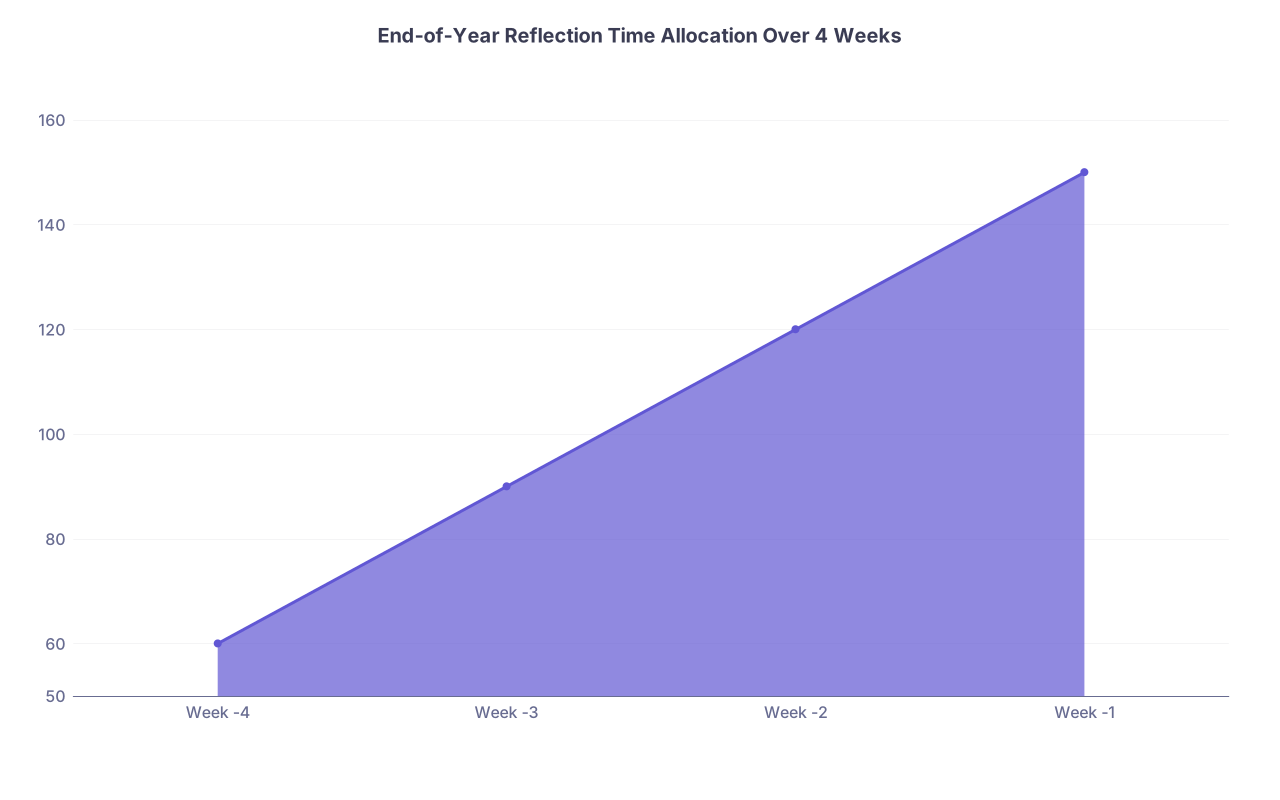
| Category | Value |
|---|---|
| Week -4 | 60 |
| Week -3 | 90 |
| Week -2 | 120 |
| Week -1 | 150 |
Week +1: Reality Check
- Ask:
- “What surprised me about being PGY2/PGY3?”
- “Which responsibilities feel heavier than expected?”
- Update your document with:
- 3 ways your life is different now
- 2 things that are already better than last year
- 2 things that feel worse
Week +2: Feedback on One Specific Target
Pick one growth area (e.g., communication on rounds).
- Ask one attending or senior:
- “I’m working on being clearer when I present and summarize plans. What have you noticed this week that I am doing well or could improve?”
- Document their exact words. Adjust your plan.
Week +4: Mini-Retreat (30–45 Minutes)
- Re-open your “Next-PGY Contract”
- For each goal:
- Mark: On track / Partially / Ignored
- Write 1 sentence on why
- Adjust:
- Drop 1 goal that is unrealistic
- Add 1 small, more achievable behavior
7. Visual Map of the End-of-Year Reflection Process
Use this as your mental roadmap. This is the whole thing in one view.
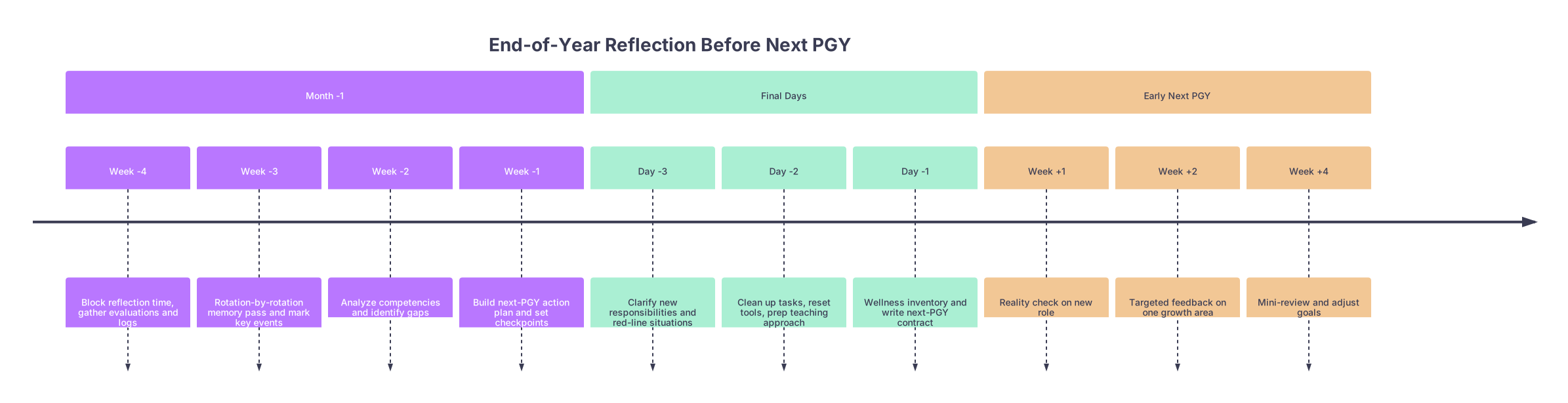
| Period | Event |
|---|---|
| Month -1 - Week -4 | Block reflection time, gather evaluations and logs |
| Month -1 - Week -3 | Rotation-by-rotation memory pass and mark key events |
| Month -1 - Week -2 | Analyze competencies and identify gaps |
| Month -1 - Week -1 | Build next-PGY action plan and set checkpoints |
| Final Days - Day -3 | Clarify new responsibilities and red-line situations |
| Final Days - Day -2 | Clean up tasks, reset tools, prep teaching approach |
| Final Days - Day -1 | Wellness inventory and write next-PGY contract |
| Early Next PGY - Week +1 | Reality check on new role |
| Early Next PGY - Week +2 | Targeted feedback on one growth area |
| Early Next PGY - Week +4 | Mini-review and adjust goals |
8. The Checklist: Condensed Version
Print this. Screenshot it. Whatever. This is the End-of-Year Reflection Checklist in pure checklist form.
Four Weeks Out
- Schedule 2–3 hours for reflection
- Create a digital or physical folder for PGY materials
- Collect evaluations, logs, exam scores, feedback notes
- Create a 3-section document (Clinical, Professional, Personal)
Three Weeks Out
- List each rotation and note:
- 1 key learning
- 1 struggle
- 1 memorable moment
- Mark high-impact items (★, !, ?, Δ)
- Capture exact feedback phrases in your document
Two Weeks Out
- Review:
- Clinical reasoning and knowledge
- Procedural skills
- Communication and teamwork
- Leadership and autonomy
- Systems efficiency
- Professionalism and reliability
- List 2–3 strengths and 2–3 gaps in each major domain
One Week Out
- Choose 3–5 priority targets for next PGY
- Attach each to a specific rotation/timeframe
- Set 4–6 week micro-checkpoints
- Decide how and when you will ask for feedback
Day -3
- List new responsibilities at your next PGY level
- Define 2–3 red-line “always call” situations
- Review your scariest cases and what you would do differently
Day -2
- Close or list all lingering tasks and notes
- Clean and update EMR tools and templates
- Prepare simple orientation and teaching structure for juniors
Day -1
- Rate sleep, activity, relationships, burnout, meaning (1–5)
- Define 2–3 non-negotiable personal boundaries
- Write a one-page “Next-PGY Contract” and store it where you will see it
Week +1, +2, +4
- Week +1: Document what surprised you about the new role
- Week +2: Ask one person for feedback on one specific target
- Week +4: Revisit contract, mark progress, adjust one goal
If you remember nothing else:
- Do not rely on vague memory. Gather real data and write things down.
- Pick a few precise targets, tie them to specific times, and schedule check-ins.
- Treat your next PGY like a promotion you prepared for, not a level you were passively granted.