
You will feel behind at some point in residency. And it will feel like everyone else is sprinting while you’re drowning in quicksand.
I’m going to say the quiet part out loud: almost every resident is secretly terrified they’re the weak link. The one everyone talks about on the way to the parking lot. The one attendings “keep an extra eye on.”
You’re not crazy for worrying, “What if I just… can’t keep up?”
Let’s walk straight at that fear instead of dancing around it.
The Nightmare Scenario in Your Head
Let me guess what your brain is doing:
- You’re picturing your co-residents effortlessly presenting crisp plans on rounds while you’re still trying to remember which lab you forgot to check.
- You imagine the senior sighing when you ask another “dumb” question.
- You picture an attending saying, “We need to talk about your performance,” and your stomach drops.
- Worst of all, you’re afraid there’s going to be this moment where everyone realizes you shouldn’t be there.
That last one? That’s the real fear. Not just “I’m slower.” But “I am fundamentally not cut out for this, and it’s about to be exposed.”
Here’s the ugly truth: residency is built to make you feel that way. You’re thrown into high-stakes work, steep learning curves, sleep deprivation, messy systems, and constant evaluation. Of course you feel behind.
The problem isn’t that you’re anxious. The problem is your brain has started equating:
- “I’m slower than them” → “I’m unsafe.”
- “I need help” → “I’m incompetent.”
- “I missed something” → “I don’t belong in this field.”
That’s how you end up panicking instead of actually fixing anything.
The Reality: People Don’t Start in the Same Place
Residency pretends everyone starts at the same line. That’s just false.
Some people:
- Trained at insanely busy medical schools with heavy intern-level responsibility.
- Spent a research year in your specialty and already know half the attendings.
- Were scribes, nurses, or techs before med school and speak “hospital” fluently.
- Just naturally think faster when they’re tired and stressed.
Others:
- Came from lower-resourced schools with less hands-on responsibility.
- Had mostly outpatient or specialty-heavy rotations.
- Are neurodivergent and process information differently (not worse—just not standard).
- Have anxiety or depression that makes their cognitive bandwidth smaller.
But nobody hands out a syllabus labeled: “Here’s where everyone actually started.” You only see the surface: the ones who’re smooth on rounds, know obscure guidelines, and never seem flustered when their list explodes.
So you decide: “They’re just better. I’m broken.”
No. They’re just different on the timeline.
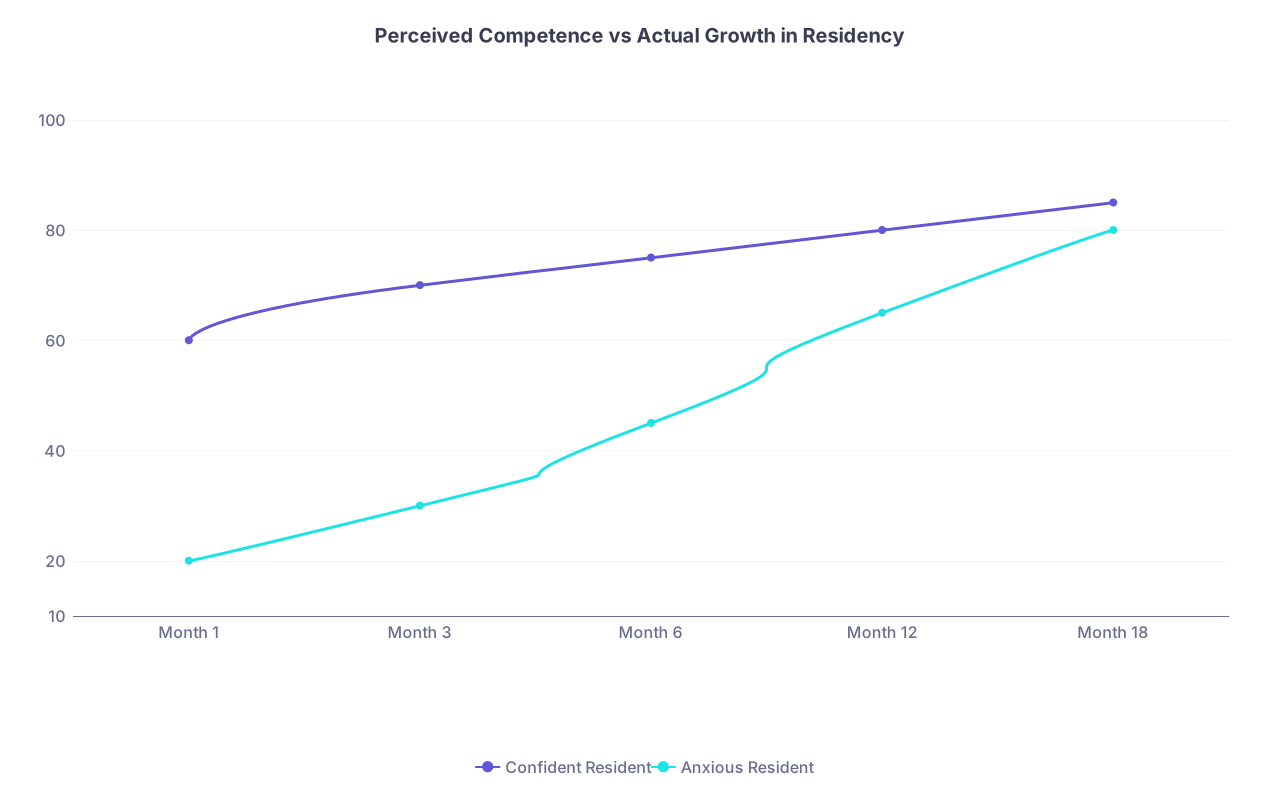
| Category | Confident Resident | Anxious Resident |
|---|---|---|
| Month 1 | 60 | 20 |
| Month 3 | 70 | 30 |
| Month 6 | 75 | 45 |
| Month 12 | 80 | 65 |
| Month 18 | 85 | 80 |
The anxious resident always underestimates their growth. You put so much energy into self-criticism that you don’t notice how far you’ve moved.
The Terrifying Question: What If I’m Actually Unsafe?
Let’s talk about the worst-case scenario your brain keeps shoving in your face:
“What if I truly can’t keep up and I put patients at risk?”
That’s not a stupid question. That’s a very appropriate, mature question.
Here’s how programs look at “unsafe” vs “still learning but fine”:
| Pattern You Show | How It’s Usually Interpreted |
|---|---|
| Slow but asks for help | Safe, teachable |
| Misses stuff but owns it | Educable, needs support |
| Defensive, blames others | Concerning |
| Repeats same mistakes | Red flag |
| Hides errors | Huge problem |
You know what’s missing from that table?
“I’m not as fast as my co-resident.”
Nobody’s getting called into a remediation meeting because they can’t preround as fast as the PGY-3 who’s been on that service 6 times. People get flagged when they:
- Don’t recognize what they don’t know.
- Refuse to ask for help.
- Make the same mistake repeatedly without changing behavior.
If you’re even worrying about being unsafe, that’s already a sign your internal alarm system works. Scary as it feels, it’s better than the overconfident resident who never thinks they’re wrong.
What “Falling Behind” Actually Looks Like on the Ground
Let’s get concrete about what “I can’t keep up clinically” usually means.
Common patterns:
- Your notes take forever and you’re staying late almost every day.
- You feel behind on prerounding—vitals not checked, new labs missed, imaging not fully reviewed.
- On rounds, your plans are half-baked, and your senior has to fix or reframe a lot.
- Cross-cover nights feel like chaos; you’re constantly on your back foot.
- You’re terrified you’re missing silent trainwrecks on your list.
And then you compare yourself to the co-resident who:
- Leaves on time.
- Seems to always know the next step.
- Carries 16 patients without drowning while you’re dying at 8.
Your brain: “They’re built for this. I’m not.”
What’s more accurate: different experience + different brain wiring + different learning curve.
The Brutal Middle Ground: You’re Not Broken, But You Can’t Just “Try Harder”
Here’s the mistake anxious residents make: they respond to “I’m behind” with pure brute force.
Sleep less. Stay later. Skip meals. Double chart-check. Re-read UpToDate at 1 a.m. Rehearse rounds in your head on the drive home.
That works for a while. Then you hit a wall. Your processing slows more. You get more disorganized. You start missing more things. That freaks you out, so you grind even harder.
Congratulations, you’re now in the burnout death spiral.
You don’t need more desperation. You need system-level changes for you.
And yeah, that usually means the thing you least want to do: letting someone see that you’re struggling.
The Conversation You’re Afraid to Have (But Probably Need)
I get it. The words “I’m having trouble keeping up clinically” feel like detonating your career in front of your PD or chief.
But there’s a way to say it that signals responsibility, not weakness.
Something like:
“I’m noticing that compared to my co-residents, I’m slower at managing my list and formulating plans, especially on busy days. I’m working hard, but I’m worried I’m not as efficient as I should be. Can we talk about whether this is just a normal learning curve or if there are specific skills I should be focusing on?”
That is very different from:
“I can’t do this.”
One sounds like panic. The other sounds like insight.
Most programs would rather hear this in month 2 than in month 10 when issues are entrenched and you’re already half burnt to ash.
Concrete Ways to Get Faster and Safer (Without Selling Your Soul)
Let’s get out of the abstract. You want to know: what do I do tomorrow when I walk into the hospital and feel behind again?
Here’s where you actually can move the needle.
1. Ruthless Pre-Round Prioritization
Stop trying to do “perfect” prerounds on every patient. You don’t have time. Identify your highest-risk patients and front-load them.
- The fresh postop.
- The GI bleeder.
- The patient on pressors.
- The new admit you barely saw last night.
Have a 30-second template you run through for each patient: vitals, I/Os, labs, imaging, overnight events, big changes in meds, pending tests. Don’t get lost in the EHR rabbit hole.
2. Script Your Presentations
Presentations slow you down more than you think. Trying to build them in your head while scared on rounds? Cognitive nightmare.
Make templates—literally written—on your phone or a card. Something like:
- “Yesterday we were doing X for Y. Overnight Z happened. Today I think we should A, B, C because D.”
- “I’m most worried about [X] and I did [Y] to address it. I’m not sure if we should also consider [Z].”
That shift—from chaotic rambling to a clear structure—makes you sound more competent even if you still feel underwater. And it forces your brain to organize information the same way every time.
3. Stop Hiding Your Thinking
You know what seniors and attendings actually want to see? How you think. Not just the final plan.
If you’re behind, this is crucial. Say things like:
- “Here were the three things I considered and why I chose this one.”
- “I’m not confident about the fluid status, so I checked X and Y, but I’m still uncertain.”
- “I’m torn between sepsis vs PE here; I leaned sepsis because…”
This does two things:
- It shows you’re not guessing.
- It lets them correct your framework, not just the outcome.
That’s how you get better faster.
When It’s Not Just Speed: Attention, Memory, and Anxiety
Sometimes “I can’t keep up” is actually “my brain doesn’t work like theirs.”
You might notice:
- You reread the same note three times and still can’t pull the plan together.
- You forget what the attending just said 10 minutes ago.
- You zone out when you’re overwhelmed and then panic because you missed critical details.
- You leave the hospital with an unshakeable feeling you forgot something important.
That’s not laziness. That can be executive dysfunction, attention issues, anxiety, depression, sleep deprivation, or all of the above stacked on top of each other.
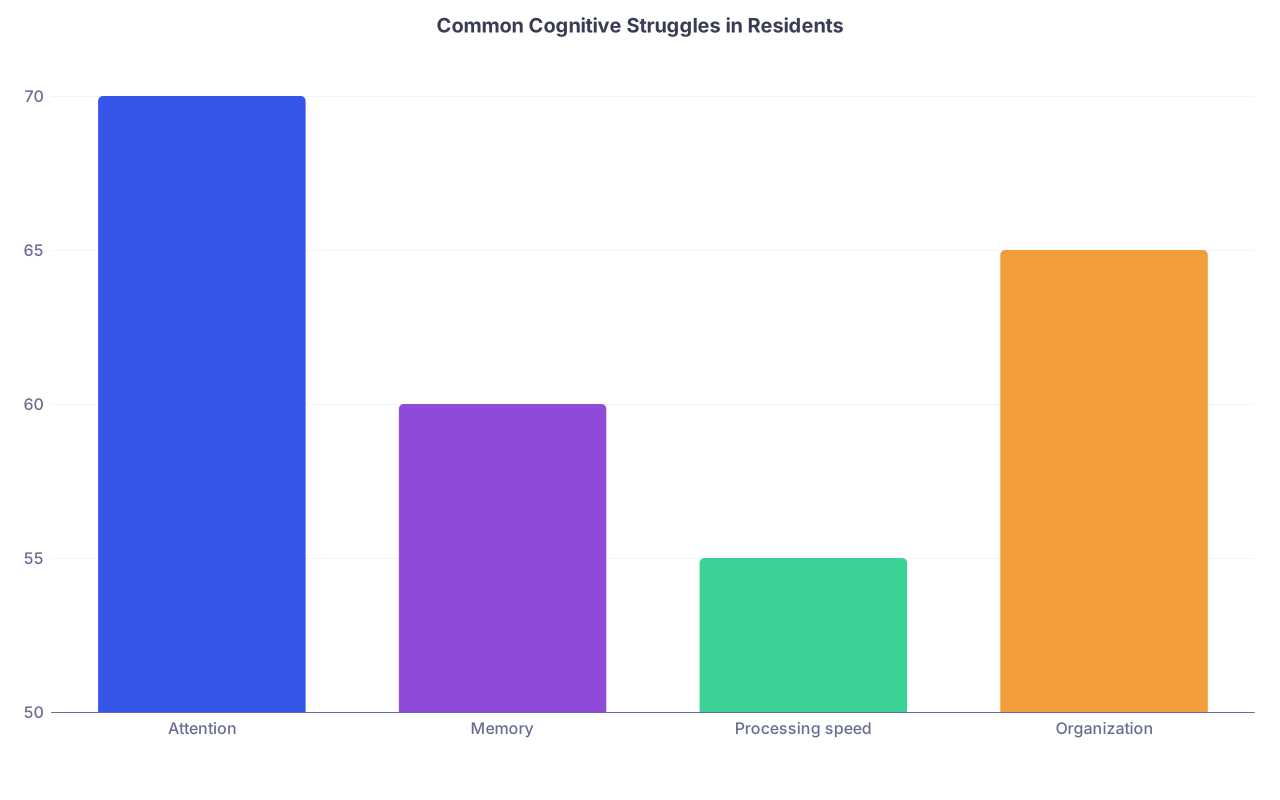
| Category | Value |
|---|---|
| Attention | 70 |
| Memory | 60 |
| Processing speed | 55 |
| Organization | 65 |
This is where you have to be brutally honest with yourself:
- Do you have untreated or undertreated ADHD, anxiety, or depression?
- Are you sleeping 3–4 hours a night and expecting your brain to function?
- Do you rely on “just remember it” instead of external supports (lists, alarms, checklists)?
If any of that hit too close, this isn’t a grit issue. It’s a brain-resources issue. And the fix is boring and unsexy: see a doctor, adjust meds if you have them, find a therapist if you can, and build external systems so your brain doesn’t have to brute-force everything.
The Fear of Being “Found Out” by Your Co-Residents
Here’s a scenario you probably replay in your head:
You confess to a co-resident that you’re struggling, and they respond with that “oh… wow” face. Next thing you know, everyone knows you’re the weak one.
But I’ve watched what actually happens when residents open up.
One PGY-1 finally told her co-intern, “I feel like I’m 3 steps behind you on everything.” The co-intern laughed and said, “Dude, I pre-chart at night and copy forward my own templates. I’m not faster, I just cheat the system.”
Another IM resident told their senior, “I feel like I’m always behind on notes.” The senior handed over his note templates and said, “Use these. They cut my time in half. Nobody taught me either.”
People hoard systems because no one asks. They assume everyone else already knows.

| Step | Description |
|---|---|
| Step 1 | Feel Behind |
| Step 2 | Work Harder Alone |
| Step 3 | Burnout and Shame |
| Step 4 | Get Tips and Templates |
| Step 5 | Gradual Improvement |
| Step 6 | Ask PD/Chief for Support |
| Step 7 | Targeted Coaching or Lighter Rotations |
| Step 8 | Tell No One |
| Step 9 | Tell Trusted Senior |
Most people aren’t waiting to judge you. They’re too busy wondering if they’re about to be exposed themselves.
When You’re Truly on the Edge
I’m not going to pretend it never gets serious. Sometimes:
- You get formal feedback that you’re behind expectations.
- You’re placed on a performance improvement plan.
- You feel like you’re constantly one mistake away from harming someone.
That’s the nightmare, right?
Here’s the hard but honest truth: this is still not the end of your story unless you quit on yourself in shame. I’ve seen residents:
- Remediated for clinical performance and still finish strong.
- Take a leave, get treatment for anxiety/ADHD/depression, and come back far more functional.
- Switch specialties to a better fit and excel.
What kills people is isolation + silence + shame. Not imperfection.
If you ever get to that edge, the move is:
- Ask for clear, written expectations. “What exactly do I need to be able to do by X date?”
- Ask for resources. “Who can work with me on efficiency/organization/clinical reasoning?”
- Pull in outside support: therapist, coach, trusted attending not involved in evaluation.
“You’re behind where we want you” is feedback, not a life sentence.
The Quiet Competence You’re Not Giving Yourself Credit For
One last thing your anxiety conveniently ignores: the parts you’re probably already good at.
Usually, the worried resident:
- Overcommunicates handoffs.
- Double-checks meds.
- Notices subtle changes because they’re paranoid.
- Is kind to nurses and patients.
- Owns their mistakes and fixes them.
Ask any nurse who they’d rather have: the fast, cocky resident who assumes they’re always right, or the slower, anxious one who checks in and listens.
Speed comes. Safety and humility are harder to teach.
A Small, Specific Step You Can Take Today
Don’t try to fix your whole residency in one night. That’s how you end up doom-scrolling and spiraling.
Pick one concrete action:
Open a blank note on your phone right now and write a 30-second preround template you’ll use tomorrow for every patient:
- Overnight events:
- Vitals trends:
- I/Os:
- New labs/imaging:
- Active problems (top 3):
- Plan bullets:
That’s it. Stick to it for one week. No reinventing the wheel each morning.
You don’t have to “catch up to everyone” in a day. You just have to make it 5% easier to be you on the ward tomorrow. Then another 5% next week. That’s how residents who think they’re behind… quietly, steadily, become solid.