Afraid Residency Will Destroy My Relationships: What Actually Happens
It’s 11:47 p.m. You’re lying in bed, scrolling Reddit threads about residency horror stories. Someone’s fiancé broke up halfway through intern year. Another person hasn’t seen their kids awake in three days. Yet another said their entire friend group just “moved on” without them.
You close the app. But the thought sticks:
Is residency going to blow up my relationships? Like… all of them?
Let me just say the quiet part out loud: a lot of us are scared that becoming a doctor means losing everyone we care about. Partners. Friends. Family. Even ourselves.
You’re not crazy for thinking it. And yeah, some relationships don’t survive residency. I’ve seen it. You probably have too. But it’s not the simple “residency = relationship death” equation people make it out to be.
Let’s talk about what actually happens.
The Truth You Don’t Want But Need: Some Relationships Do Break
First, I’m not going to sugarcoat this.
Residency puts relationships under stress in three ways:
- Time
- Energy
- Emotional availability
You can fake one. You can’t fake all three forever.
Here’s the pattern I’ve seen again and again:
- You start residency with good intentions. “We’ll schedule date nights.” “I’ll call my parents every Sunday.” “We’ll FaceTime every night.”
- Then you hit your first brutal month. Surgical nights. ICU. Night float. And suddenly you’re that person replying to texts 48 hours later with, “Sorry, just seeing this.”
This is where some relationships start to crack. Not instantly. Slowly.
The relationships that usually struggle most:
- Long-distance partners who already felt shaky before Match
- Situationships that depended on convenience and free time
- Friends who needed constant interaction to feel close
- Partners who didn’t actually understand what “80 hours a week” looks like in real life
What I’ve literally heard from partners of residents:
- “I feel like I’m not a priority anymore.”
- “I never know when you’ll be home or what mood you’ll be in.”
- “It feels like your whole life is the hospital and I’m just… here.”
That stings. But it’s real.
And sometimes, yes, the relationship ends. Not because anyone is evil, but because the life you’re choosing is intense and not everyone signed up for that level of chaos.
But here’s the part people don’t talk about enough: residency doesn’t only destroy weak relationships. It also exposes them.
There’s a difference.
What Actually Changes Day-to-Day (And Why It Feels So Dramatic)
Let’s get concrete instead of just vibes.
What changes in residency that hits relationships so hard?
| Area | Med School (Clinical Years) | Residency |
|---|---|---|
| Hours | 50–60 typical | 60–80 typical, plus call |
| Control | Some say over schedule | Almost zero control |
| Fatigue | Tired | Bone-deep, constant exhaustion |
| Emotions | Stressful but buffered by school | Real responsibility, real stakes |
| Pay | Negative to minimal | Paid, but time-poor |
What that actually looks like in human terms:
You will:
- Miss birthdays, anniversaries, family trips
- Cancel plans last-minute because someone coded at 6:45 p.m.
- Come home too drained to talk some nights
- Sometimes choose sleep over your partner, your friends, your hobbies
You will not:
- Become an emotional robot
- Stop caring about people
- Magically lose all your attachments and identity
It just gets more… compressed. Relationships don’t disappear; they have to fit in the margins. And if the relationship needs constant attention to feel okay, that’s where it starts to suffocate.
The Weird Upside: The Relationships That Actually Get Stronger
Here’s the thing nobody on those Reddit meltdown threads admits: some relationships get stronger in residency. A lot stronger.
I’ve seen:
- Couples who used to fight about small stupid things suddenly get very aligned because they literally don’t have the energy for drama anymore.
- Friends who talk less often but way more honestly. Zero small talk, straight to “I’m not okay.”
- Families who finally understand what you do, and respect you in a different way once they see you exhausted in scrubs falling asleep at the kitchen table.
Why those survive:
- They don’t interpret your exhaustion as rejection.
- They understand that “I only have 10 minutes” doesn’t mean “I don’t care about you.”
- They adapt with you instead of waiting for “things to calm down” (they don’t, not really).
I know residents who:
- Call their partner every day on the commute home, even if it’s 7 minutes from hospital to apartment. That’s their ritual.
- Have “standing” family FaceTimes every Sunday at 3 p.m., even post-call, even if they look like zombies.
- Send quick voice notes on the walk from one building to another because texting feels like too much effort.
Does that sound small and sad? Maybe. But it’s also real life. And for the right people, those little threads are enough to keep the connection alive until the month gets easier.
What Actually Kills Relationships (Spoiler: It’s Not Just the Hours)
Residency hours are brutal, yes. But they’re not the only villain.
The stuff that really breaks things:
Unspoken expectations
- Partner thinks: “Once intern year is over, you’ll have way more time.”
- You think: “Fellowship will be better.”
- Reality: There is always another hard rotation, exam, service, attending, whatever. When nobody names that out loud, resentment builds quietly.
Guilt-driven avoidance
You feel bad for always being gone, so when you are home, you:- Zone out on your phone
- Avoid conflict because “I don’t want to fight with the only 2 hours I have”
- Overpromise future time you can’t actually give
That fake harmony rots things from the inside.
Two competing “big lives”
This one’s controversial but I’ve seen it blow up repeat relationships:- You’re in residency.
- They’re also in a high-demand job (consulting, law, finance, tech startup, also medicine).
Neither of you is “the flexible one.” And if you’re not very intentional, you become two exhausted roommates with shared logistics and zero emotional life.
You changing and them not wanting you to
Residency will change you. You’ll:- Get darker humor
- Feel less patient with certain complaints
- Carry more emotional weight from work
Some people close to you won’t like that version. That hurts. But it’s also part of growing into this role.
What Surprised Me: Who Drifts, Who Stays
You probably have a mental list right now:
- “This friend will definitely stick around.”
- “That relationship is probably doomed.”
You might be wrong.
The people who often drift:
- Friends who were built entirely around “we see each other every day” convenience (lab mates, classmates, gym friends). Once you don’t share that physical space, things just… fade.
- The friend who says, “You’re always so busy” in a passive-aggressive way every time you talk. That sentence is usually the beginning of the end.
- Family members who expect you to be available for every event “because it’s family” and don’t accept “I’m on call” as a real reason.
The people who weirdly stay:
- The friend you talk to 3 times a year but can pick up exactly where you left off.
- The partner who sends “thinking of you” texts without needing an instant reply.
- The sibling who doesn’t guilt-trip you when you miss things and instead sends you photos and videos so you feel included.
You can’t fully predict which category people will fall into. That’s the unnerving part. Residency exposes character—yours and theirs.
What You Can Actually Control (That Isn’t Just “Communicate More”)
Telling someone “just communicate” when they’re working 70 hours a week and emotionally fried is useless. Let’s be specific.
Some things that actually help:
Pre-residency expectations talk
If you’re partnered, this is non-negotiable. Sit down and be uncomfortably honest:- How many nights a week will I realistically be home for dinner?
- What’s going to happen to chores and household stuff?
- How will we handle holidays and visits with family?
- What will we do when I’m too tired to talk—how do we still connect?
It’s not romantic. It’s logistics. But it’s what keeps you from meltdown conversations later.
Pick your “non-negotiables”
You can’t do everything. But you can choose a few hills to die on. For example:- I will call my parents once a week, even if it’s 10 minutes walking from the hospital to the car.
- I will have one real date (out of the apartment) with my partner twice a month, even if it’s breakfast instead of dinner.
- I will be physically present at my sibling’s wedding, no matter what.
Everything else is case-by-case. You’ll disappoint people sometimes. That’s unavoidable.
Low-effort connection
When you’re wiped, you need connection that doesn’t feel like another task. Things that actually work:- Voice notes instead of long texts
- Sending one photo from your day (a sunrise leaving night shift, your coffee, your disaster of a call room)
- 5-minute “check-in” calls: “How are you? Here’s my day in 3 sentences. I love you. I have to sleep.”
Let one or two people see the messy version of you
A lot of residents try to keep it together for everyone. Very polished updates, no complaints, always “it’s fine.”
That distance kills intimacy. Choose a couple people who get the unfiltered version:- “I watched someone die today and I don’t know how to feel.”
- “I hate this rotation and I feel like a terrible doctor.”
- “I’m so tired I almost cried in the supply closet.”
The people who can handle that and still want to be there? Those are your people.
What If I’m Single and Terrified I’ll Never Have Time To Find Someone?
This one sits under the surface but it’s loud:
“What if I end up alone because residency eats my 20s/30s?”
Here’s the unglamorous truth:
- Residents date. A lot.
- People meet partners in residency, fellowship, even as attendings.
- Yes, the logistics are messier. But your life is not frozen for 3–7 years.
You will:
- Miss some dating opportunities because you’re on nights.
- Have weeks where you don’t have the capacity to date at all.
- Probably cancel on someone at least once because of a shift or an emergency.
You will also:
- Be surrounded by people who understand this lifestyle
- Have less tolerance for nonsense, which honestly filters out the wrong people faster
- Be a more fully formed human with real experiences, which is actually attractive to the right person
No, residency does not lock you into a lifetime of loneliness. It just forces your relationships, romantic or not, to be very intentional.
The Part You Keep Avoiding: You Might Have to Let Something Go
Here’s the worst-case thought you probably have but don’t say:
“What if I can’t be a good doctor and a good partner/friend/family member at the same time?”
Sometimes… you can’t. At least not equally. Not in every season.
There will be months where:
- Your partner gets 20% of you
- Your friends get 5%
- Your patients and your job get everything else
That doesn’t make you a bad person. It makes you a resident.
The real question isn’t “Will residency destroy my relationships?”
It’s “Which relationships will flex with this, and which will snap?”
And you won’t know 100% until you’re in it. That uncertainty is brutal. I know. But pretending you can keep everyone perfectly happy is a guaranteed path to burnout and resentment.
You’re allowed to mourn the friendships that fade and the relationships that don’t make it. You’re also allowed to be surprised and grateful for the ones that do.
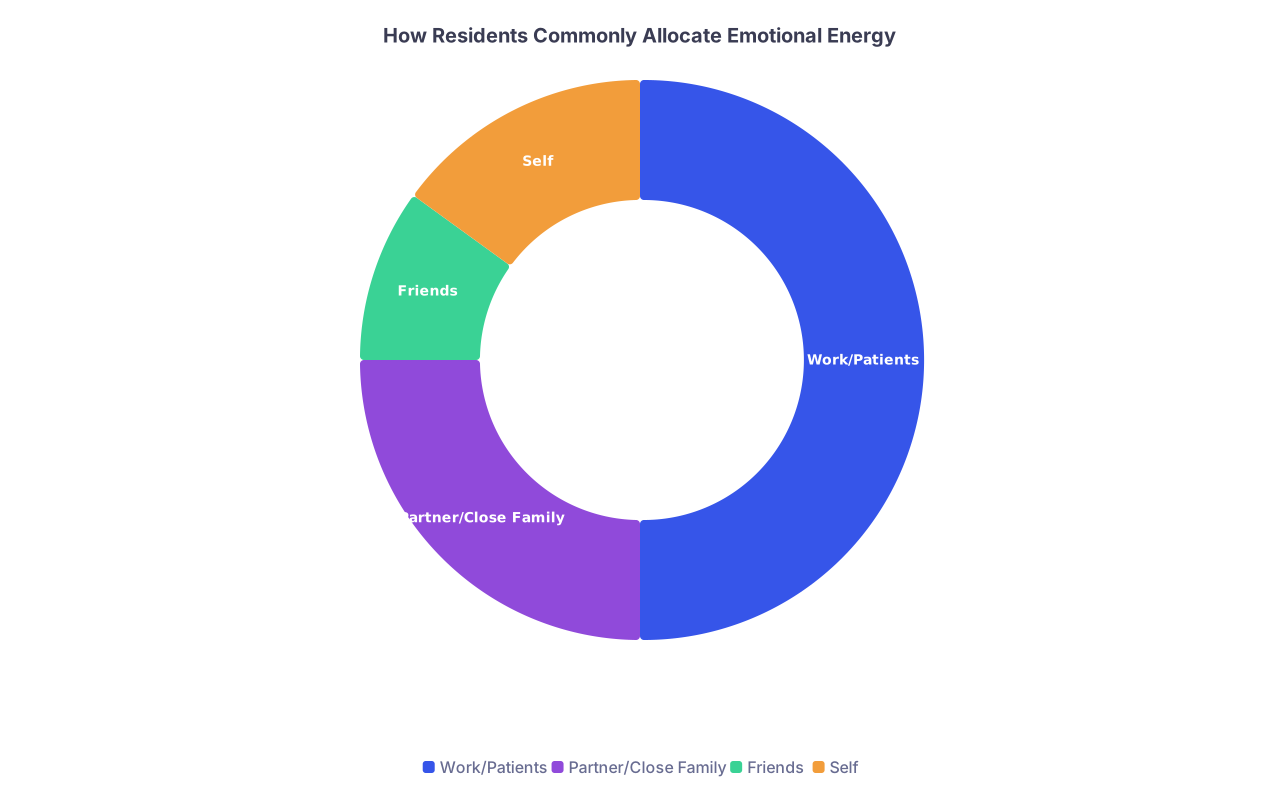
| Category | Value |
|---|---|
| Work/Patients | 50 |
| Partner/Close Family | 25 |
| Friends | 10 |
| Self | 15 |

| Step | Description |
|---|---|
| Step 1 | Start Residency |
| Step 2 | New schedule chaos |
| Step 3 | Adjust routines together |
| Step 4 | Resentment and confusion |
| Step 5 | Stronger connection |
| Step 6 | Drift or breakup |
| Step 7 | Relationship expectations clear |
| Step 8 | Willing to talk honestly |
FAQ (The Things You’re Probably Still Worried About)
Is it realistic to think my current relationship will survive residency?
Yes, if you both walk in with your eyes open. Survival isn’t about love only; it’s about:- Honest expectations
- Willingness to adapt
- Not taking each other’s exhaustion personally
If your partner already resents your time commitments as a med student, I’d be more worried. If they’re curious, patient, and problem-solving with you now, that’s a good sign.
What if my partner says “I support you” but then gets angry every time I’m busy?
That’s a mismatch between words and capacity. They may genuinely want to support you but not realize what it costs them emotionally. You can’t fix that by just “trying harder.” You need a blunt conversation: “This is what my schedule will be. This is what I can realistically give. Can you live with that without hating me?” If the answer is no, it’s better to know earlier than mid-intern-year meltdown.How do I stay close to friends who aren’t in medicine and don’t get it?
Don’t try to make them understand every detail of your life. Give them bite-sized windows: one story from your week, one honest sentence about how you’re doing. Invite them into your world without turning every conversation into “let me explain call schedules.” And accept that some will drift. That’s not always a betrayal; sometimes it’s just life moving in different directions.Is it selfish to choose residency knowing it’ll hurt my partner/family?
No. It’s a big life choice, but it’s not a crime. People choose demanding careers all the time. What is unfair is hiding the impact or minimizing it. If you’re clear and honest, and they choose to stay, that’s their decision too. You’re not forcing anyone. You’re building a life that will always be demanding—and you’re inviting them into it with full disclosure.How will I know if a relationship isn’t going to make it through residency?
Red flags I’d take seriously:- Constant guilt-tripping about your schedule (“If you really cared, you’d make time.”)
- Refusal to believe your time constraints are real
- No interest in problem-solving, only complaining
- You dread checking your phone because you know there will be drama waiting
On the flip side, if someone says, “This is hard, but I’m with you, so let’s figure it out,” and backs that up with action—not perfection, just effort—that’s worth holding onto.
If you remember anything from this, let it be this:
- Residency doesn’t automatically destroy your relationships. It tests them.
- The right people won’t need constant proof you care; they’ll feel it in the small, consistent things you still manage to give.
- You’re allowed to want both: to be a good doctor and to keep your people. Just don’t pretend you can do it without trade-offs.
You’re not doomed. You’re just walking into a hard season that will show you, very clearly, who’s really in your corner—and who you are when things get tight.