
Most people massively underestimate how brutal intern year feels from the inside.
So if you’re sitting there thinking, “I hate this. I made a mistake. I picked the wrong specialty. Maybe I shouldn’t even be a doctor,” I’m going to say something almost no one on your team will say out loud:
That reaction is common. And it does not automatically mean you’re in a true crisis or that you chose wrong.
But yeah, it might mean that. And that’s the part that keeps you up at 2:47 a.m. between pages, googling “how to quit residency” on your workroom computer and then quickly closing the tab when the senior walks in.
Let’s untangle this. Slowly. Honestly. No sugarcoating.
The Ugly Truth: A Lot of Interns “Hate” Intern Year
Let me start bluntly: if you put a completely anonymous survey in front of a bunch of interns in November and asked:
“Do you currently hate your life at least 2–3 days per week?”
You’d get a terrifying number of “yes” answers.
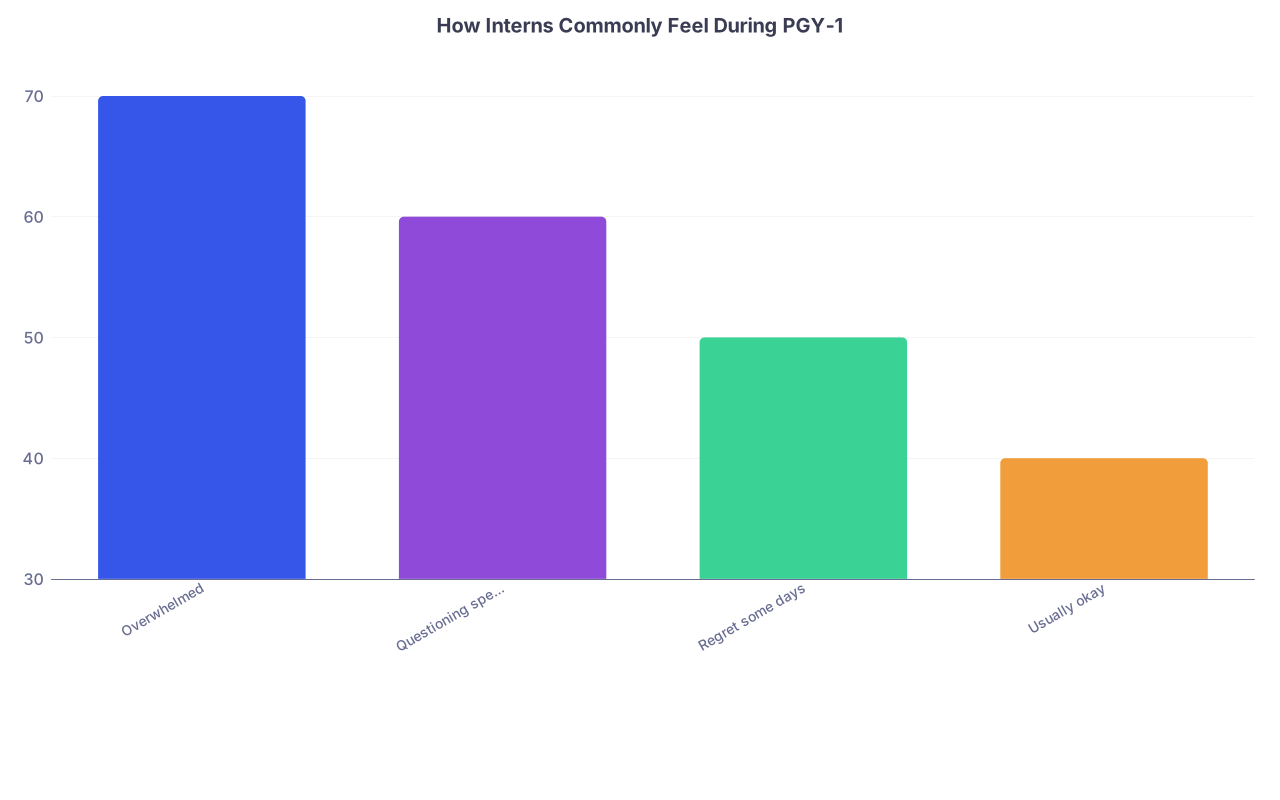
| Category | Value |
|---|---|
| Overwhelmed | 70 |
| Questioning specialty | 60 |
| Regret some days | 50 |
| Usually okay | 40 |
The part no one explains clearly is this: there’s “I hate this because it’s hard and I’m exhausted,” and then there’s “I hate this because something is actually wrong with my situation or with my mental health.”
From the outside, those can look similar. From the inside, they can feel identical.
From what I’ve seen and heard (and freaked out about myself):
- It’s normal to dread certain rotations.
- It’s normal to cry in your car after a 28-hour call.
- It’s normal to fantasize about walking out of the hospital and never coming back.
- It’s not automatically a crisis to think “I hate this” when your pager goes off for the 50th time since midnight.
The real question isn’t, “Do I hate intern year?”
The real question is, “What exactly do I hate — and is any of it realistically changeable?”
Normal Intern Misery vs. Real Crisis: How Do You Tell?
This is the part your brain keeps turning into a horror movie:
“What if this isn’t normal tired, what if this is me actually burning out, ruining my mental health, destroying my future, and I just think it’s normal because everyone’s suffering quietly?”
So let’s draw some lines. Not perfect, but at least clearer than the vague “hang in there” advice you’re probably getting.
Signs you’re likely in “normal but awful” intern stress
You might be in the painful-but-typical category if:
- Your mood is clearly worse on brutal rotations (like wards, ICU, night float), but you feel at least slightly more human on lighter ones.
- You still have moments where you think, “Oh. That felt good,” like when a patient thanks you, a senior trusts you, or you nail a difficult task.
- Your sleep is trash on call-heavy weeks, but on golden weekends you can actually sleep and feel at least somewhat better.
- You complain nonstop, but if someone said, “You’re fired, you can never practice medicine again,” you’d panic more than you’d feel relieved.
- You’re not happy, but you’re still basically functioning: you show up, you get your work done, you can still follow a TV show, text friends, pay bills.
This is that awful middle ground of: “I’m deeply unhappy right now, but there are small, real glimmers of satisfaction buried under the chaos.”
Signs things are sliding into real crisis territory
Now the scary stuff. These are red flags where “just a tough year” is not an okay explanation anymore. You need more help than just “it’ll get better as a PGY-2.”
Pay attention if:
- You feel numb or hopeless most of the time — not just tired, but like nothing will ever improve, no matter what.
- Days off don’t really restore you; you wake up on your off day and still feel like there’s a heavy rock on your chest.
- You start thinking, genuinely, that if you got hit by a car and had to stop residency, it would be a relief.
- You have frequent thoughts of self-harm or suicide, even passive ones like “I wouldn’t care if I didn’t wake up.”
- You find yourself withdrawing from literally everyone: ignoring texts, avoiding co-residents, not talking to family.
- You’re making more and more mistakes because you’re just too exhausted or foggy to focus.
- You can’t remember the last time you felt normal — not happy, just not weighed down.
If you’re reading that list and flinching because it hits too close, that’s not a character failure. That’s your brain and body screaming that this is not just “hard year” territory anymore.
You don’t “toughen up” out of this. You treat it. You change something. You ask for serious help.
Do I Hate Medicine, or Do I Just Hate Being an Intern?
This is the mind game that wrecks people: “If I hate intern year, does that mean I picked the wrong specialty? Or that I shouldn’t be a doctor at all?”
So, here’s the harsh secret: it’s almost impossible to objectively judge your specialty choice while you’re:
- Sleep deprived
- Overloaded with scut
- Terrified of messing up
- Constantly being evaluated
- Working in a system that treats your body like a disposable resource
Your brain goes, “I feel horrible. I am doing internal medicine. Therefore, internal medicine is the problem.”
Which is like blaming your shoes for the fact that you’re being forced to run a marathon in 100-degree heat with no water.
Let’s get more specific.
You might hate intern year but still basically like your specialty if:
- You enjoy the actual content when you have time: the pathophys, reading about cases, discussing plans.
- When you imagine the attending life version of this specialty — with some control, better hours, deeper relationships — it sounds… not awful. Maybe even good.
- You can remember pre-med-school you being excited about this field for reasons that still make sense.
You might be in the totally-wrong-fit territory if:
- Even when you’re rested, on a light elective, you feel a pit in your stomach at the idea of doing this kind of work long-term.
- You’re not just tired of how much you’re doing — you’re bored or repelled by what you’re doing.
- You notice yourself gravitating mentally toward a different type of medicine (or non-clinical path) and feeling genuine relief when you imagine that instead.
Here’s the messed-up thing: you can be in both camps. Miserable intern and misfit specialty. That’s why this is so confusing.
If you’re unsure, don’t try to figure out your entire career path at 3 a.m. post-call. Your brain at that moment should not be allowed to make major life decisions. On anything.
How Much Misery Is “Expected” in Intern Year?
Let’s be really blunt: a certain amount of misery is basically baked into the current structure of residency. It shouldn’t be, but it is.

To make this less vague, think of it like this spectrum:
| Zone | What It Feels Like |
|---|---|
| Green | Tired, challenged, but engaged |
| Yellow | Frequently overwhelmed, often dreading work |
| Orange | Daily dread, emotional exhaustion |
| Red | Hopeless, unsafe thoughts, shutdown |
Most interns swing between Yellow and Orange depending on the rotation. That’s unfortunately “normal” in our broken system.
But living in Red — or stuck deep in Orange with no variation and no small joys — isn’t just “part of the process.” That’s where people break.
If your program culture is toxic, your seniors are abusive, or your workload regularly violates duty hours but no one cares, your experience is going to skew much more Orange/Red than it should.
That doesn’t mean you’re weak. It means the environment is sick.
Concrete Ways to Tell: Crisis vs. Normal Stress
You probably want something more objective than “vibes.” So here’s a brutally honest self-check I wish more people used.
1. The “Day Off” Test
Ask yourself: On a true day off (no jeopardy, no moonlighting, no charting), can you:
- Enjoy anything? A show, a nap, a walk, a meal?
- Feel even a small decrease in anxiety or sadness?
- Notice your brain loosening its grip on work for at least an hour?
If yes, that points more toward severe but recoverable stress.
If even on a real day off you feel crushed, panicky, empty, or just dead inside the entire time — that leans more toward real burnout or depression.
2. The “If I Could Change X” Question
Imagine a genie shows up and lets you change one thing for the rest of the year:
- Fewer hours
- Better senior support
- Nicer co-residents
- Different hospital
- Different specialty
Which one instantly lightens your chest?
If “fewer hours, better coverage, kinder attendings” makes you think, “I could do this,” you might still basically be in the right lane — just suffering in a crummy system.
If “new specialty” or “no clinical medicine at all” is the only thing that feels like relief, listen to that. Don’t make a rash decision in the middle of the year, but don’t bury that data.
3. The “Would I Want to Quit Anything Hard Right Now?” Check
Ask: Am I so depleted that if I were doing any demanding job right now, I’d want to quit?
Because if you’re at that level of exhaustion, your brain will attach your misery to whatever you’re currently doing. Medicine, law, tech, doesn’t matter. The specific job isn’t the whole problem; your tank is just empty.
That means: treat the exhaustion first. Then re-evaluate the career question.
What If I Decide I Really Do Hate It?
Here’s the nightmare scenario you’re quietly spiraling about:
“What if I realize I truly hate my specialty or residency and I’m stuck forever because of debt, expectations, and the Match?”
You’re not as trapped as you think. You are constrained. But you’re not locked in a dungeon.

| Step | Description |
|---|---|
| Step 1 | Hate Intern Year |
| Step 2 | Get urgent mental health support |
| Step 3 | Gather data over months |
| Step 4 | Explore switching specialties or programs |
| Step 5 | Adjust within current program |
| Step 6 | Schedule changes, mentor, therapy |
| Step 7 | Talk to program leadership and advisors |
| Step 8 | Crisis Level? |
| Step 9 | Hate specialty content too? |
Real options people actually use:
Adjustments within your program
Different electives, avoiding the most toxic sites if possible, advocating for safer schedules, getting formal accommodations if mental health is truly impaired.Switching specialties after intern year
People do this more than you think: IM → anesthesia, surgery → radiology, peds → psych, etc. It’s messy, but not impossible.Switching programs within the same specialty
Sometimes it’s the culture, not the field. A malignant program can make you hate something you’d like in a healthier setting.Non-clinical or hybrid paths later
You can finish residency and move toward research, informatics, admin, teaching, etc. Not everyone ends up in 100% front-line clinical roles.
Is any of this easy? Absolutely not. The process can be long and bureaucratic and emotionally draining.
But your current feeling of “I’m stuck forever no matter how miserable I am” is not accurate. That’s your burnout brain talking. It lies.
Practical Steps You Can Take This Week
Let’s say you don’t know yet: crisis or “just” suffering? Hate medicine, or hate this specific rotation?
You don’t need to perfectly answer all of that tonight. But you can do a few very practical things that will give you more information and buy you some sanity.

Start a 2-week log — but super short.
At the end of each day, write down:- Rotation/site
- 1–10: how awful the day felt
- One sentence on why: “too many admits,” “toxic attending,” “felt incompetent,” “actually decent day — helped a patient.”
After 2 weeks, look for patterns. Sometimes what feels like “I hate everything” is “I hate nights + this one attending + feeling lost.”
Tell one person the uncut version.
Not the “haha, residency is rough” joke. The real thing: “I’m starting to wonder if I made a mistake,” or “I’m genuinely not okay.”
Pick someone safe: a co-resident you trust, a friend outside medicine, a partner, a sibling. Say the thing out loud.Book a mental health appointment, even if you’re “not sure it’s that bad.”
Most programs have confidential counseling resources. Use them. Worst case, they say, “You’re under extreme stress, here’s how we support you.” Best case, they catch something worsening early.Identify one small boundary you can actually enforce.
Maybe it’s:- You stop checking email after 9 p.m. on days off.
- You always eat something by 11 a.m., pager or not.
- You block one hour on your post-call day as untouchable sleep.
Tiny, kind of pathetic boundaries still matter. They’re proof to your brain that you are not totally powerless.
Ask one senior or attending a blunt question.
Something like: “Did you ever truly hate intern year or question medicine? What helped you figure out if it was just the year or the field?”
Most will be more honest in a 1:1 conversation than in group “wellness” sessions.
You’re Not Broken for Struggling With This
The system loves to whisper: “Everyone else is handling this. You’re the weak one.”
That’s garbage.
You’re doing life-and-death work with barely enough sleep, inconsistent supervision, constant evaluation, and a schedule that would break almost anyone. Feeling like you hate it sometimes is not a sign you’re flawed. It’s a sign you’re human.
The real danger isn’t that you’re miserable. The real danger is pretending you’re fine while you’re slipping into crisis territory.
You don’t have to decide tonight whether this is “just” normal stress or a true misalignment or a mental health emergency.
But you do have to pay attention to the difference.
So here’s your next step — specific, not theoretical:
Tonight, before you crash, write down three sentences:
- “Today I felt (1–10) in terms of how much I hated intern year.”
- “The top 2 things that made it worse were: ______ and ______.”
- “One thing that might have made today slightly less awful is: ______.”
Do that for a week. Then look at what you wrote like you’re reading someone else’s journal. Would you tell that person “this is just normal, suck it up”? Or would you tell them they need more help than they’re getting?
Then — and only then — decide your next move.