
Last week, a new intern told me he keeps having the same nightmare: he’s on call, a patient is crashing, and everyone turns and looks at him like, “Well? What do we do?” And he has no idea. He wakes up sweating, already exhausted before the day even starts.
If you’re reading this, I’m guessing some version of that lives in your head too. The fear that one night, on some call, you’ll miss something big. That you’ll hurt someone. That you’ll be the reason a morbidity and mortality slide exists.
Let’s talk about that straight, without sugarcoating it. And then figure out what you can actually do now so this fear doesn’t own you.
The Ugly Thought You’re Probably Having But Won’t Say Out Loud
You’re not just “worried about learning.” You’re thinking:
“What if I kill someone on call?”
Not in a dramatic, TV way. More like: I’ll be tired, overworked, my senior is busy, I’ll mis-hear a lab value, or not re-check vitals, or miss early sepsis, and then… that’s it.
Here’s the part nobody says clearly enough:
You will make mistakes in residency.
You may miss stuff.
You will absolutely have cases that haunt you.
The question isn’t “How do I avoid ever being wrong?”
It’s “How do I build enough structure around myself so that when I’m wrong, the system catches it early, and it doesn’t become a catastrophe?”
That’s what preparation actually is. Not becoming superhuman. Building guardrails.
What “On Call” Actually Feels Like (So You’re Not Blindsided)

The fear is partly because “on call” is this vague, massive monster in your mind. Let me shrink it into something real.
Most call nights follow the same pattern:
Early in the night, the pages feel nonstop. Nurses calling about pain meds, high blood pressure, low potassium, “can you come see this patient who looks off?” Admit after admit after admit. Your brain is juggling:
- Patients you’ve never met
- Problems you’ve barely seen
- Protocols you sort of remember from a PowerPoint three years ago
You’re tired, you feel slow, and every decision suddenly feels like it could be the one that ruins someone’s life.
And the worst loop your brain gets stuck in is this:
“What if I bother my senior too much?”
vs.
“What if I don’t bother them and I miss something lethal?”
That tension is the birthplace of serious error. Not ignorance. Not laziness. That fear of “looking dumb” or “needy” and trying to handle something alone that you shouldn’t.
So preparing for call is partly clinical. But it’s also psychological: you have to rehearse how you’ll act when your brain is screaming, “Don’t call them, they’ll think you’re incompetent.”
The Real High-Risk Situations You Should Obsess Over (Productively)
You can’t memorize everything. But you can deliberately prepare for the handful of situations that cause most of the terror and most of the bad outcomes.
Here are the scenarios that actually matter on call, the ones worth your anxiety-buckets:
| Scenario | Why It’s High-Risk |
|---|---|
| Chest pain / SOB | Missed MI, PE, decomp HF |
| Sepsis / fever | Delayed antibiotics, shock |
| Hypotension / tachy | Early decompensation |
| AMS / new neuro issue | Stroke, bleed, meningitis |
| Post-op complaints | Bleeding, leak, PE |
If you spend your limited energy getting decent at just these buckets, you’re already way safer than the average deer-in-headlights intern.
For each one, you should know three things cold:
- The first 5 minutes: your immediate move
- The data you need before you call your senior
- The phrases you’ll use when you don’t know what’s going on
Not protocols for every disease. Just the scaffolding to not freeze.
Building a Simple Mental Script for When You Panic

| Step | Description |
|---|---|
| Step 1 | Page comes in |
| Step 2 | Write down details |
| Step 3 | Go see patient now if acute |
| Step 4 | Check vitals and bedside exam |
| Step 5 | Form one line summary |
| Step 6 | Call senior with SBAR |
| Step 7 | Start basic management |
| Step 8 | Document and recheck patient |
| Step 9 | Know what to do? |
You know that thing where you get a scary page and your brain goes completely blank? That’s normal. So don’t rely on “I’ll just think of it in the moment.” You won’t.
You need a script. A literal, spoken-out-loud-if-needed script.
When a scary page hits (e.g., “patient looks worse,” “blood pressure is 80/40,” “patient is more confused”), your steps are:
- Write it down. Name, room, issue. Just the act of writing interrupts the panic spiral.
- Say to yourself: “Go see the patient now.” No overthinking. No reading the whole chart first. Move.
- At bedside, do a vitals + ABC check:
Airway, breathing, circulation. Are they talking? Breathing fast? Diaphoretic? - Then use a one-line summary before you touch a single order:
“This is a [age] year-old with [main problem] now with [new issue].” - If you don’t know what’s happening after 2–3 minutes of thinking:
Call. Your. Senior.
The script for that call can literally be practiced in your room before you ever start:
“Hey, sorry to bother you. This is [you] on [service]. I’m calling about a [age] year-old with [underlying condition] who now has [issue – hypotension, shortness of breath, AMS]. Vitals are [list]. I’ve done [quick actions: exam, fluids, labs ordered]. I’m not sure if I should [X vs Y] and wanted your guidance.”
You don’t sound incompetent. You sound safe.
The Boring Stuff That Quietly Prevents Disasters
I wish I could say it’s one heroic act that saves patients. More often, it’s the unsexy prep work.
1. Take sign-out seriously, even when everyone’s rushing.
On call, your worst cases are often “watch this patient, they’ve been a little soft” or “they look fine but something feels off.” If you ignore that vague unease at sign-out because you’re tired and hungry, you’ll walk into the night blind.
Ask these at sign-out, even if it feels annoying:
- “Who are you most worried about?”
- “Any ‘if X happens, do Y’ plans?”
- “Anyone unstable or borderline?”
Write their names with a little star. Check on them early.
2. Have a “can’t-miss” checklist in your pocket.
Not a 20-page manual. Just a one-page cheat sheet for chest pain, sepsis, AMS, hypotension. Print it, fold it, beat it up over months.
3. Know your hospital’s emergency numbers and locations.
Rapid response, code, blood bank, radiology stat line, ICU. This is the kind of thing that sounds obvious and then you’re on hour 18 and you’re like, “Uh… how do I get a stat CT again?”
How to Use Your Senior Without Feeling Like a Burden

Let me be blunt: trying to be “low maintenance” is how new residents get into trouble.
Your senior’s actual job on call is not just admitting patients and charting. It’s supervising you so patients don’t suffer because you’re brand new. That’s the deal.
The residents who scare me are never the ones who call a lot. It’s the ones who don’t call enough.
So set a personal rule before the year starts. Something like:
- I will call my senior for:
New oxygen requirement, sustained hypotension, chest pain, acute neuro changes, uncontrolled bleeding, concern for sepsis, or if a nurse says “I’m really worried.” - I will never spend more than 10–15 minutes “thinking” about a scary situation without calling.
Decide that now, not at 3 a.m. when your shame and anxiety are loud.
And when you call, you can admit you’re over your head:
“I don’t know what’s going on, but I have a bad feeling and I don’t want to miss something.”
I’ve never met a decent senior who hears that and thinks, “Ugh, what an idiot.” They think, “Good. They’re safe.”
Sleep Deprivation, Cognitive Fog, and Why Checklists Are Your Friend
There’s another piece to this: you on call are not you right now, well-rested at your desk. You’re going to be slower. You’re going to miss stuff you wouldn’t miss at noon conference.
Your IQ basically drops when you’re sleep-deprived. That’s not a character flaw. It’s biology.
So build systems that don’t depend on “being sharp”:
- Use templates for your notes and admits so you don’t forget basic questions.
- When you put in high-risk orders (insulin drips, anticoagulation, electrolytes), pause and re-check the dose out loud. Literally: “Okay, 10 units, not 100.”
- When a case feels strange, say to yourself: “What am I missing?” and do one more pass over the vitals and labs.
None of this makes you perfect. It just buys you a margin.
When (Not If) You Make a Mistake

I wish I could promise that if you read enough and care enough, nothing truly bad will ever happen. That’s not how residency works.
At some point, you will:
- Misinterpret a lab
- Delay a call you should’ve made earlier
- Miss early warning signs
And something will go wrong. It might not be catastrophic. It might just be a scare. But you’ll feel that hot flush in your chest and think, “This is it, I’m not cut out for this.”
Here’s the part you have to anchor to:
Serious errors almost always have multiple contributing factors. System issues. Communication gaps. Handoffs. Staffing. Not just “the intern sucked.”
You’re still responsible for your part. But you’re not the sole villain in the story.
When something goes wrong:
- Tell someone. Your senior, attending, program director. Hiding makes it worse medically and emotionally.
- Ask to walk through the case later: “What should I have done earlier? Where was the actual decision point?” That’s painful, but it’s how you grow instead of just marinating in shame.
- Remember that everyone you respect has a story like this. They’re just not telling it on rounds.
The fear that you’re “one mistake away from being unmasked as a fraud” is very loud. Reality is usually quieter and more complicated.
A Quick Reality Check: You’re Not the First, and You Won’t Be the Last
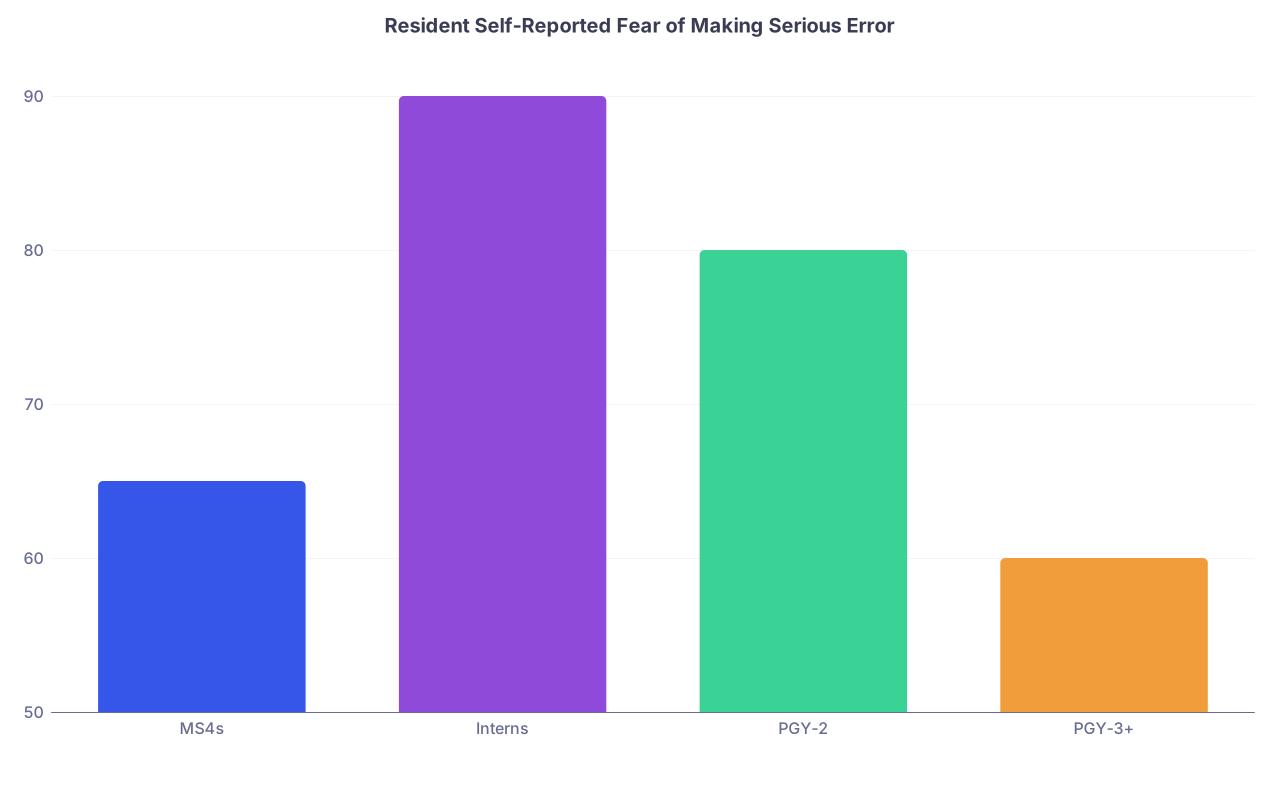
| Category | Value |
|---|---|
| MS4s | 65 |
| Interns | 90 |
| PGY-2 | 80 |
| PGY-3+ | 60 |
Almost every intern I’ve met has quietly believed they were uniquely underprepared. That everyone else is handling call fine and they’re the weak link.
Then you talk to them one-on-one and it’s all the same:
- “I’m terrified of missing sepsis.”
- “I don’t trust myself to interpret EKGs fast.”
- “What if I freeze in a code?”
You are absolutely not special in your fear. That’s actually comforting. Programs know this is where you’re starting from. Good seniors anticipate your gaps. Good nurses quietly babysit you more than you realize.
None of that absolves you of preparing. But it does mean the entire system is not secretly expecting you to function like a board-certified attending on night one.
What You Can Start Doing Today

If your brain is spiraling about making a catastrophic call-night error, channel it into something concrete.
In the next week, you can:
- Make a one-page cheat sheet on: chest pain, shortness of breath, hypotension, AMS, fever/sepsis. Simple: key questions, must-have orders, when to call senior.
- Ask a senior: “What are the 3 scariest cases you’ve had on call and what did you wish you’d known as an intern?” Then write down the lessons.
- Save your hospital’s protocols (sepsis bundle, stroke alert, ACS, DKA) as PDFs on your phone. You won’t memorize them. You just need them reachable at 2 a.m.
And mentally, decide your call rules:
- “If I feel scared and don’t know why, I will go see the patient and then call my senior.”
- “I will never let ‘I don’t want to bother them’ override ‘I think this could be bad.’”
That’s how you prepare for call when you’re anxious and scared of yourself: not by pretending you won’t mess up, but by building habits that catch you when you do.
FAQ (Exactly What Your 3 a.m. Brain Will Ask You)
1. What if my senior gets annoyed that I’m calling so much?
Then… they’re annoyed. So what. Mild irritation from a tired senior is nothing compared to missing a crashing patient alone. Most of the time, the annoyance you’re afraid of is in your head. If a senior is genuinely toxic about you calling for help, that’s a leadership problem, not a sign you should “manage more by yourself.” Safe > likable. Always.
2. How much should I know before I call? I don’t want to sound clueless.
You should know: a one-line summary, vitals, basic exam, what’s changed from baseline, and what you’ve already done (if anything). That’s it. Don’t spend 30 minutes combing the chart while the patient keeps decompensating just so you can present perfectly. Imperfect data + early call beats perfect presentation + late rescue every single time.
3. What if I freeze when something really bad happens, like a code?
You might. A lot of people do the first few times. That’s why codes are team events with built-in roles. As an intern, your job is usually specific (compressions, meds, documenting, running to grab things). If you feel yourself freezing, anchor yourself to a single task: “I’m going to focus on compressions,” or “I’m going to track times.” Action breaks paralysis. You are not expected to be the code leader on day one.
4. Can one mistake actually ruin my entire career?
A single error, even a serious one, almost never exists in a vacuum. Programs look at patterns: honesty, insight, how you respond, whether you learn and change. Covering things up, lying, or repeating the same careless behavior—that’s what wrecks careers. Owning a mistake, engaging in review, and improving from it is literally what training is for. Is it emotionally brutal? Yes. Is it the end? Almost never.
5. I feel like I’m already behind everyone else. Should I even be here?
That thought is brutal and common. Most of the time it’s impostor syndrome mixed with seeing everyone’s “competent” side and no one’s panic. You got here through the same gatekeeping everyone else did: exams, rotations, letters. Programs don’t randomly pick someone totally incapable of learning. Feeling behind is not proof you’re unfit; it’s proof you care and you’re aware of the stakes. Use that fear to prepare, not to torture yourself.
Open your notes app right now and start a new page called “Call Night Cheats.” Put five headings: chest pain, shortness of breath, hypotension, AMS, fever/sepsis. Under each, jot 3–5 things you want to remember. It doesn’t need to be perfect. It just needs to exist before you’re half-asleep with a pager screaming at you.