
Last week, a new intern messaged me at 3:17 a.m. from the call room: “I’m honestly waiting for someone to realize I shouldn’t be here and send me home.” She’d just finished admitting a septic patient and was convinced she’d missed something huge. She hadn’t. The patient was stable. But her brain wouldn’t shut up.
If you’re reading this, I’m guessing you know that feeling in your bones. The constant low-grade fear that everyone overestimated you, and tomorrow is the day you finally get exposed.
Let’s talk about that. Honestly. Not the sanitized “everyone feels imposter syndrome sometimes” line they give you at orientation. The real version that keeps you staring at the EMR screen, heart racing, sure you’re about to kill someone.
What “Constant” Imposter Syndrome Actually Looks Like as an Intern
I’m not talking about the occasional “wow, everyone else is smart” moment. I mean the heavy, daily stuff.
It looks like:
- You sign every note, see “MD” or “DO” after your name, and feel like you’re forging a signature.
- You pre-chart for an hour, then still stall outside the patient’s room because you’re sure you don’t know enough.
- You only remember your mistakes. Not the 30 normal decisions you made that day. Just the one maybe-should-have-ordered-this-earlier.
- At sign-out, you avoid eye contact when seniors ask, “Any questions?” because you have 12, but you’re afraid they’ll realize you’re clueless.
- Any feedback, even neutral, lands like, “You’re behind. Everyone else is ahead of you.”
And then the worst spiral: you start to interpret everything as proof.
Patient gets readmitted? Proof you’re incompetent.
Senior double-checks your insulin doses? Proof they don’t trust you.
You ask for help? Proof you’re not ready to be a doctor.
You don’t ask for help? Proof you’re reckless.
You can’t win with your own brain. And it’s exhausting.
Why Intern Year Is Basically an Imposter Syndrome Factory
You’re not broken. The system is set up in a way that makes even solid people feel like frauds.
Here’s the ugly combo:
| Factor | How It Hits You |
|---|---|
| New Role | You go from student to “doctor” overnight |
| Responsibility | Orders, diagnoses, and pages never stop |
| Constant Evaluation | Seniors, attendings, nurses, patients watching you |
| High Stakes | Bad outcomes feel personal and permanent |
| Comparison | You only see others’ highlight reels |
And on top of that:
- You’re sleep-deprived. Catastrophic thinking thrives on no sleep.
- You’re always on someone else’s turf. ICU, ED, wards, clinic—never fully comfortable anywhere.
- You rarely see the full story. You meet patients at their worst, and outcomes are often unclear by the time you rotate off. So your brain fills in the blanks: “If something went wrong later, I probably caused it.”
Nobody tells you this clearly at orientation. They say, “Ask for help” and “Wellness matters.” Meanwhile, 2 weeks into wards you’re already googling “signs I’m an unsafe resident” at 1 a.m.
The Part of You That’s Terrified Is Also the Part That Cares
Let me say something that might not feel true yet:
The fact that you’re worried you’re not good enough is exactly why you’re probably a safer intern than you think.
The dangerous intern isn’t the one sitting in the call room thinking, “Did I really understand that chest pain?”
It’s the one shrugging, “Whatever, probably fine,” and never asking anyone to look with them.
Your anxiety is trying to protect patients. It’s just doing it with a sledgehammer.
But there’s a line where “I’m careful and double-check things” turns into “I’m paralyzed and think everyone else is better than me.”
You’re not going to logic your way out of this with one pep talk. But you can start separating:
- “This is a situation where I need help”
vs. - “This is my brain screaming at me because I feel like a fraud.”
They’re not the same thing. Even though they feel identical at 4 a.m.
How to Tell If You’re Actually Unsafe vs Just Anxious
This is the fear under everything, right? That it’s not “just imposter syndrome,” that you genuinely shouldn’t be there.
Here’s the painful but necessary distinction.
Red flags you might need serious remediation (not just reassurance)
- Multiple attendings independently express concern about your basic clinical reasoning or reliability.
- You’re consistently missing obvious emergencies (e.g., you don’t recognize a crashing patient or you ignore vitals that are clearly bad).
- You avoid seeing patients or routinely delay answering pages because you’re so overwhelmed.
- You’ve had formal written warnings or been told you’re at risk for not progressing.
If that’s happening, you don’t need to disappear in shame. You need structured support. People do improve with remediation when they get real help, not just quiet panic.
But here’s what I actually see way more often:
Signs it’s mostly imposter syndrome chewing on you
- You obsess over minor things but your seniors and attendings keep saying, “You’re doing fine, seriously.”
- Nurses and staff trust you enough to call you first and say things like, “You’re always responsive” or “You explain things well to families.”
- You’re terrified each morning, but when the work hits, you do actually get through it.
- Your evals say “appropriate for level” while your brain reads them as “bare minimum disaster.”
The hardest thing is believing feedback that doesn’t match your internal narrative. Your brain is used to the story: “I’m behind. I’m the weak link. I slipped through the cracks in the match.”
So when someone tells you, “You’re on track,” your mind says, “They’re just being nice.”
They’re not. Most faculty aren’t that invested in protecting your feelings. If they’re worried, they tell you or tell your PD.
Day-to-Day Survival When You Feel Like a Fraud All the Time
Let’s be blunt: intern year is not the time for a 40-step self-care plan. No one has the energy for that. You need low-friction stuff that fits between pages and notes and cross-cover.
1. Use “micro-scripts” for when your brain starts spiraling
Stuff you can literally say to yourself in the hallway, under your breath.
Examples:
- “I’m allowed to be a learner. I’m not supposed to know everything.”
- “My job tonight is not to be perfect; it’s to be safe and ask when unsure.”
- “Feeling anxious doesn’t mean I’m wrong. It just means I care.”
Corny? Maybe. But this is about interrupting the automatic “I’m incompetent” loop.
2. Decide ahead of time what triggers a senior call
Don’t make this decision at 3 a.m. when you’re scared.
Pick a short list. For example:
- New chest pain or shortness of breath
- SBP < 90 or MAP < 65 that’s persistent
- New confusion or focal neuro changes
- Anything where you’re considering ICU, rapid response, or stat imaging
Then make a rule: if it hits the list, you call. No overthinking. That way your anxiety doesn’t get to argue every time.

| Step | Description |
|---|---|
| Step 1 | Notice patient issue |
| Step 2 | Page senior immediately |
| Step 3 | Execute plan and recheck in 30 to 60 min |
| Step 4 | Continue routine care |
| Step 5 | On my call list? |
| Step 6 | Do I have a clear plan? |
| Step 7 | Better, same, or worse |
You’re not weak for calling. What terrifies seniors isn’t an intern who calls “too much.” It’s the intern who doesn’t call and lets things smolder.
3. Build a tiny “evidence file” against your imposter brain
Your mind keeps a perfect highlight reel of your failures. You need actual receipts of reality.
Take 30 seconds at the end of a shift (or on your phone while waiting for labs) and jot down:
- 1 thing you handled better than last week
- 1 thing someone appreciated (nurse, patient, co-resident, attending)
- 1 question you asked that led to a better plan
You’ll roll your eyes at this. Do it anyway. In three months you’ll have pages of, “Oh yeah, there is progress.”

The Social Part: Everyone’s Faking Confidence Too
You know that one co-intern who’s always like, “Yeah, I did two thoracenteses last week, no big deal,” and already has a research project and three mentors and a five-year plan?
They go home and panic too. They just don’t show it the same way.
I’ve watched this pattern for years:
- The loudest, most confident-sounding interns often have the gnarliest imposter syndrome under the surface.
- The quiet, methodical ones think they’re behind, but seniors love them because they’re careful and reliable.
The problem is you see everyone’s outside and only your inside.
You don’t see:
- The senior who triple-clicks every order before signing it because they’re scared of dosing mistakes.
- The co-intern who re-reads UpToDate after every admit and then presents like they just “remembered it.”
- The resident who cries in their car after a bad code and comes in the next day acting like nothing happened.
If you bring this up with trusted co-residents—not in a vague “I’m stressed” way but directly: “Do you ever feel like you’re faking it?”—you’ll be shocked how many say, “Constantly.”
When Imposter Syndrome Starts to Crush You, Not Just Motivate You
There’s a line where normal intern anxiety turns into “I can’t keep doing this.”
Watch for:
- You dread every shift so much you can’t enjoy anything on your days off.
- You replay mistakes for hours or days, to the point you can’t sleep.
- You start thinking, “My patients would be safer with anyone but me” on repeat.
- You’re fantasizing about quitting weekly, not as a “rough call night” thing but a persistent wish.
- You’re using alcohol, stimulants, or benzos just to get through.
This isn’t you being weak. This is burnout + anxiety + a brutal system.
At that point, you don’t need more “grit.” You need help. And not someday—now.
That can look like:
- Talking to your PD or APD in a direct way: “I’m functioning, but my anxiety is constant and intense. I’m scared I can’t sustain this.”
- Reaching out to GME wellness or an outside therapist who works with residents. (Yes, they exist. They’re busy. For a reason.)
- Asking for a schedule adjustment or short leave if you’re at the “I’m breaking” point. Programs would rather tweak your schedule than deal with a full collapse later.
You’re not the first resident to need this, and you won’t be the last. The quiet truth: programs already build in slack because they know people will get overwhelmed, sick, pregnant, depressed. You’re not derailing the system by needing help. You’re using it the way it was secretly designed.
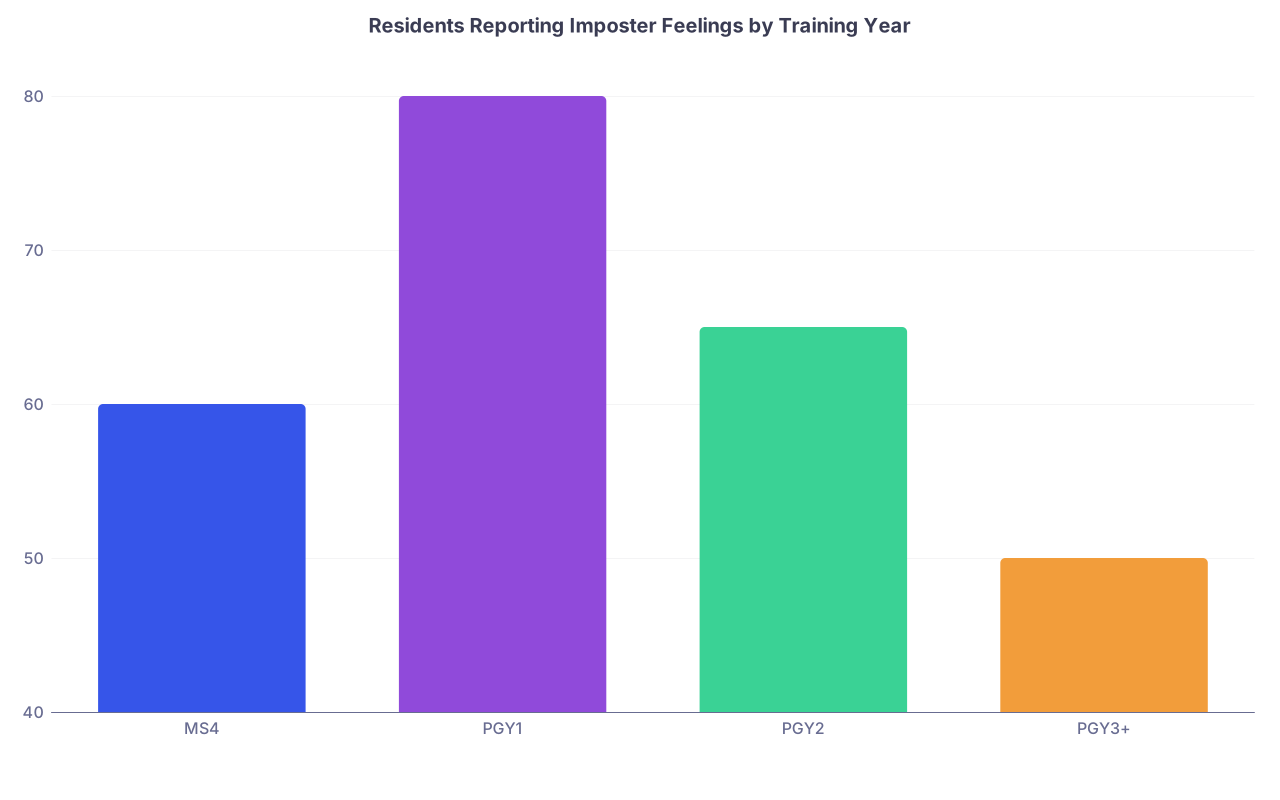
| Category | Value |
|---|---|
| MS4 | 60 |
| PGY1 | 80 |
| PGY2 | 65 |
| PGY3+ | 50 |
(Those numbers are approximate, but they’re not far off from the surveys I’ve seen. PGY1 really is peak “I don’t belong here” time.)
How This Actually Changes Over Time (Even If You Don’t Believe Me Yet)
Intern year you think:
“I have no idea what I’m doing.”
Second year you think:
“I have some idea what I’m doing, but now they made me responsible for others, which is insane.”
Third year (or later) you realize:
“Nobody ever reaches a point where they know everything. I just have a much better sense of what I don’t know and how to handle that.”
What changes isn’t that you magically stop making mistakes or stop being scared. It’s that:
- Your pattern-recognition gets better.
- You’ve seen enough badness to know what actually requires panic.
- You gain evidence over and over: “I thought I couldn’t handle X. Then I did.”
Imposter syndrome doesn’t vanish. But it moves from center stage to background noise.
And at some point you’ll watch a brand-new intern present a patient and think, “Oh wow, I used to be that lost.” Which is exactly what your seniors are thinking about you right now—even while you’re convinced you’re behind.
FAQ: The 3 a.m. Questions You’re Afraid to Say Out Loud
1. What if my imposter syndrome means I really am worse than my co-interns?
Then your job is the same as theirs: show up, ask for help, and get better. “Worse” in July says almost nothing about where you’ll be in March. I’ve seen shaky, slow interns become absolute rockstars once their confidence caught up to their work.
No one gets an extra line on their diploma that says “struggled more as intern.” Patients won’t know. Employers won’t care. Your co-residents will remember if you were kind and reliable, not how long it took you to “get it.”
2. What if I made a mistake that hurt someone—does that prove I shouldn’t be here?
Everyone who touches patients long enough makes a mistake that haunts them. Attendings carry cases from 15 years ago. Mistakes don’t mean you shouldn’t be here. They mean you’re practicing medicine.
The real test is what you do next:
- Do you own it?
- Do you learn from it?
- Do you change your behavior?
If the answer is yes, you’re exactly the kind of physician I’d want.
3. What if my seniors are just being “nice” when they say I’m doing fine?
Seniors are too tired to sugarcoat consistently. If multiple seniors and attendings say you’re on track, that’s not a conspiracy. That’s data. They’re comparing you to dozens of interns they’ve seen before.
You don’t have to feel like you’re doing fine. But you should at least consider that their view might be more accurate than the anxious movie playing in your head.
4. What if I never stop feeling like an imposter?
You won’t feel like this forever at this intensity. The edges soften. The peaks space out. You may always have moments of “I’m out of my depth,” especially with new roles or high-stakes calls. But “constant, crushing fraud feeling” isn’t sustainable, and your brain will adapt. Especially if you stop treating it like a secret shame and start treating it like something you can actually work on.
5. What if I decide I actually don’t want to be a doctor anymore?
Then that’s not imposter syndrome. That’s a serious, valid question about your life. Lots of people stay in medicine by inertia because they’re afraid to admit they’re unhappy. If this thought keeps coming back outside of bad call nights, talk to someone you trust outside your program—therapist, mentor, former attending. There are people who leave and build other lives. There are people who stay and find a version of medicine that doesn’t slowly destroy them. You’re not locked in a burning building with no exits.
Years from now, you won’t remember the exact wording of your worst self-doubt at 3 a.m. You’ll remember that, even while your brain screamed “fraud,” you still showed up for your patients, asked for help when it mattered, and kept going long enough for the feeling to lose its grip.