
The way most residents handle sleep is broken. “I’ll catch up post-call” is not a plan. It is how you slide into chronic sleep deprivation, burnout, and stupid mistakes.
You are not going to fix residency hours. You can absolutely fix how your brain and body survive those hours. That is what this 4‑week plan does.
This is not theory. This is the stuff that separates the residents who still think clearly in June from the ones who cry in the med room because they cannot remember if they ordered the CT.
Let me give you a structure that works even on q4 call, nights, or “we don’t follow the rules” services.
Ground Rules: What You Are Actually Up Against
Before the plan, you need to understand the constraints. Residency sleep is not “lack of discipline.” It is math, physiology, and politics.
Non‑negotiable realities
You will not get perfect 8‑hour nights most days.
Target: 5.5–7 hours total per 24 hours, consistently. Fragmented is acceptable. Chronic 3–4 hours is not.Your schedule is the enemy of your circadian rhythm.
Switching from days → nights → days without a plan wrecks you. You need system-level adaptations, not random “nap when you can.”Your brain does not “catch up” on severe chronic sleep debt.
One post-call 10‑hour sleep does not fix 10 days of 4‑hour nights. Symptoms improve; performance does not magically reset.You are making safety‑critical decisions while impaired.
You must treat sleep like a medication. Doses. Timing. Side effects. Not a luxury you “fit in if possible.”
So the goal of this 4‑week plan is not fantasy wellness. It is:
- Raise your average weekly sleep by 1–2 hours per night.
- Reduce your worst nights from 2–3 hours to 4–5.
- Build habits that survive rotations, not just easy months.
Overview: The 4‑Week Structure
Each week has a specific mission:
- Week 1 – Baseline and triage: Track, stop the bleeding, fix the worst offenders.
- Week 2 – Anchor points and micro‑recovery: Lock in wake/bed anchors and nap strategy.
- Week 3 – Tactical adjustments for days vs nights vs 24s.
- Week 4 – Automation, boundaries, and long‑term maintenance.
You will not do this perfectly. You do not need to. If you implement 60–70% of this, you will feel a measurable difference.
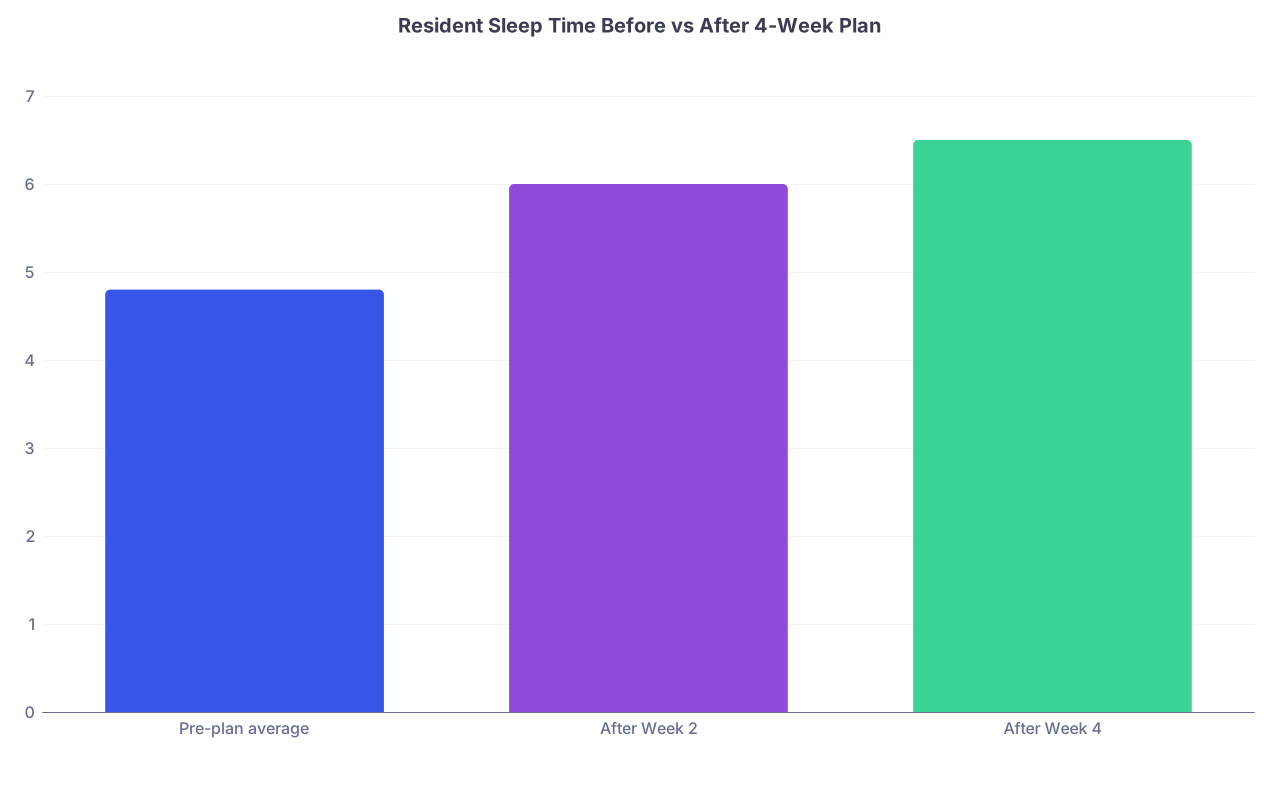
| Category | Value |
|---|---|
| Pre-plan average | 4.8 |
| After Week 2 | 6 |
| After Week 4 | 6.5 |
Week 1 – Baseline and Triage: Stop the Bleeding
Week 1 is not about optimization. It is about figuring out where your sleep is actually going, then patching the biggest holes.
Step 1: Track 7 days brutally honestly
Use anything that does not create friction:
- Notes app on your phone
- Paper index card in your pocket
- Sleep tracking app (fine, but not required)
Track for 7 consecutive days:
- Time you lie down to sleep
- Time you estimate actually falling asleep
- Night awakenings over 10 minutes
- Wake time (when you get out of bed)
- Any naps > 10 minutes
- Caffeine timing (first and last dose)
You are not trying to impress anyone. You are collecting data to fix the system.
At the end of 7 days, calculate:
- Average total sleep per 24 hours
- Shortest sleep in that week
- Number of days with < 5 hours total sleep
If you are under 5.5 hours average or you have ≥3 days with < 5 hours, you are in the chronic sleep deprivation zone most residents live in. That is what we are fixing.
Step 2: Identify your top 3 “sleep leaks”
From those 7 days, circle the patterns that keep repeating. Common culprits I see:
- “Zombie scrolling”: 30–90 minutes on your phone after you get into bed because your brain feels fried.
- Pointless debriefing: Post-shift venting that turns into 90 minutes of rehashing rounding drama.
- Late caffeine: 5 pm energy drink or coffee “just to finish notes.”
- Noise/light at home: Roommates, partner, kids, no blackout curtains, TV in bedroom.
- Chaotic pre-sleep routine: In bed with pager, email, and sign-outs in your face.
Pick only three. Do not try to fix everything.
Step 3: Create “Week 1 Rules” that specifically attack those leaks
You are going to establish hard rules just for this week. Not forever. Just 7 days.
Examples:
If your leak is phone use:
- Phone goes to charging spot across the room when you get into bed.
- If you must be reachable: only pager and calls; disable social media notifications entirely.
If your leak is late caffeine:
- No caffeine after 2 pm on day shifts.
- On nights: nothing caffeinated within 6 hours of planned end of shift if you are going home to sleep.
If your leak is noise/light:
- Order blackout curtains or use an eye mask.
- Get cheap foam earplugs and a white noise app. Not optional. Residents who sleep post-call without this are punishing themselves for no reason.
Commit to these rules like you commit to checking allergies before writing a penicillin order. This is not “self-care.” This is practice safety.
Step 4: Minimum non‑negotiable: The 30‑minute wind‑down
End of Week 1 goal: you have one predictable pre‑sleep pattern that lasts 20–30 minutes, even if the clock says 1:30 am.
Pick any combination that is:
- Repeatable
- Offline
- Low light and low stimulation
Example pattern:
- 5 min: put phone on charger, set alarm, silence notifications except calls.
- 5–10 min: very short hygiene routine (brush teeth, wash face, maybe warm shower).
- 10–15 min: sit on bed/chair with one low-stimulation activity:
- Paper book
- Guided relaxation audio
- Simple stretching routine (cat-cow, hamstring, neck)
That is it. Same sequence. Every time. You want your brain to start recognizing: “When this starts, we are heading to sleep.”
Do not overthink this. Consistency matters more than the perfect routine.
Week 2 – Anchor Points and Micro‑Recovery
Now that the worst self-inflicted damage is controlled, you need structure.
Residency schedules are chaotic. Your sleep cannot be. You need anchors—fixed points your body can rely on.
Step 1: Choose your two anchor times
You cannot control every night. You can often control two time windows on most days:
- Anchor wake time on day shifts
- Anchor sleep block on nights or post‑call days
Pick realistic windows:
On day rotations:
- Example: alarm set so you are up 60–75 minutes before you must leave (not 20 minutes before). This gives room for a quick breakfast + light exposure.
On night rotations:
- Example: 11:30 am–4:30 pm anchor sleep block, protected like an OR case.
You are aiming for consistency within 60–90 minutes, not perfection to the minute.
Step 2: Implement “Light and Caffeine Discipline”
Two levers control your circadian rhythm: light and stimulants. Most residents treat both randomly.
For the next 7 days:
On day shifts:
- Get at least 10–15 minutes of bright light within an hour of waking:
- Walk outside
- Stand by a window with coffee
- Keep caffeine:
- Front-loaded: majority before 10 am.
- Last small dose by 2 pm.
On post‑call / sleeping after nights:
- Wear sunglasses on your way home. Yes, you will look like an overdramatic fellow. You will also fall asleep faster.
- Keep lights dim at home until you get into bed.
- No caffeine within 6 hours of your main sleep block.
On nights:
- Bright light during the middle of your shift (workroom light, well-lit central station).
- After 3–4 am, start dimming light exposure if possible.
- Last caffeine dose around 2–3 am, small (green tea, half coffee).
You are training your body to know when to be alert and when to wind down, even when the clock is insane.

Step 3: Install a nap protocol – not random crashing
Residents either never nap (“If I lie down, I will never wake up”) or take accidental 3‑hour naps at the wrong time.
You need intentional micro‑recovery:
Nap rules for day rotations:
- If you get less than 6 hours overnight:
- Aim for one nap of 20–30 minutes in the afternoon or early evening.
- Latest nap start: 7 pm. After that, it will destroy your nighttime sleep.
How to nap effectively:
- Dark, cool, quiet environment – or:
- Eye mask
- Earplugs / white noise
- Set a loud alarm for 25–30 minutes.
- If you lie there awake the whole time, you still win. You gave your body a rest interval.
Nap rules for night rotations:
- Pre‑shift “anchor nap”:
- 60–90 minutes in the late afternoon before your first few nights, if you can.
- During shift:
- If your hospital allows “rest periods,” set a 20‑minute power nap between 1–4 am, supervised/covered if possible.
- Same: dark, alarm, short.
You are not trying to feel amazing. You are trying to keep your sleep debt from going into free fall.
Step 4: Protect one weekly “sleep reset”
In Week 2 you also claim one day per week where you get extra sleep on purpose.
Pick the day where you are least likely to be on call. Strategy:
- Keep your wake time within 1–2 hours of usual.
- Add a 90‑minute nap mid‑day or earlier afternoon.
- Bedtime can be up to 1 hour earlier than usual.
You are giving your brain and body a slightly larger block to do repair work. Not a 13‑hour marathon that wrecks your next two nights.
Week 3 – Tactics for Days, Nights, and 24‑Hour Calls
Now we adapt the system for three main patterns: day floats, night shifts, and 24s/post‑call.
A. Day rotations: Getting from 5 to 6–7 hours
For standard day shifts (e.g., 6 am–6 pm, 7 am–5 pm), your enemies are:
- Late charting
- Social obligations
- Mindless phone use once you finally get home
Here is the Day Shift Protocol:
Post-shift decompression cap: 45 minutes, maximum.
- Walk home or short walk outside if possible.
- Quick food.
- One debrief (partner, co-resident, journal) with a timer.
“Stop charting” time.
- Hard cut-off for non-urgent charting 60–90 minutes before planned bed.
- If your attendings send late-night messages, you can check, but do not start long note-writing sessions at 10 pm.
Scheduled bedtime window.
- Choose a 60-minute window you aim for every workday (e.g., 10–11 pm).
- Your wind‑down routine from Week 1 starts within this window, even if notes are not “perfect.”
Strategic social life, not chaos.
- Max 2 late nights/week when you are on a tough rotation.
- You say “I am on a heavy block; I can do Friday night, not Wednesday” instead of “Sure, I can make it work” while dying inside.
| Rotation Type | Main Sleep Block | Nap Strategy | Caffeine Cutoff |
|---|---|---|---|
| Day shift | 5.5–7 h at night | 20–30 min, before 7 pm | 2 pm |
| Night shift | 4–6 h daytime | 20–30 min during shift | 2–3 am |
| 24 h call | 6–8 h post-call | 0–20 min micro-naps | No caffeine after 3–4 am |
B. Night float: Surviving without wrecking the next month
Nights are where most residents absolutely destroy their sleep architecture.
Night Shift Protocol (for blocks of 3+ nights):
Before first night:
- Sleep in moderately late that morning (not until 2 pm; 9–10 am is fine).
- Take a 90‑minute nap in late afternoon (3–5 pm).
- First caffeine of “day” around 6–7 pm.
During night:
- Main caffeine window: start of shift to ~2–3 am.
- Bright light at work; move regularly.
- If volume allows, one 20–30 min nap between 1–4 am, with clear coverage and alarms.
After each night:
- Go home, sunglasses on.
- Light snack if needed; keep lights dim.
- In bed within 60 minutes of arriving home.
- Main sleep block: whatever your life allows, but target at least 4–6 hours, same rough timing daily (e.g., 9 am–2 pm or 11 am–4 pm).
On last night of the block:
You have two decent options:
Fast flip to days:
- Sleep 3–4 hours after your last night shift, wake up early afternoon.
- Push through with no nap, use bright light and minimal evening caffeine.
- Go to bed 9–10 pm and reset to days.
Gradual flip (if you have a day off):
- Sleep usual post‑night block.
- Next day, take a short 20‑min nap early afternoon, go to bed a bit later than normal.
- It takes 2–3 days to fully flip, but you are functional.
Pick a strategy based on how brutal your next rotation is.

| Step | Description |
|---|---|
| Step 1 | Identify Rotation |
| Step 2 | Use Day Shift Protocol |
| Step 3 | Use Night Shift Protocol |
| Step 4 | Use Call and Post Call Protocol |
| Step 5 | Anchor wake time |
| Step 6 | Define daytime sleep block |
| Step 7 | Plan post call sleep |
| Step 8 | Day, Night, or 24 h? |
C. 24‑hour call and post‑call days: Where residents waste their one chance to recover
I have watched residents do this:
- Stay awake almost all call.
- Go home at 10–11 am, “just lie down for a bit,” sleep until 8 pm.
- Then be wide awake all night, dragging for two more days.
You can do better.
During 24‑hour call:
Accept that you will not get high-quality sleep.
Aim for micro-naps:
- 10–20 minutes in a call room when there is a lull and you have coverage.
- Do not push for a 2‑hour block if the service is chaotic; you will get interrupted and feel worse.
Caffeine:
- Small to moderate doses early.
- Cut off by 3–4 am if you are going home in the morning.
Your goal is to consolidate one solid 6–8 hour block, not to sleep the entire day and reset your clock to nocturnal.
- Get home, dark environment.
- Light food or no food if you are not hungry.
- Sleep as soon as possible.
- Set an alarm for 6–8 hours. Yes, an alarm.
- Example: home at 10 am, asleep by 11 am, alarm at 5 pm.
When you wake:
- Expose yourself to bright light (go outside for 10–15 min).
- Move a bit (short walk, light stretching).
- No more sleep until your normal bedtime, which you keep within 1–2 hours of your usual.
If you absolutely cannot stay awake in the late evening, allow a single 15–20 min nap before 5 pm. Nothing later.
Week 4 – Automation, Boundaries, and Maintenance
By Week 4, you will know what works and what keeps breaking. This week is about making the system resistant to chaos.
Step 1: Turn your best habits into default “orders”
Think of your habits as standing orders on yourself. You want few, clear rules that cover most situations.
Examples of standing orders:
- “On day shifts, I am in bed between 10–11 pm, wind‑down starts at 9:30 pm.”
- “I never drink caffeine after 2 pm on days, 3 am on nights.”
- “Post‑call, I sleep 6 hours max, then stay awake until normal bedtime.”
- “If I sleep under 5 hours, I take a 20–30 min nap before 7 pm.”
Write them down somewhere you see daily (back of badge card, phone note). This seems childish. It works.
Step 2: Plan for the next month’s rotations in advance
Do this on your golden weekend or any half-day off before the next block.
Look at your next month’s schedule.
Identify:
- Which weeks are heavy days
- Which are nights
- Which contain 24‑hour calls
For each “phase,” define:
- Your target main sleep window
- Your caffeine rules
- Your nap rules
You are building a rotation‑specific sleep plan before you are too tired to think.
Step 3: Set boundaries with co-residents and attendings
This feels risky but is often simpler than you think. You are not demanding less work. You are asking for small, reasonable protections around your only recovery time.
Some scripts that actually work:
To co‑resident who loves debriefing until midnight:
- “I can do 15 minutes, then I need to crash or I am useless tomorrow.”
To attending who sends notes at 11 pm:
- You do not need to respond real‑time unless explicitly stated.
If they complain:
“I try to keep a hard cutoff for charting by 10 pm so I can function safely the next day. I will finish any loose ends first thing in the morning.”
- You do not need to respond real‑time unless explicitly stated.
To family/friends who do not get it:
- “My call schedule is brutal this month. I can probably do Friday evening, but weeknights I am prioritizing sleep so I do not screw up at work.”
You are not being selfish. You are protecting patients from sleep‑deprived you.

Step 4: Fix the bedroom environment once, benefit for years
If you do nothing else from this article, do this:
Turn your sleeping space into something that actually lets your nervous system shut off.
Non-negotiables:
Blackout or near-blackout:
- Real blackout curtains, or:
- Cheap eye mask that blocks light completely.
Quiet or controlled noise:
- Foam or silicone earplugs.
- White noise app or small machine (fan, app, etc.).
Cool temperature:
- 60–68°F (15–20°C) target if possible.
- At least a fan at bedside.
No work in bed:
- Do not chart, answer non-urgent messages, or review labs in bed.
- Bed = sleep and sex. That is it. You want your brain to associate lying down with “we are done.”
You set this up once and it silently supports every rotation, every call, every post‑night crash.
Step 5: Monitor, adjust, and know when you are in trouble
By now you should have:
- A rough idea of your true average sleep time.
- A few weeks of trying to improve it.
You need a simple monitoring rule:
- If your average sleep drops below 5 hours for >7–10 days, and:
- You are making frequent small mistakes.
- You feel emotionally volatile (tearful, unreasonably angry).
- Your reaction time feels slowed (e.g., you reread orders 4 times).
You are not just tired. You are at risk.
At that point:
- Tighten all your rules for at least a week (caffeine cutoffs, extra naps, hard boundaries).
- If things do not improve and your schedule is extreme (q2–q3 call, violation‑level), talk to:
- Chief residents
- Program director or wellness officer
Yes, programs talk about “wellness” and then destroy you with schedules. Still. They are responsible for duty hours. If you are running unsafe, they need to know.
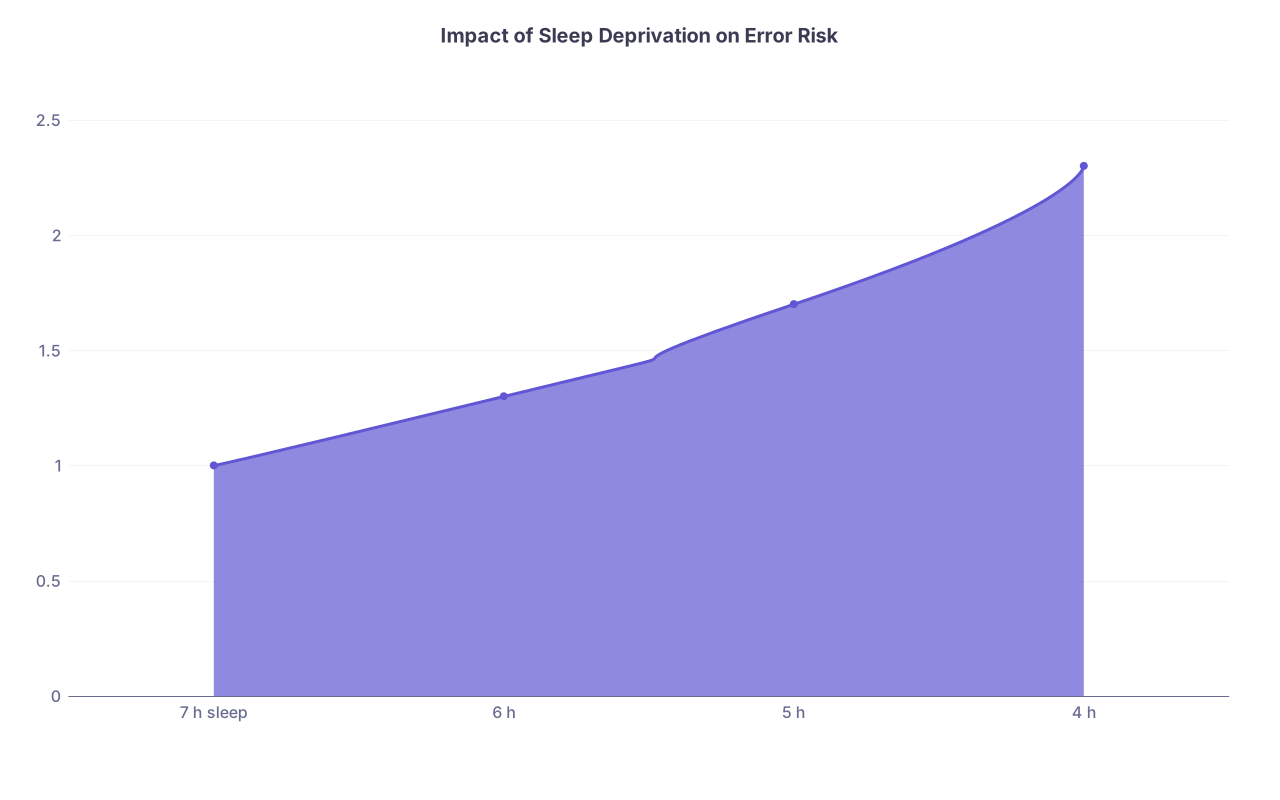
| Category | Value |
|---|---|
| 7 h sleep | 1 |
| 6 h | 1.3 |
| 5 h | 1.7 |
| 4 h | 2.3 |
Putting It All Together: A Realistic Example
Let’s walk through one realistic month using this framework.
Scenario: You are a PGY‑1 on internal medicine.
- Week 1–2: Day shifts, 6 am–6 pm, q4 call.
- Week 3: Night float, 7 pm–7 am.
- Week 4: Clinic, 8 am–5 pm.
How this 4‑week plan plays out:
Weeks 1–2 (Day + q4 call):
- Anchor:
- Wake at 4:30–5:00 am.
- In bed 10–11 pm on non-call nights.
- Caffeine:
- Coffee at 5 am, second at 9 am, nothing after 2 pm.
- Post-call:
- Home by 11 am.
- Sleep 11:30 am–5:30 pm (alarm set).
- Stay awake until 10–11 pm, then back to normal schedule.
- Naps:
- On non-call days with <6 h sleep, 20–30 min nap at 5–6 pm.
Week 3 (Night float):
- Before first night:
- Wake at 9 am, 90‑min nap 3–4:30 pm.
- Shift:
- Caffeine 7 pm and midnight; last small dose 2 am.
- Attempt 20‑min nap at 3 am if service allows.
- Post-shift:
- Home 7:30–8 am, sunglasses on.
- Sleep 9 am–2 pm (anchor block).
- Light exposure after 2 pm, no caffeine after 3 pm.
Week 4 (Clinic):
- Reset:
- After last night, sleep only 3–4 hours (9 am–1 pm).
- Stay awake with light, small walk.
- Bed at 9–10 pm, alarm at 6:30 am for clinic.
- Then standard day‑shift protocol again with 10–11 pm bedtime, no caffeine after 2 pm, 20‑min nap if sleep <6 h.
Is it perfect? No. Is it dramatically better than free‑for‑all sleeping? Absolutely.
Final Takeaways
- You will not control residency hours. You can control sleep structure using anchors, light, caffeine, and short, deliberate naps.
- Treat sleep like a medication: dose, timing, and consistency matter more than rare marathon catch‑ups.
- Build a simple, written rotation‑specific sleep plan and enforce small boundaries. That is how you protect your brain, your patients, and your long‑term career.