
The way you talk about burnout can quietly end your career—or quietly save it—and program directors will never tell you that out loud.
They hear the word “burnout” multiple times a week. In wellness surveys. In faculty meetings. In GME town halls. But when you say it, in an email, in a meeting, on an evaluation, in an interview—there’s an entirely different, unspoken calculus running in their heads.
Let me walk you through what actually happens behind that professional smile.
The First Thing They’re Really Assessing: Are You Safe?
Program directors are not primarily thinking, “How do I help this person thrive?” when you bring up burnout.
Their first reflex is much more primitive: “Is this resident safe for my patients and my program?”
Here’s the mental checklist I’ve watched PDs run in about five seconds when a resident says, “I’m burned out,” or “I’m struggling,” or “I’m overwhelmed”:
- Is this resident about to make a serious clinical mistake?
- Is this resident about to quit or go on leave?
- Is this resident about to report us to GME/ACGME/state board?
- Is this resident going to poison the culture for everyone else?
The rest comes later: empathy, solutions, wellness committee nonsense. The first layer is risk assessment.
And this is where a lot of residents accidentally set off alarms they never meant to.
The words that scare them
You say:
“I’m completely burned out.”
What some PDs hear:
“I’m at my limit. I might not be reliable anymore.”
You say:
“I feel depressed all the time and can’t keep going like this.”
What some PDs hear:
“We may be headed for leave, remediation, or an incident.”
You say:
“This program is toxic; everybody is burned out.”
What some PDs hear:
“This person may escalate to GME, social media, or legal channels.”
Am I saying you should lie about your mental health? No.
I’m saying: program directors are running a risk matrix in the background, and if you don’t understand that, you will misinterpret their reactions—and you can unknowingly tank how they talk about you in closed rooms.
The Four Invisible Buckets: How PDs Classify “Burnout Talk”
Behind closed doors, when they’re honest with each other (and I’ve heard these conversations), PDs mentally sort residents into rough “buckets” when burnout comes up.
| Bucket | How They See You | Typical PD Reaction |
|---|---|---|
| High performer, insightful | Asset, self-aware | Support + protect |
| Overwhelmed but salvageable | Needs guardrails | Conditional help |
| Chronically negative | Culture risk | Contain + document |
| High-risk (safety/legal) | Liability | Formal process |
They will never show you this table. But they use it.
Bucket 1: High performer, insightful
This is the resident pulling 4+ on evaluations, strong clinical instincts, shows up prepared—and then comes in and says:
“I’ve been noticing I’m more irritable, my empathy feels thinner, and I’m worried I’m heading toward burnout. I want to stay effective, but my tank’s running low.”
PD translation:
Self-aware. Still functioning. Wants help before they spiral. Likely to recover with support, not blow up.
These residents usually get real accommodations: rotation swaps, lighter elective, protected appointments with counseling, an ally among the faculty. PDs want to keep them.
Bucket 2: Overwhelmed but salvageable
These are the ones with OK-but-not-great evaluations, maybe a flagged mini-CEX here and there, and they come in like this:
“I’m burnt out. I’m struggling to keep up. I’m just exhausted all the time. I feel like I’m drowning.”
PD translation:
Performance and burnout are mixed. Some of this is system pressure; some is time management, knowledge gaps, or resilience. Might improve with structure, but also might drag down the team.
Here, the PD starts thinking in terms of “conditional help”:
We’ll support you, but we’re also going to track everything. Close supervision. Documentation. Maybe a “development plan” that’s definitely going in your file.
Bucket 3: Chronically negative
These are residents who live in the complaint channel. Everything is unfair. Every rotation is malignant. Every attending is the problem.
They say “burnout,” but it comes wrapped in attacks:
“This rotation is exploitative.”
“Everyone here is burned out, nobody cares about wellness.”
“This program doesn’t care about us as humans.”
PD translation:
Culture risk. High probability of spreading discontent. Potential GME or social media wildcard.
Reactions here are usually surface-level supportive and privately defensive:
- Smile and nod.
- Offer generic wellness resources.
- Start documenting every conversation.
When this person talks about burnout, PDs think, “How do I keep them from destabilizing the rest of the class?”
Bucket 4: High-risk (safety or legal)
These are rare, but they occupy a huge amount of leadership bandwidth.
Language like:
“I’m not sure I want to be alive.”
“I don’t trust myself to be safe with patients.”
“If something bad happens, it’s on this program.”
PD translation:
We need to loop in GME & legal now.
We must protect patients, the resident, and the institution.
Here, the burnout conversation immediately shifts from “support” to “process”: fitness-for-duty, formal evaluations, maybe leave of absence, occupational health, psychiatry, HR.
I’ve watched PDs genuinely care about these residents and still spend 80% of the time talking about documentation, liability, and policy. That’s the reality.
What They Wish You Would Do Before You Ever Say “Burnout”
Let me say the quiet part aloud: “Burnout” has become such a loaded, vague word that many PDs tune out as soon as they hear it.
What cuts through that noise?
Specifics. Functioning. And a plan.
When a resident walks in and says something like:
“I’m noticing I’m making more small mistakes and I’m slower to think on rounds because I’m so drained. I’m still safe, but I don’t want this to escalate. I’ve already started seeing a therapist and moved my workouts to post-call days, but I need some structural help on my schedule.”
This hits very differently than:
“I’m burned out. This is unsustainable.”
The first signals:
- Insight
- Ownership
- Ongoing effort
- A clear ask
The second signals:
- Emotional flood
- Blame
- Burden being pushed entirely onto the program
PDs are not monsters. Most of them went through savage training themselves, and many are quietly burned out too. They just react far better when they see you’re working with them, not dropping a problem at their feet.
How They Talk About You Afterward: The Real Meeting
You walk out of the office. The PD goes back to their day. Then comes the real conversation—faculty meeting, CCC (Clinical Competency Committee), or an informal chat in the hallway.
This is where your future letters, your graduating evaluation, and sometimes your career trajectory are shaped.
I have heard variations of all of these:
“She’s been really overwhelmed but she came early, asked for help, and is putting in the work. I think with support she’ll do very well.”
versus
“He keeps saying he’s burned out, but he’s on his phone at the computer, disappears at 4:30, and the nurses say he’s hard to find. I’m not sure how much is burnout and how much is attitude.”
versus
“I’m concerned. She used the word ‘burnout’, but she also talked about not caring what happens to patients anymore. We need to watch her closely and maybe limit autonomy.”
And here’s the uncomfortable truth: that one 20–30 minute meeting colors everything that comes after.
The “burnout” label that quietly sticks
Programs talk about residents in shorthand. You will never hear this, but it happens:
“The superstar on nights.”
“The one who struggled on ICU but improved.”
“The one who went on leave.”
“The burnout guy.”
Once “burnout” becomes your label, future conversations tilt. When your name comes up for chief. Or a competitive fellowship. Or a letter for that dream job.
No one says, “We shouldn’t support them; they were burned out.”
They say, “Let’s just see how they do this year,” or “Maybe someone with a more consistent track record.”
Soft language. Hard consequences.
How Different PDs React: Not All Are Created Equal
Let me strip away the fantasy: PDs are not a monolith. Their personal history with stress and mental health massively skews how they hear your burnout story.
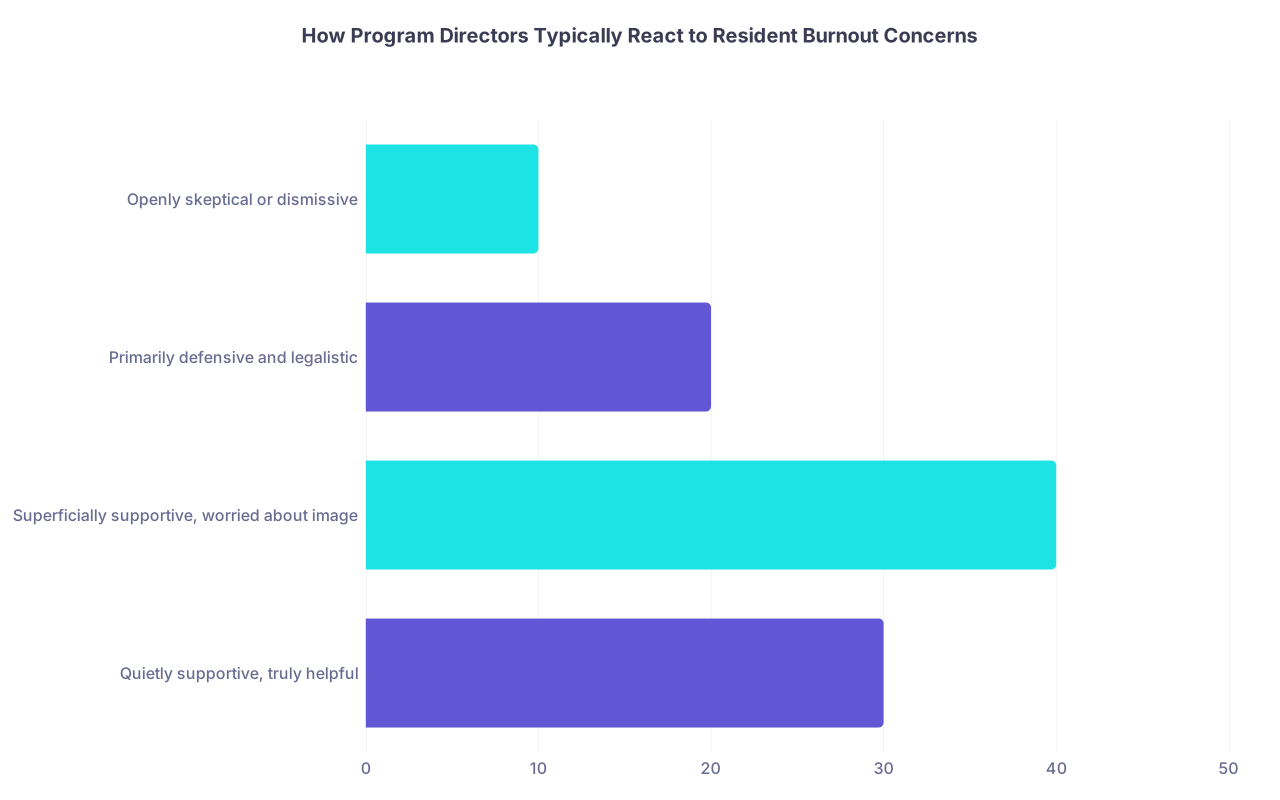
| Category | Value |
|---|---|
| Quietly supportive, truly helpful | 30 |
| Superficially supportive, worried about image | 40 |
| Primarily defensive and legalistic | 20 |
| Openly skeptical or dismissive | 10 |
These numbers aren’t from a paper. They’re from years of hearing the same patterns across institutions.
- Some PDs have done therapy themselves. They get it. They’ll go to bat for you.
- Some care mainly about the program’s reputation. They’ll slap a wellness brochure on your problem and move on.
- Some are terrified of legal blowback. They document everything and talk like HR reps.
- A small but still-real group think burnout is mostly weakness. Those are the ones who say things like, “Back when I trained, we just sucked it up.”
You can’t control which type you get. You can control how you present your situation so you’re treated as the first bucket: the self-aware, still-functioning resident worth backing.
The Smart Way to Talk About Burnout (Without Getting Branded)
Let me be blunt: you should speak up before you break. You just need to do it in a way that doesn’t light up every risk sensor in your PD’s brain.
Here’s the strategy I’ve seen work consistently.
1. Talk about functioning, not just feelings
Instead of leading with, “I’m burned out,” lead with observable consequences:
“I’ve noticed I’m slower to synthesize data on rounds and I’m more easily overwhelmed by cross-cover calls. That’s new for me, and I’m concerned it’s tied to exhaustion more than ability.”
You’re telling them:
I’m monitoring my performance. I care about being effective.
2. Separate you from the program attack
If you walk in swinging at the program, most PDs armor up.
“This night float system is destroying residents” puts them on defense.
“I’m struggling to recover between night shifts and I’m trying to figure out how to stay functional within this system” keeps the problem shared.
Later, once you’ve earned trust and a reputation for being fair, you can start pushing for system-level changes. Many PDs will actually listen to you then.
3. Come with proof you’ve already tried
You look very different from the chronic complainer if you can say:
- “I started seeing counseling through the resident wellness program.”
- “I’ve already adjusted my sleep routine and stopped picking up extra shifts.”
- “I asked my senior for feedback on my efficiency and applied what they suggested.”
Now when you say, “I still need help,” they believe you.
4. Make a specific, reasonable ask
Vague plea:
“I need things to be better. This is unsustainable.”
Targeted, concrete approach:
“I think a two-week elective without nights after this ICU block would help me reset. I’m not asking to reduce my overall requirements, just rearrange timing.”
That’s something a PD can actually act on without rewriting the schedule for 30 people.
How They Weigh You Against the Rest of the Class
Here’s another behind-the-scenes truth: PDs are always looking at you in context of your cohort.
They’re thinking:
- Who else is struggling right now?
- Can we afford to adjust this person’s schedule without collapsing coverage?
- Has this resident been a giver or a taker up till now?
If you’ve built a reputation as the one who stays late to help on cross-cover, who teaches the interns, who doesn’t dump work on night float—your burnout story lands very differently.
You become:
“The usually solid rock who’s finally asking for help. We owe them one.”
If you’ve been the one leaving early whenever you can, grumbling on every rotation, nitpicking every call schedule change—you’re now the boy/girl who cried wolf.
Burnout might be 100% real in both cases. The institutional response will not be.
When Burnout Becomes Leave: What PDs Really Think
Residents are terrified that taking leave for mental health—or even “for personal reasons”—will ruin them. So they push until they crash. PDs watch this happen every year.
Here’s the real equation PDs are doing when you’re on that edge:
Option A:
Resident keeps going, deteriorates, maybe has a meltdown on the unit, makes a serious error, or walks out mid-rotation.
Option B:
Resident takes a planned, documented leave, gets help, comes back more stable, maybe needs an extra training time.
Every PD I respect prefers B. The mediocre ones prefer A until something blows up.
When you raise burnout early, calmly, and with insight, you make Option B feel controlled, predictable, responsible. That makes them far more willing to support it.
And here’s the thing hardly anyone tells you: a well-managed leave with a story of insight and growth can be spun positively to fellowship directors.
“I had a period during residency where I recognized I was heading toward burnout. I took protected time, worked with a therapist, learned specific strategies, and since then my performance has been consistently stronger.”
Versus:
“This person barely made it through training with multiple incidents flagged in their file.”
Who do you think they’d rather take?
What Comes Next For You
You’re not going to outrun burnout in residency by reading nicer quotes on wellness posters. You’re not going to fix a broken system single-handedly. And you’re definitely not going to survive by pretending you’re fine until you shatter.
Your real leverage sits in three places:
- Understanding how program directors actually think when you say “burnout.”
- Choosing your words and timing so you’re seen as an asset worth helping, not a problem to be contained.
- Building enough day-to-day credibility that when you finally say, “I need backup,” they believe you.
You will see co-residents mishandle these conversations and get quietly sidelined. You will see others handle them shrewdly and come out the other side protected, even respected.
The difference isn’t who “deserved” help. It’s who understood the game.
You now know how the other side of the table is thinking. Use that. Decide whom to talk to, when to talk, and how to frame your struggle so you’re heard without being branded.
Because once you can have that first hard conversation without losing control of your narrative, you’re ready for the next level of this messy business: not just surviving residency, but shaping it—for yourself and the people coming up behind you. But that’s a story for another day.
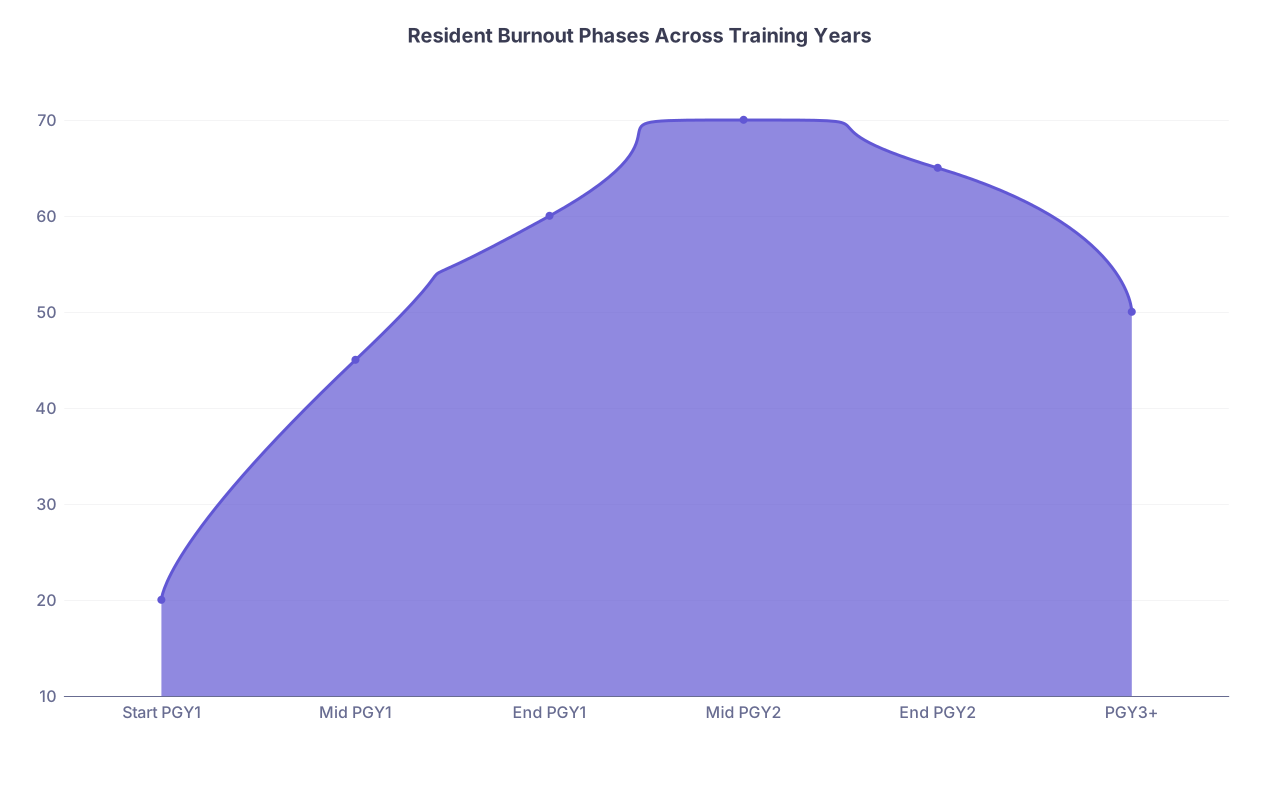
| Category | Value |
|---|---|
| Start PGY1 | 20 |
| Mid PGY1 | 45 |
| End PGY1 | 60 |
| Mid PGY2 | 70 |
| End PGY2 | 65 |
| PGY3+ | 50 |