
The way you write emails and chart in the EMR is quietly building — or destroying — your reputation with faculty every single day.
Residents always think “reputation” is about presentations, procedures, and exam scores. Those matter. But the smartest faculty I know — the ones who actually run promotions committees, choose chiefs, write big-name letters — judge you heavily on two unsexy things: how you communicate over email and how you document in the chart.
Let me walk you through what really happens on the other side of that “Send” button and “Sign Note” click.
What Faculty Are Actually Reading Between the Lines
Here’s the part nobody tells you: faculty almost never see your “best” self. They see you at 6:42 am in their inbox and at 11:17 pm in your progress notes.
They build an entire mental profile of you off those two sources.
When a program director or associate PD talks about a resident in closed-door meetings, they do not pull up your eval scores first. They pull up the EMR and their email history. I’ve watched it. Multiple times.
- “Let’s look at how he writes his notes. That’ll tell us how careful he is.”
- “Search my email — I want to see how she responds to feedback.”
- “Scroll through her inbox. Is she someone who answers quickly or do I always have to chase her?”
They are not just reading your words. They’re reading your habits.
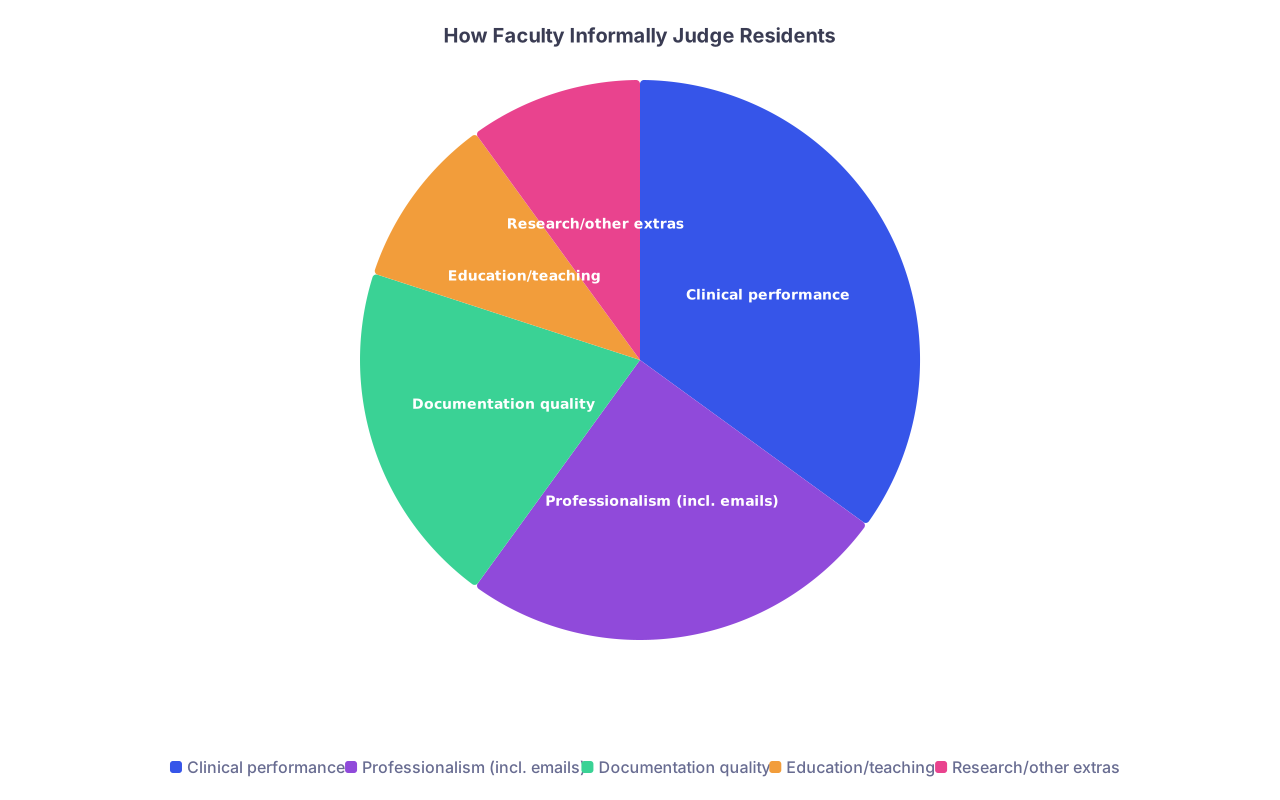
| Category | Value |
|---|---|
| Clinical performance | 35 |
| Professionalism (incl. emails) | 25 |
| Documentation quality | 20 |
| Education/teaching | 10 |
| Research/other extras | 10 |
Most residents think the “professionalism” slice is about showing up on time and not yelling at nurses. In reality, a huge portion of that professionalism bucket is: how you communicate in writing.
Email: The Quiet Professionalism Exam You Take Every Day
Here’s what faculty really think when your name appears in their inbox.
1. Subject lines: your first impression test
Vague subjects are the hallmark of disorganized residents. I’ve seen faculty roll their eyes at:
- “Question”
- “Quick thing”
- “Patient”
What they infer: you make more work for other people. They have to open the message to know whether it’s urgent, minor, or something they can ignore.
Compare that to:
- “Discharge plan question – Mr Smith 7E”
- “Schedule request – nights switch in March”
- “Follow-up from 1/3 feedback – progress update”
Same content, different signal. The second version screams, “I respect your time, I can organize my thoughts, I know how busy you are.”
2. Timing and response speed: yes, they notice
Faculty track how you respond. Not formally. Just in their head.
Here’s how they subconsciously categorize residents:
| Resident Type | Typical Pattern |
|---|---|
| “Rock solid” | Replies same day, clear answers |
| “Chronic drifter” | Needs 2-3 nudges to respond |
| “Fire drill maker” | Last-minute, urgent tones |
| “Over-emailer” | Walls of text, vague asks |
| “Ghost” | Unreliable, faculty avoid |
You don’t want to be in any bucket except the first.
If a faculty member sends you something at 8 am and you consistently answer 2–3 days later — or not at all — they do not see “busy resident.” They see “I cannot trust this person with time-sensitive tasks” or “I’m not putting this person on the research project / teaching role / chief shortlist.”
And yes, they remember who ghosts them about letters, schedule changes, or academic opportunities.
3. Tone: how you sound when you’re not in the room
Here’s what faculty quietly judge from your tone:
- Too casual → “Does not get professional norms”
- Too stiff → “Socially awkward but safe”
- Defensive → “Will be hard to coach, avoid hard feedback”
- Clear and brief → “This person gets it; I can trust them with more”
I’ve literally watched an attending say, “I liked her on rounds, but the email she sent me about her letter was surprisingly entitled. I’m going to keep the letter more generic.”
You will never see that written anywhere. But it happens.
The Hidden Rules of Email Respect in Residency
Let me be blunt: most residents underestimate how much their email etiquette is killing their reputation.
Rule 1: Don’t make faculty hunt for the ask
If your main question is buried in paragraph four, you’ve already lost.
Bad: “Hi Dr. X, thank you so much for the great teaching this month. I learned a lot from the ICU rotation and especially liked how you discussed shock states and ventilator management. I had a question about my schedule because I was hoping to attend my cousin’s wedding in May…”
Better: “Hi Dr. X, I’m on your ICU team in April and have a schedule question. [One-sentence ask.] Then your context.”
Faculty scan. They do not read carefully. If they have to figure out what you want, they resent it.
Rule 2: Close the loop like a professional
“Got it, thank you” is not just politeness. It’s a trust signal.
Faculty hate black holes. If they send you a plan, a schedule change, or feedback and never hear back, you get mentally filed as “maybe did not read, maybe did not process.”
- “Got it, I’ll update the note and call the family.”
- “Understood, I’ll be there at 7:30 for pre-rounds.”
- “Thanks for the feedback — I’ll work on tightening my SOAPs.”
I’ve seen PDs specifically praise residents in meetings: “She always closes the loop, even on small stuff. I never have to guess where things stand.”
Rule 3: Faculty absolutely forward your emails
This is the part nobody tells you when you’re a PGY1.
That late-night email where you vent about a co-resident? That overly defensive reply to constructive feedback? That clumsy attempt to push back on a schedule?
I’ve seen versions of those forwarded to:
- Program leadership
- Chief residents
- Other faculty
- Occasionally, HR
Once you show you’re impulsive on email, faculty become extremely cautious with you. You stop hearing about certain opportunities. You get fewer “informal” chances because everything now needs to be documented, careful, and formal.
Documentation: Your EMR Pages Are Your Shadow CV
Now let’s talk about your notes. Because I promise you, attendings are reading them for far more than medical content.
Your documentation is how you sound when nobody is coaching you live. It’s the purest look at your judgment and your thinking process.

Here’s what faculty infer from your charting:
1. Are you safe?
Program leadership absolutely look at EMR notes when there are patient safety incidents, borderline residents, or promotion questions.
I’ve sat in meetings where they scroll through weeks of notes and ask:
- “Did this resident even recognize how sick the patient was?”
- “Where is the differential? It’s been copy-paste for days.”
- “Why is nobody documenting conversations with the family?”
If your notes are one-line “doing fine, no complaints” templates, they don’t think “efficient.” They think “this person is blind to risk and liability.”
2. Do you actually think?
Faculty use notes to see how your brain works when no one is spoon-feeding you on rounds.
An assessment that reads:
“Sepsis – continue treatment”
tells them almost nothing.
An assessment that says, concisely:
“Severe sepsis likely 2/2 pneumonia. Now HD stable on 2L NC, improving lactate. Still tachycardic. Plan: de-escalate to ceftriaxone if afebrile and cultures negative at 48h; monitor for fluid overload given CKD 3.”
That signals: This resident understands trajectory, risk, and future steps.
I’ve heard attendings say, “Her notes are better than some fellows. She really thinks.”
Guess who they go out of their way to mentor? That person.
3. Are you lazy, burned out, or just sloppy?
There’s a difference between “efficient” and “checked out.” Faculty can tell.
Red flags faculty quietly track:
- Obvious copy-paste errors (wrong gender, wrong problem list, labs from 3 days ago)
- Assessments that never change despite clinical changes
- Zero mention of family discussions around big decisions
- No documentation of overnight events you were paged about
They do not always call you out. They just downgrade their internal rating of your reliability.
And that rating comes back when someone asks, “Is this person ready to be senior? Would you trust them on nights alone?”
How Reputation Is Really Formed: The Backstage Conversations
Here’s the part residents never get to hear.
After you leave a rotation, the real evaluation happens in places without forms:
- Sitting in a workroom after sign-out
- Quick “what did you think of them?” hallway chats
- End-of-year promotion and remediation meetings
And in those conversations, your emails and documentation come up constantly.
Examples I’ve personally heard:
- “He was fine clinically, but I had to chase him three times for every follow-up email. I would not put him in a role that needs independent follow-through.”
- “Her notes are always clear and thorough. Families told me they understood what was going on because she’d explain and then document it. That’s someone I trust with hard cases.”
- “He sent me a really aggressive email about his schedule change. I’m not touching that drama; someone else can deal with him.”
- “She’s the only intern who consistently emails me a brief update when something big happens overnight. That level of professionalism stands out.”
These small patterns, over months, form your “brand” in the building.
It’s rarely one huge event. It’s hundreds of tiny data points from your inbox and the EMR.
Practical Email Moves That Raise, Not Lower, Your Stock
Let me give you the habits I’ve seen consistently in residents who are universally respected by faculty.
Keep your emails scannable, not pretty
You’re not writing essays. You’re writing briefing notes.
The best residents use:
- A clear subject like “Time-sensitive: discharge barrier for Ms Jones 5B”
- A one-sentence opener: “I’m emailing about X because Y is happening.”
- Short, separated lines — not walls of text.
Faculty will absolutely read a 10-line email if it’s structured like clean notes. They will ignore a 4-line block of dense text.
Make it easy to say yes
If you’re asking for something (schedule change, letter, project), your job is to lower the work and risk for the faculty member.
Bad: “Can you write me a strong letter? It’s due tomorrow.”
Better: “I’m applying to cardiology fellowships for this cycle and would be honored if you could support me with a letter. I’ve attached my CV, draft personal statement, and a bullets summary of cases we shared on CCU. Deadline is 3 weeks from now; happy to send reminders if helpful.”
Faculty talk about this. I’ve heard: “His email made it really easy. I had everything I needed.”
Those people get favors.
Do not argue by email when you’re emotional
Here’s a rule faculty know that residents don’t: they will screenshot or forward anything that feels risky.
If you’re angry about feedback, schedules, or evals, do not fire off an email in the heat of the moment. That’s how people write things that live forever in someone’s archive and resurface at the worst possible time.
Better:
- Draft it.
- Save it.
- Re-read it 12 hours later.
- Or better, switch to: “Can we talk briefly about this in person or over Zoom?”
Faculty respect residents who know when to pick their medium.
Documentation Habits That Make Faculty Say “I Trust Them”
I’m not going to give you note templates. You already have those. I’ll tell you what makes faculty quietly nod when they read your chart.
Consistency over drama
You don’t need literature reviews in your notes. You need:
- A stable structure each day so they know where to look.
- Clear linkage between assessment and plan.
- Evidence you’re tracking change over time, not living in copy-paste land.
Faculty love reading notes where they can see your thinking evolve:
- “Day 1: Concern for aspiration vs CHF exacerbation.”
- “Day 2: Now leaning CHF given CXR and BNP; treating accordingly.”
- “Day 3: Improvement with diuresis supports CHF as primary.”
That’s what they mean by “clinical reasoning.”
Protect yourself and the patient with key sentences
The smartest residents document key moments with simple, clean lines:
- “Discussed risks and benefits of contrast CT with patient; patient agrees to proceed.”
- “Family updated at bedside about poor prognosis; they would like full code status for now.”
- “Called attending at 22:15 regarding new chest pain; EKG obtained, troponin ordered, will continue to monitor.”
Those lines tell any future reviewer:
- You were aware.
- You communicated.
- You escalated appropriately.
Program directors reviewing cases months later remember who documents like that. Those residents are tagged as “safe.”
The Uncomfortable Truth: EMR and Email Are Your Promotion Portfolio
Residents obsess over publications, teaching awards, and presentations. Fine. But faculty deciding future leadership roles secretly care more about something else: do you make other people’s lives easier or harder?
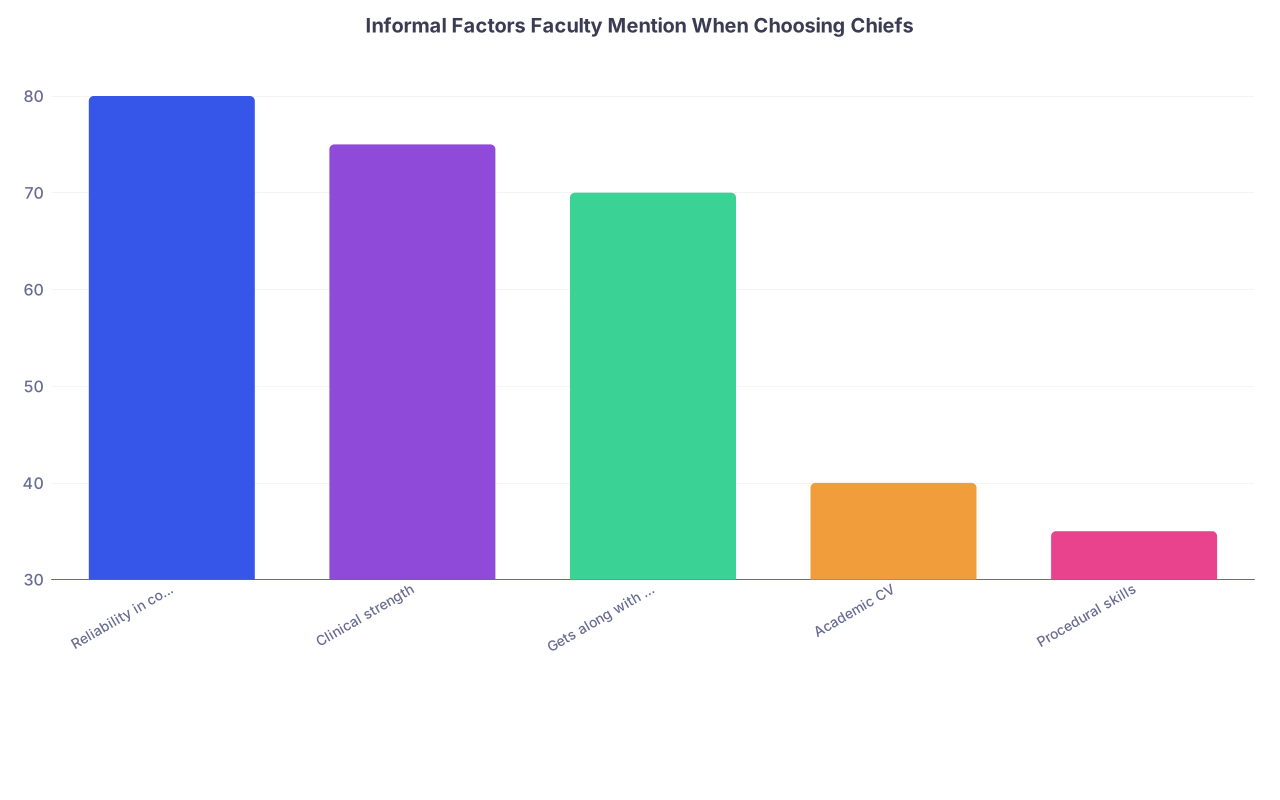
| Category | Value |
|---|---|
| Reliability in communication | 80 |
| Clinical strength | 75 |
| Gets along with staff | 70 |
| Academic CV | 40 |
| Procedural skills | 35 |
Notice what’s at the top. Reliability in communication. That’s largely email and documentation.
I’ve seen borderline-strong residents become chiefs because:
- They were flawless in communication.
- Attendings never had to chase them.
- Their notes made everyone’s life easier on busy services.
And I’ve seen clinically brilliant residents passed over because:
- “I don’t trust them to answer an email.”
- “Their documentation is always a mess.”
- “I don’t want to be dealing with their drama all year.”
Nobody tells you this when you start internship. But faculty talk like this behind closed doors every single spring.
How To Tell If You’re Doing This Right
You’re doing it right if:
- Faculty start copying you on more complex cases because they know you’ll document well.
- Attendings spontaneously say, “Thanks for the clear emails, that helps a lot.”
- Chiefs use your notes as examples for interns.
- People above you respond quickly to your emails — because you’ve shown them it’s worth opening mail from you.
You’re doing it wrong if:
- You routinely hear, “Did you see my email?” in a slightly annoyed tone.
- Attendings say, “Make sure your notes are more detailed please” more than once.
- You get left off group emails for projects you expected to be part of.
- You find out about opportunities only after they’re given to others.
Fixing this doesn’t require genius. It requires awareness and discipline.

Final Thought
Years from now, you won’t remember every patient name or every admission note you wrote at 2 am. But faculty will remember one thing very clearly: whether you were the resident whose emails and documentation made them relax — or tense up.
Your inbox and your EMR pages are talking about you when you’re not in the room.
Make sure they’re telling the story you actually want your career to be built on.