
You’re on call room Wi‑Fi at 2:13 a.m., scrolling through next month’s schedule on Amion with that sinking feeling.
You see it immediately. Three Saturday nights in a row. Your golden weekend? Gone. Your co‑resident somehow landed four Fridays off and a string of chill clinic days before boards. You refresh the page like it might change.
It will not.
Let me tell you what really happened between your “schedule requests due by the 15th” email and this monstrosity you’re staring at now.
Who Actually Makes Your Schedule (It’s Not Who You Think)
You picture some faceless algorithm in the cloud assigning shifts. Or a disinterested coordinator just dragging names around a spreadsheet. That’s not how it works in most places.
In reality, one of three models is running your life:
The “one burned‑out chief” model
A single chief (often the “admin chief”) lives inside a massive Excel file or QGenda instance for weeks. They’re fielding angry emails, trying to remember who begged for what, and getting pinged by the PD about coverage holes.The “scheduler + chief” partnership
A program coordinator or departmental scheduler builds a rough grid: required bodies per day, clinic templates, call caps, rotation counts. Then chiefs plug actual names in and deal with the fallout.The “attending or APD empire”
In some surgical and smaller specialties, one attending or APD controls the master schedule like it’s their personal chessboard. Residents’ requests are “taken under consideration,” which is code for: they might look at them, or not.
Here’s the unspoken piece: whoever is making your schedule is under pressure from above. PDs say things like:
- “Make sure we don’t have all the strong seniors off the same weekend.”
- “We cannot have ICU and nights both heavy with interns.”
- “I don’t want Dr. X complaining about coverage again. Fix his clinic first.”
Coverage and service needs always win. Your friend’s wedding, your sibling’s graduation, your mental health weekend—those only get honored if they fit after all of that.
And yes, there are favorites. Not officially. But unofficially, of course.
The Real Priorities: What Gets Decided First (Before You Ever See It)
Before your name touches a cell in QGenda, a few things are locked in stone. This is the part residents never see, but it dictates everything.
There’s a back-room conversation that goes something like this:
- “We need at least 2 seniors and 3 interns on wards every day.”
- “ICU must have a PGY‑2+ at all times on nights.”
- “We promised surgery we’d fill their trauma nights before anything else.”
- “Avoid interns over 80 hours averaged; we got flagged last year.”
So the scheduler/ chief starts with a grid. Not with you. With these:
- Required bodies per service per day
- Clinic templates that “must be protected” (attendings’ words, not mine)
- Call caps and duty hour limits
- Graduation requirements: ICU months, elective months, subspecialty exposure
Residents like to think: “They started with vacations and worked around them.” No. They started with the wards, ICU, ED, and call pool. Your vacation request is a late guest at a fully booked restaurant.
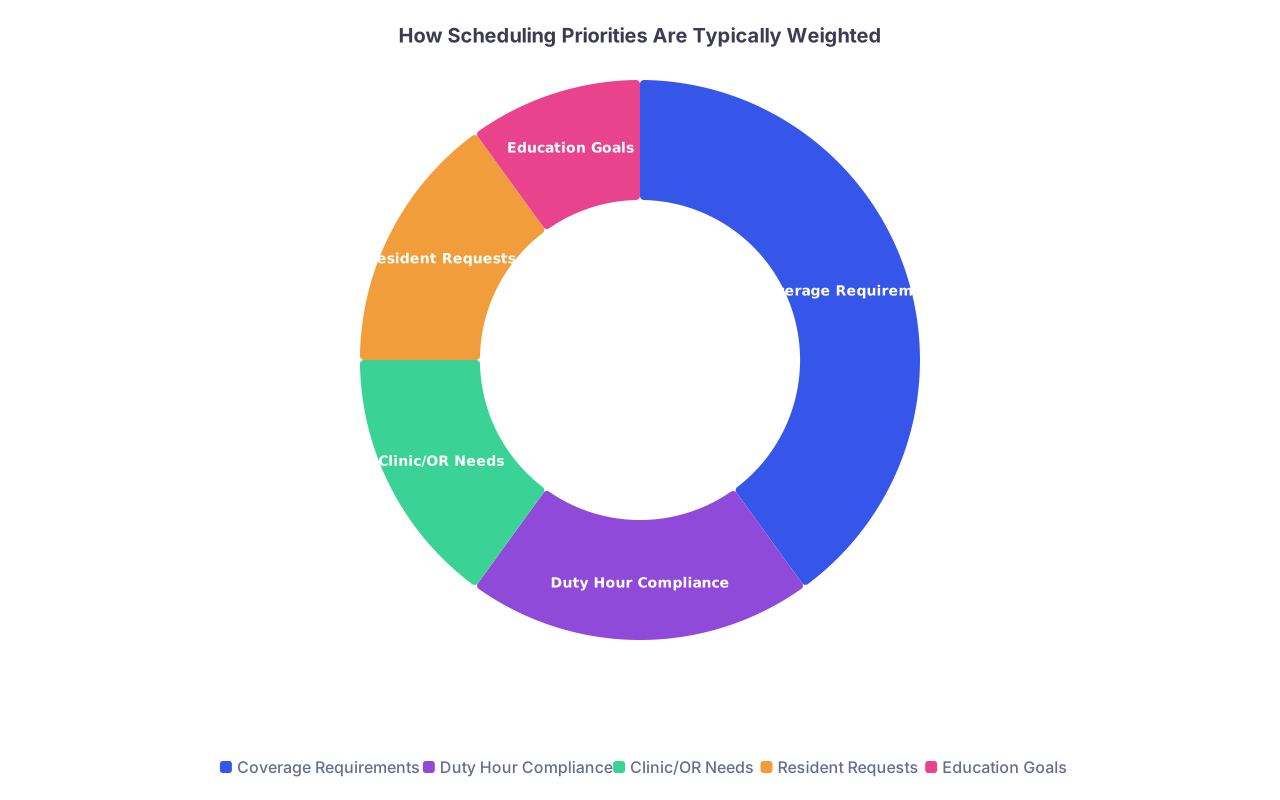
| Category | Value |
|---|---|
| Coverage Requirements | 40 |
| Duty Hour Compliance | 20 |
| Clinic/OR Needs | 15 |
| Resident Requests | 15 |
| Education Goals | 10 |
That rough weighting? That’s about how it feels in a lot of programs. No one will ever put that in a policy document, but that’s how chiefs talk when the Zoom room is closed.
How Shift Requests Really Get Processed
Let’s walk through what usually happens when you submit “requests” for next block’s schedule.
You fill out a Google Form:
– “Hard request (cannot work at all)”
– “Soft preference (would like off)”
You think this is a contract.
The admin chief downloads the responses into a spreadsheet. Columns of chaos: weddings, Step 3, religious holidays, family illness, partner’s due date, concerts, “need a mental break” (which, by the way, everyone needs).
What happens next:
True emergencies get flagged.
Known surgeries, chemotherapy, funerals (if disclosed), partner due dates. Most chiefs will go to bat for these.Institutional non‑negotiables get inserted.
Clinic templates that the department leadership cares about. “Dr. Smith expects his resident every Thursday.” That goes in before your cousin’s destination wedding.Then the “political” stuff.
- Residents in serious trouble
- The PGY‑3 who is barely scraping by and needs a lighter month
- The person PD wants at their best for fellowship letters
Finally: the rest of you.
Hard requests are honored when feasible. Soft requests fill in the leftover cracks.
But here’s the ugly part: when conflicts clash—two people want the same weekend off on a small team—the tie breakers are not random.
I’ve watched this kind of conversation play out in real time:
“Both want the same Saturday off for weddings.”
“Who’s been more flexible this year?”
“Who took that extra night swap for us in March?”
“Who’s been complaining nonstop?”
“Who’s our problem child with duty hours?”
“Whose evals are tanking and needs a break?”
That’s the real calculus.
No, it won’t be documented anywhere. But it absolutely happens.
Why Some People Always Get Better Schedules
Every resident thinks there’s some conspiracy when they see the same names on the “good” rotations and lighter stretches around important exams.
It’s not always a conspiracy. Sometimes it’s just pattern recognition.
Certain behaviors put you in the “make this person’s life a bit easier if possible” bucket:
- You cover last‑minute call without drama, then don’t weaponize it later.
- You respond to scheduling texts/emails quickly and clearly.
- You don’t treat the scheduler like a customer service rep.
- You actually read the policies before asking for special exceptions.
I’ve watched chiefs look at two names and say:
“They’ve bailed us out three times this year. Let’s give them that weekend.”
On the flip side, certain behaviors quietly poison your schedule for years:
- Constantly asking for swaps then backing out.
- Guilt‑tripping co‑residents who don’t bail you out.
- CC’ing the PD on minor scheduling annoyances.
- Going nuclear on a small perceived unfairness.
People remember. And when the chief is staring at two names for the single open golden weekend slot and they’ve been burned by yours three times? You can guess who loses.
The Dark Arts: Last-Minute Changes and “Schedule Creep”
You think the schedule is final when it appears on Amion. The chiefs know that’s just version one.
What really happens the next few weeks is what I call schedule creep.
Common scenarios:
An attending decides to take vacation late and demands coverage.
Suddenly a “clinic day” becomes a “float” day, then a “ward coverage” day. Your golden Friday evaporates.Administration adds coverage demands.
Flu season ramps up, ED volume spikes, “we need another night resident for the next two months.” That gets patched out of your rest days.A co‑resident goes out on leave.
Medical, parental, mental health, injury. The gaps get filled by cannibalizing your electives and “admin” days.
This is where favoritism shows more starkly.
When something blows up, someone loses their nice stretch of days. And the mental math is not always noble:
“We can’t hit X again, they just had a rough month.”
“Y is already barely stable.”
“Z is resilient, they’ll be ok. Move Z.”
“Resilient” is often code for: “We pile things on them because they don’t scream.”
You see the end product and think: “Why me again?”
Because in the back room, someone decided you could take another hit and not break.
How Vacation Actually Gets Approved (and Denied)
Vacation feels like a lottery because, behind closed doors, it often is.
Most programs claim something like “vacations assigned on a first‑come, first‑served basis” or “fair and equitable distribution across residents.”
What this turns into:
Fixed blackout periods
July. First two weeks of intern year. Specific heavy rotations (trauma, MICU). These are basically “do not ask” zones, even if no one wrote it down.High‑risk timeframes
December holidays, major religious holidays, spring break. These weeks ignite scheduling wars.Rank ordering within a class
- Some programs use seniority.
- Some rotate who gets “holiday priority” each year.
- Some pretend it’s random, then quietly override for the PD’s favorites or for those with major life events.
I’ve watched a PD overrule a clearly stated policy because someone was getting married and the “official process” would’ve blocked them. And I’ve watched similar requests denied cold because the resident had already annoyed half the staff.
Same ask. Different history.
If you’re wondering how strict your program actually is about this, listen to how chiefs talk about holiday blocks. If they say things like, “We try to rotate but it’s complicated,” that’s code for: “We break our own rules sometimes.”
Why the Night Float / Call Schedule Feels So Brutal
Call is where scheduling ethics get truly tested.
You notice the same interns getting:
- More weekend calls
- Consecutive short‑turnaround nights
- Heavy call right before a big exam
Meanwhile someone else magically avoids the worst strings.
Here’s what’s usually happening:
- Some people are protected because they’re about to apply for fellowship and the PD wants them sharp.
- Some are protected because they blew past 80 hours before and the program can’t risk it again.
- Some are shielded because attendings specifically requested them for “good cases” on specific days.
Call often gets built in this order:
- Required minimum coverage per rotation
- Fix clearly unsafe patterns: 24 + 24 + 24 in too tight a sequence
- Protect a few key people (graduation requirements, fellowship season, known issues)
- Backfill with the rest
If you’re in group 4, you feel it. Hard.

Tech vs. Reality: QGenda, Amion, and the Illusion of Fairness
Those scheduling platforms your program brags about? They’re tools, not referees.
Amion, QGenda, whatever—none of them enforce fairness. They enforce constraints:
- Max shifts per week
- No back‑to‑back 28‑hour calls
- Don’t schedule the same person in two places at once
They do not enforce:
- “This resident had three bad months in a row.”
- “This intern hasn’t had a real weekend off in six weeks.”
- “This person is clearly burning out.”
Software doesn’t notice that. People do.
And here’s the ugly truth: the more complex the constraints, the more likely someone gets quietly screwed to make the algorithm “solve.”
Someone—usually a chief—will manually override to get a schedule that technically works. And often that means:
“We’ll just put A on one more night, they already have a bunch anyway.”
That’s how the same folks keep drawing the short straw.
| Area | Software Handles Well | Chiefs Handle Manually |
|---|---|---|
| Duty hour caps | Yes | Yes |
| Ensuring coverage numbers | Yes | Yes |
| Fair holiday distribution | No | Yes (imperfectly) |
| Life events (weddings, etc) | No | Yes |
| Burnout / wellness | No | Yes (informally) |
How Chiefs Actually Think About “Fairness”
You imagine fairness as everyone getting the same number of bad weekends and holidays.
Chiefs are looking at a different scoreboard:
- Who’s drowning academically or clinically
- Who’s at risk of the PD getting a call from GME for duty hours
- Who’s under disciplinary watch
- Who’s applying for something high‑stakes
They’re playing a long game with incomplete information and way too many demands. And they rationalize a lot.
The mental gymnastics sound like this:
“Yeah, this looks rough for them, but their last block was light.”
“They’re on electives after this, they’ll recover.”
“We just need this month to not implode.”
Here’s the quiet truth: sometimes fairness is sacrificed for stability. For protecting the program’s reputation. For making sure a specific rotation doesn’t implode and generate complaints.
The resident who “can handle it” gets more dumped on them. And if that’s you, you won’t see it written anywhere, but you’ll feel it every month.
If You Want Better Schedules, Do This (The Stuff No One Tells You)
You cannot control everything. The system is built first around service, then education, then you. But you’re not powerless.
There are a few moves that consistently change how your name gets treated when the schedule is being hacked together at midnight.
1. Make your big asks rare and specific
If every month you have a “critical” request, none of them are critical. Chiefs start tuning you out.
Use that “hard request” label only for truly non‑negotiable events: weddings you’re in, immigration appointments you can’t reschedule, major religious holidays, Step exams.
Be explicit:
“Need off September 10–12. Brother’s wedding, I’m in it. Can flex literally anything else that month.”
Specific + rare = more likely to be honored.
2. Trade bank, not IOUs
The people who get favors during scheduling are the ones chiefs instinctively trust.
Cover call. Swap into bad shifts. But here’s the catch: don’t guilt trip afterward and don’t keep a running public scoreboard. Chiefs notice that.
They remember:
“They took that brutal ICU New Year’s stretch for us and didn’t make it a whole dramatic thing.”
When a conflict lands, those names rise to the top of the “if anyone deserves the better hand, it’s them” list.
3. Communicate early, like a grown adult
Dropping a huge request after a schedule is “final” is social suicide. Every time you do that, your name slides down the invisible priority ladder.
If you know about a big life event months in advance, say so clearly and early. If your program uses formal request portals, use them properly. Then send one short, direct email to the chief:
“Submitting formal request for X dates off (reason: Y). Totally flexible on holidays and weekends otherwise. Happy to take heavier calls before/after if needed.”
That sounds like someone who understands the system, not someone who thinks the system orbits them.
4. If you’re drowning, say it before you implode
There’s a nasty phenomenon with scheduling: the person who looks “fine” keeps getting loaded up until they’re not.
If you’re at the edge, chiefs are not mind readers. They see duty hour logs and eval numbers, not your 3 a.m. panic attacks.
One calm, private conversation with a chief or APD can change how your name is handled for the next six months. It’s not weakness. It’s data they need.
What Chiefs Won’t Tell You, But I Will
Let me strip away the nice language and give you the blunt version of how schedules really get shaped:
- Service coverage beats your preferences. Always.
- The squeaky wheel gets attention, but not always in the way they want. Chronic complainers get less sympathy over time, not more.
- Quiet workhorses get abused unless someone explicitly protects them.
- Life events matter more when you have built trust over time.
- “Fair” often means “least catastrophic for the program,” not “equally pleasant for everybody.”

| Step | Description |
|---|---|
| Step 1 | Set Coverage Requirements |
| Step 2 | Assign Rotations |
| Step 3 | Layer Call And Nights |
| Step 4 | Apply Vacation Requests |
| Step 5 | Adjust For Duty Hours |
| Step 6 | Handle Conflicts And Politics |
| Step 7 | Publish Schedule |
| Step 8 | Last Minute Changes |
You’re living in step H most of the year. That’s why it feels unstable and unfair.
The Part You’ll Remember
Years from now, you won’t recall the exact pattern of those three awful night floats or whether you got Thanksgiving intern year. You’ll remember how you responded when the schedule wasn’t in your favor. Who you backed up. Who backed you up.
You cannot make the system perfectly fair. No one can.
But you can choose how you show up in the back‑channel conversations people have about you when the schedule is on the line. You can become the resident chiefs quietly protect instead of the one they quietly sacrifice when things blow up.
That part is under your control, even when everything else feels like it isn’t.