
The most dangerous orders you’ll ever give are the ones you meant to say in sign-out but didn’t.
Sign-out is where patient care quietly falls apart. Not usually in spectacular, lawsuit-level fashion. More in the slow, insidious ways that turn into missed sepsis, delayed strokes, and 3 a.m. disasters that “nobody saw coming.” I’ve watched excellent clinicians be the weak link in care simply because their handoffs were sloppy, rushed, or badly prioritized.
Let me walk you through how not to hand off—because these are the mistakes that actually hurt people.
1. The “Drive-By” Sign-Out: Rushed, No Accountability
If your handoff sounds like this—“Everyone’s fine, nothing to do, I’ll text if I remember anything”—you’re already in the danger zone.
The classic drive-by handoff mistakes:
- You’re standing at the door, badge in hand, half-logged-out of Epic.
- You summarize 20 patients in 5 minutes.
- You say “stable” five times without defining what “stable” actually means.
- You leave before the covering resident finishes skimming the list.
This is how sentinel events are born.
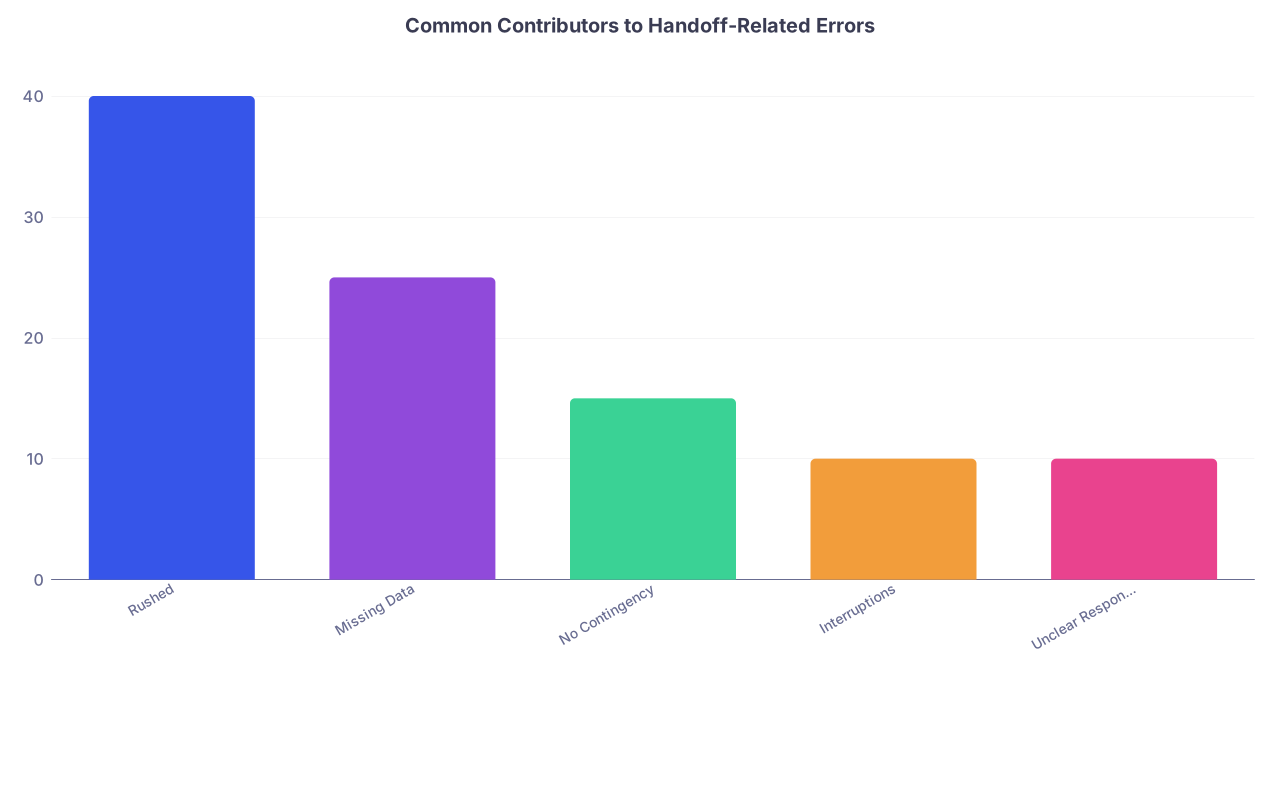
| Category | Value |
|---|---|
| Rushed | 40 |
| Missing Data | 25 |
| No Contingency | 15 |
| Interruptions | 10 |
| Unclear Responsibility | 10 |
What’s actually going wrong?
No mental transition. You’ve mentally left already. When you rush, you skip key cognitive steps: “What am I actually asking this person to watch for? What would I want to know if I were covering?”
No time for questions. Drive-bys kill clarification. The covering person nods, doesn’t want to look dumb, and just accepts the chaos.
No verification. Nobody cross-checks what’s in the EMR vs what’s in your head vs what’s in the sign-out tool.
The specific risks you’re creating
- The patient “doing okay” is actually on 4 L O2, borderline blood pressure, and missed AM labs.
- The “no active issues” post-op patient hasn’t had urine documented in 8 hours.
- The “probably discharge tomorrow” patient still needs a CT read and a social work clearance that will not magically appear overnight.
How to avoid this
Do not hand off standing up if you can help it. Sit. Open the sign-out tool. Make it clear: this is protected time.
Before you start, say to yourself (or even out loud): “My job is to make this person successful overnight. Not to escape.” It changes your tone.
And always end with: “What’s unclear? What do you want me to repeat?” Not: “Any questions?” (which people reflexively say no to).
2. The “Everyone’s Fine” Lie: Over-Reassurance and Vague Language
“I signed out 18 patients and said they were all stable. One of them coded overnight.”
I’ve heard almost that exact sentence. More than once.
Calling everyone “stable” is lazy and dangerous. “Stable” tells you nothing about:
- How sick they could get.
- How easy it is to tip them over.
- What “bad” would look like for this patient.
The vague-language landmines
Here are phrases that should make you flinch when you hear yourself say them:
- “Chronic troponin bump” (with no trend context)
- “Soft pressures” (what’s soft—90? 110? for whom?)
- “Mildly hypoxic baseline”
- “Little AKI”
- “He’s a tough stick” (translation: nobody has a plan if we need more access)
That language hides risk. It also gives the covering person false reassurance—so when something goes wrong, they’re behind before they even start.

What you should do instead
Force yourself into specifics:
- “On 2 L nasal cannula, baseline RA at home, sat 92–94% now; if needing 4 L or more, please evaluate at bedside and consider ABG/chest X-ray.”
- “BP has run 90s/50s all day, MAP 60–65, lactate normal, mentating well; if MAP <60 or change in mental status, I’m worried about early shock—please call ICU fellow early.”
You’re not writing a novel. Just one sentence that actually says something concrete about risk and thresholds.
3. The Missing “If-Then”: No Contingency Planning
This is the single most common and most fixable sign-out error: you list facts, but never say what you want done if the patient changes.
Facts without a plan are useless at 3 a.m.
Bad sign-out:
“She’s been spiking fevers to 38.5, cultures sent, on Zosyn.”
The night float hears: “Okay, stuff is happening, but I guess it’s handled.”
Better:
“Fevers to 38.5, cultures sent, already on Zosyn. If she spikes >39 again or has rigors, please re-examine, consider repeating lactate, and if she looks worse, call the ICU fellow. I’m worried she’s on the edge.”
The difference is not subtle. One is trivia. The other is guidance.
Why skipping contingencies is unsafe
- Night coverage often has 30–60 patients. They will not spontaneously remember your borderline patient unless you plant a mental flag.
- Many night residents are in earlier years or off-service. They may not know how aggressively you want to manage threshold changes.
- “Just use your judgment” at 2 a.m. when you’ve given them zero of your judgment is a cop-out.

| Step | Description |
|---|---|
| Step 1 | Identify Active Issues |
| Step 2 | State Current Status |
| Step 3 | Define Risk Level |
| Step 4 | Set If Then Triggers |
| Step 5 | Confirm Receiver Understands |
The rule: Every high-risk patient gets an if–then
If you’d be upset to find out something changed overnight and nothing was done, you need an if–then.
- “If pain uncontrolled on current regimen, okay to give one additional 0.5 mg IV dilaudid and page me if no improvement.”
- “If chest pain recurs, get EKG/troponin and call cardiology fellow.”
- “If urine output <0.3 mL/kg/hr for 4 hours, please page renal; they’re aware and following.”
If-then isn’t overkill. It’s how you extend your brain into the hours you’re not there.
4. The Black Box Patient: No Story, Just Data Dump
Another common failure: you turn your sign-out into a lab report. Numbers, meds, vitals—zero narrative.
You know the patient; the night provider doesn’t. They’re trying to reconstruct a story at 3 a.m. through your half-baked bullet points. That’s a setup for missed context.
Bad:
“58M, CHF, COPD, DM, HTN, here with SOB. On 2 L O2, IV Lasix, home meds, sats 93–95, creat 1.4.”
Okay, so what? Is he better? Worse? Is this day 1 of a crisis or day 5 of a slow recovery?
Better:
“58M with CHF (EF 25%) and COPD, admitted 2 days ago with acute decompensated HF and COPD exacerbation. Now improved: less dyspnea, sats 93–95% on 2 L (home 0–1 L), down 3 kg from admission. Still mildly volume overloaded but trending the right way.”
That’s 2–3 extra lines that completely change how you interpret any change overnight.
| Element | Dangerous Version | Safer Version |
|---|---|---|
| Problem framing | “SOB” | “Acute decompensated HF, COPD flare” |
| Trajectory | Not mentioned | “Improved vs admission” |
| Baseline | “On 2 L” | “Baseline RA, now 2 L” |
| Risk signal | None | “Still mildly volume overloaded” |
The minimum story you must give
For each non-trivial patient, hit:
- Why they came in (original problem).
- What’s happened since (trajectory).
- Where they are on that path (improving, unchanged, worsening, uncertain).
- What you’re still worried about.
If you cannot summarize in 2–3 sentences, you don’t understand the case well enough. And yes, that’s a problem.
5. The “Copy-Forward” Disaster: Outdated or Wrong Info
You know that sign-out that still says “admit from ED tonight” when the patient has been on the floor for three days? Or still lists vancomycin, even though it was stopped yesterday?
Those aren’t cosmetic errors. They erode trust in the entire sign-out.

Common copy-forward mistakes that actually hurt:
- Labs or imaging listed as “pending” that are already back and abnormal.
- “To-do: call family with results” that was completed but never removed—so it gets repeated or ignored.
- Old code statuses, old goals of care, outdated consult plans.
- Wrong level of care (“consider transfer to step-down” when the patient’s already there).
This is how serious things get missed:
- Nobody checks the CT result you flagged as “pending.”
- Overnight provider assumes nephrology hasn’t been called yet.
- Comfort-care preferences get overridden because your sign-out says “Full code, no ACP discussion yet.”
Fix: ruthlessly update or delete
Before sign-out, scan your list for:
- Old “to-do” items that are done.
- “Pending” anything.
- Meds or treatments that changed in the last 24 hours.
- Disposition plans that are no longer true.
If it’s wrong, fix it. If it’s irrelevant, delete it. A shorter but accurate sign-out is always safer than a long, wrong one.
6. The “FYI Only” Culture: Underplaying Real Risk
I see this constantly: you’re uncomfortable with how sick a patient is, but you also don’t want to sound alarmist. So you bury your concern under a casual “FYI.”
Examples:
- “FYI: troponins were a bit uptrending, cards aware.”
- “FYI: lactate 2.2 but patient looks okay.”
- “FYI: borderline urine output but will likely pick up with fluids.”
This is how “FYI” becomes “ignore this.”
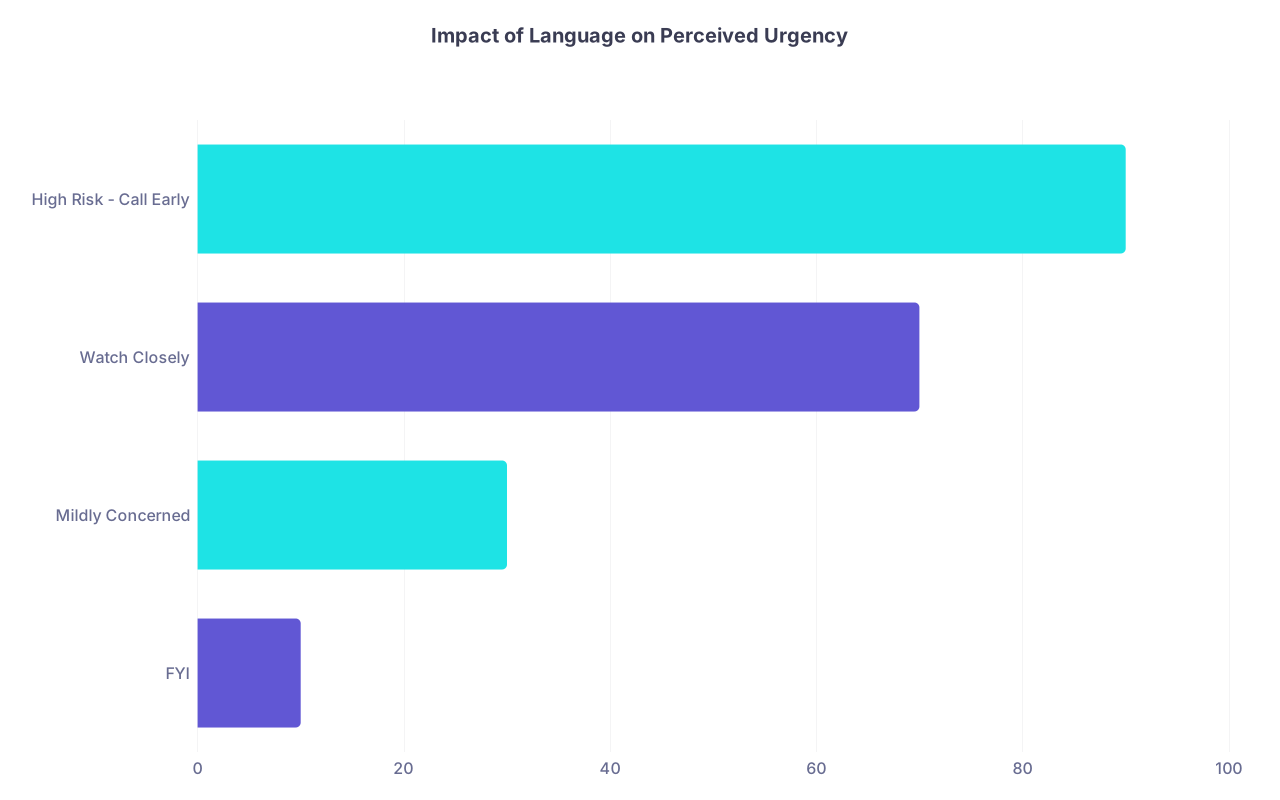
| Category | Value |
|---|---|
| FYI | 10 |
| Mildly Concerned | 30 |
| Watch Closely | 70 |
| High Risk - Call Early | 90 |
Learn to label risk honestly
You need to distinguish:
- True FYIs (low impact, low risk).
- “I’m slightly worried, please keep an eye.”
- “I am actively concerned—call early if anything changes.”
- “This could blow up—if X happens, treat it like an emergency.”
You don’t have to give a speech. Just use clear statements:
- “I am mildly concerned about X; if Y happens, I’d treat that as a big deal.”
- “High risk for deterioration overnight. Please lay eyes on them early in your shift.”
- “If they decompensate, I’d rather you over-call consultants than under-call.”
Understating risk to sound “chill” is not professional. It’s avoidance. And it offloads your discomfort onto the night team.
7. The Silent Psych/Social Minefields: Ignoring Behavioral Risk
One of the deadliest sign-out errors: pretending the psych or behavioral red flags don’t exist because they’re messy or uncomfortable.
You gloss over:
- The agitated alcoholic who threatened staff earlier.
- The borderline personality patient who split the team and is furious about pain control.
- The delirious patient who keeps trying to leave AMA.
- The suicidal patient “denying SI now” but clearly not safe.
Then you’re surprised when the night team gets blindsided by a violent outburst, an elopement, or a self-harm attempt.

What you must never skip
If any of these are present, they must be in your sign-out:
- Recent agitation, restraints, or security involvement.
- Active SI/HI, even if currently “denied.”
- Elopement risk (patient packing bags, calling rides, repeatedly refusing care).
- Major family conflict or surrogate disagreement.
- Threats about lawsuits, media, or violence.
And not just facts—give a plan:
- “High elopement risk, had security involvement earlier. If he tries to leave again, do not physically restrain without backup—call security and attending. Psych aware and following.”
- “Has made conditional suicidal threats related to pain; psych believes chronic risk is high. If he escalates, 1:1 sitter and call psych stat.”
Leaving out behavioral risk is how you set the night team up for the worst surprises.
8. The “Everybody Owns It” Trap: No Clear Responsibility
When multiple teams or services are involved and your sign-out says, “Cards following, renal following, primary team following,” what you’re really saying is: “Nobody clearly owns the overnight decisions.”
Ambiguous ownership is dangerous.
Example:
“Renal vs cards vs primary all aware of rising creatinine.”
So who should the night float call at 2 a.m. when the creatinine jumps again or the patient stops peeing? If they guess wrong—or assume someone else will care—nothing happens.
Clarify who owns what
You must answer:
- Who is primary overnight? (Night float? Cross-cover? Hospitalist?)
- Which consultant wants to be called for acute changes?
- Which team is responsible for disposition decisions?
- Who’s actually writing orders overnight?
Say it explicitly:
- “Medicine B is primary; cards consult for ischemia only, renal for dialysis timing only. For any acute decompensation, page Medicine B cross-cover first.”
- “Neurosurgery is primary but wants MICU involved for hemodynamics; if any blood pressure issues or respiratory decline, call MICU fellow first, not neurosurgery junior.”
If the person covering doesn’t know who to call, they will either:
- Call nobody, or
- Waste 30–60 minutes ping-ponging between services.
Both are bad.
9. The Multi-Tasking Myth: Letting Interruptions Shred Your Handoff
Trying to sign out while answering pages, discharge questions, and consult calls is like doing airway management while answering your email. You can, but you shouldn’t.
Interruptions in handoff aren’t just annoying. They’re objectively lethal. Every time you stop mid-patient, you risk:
- Skipping their to-do items.
- Forgetting the contingency plans.
- Dropping the one critical caveat you meant to say.

| Step | Description |
|---|---|
| Step 1 | Start Sign-Out |
| Step 2 | Patient Summary |
| Step 3 | Lose Task Details |
| Step 4 | Forget If Then Plan |
| Step 5 | Omit High Risk Warning |
| Step 6 | Complete Safe Handoff |
| Step 7 | Interruption |
Set boundaries, even as a resident
You’re not powerless here. You can:
- Ask a colleague to cover pages for 10–15 minutes while you sign out the sickest patients.
- Say to a non-urgent caller: “I’m in sign-out, I’ll call you back in 10 minutes unless this is emergent.”
- Silence non-critical notifications during the core handoff block.
At minimum, if you must interrupt, say: “Let’s pause after this patient. When we resume, we’ll start with: ‘What are we watching for overnight?’ so we don’t miss anything.”
10. The “Just Read the Chart” Cop-Out
If you ever hear yourself say, “It’s all in the note,” you’ve already failed at safe sign-out.
The chart is not a handoff. It’s a record. Those are different jobs.
Reasons “just read the chart” is lazy and unsafe:
- Notes are bloated with copy-paste trash. The key idea is buried.
- The overnight provider doesn’t have 10 minutes per patient to reconstruct your reasoning.
- Notes capture what you did, not what you’re worried about.

Your job in sign-out is to compress:
- Diagnosis and trajectory.
- Current active issues.
- Watch items.
- If–then plans.
If they have to dig through the chart to know what matters tonight, you didn’t hand off—you offloaded.
11. The Overnight To-Do Dump: Tasks Without Priorities
Finally, one more way to quietly sabotage patient safety: turning your sign-out into a random, unprioritized “to-do list.”
You know this one:
- Call cards in the morning
- Check CBC
- Follow up CT report
- Replete K if low
- Confirm outpatient dialysis slot
- Consider PT/OT eval All listed at the same “urgency level.”
Here’s the problem: the night provider triages by your list structure whether you meant them to or not.
If the emergent task (“follow up CT head”) looks like every other checkbox, it gets treated like every other checkbox. It might get done at 6 a.m., or not at all.
Fix: label and separate
At a minimum, split tasks into:
- Must do overnight (safety-critical)
- Nice if done (but not mandatory for safety)
- Day team only (for info, not action)
And for every “must do overnight,” attach a why:
- “Must page radiology for CTPE result—suspected PE; this will change anticoagulation tonight.”
- “Must check 2 a.m. BMP—on insulin infusion with K borderline 3.2; if <3.0, please replete before morning.”
Without the why, your tasks blend into background noise.
Your Next Step (Do This Today)
Pull up your most recent sign-out list. Pick the sickest 3–5 patients. For each one:
Rewrite their sign-out to include:
- A 2–3 sentence story (why they’re here, trajectory, current status).
- One clear risk statement (“I’m worried about…”).
- At least one explicit if–then plan.
- Clear ownership (“Call X first if they decompensate.”).
Then ask a co-resident: “If you covered this patient overnight with just this sign-out, what would you still be unsure about?”
If they can name more than one thing per patient, your handoff isn’t there yet.
Do not wait for the first bad outcome to fix your sign-out habits. Open your sign-out right now and rewrite one patient’s handoff as if you knew something would go wrong tonight and you wanted the night provider to be ready. That’s how you stop the mistakes before they happen.